Within Steelman
The Housing Objection Worth Taking Seriously
The best objection to rapid upzoning focuses on displacement, land values, and infrastructure, not hostility to new neighbours.
On this page
- Why the strawman fails
- Displacement, land values, and local services
- How steelmanning clarifies the policy tradeoff
Page outline Jump by section
Introduction
A good steelman does not ask whether opponents of housing reform can be portrayed as resistant to change. It asks what the strongest evidence-based objection actually is. In debates over upzoning, higher-density development, and planning reform, the most serious critics are often concerned not with new neighbours but with the risk that poorly designed reforms can raise land values, accelerate displacement of vulnerable residents, and place pressure on transport, schools, utilities, and other public services before they are expanded. These concerns deserve to be taken seriously because they identify genuine policy trade-offs rather than imagined motives. Steelmanning this position improves analytical thinking by forcing the debate onto the strongest competing explanations instead of the weakest caricatures.
Why the strawman fails
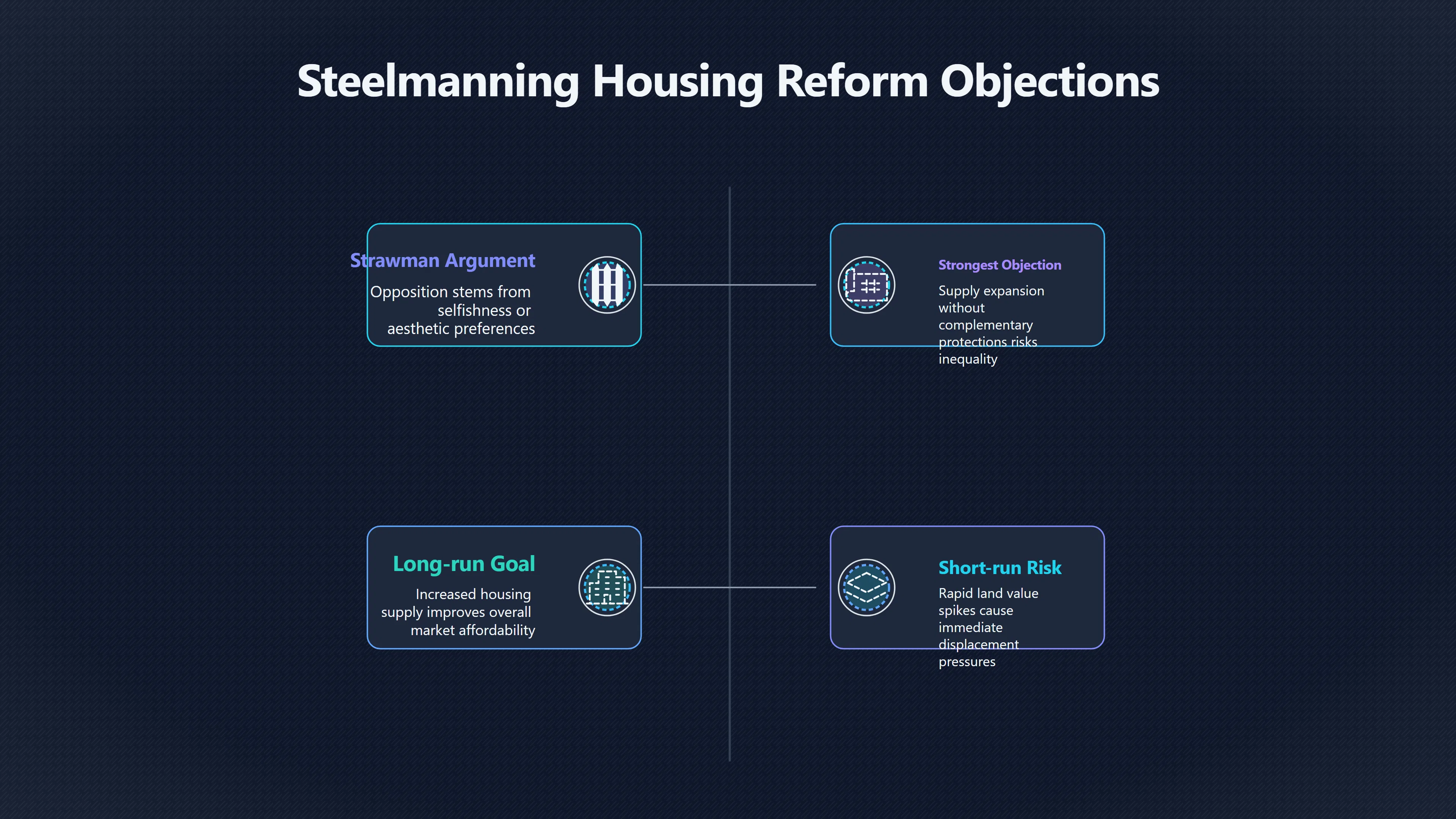
The common strawman is that opposition to housing reform is simply driven by selfishness, aesthetic objections, or hostility to newcomers. While such motives sometimes exist, treating them as the entire case ignores a much stronger argument advanced by many housing researchers, urban planners, and community organisations.
The strongest objection is not “do not build”. It is instead:
Increasing housing capacity without complementary policies may redistribute both costs and benefits unevenly. Existing landowners may receive windfall gains, speculative investment may intensify, lower-income renters may face heightened displacement pressures in desirable neighbourhoods, and infrastructure may lag behind population growth.
That argument accepts that housing shortages are real while questioning whether supply reform alone adequately addresses who bears the transitional costs. Reviews of anti-displacement policies consistently conclude that housing production and displacement prevention should be considered together rather than as mutually exclusive alternatives. [PMC]pmc.ncbi.nlm.nih.govHealthy Community Design, Anti-displacement, and Equity…by N Serrano · 2022 · Cited by 46 — This review scanned the literature for…
This distinction matters because rebutting “people just dislike development” says little about whether safeguards against displacement are necessary.
Displacement, land values, and local services
Rising land values can create winners and losers
Upzoning increases what can legally be built on land. That additional development potential often raises the value of affected sites before substantial new housing has been constructed.
For homeowners, this appreciation can represent increased wealth. For renters, however, higher land values may encourage redevelopment, rent increases, or replacement of older, relatively inexpensive housing with newer, more expensive units. The immediate financial gains therefore accrue unevenly across residents. Research evaluating zoning reform notes that land prices often respond quickly to regulatory change even though housing supply takes years to materialise. [Auckland University]cdn.auckland.ac.nzAuckland UniversityEvaluating the Long-Run Effects of Zoning Reform on…May 2, 2023 — by R Greenaway-McGrevy · 2023 · Cited by 20 — Thi…
The strongest objection therefore distinguishes between:
- Long-run affordability, which may improve if enough housing is eventually built.
- Short-run neighbourhood impacts, where redevelopment pressures may arrive sooner than new affordable homes.
This is not an argument that additional housing is always harmful. It is an argument that timing and distribution matter.
Displacement is more than physical eviction
Housing debates often use “displacement” broadly. The concern includes several related mechanisms:
- households forced to move because rents increase;
- tenants displaced during redevelopment;
- lower-income residents priced out of future moves into neighbourhoods they previously could have afforded;
- gradual replacement of communities through changing housing costs rather than formal eviction.
The literature on gentrification has long emphasised that displacement can occur through multiple channels and that measuring it is more complicated than counting demolition or eviction notices alone. [AHURI]ahuri.edu.auAHURIGentrification and displacement: a review of approachesMay 18, 2011 — The definition of gentrification used for this work was: the migration of higher income and status groups to lower social…
A steelman therefore avoids claiming that every redevelopment project causes displacement while also avoiding the opposite mistake of assuming displacement concerns are imaginary.
Infrastructure may not keep pace
Another serious objection concerns public capacity rather than housing itself.
Rapid population growth affects:
- transport networks;
- schools;
- healthcare;
- parks;
- drainage and utilities;
- local road capacity.
If planning reform substantially increases housing permissions without matching investment in these services, existing residents may experience declining service quality even if additional housing is socially beneficial overall.
This objection is particularly strong because infrastructure often depends on different budgets, agencies, and political processes than housing approvals. Critics argue that sequencing matters: approving more homes without ensuring investment in transport and public services can reduce public support for future reform. Analyses of planning systems frequently identify coordination between housing delivery and infrastructure provision as a central implementation challenge. [Policy Exchange]policyexchange.org.ukPolicy ExchangeThe UK's Broken Housing MarketHow the deficiencies of the planning system affect non-residential development, including in…
Why this objection is analytically stronger
Steelmanning improves reasoning because it changes the structure of the disagreement.
Instead of debating motives, the debate becomes one of competing empirical and normative claims:
- How large are displacement risks in different housing markets?
- How quickly does additional supply reduce housing costs?
- Which groups benefit immediately, and which benefit only later?
- Which anti-displacement measures work well enough to accompany reform?
- How should infrastructure costs be financed?
These are questions that can be investigated with evidence rather than assumptions about character.
Importantly, this stronger objection does not require rejecting the economic case for increasing housing supply. One can simultaneously believe that restrictive zoning contributes to housing shortages and that poorly designed reform can impose substantial local costs during the transition.

How steelmanning clarifies the policy trade-off
Once the objection is stated at full strength, the disagreement shifts from whether housing should be built to how reform should be designed.
The strongest version of the debate becomes:
- Supporters of reform argue that increasing housing supply is essential because persistent shortages drive up prices, worsen affordability, and exclude future residents.
- Strong critics argue that supply expansion should be paired with tenant protections, affordable housing requirements, infrastructure investment, and mechanisms that capture some of the increase in land value for public benefit, rather than allowing transitional costs to fall disproportionately on vulnerable residents. [PMC+2Chartered Institute of Housing]pmc.ncbi.nlm.nih.govHealthy Community Design, Anti-displacement, and Equity…by N Serrano · 2022 · Cited by 46 — This review scanned the literature for…
This framing creates a much more demanding target for analysis. A thoughtful rebuttal can no longer rely on dismissing opponents as anti-growth or resistant to change. Instead, it must show either that the predicted harms are smaller than claimed, that they are outweighed by larger long-term benefits, or that accompanying policies can substantially reduce those harms.
That is precisely the value of steelmanning. It transforms a moralised argument about motives into a substantive discussion about evidence, policy design, and competing priorities—making the reasoning on both sides more rigorous.
Amazon book picks
Further Reading
Books and field guides related to The Housing Objection Worth Taking Seriously. Use these as the next step if you want deeper reading beyond the article.
How to Have Impossible Conversations
Shows how to engage fairly with opposing policy views.
eBay marketplace picks
Marketplace Samples
Live-tested eBay searches with available results related to this page.




Endnotes
-
Source: pmc.ncbi.nlm.nih.gov
Link: https://pmc.ncbi.nlm.nih.gov/articles/PMC9798938/Source snippet
Healthy Community Design, Anti-displacement, and Equity...by N Serrano · 2022 · Cited by 46 — This review scanned the literature for...
-
Source: ahuri.edu.au
Title: AHURIGentrification and displacement: a review of approaches
Link: https://www.ahuri.edu.au/sites/default/files/migration/documents/AHURI_Positioning_Paper_No115_Gentrification-and-displacement-a-review-of-approaches-and-findings-in-the-literature.pdfSource snippet
May 18, 2011 — The definition of gentrification used for this work was: the migration of higher income and status groups to lower social...
Published: May 18, 2011
-
Source: cdn.auckland.ac.nz
Link: https://cdn.auckland.ac.nz/assets/business/about/our-research/research-institutes-and-centres/Economic-Policy-Centre–EPC-/013WP%20-%202.pdfSource snippet
Auckland UniversityEvaluating the Long-Run Effects of Zoning Reform on...May 2, 2023 — by R Greenaway-McGrevy · 2023 · Cited by 20 — Thi...
Published: May 2, 2023
-
Source: policyexchange.org.uk
Link: https://policyexchange.org.uk/wp-content/uploads/v3-PX4-The-UKs-Broken-Housing-Market-Web.pdfSource snippet
Policy ExchangeThe UK's Broken Housing MarketHow the deficiencies of the planning system affect non-residential development, including in...
-
Source: cih.org
Title: ukhr reader 2023 final
Link: https://www.cih.org/media/bipjq5z0/ukhr-reader-2023-final.pdfSource snippet
Housing Policy in a Changing World(2018 and 2019) 'Planning frameworks and housing delivery', in UK Housing. Review 2018; 'Land value cap...
Additional References
-
Source: smf.co.uk
Link: https://www.smf.co.uk/wp-content/uploads/2024/04/Beyond-the-comfort-zone-April-2024.pdfSource snippet
Beyond the comfort zoneby G Salutin — This paper is one of a series in which researchers undertook a literature review to evaluate housin...
-
Source: sandag.org
Link: https://www.sandag.org/-/media/4C2CE50048BF4D15BADA155043C4101E.ashxSource snippet
SANDAG Anti-Displacement Study Best Practices ReportUpzoning previously exclusive areas helps desegregate the region and unlock land for...
-
Source: tandfonline.com
Link: https://www.tandfonline.com/doi/full/10.1080/13572334.2023.2298127Source snippet
Taylor & Francis OnlineHousing development, land values and the decentred stateby E Shepherd · 2024 · Cited by 6 — Reformers influential...
-
Source: youtube.com
Title: In the zone: What can the UK learn from planning reforms abroad?
Link: https://www.youtube.com/watch?v=9g_W_4BZqxwSource snippet
Ep 83: Local Effects of Upzoning with Simon Büchler and Elena Lutz...
-
Source: youtube.com
Title: Planning reforms won’t solve housing crisis | David Ettershank MP
Link: https://www.youtube.com/watch?v=OHymk8JyIrMSource snippet
In the zone: What can the UK learn from planning reforms abroad?...
-
Source: youtube.com
Title: Upzoning and Gentrification in New York City with Minjee Kim
Link: https://www.youtube.com/watch?v=RxRtVSArSYUSource snippet
Planning reforms won't solve housing crisis | David Ettershank MP...
-
Source: yourblueline.org
Link: https://yourblueline.org/12020/widgets/36825/documents/39618Source snippet
This toolkit...
-
Source: youtube.com
Title: Ep 83: Local Effects of Upzoning with Simon Büchler and Elena Lutz
Link: https://www.youtube.com/watch?v=Xr2Ofrvuq0ISource snippet
The High Cost of "Low-Density" Zoning...
-
Source: youtube.com
Title: The High Cost of “Low-Density” Zoning
Link: https://www.youtube.com/watch?v=fizE8McJIQA
Topic Tree