Within Open Mind
Why Unfriendly Evidence Feels Less Convincing
Myside bias often feels like careful reasoning because people inspect threatening evidence more harshly than friendly evidence.
On this page
- Biased assimilation in real disputes
- Signs that scrutiny has become asymmetric
- Questions that make your standards visible
Page outline Jump by section
Introduction
When people say, “I looked at the evidence carefully and it just wasn’t convincing,” they may be completely sincere. The difficulty is that the same person might have accepted equally imperfect evidence had it supported their existing view. This is the essence of myside bias when hostile evidence feels flawed: the mind does not simply ignore opposing information but often evaluates it using stricter standards than it applies to friendly information. The result is that careful reasoning can become a defence of an existing position rather than an even-handed search for what is true. Research on biased assimilation shows that this pattern can occur even among intelligent, motivated people who genuinely believe they are being objective. [PMC+2Academia]pmc.ncbi.nlm.nih.govPMCActively Open-Minded Thinking and Its Measurementby KE Stanovich · 2023 · Cited by 133 — Actively open-minded thinking (AOT) is measured by items that tap the willingness to consider…
Biased assimilation in real disputes
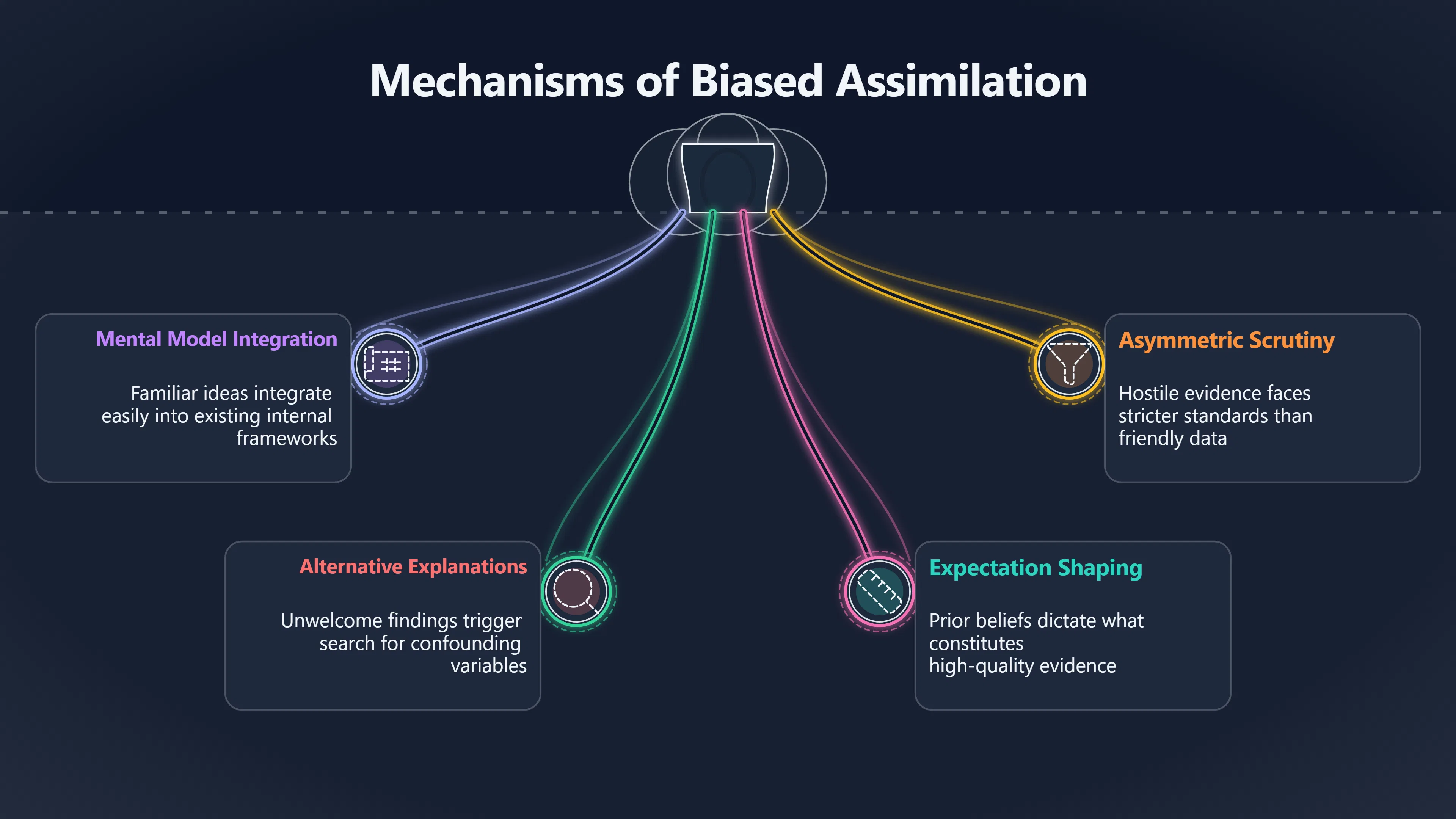
The classic demonstration comes from a well-known experiment by Charles Lord, Lee Ross and Mark Lepper. Participants who either supported or opposed the death penalty read two research summaries: one suggesting that capital punishment deterred crime and one suggesting that it did not. Both groups read the same mixed body of evidence. Yet supporters judged the pro-deterrence study as stronger and found numerous flaws in the opposing study, while opponents reached the opposite conclusion. Instead of moving closer together, both sides became more confident in their original beliefs. [Sage Journals]journals.sagepub.comSage JournalsPartisan Bias and Its DiscontentsLord C. G., Ross L., Lepper M. R. (1979). Biased assimilation and attitude polarization: Th…
The striking feature of this result is that participants did not simply dismiss unwanted evidence out of hand. They often engaged with it in detail. They questioned the sampling, criticised the methods, proposed alternative explanations and highlighted uncertainties. Those are all legitimate scientific habits. The problem was that these standards were applied asymmetrically: defects in hostile evidence received intense scrutiny, whereas comparable weaknesses in supportive evidence were overlooked or forgiven. [Academia]academia.eduAcademia(PDF) Myside Bias, Rational Thinking, and IntelligenceMyside bias occurs when people evaluate evidence, generate evidence, and te…
This process is known as biased assimilation. New information is “assimilated” into an existing belief system rather than evaluated from a neutral starting point. Evidence that fits existing beliefs feels naturally coherent, while conflicting evidence feels suspicious, incomplete or poorly designed. Because every real-world study has limitations, motivated scrutiny almost always finds something to criticise. [ResearchGate]researchgate.net368385669 Myside Bias in Individuals and InstitutionsResearchGate(PDF) Myside Bias in Individuals and Institutions24 Feb 2023 — Myside bias occurs when people evaluate evidence, generate evi…
Why unfriendly evidence genuinely feels weaker
The important point is that people usually do not experience themselves as applying a double standard. Several psychological processes make asymmetric evaluation feel like impartial reasoning.
First, familiar ideas are easier to integrate into an existing mental model. Supporting evidence therefore appears internally consistent, whereas contradictory findings create tension that invites additional checking. The increased scrutiny itself is not irrational; the problem arises when the same level of checking is not applied to congenial evidence. [PMC]pmc.ncbi.nlm.nih.govPMCActively Open-Minded Thinking and Its Measurementby KE Stanovich · 2023 · Cited by 133 — Actively open-minded thinking (AOT) is measured by items that tap the willingness to consider…
Second, people naturally generate alternative explanations for unwelcome findings. If a study challenges their view, they readily think of possible confounding variables, sampling problems or methodological flaws. When the results agree with their position, they are less motivated to search for competing explanations. This difference in hypothesis generation creates the impression that one side of the evidence is objectively weaker, even when both sides contain similar uncertainties. [Academia]academia.eduAcademia(PDF) Myside Bias, Rational Thinking, and IntelligenceMyside bias occurs when people evaluate evidence, generate evidence, and te…
Third, existing beliefs shape expectations about what “good evidence” should look like. A surprising result often feels less credible simply because it violates prior expectations. Rather than asking, “Does this evidence justify changing my mind?”, people may unconsciously ask, “Is this evidence strong enough to overcome everything I already believe?” That is a much higher evidential threshold. [PMC]pmc.ncbi.nlm.nih.govPMCActively Open-Minded Thinking and Its Measurementby KE Stanovich · 2023 · Cited by 133 — Actively open-minded thinking (AOT) is measured by items that tap the willingness to consider…
Signs that scrutiny has become asymmetric
Myside bias is not revealed by criticising a weak argument. It appears when identical standards are not used across competing claims.
Common warning signs include:
- Endless requests for stronger proof from one side only. Friendly evidence is accepted as “good enough”, while opposing evidence is expected to be nearly flawless.
- Searching harder for flaws after learning the conclusion. The quality assessment follows agreement rather than preceding it.
- Accepting uncertainty selectively. Limitations in favourable studies are treated as inevitable, whereas similar limitations in hostile studies become fatal defects.
- Treating isolated weaknesses differently. One methodological problem invalidates an opposing study but merely “suggests caution” in a supporting study.
- Feeling unusually confident after rejecting contrary evidence. Successfully finding criticisms can increase confidence even if no stronger supporting evidence has been added. [ResearchGate+2Wikipedia]researchgate.net368385669 Myside Bias in Individuals and InstitutionsResearchGate(PDF) Myside Bias in Individuals and Institutions24 Feb 2023 — Myside bias occurs when people evaluate evidence, generate evi…
These patterns are especially common in disagreements involving identity, politics, morality or professional commitment, where changing one’s mind may carry social or psychological costs beyond the factual question itself. [ResearchGate]researchgate.net368385669 Myside Bias in Individuals and InstitutionsResearchGate(PDF) Myside Bias in Individuals and Institutions24 Feb 2023 — Myside bias occurs when people evaluate evidence, generate evi…
Why intelligence alone does not solve the problem
Many people assume that better reasoning ability automatically reduces myside bias. Research has repeatedly challenged that assumption.
Higher cognitive ability often improves people’s capacity to construct arguments, identify methodological issues and explain evidence. However, those same reasoning skills can also become tools for defending an existing position. People may become better at finding sophisticated criticisms of opposing evidence without becoming more even-handed in deciding when those criticisms should matter. Studies therefore find surprisingly weak relationships between intelligence and the size of myside bias. [Academia+2ResearchGate]academia.eduAcademia(PDF) Myside Bias, Rational Thinking, and IntelligenceMyside bias occurs when people evaluate evidence, generate evidence, and te…
This does not imply that careful analysis is useless. Rather, analytical ability and impartial evaluation are partly separate skills. Someone can be highly skilled at evaluating evidence while still applying different standards depending on whether the evidence threatens their preferred conclusion. [PMC]pmc.ncbi.nlm.nih.govPMCActively Open-Minded Thinking and Its Measurementby KE Stanovich · 2023 · Cited by 133 — Actively open-minded thinking (AOT) is measured by items that tap the willingness to consider…
Questions that make your standards visible
The most practical defence against myside bias is not suppressing criticism but making evaluative standards explicit before judging individual pieces of evidence.
Useful questions include:
- Would I make the same criticism if this study supported my position?
- What level of evidence would genuinely persuade me that I am mistaken?
- Have I looked just as hard for weaknesses in evidence I already agree with?
- Am I criticising the methods, or reacting to the conclusion?
- If two competing studies had their conclusions swapped, would my quality ratings also swap?
These questions shift attention away from whether evidence feels convincing and towards whether identical rules are being applied consistently.
The practical lesson for open-minded disagreement
Actively open-minded thinking does not require lowering standards for evidence that challenges your beliefs. Quite the opposite: criticism is essential. The challenge is ensuring that scepticism is distributed fairly rather than selectively.
A useful mental habit is to imagine reviewing two anonymous studies whose conclusions have been hidden. If your methodological judgement changes only after discovering which study supports your preferred view, your standards may be following your conclusions instead of guiding them.
The goal is therefore not to become less critical of hostile evidence but to become equally critical of friendly evidence. That shift does not eliminate disagreement, but it makes disagreements more likely to reflect differences in the evidence itself rather than differences in the standards used to evaluate it. [PMC+2ResearchGate]pmc.ncbi.nlm.nih.govPMCActively Open-Minded Thinking and Its Measurementby KE Stanovich · 2023 · Cited by 133 — Actively open-minded thinking (AOT) is measured by items that tap the willingness to consider…
Amazon book picks
Further Reading
Books and field guides related to Why Unfriendly Evidence Feels Less Convincing. Use these as the next step if you want deeper reading beyond the article.
The Scout Mindset
Focuses on overcoming motivated reasoning and evaluating evidence even-handedly.
Mistakes Were Made (but Not by Me)
Examines biased assimilation, self-justification, and resistance to disconfirming evidence.
Thinking, Fast and Slow
Explains cognitive biases, including how people evaluate evidence and reach flawed judgments.
The Righteous Mind
Explores why opposing groups interpret the same evidence differently and become more polarized.
eBay marketplace picks
Marketplace Samples
Live-tested eBay searches with available results related to this page.


Endnotes
-
Source: pmc.ncbi.nlm.nih.gov
Title: PMCActively Open-Minded Thinking and Its Measurement
Link: https://pmc.ncbi.nlm.nih.gov/articles/PMC9966223/Source snippet
by KE Stanovich · 2023 · Cited by 133 — Actively open-minded thinking (AOT) is measured by items that tap the willingness to consider...
-
Source: academia.edu
Link: https://www.academia.edu/55787043/Myside_Bias_Rational_Thinking_and_IntelligenceSource snippet
Academia(PDF) Myside Bias, Rational Thinking, and IntelligenceMyside bias occurs when people evaluate evidence, generate evidence, and te...
-
Source: researchgate.net
Title: 368385669 Myside Bias in Individuals and Institutions
Link: https://www.researchgate.net/publication/368385669_Myside_Bias_in_Individuals_and_InstitutionsSource snippet
ResearchGate(PDF) Myside Bias in Individuals and Institutions24 Feb 2023 — Myside bias occurs when people evaluate evidence, generate evi...
-
Source: Wikipedia
Title: Confirmation bias
Link: https://en.wikipedia.org/wiki/Confirmation_bias -
Source: researchgate.net
Link: https://www.researchgate.net/publication/390843764_The_Puzzle_of_Myside_Bias_and_Actively_Open-Minded_Thinking_in_the_Conceptualization_of_Critical_ThinkingSource snippet
It is unrelated to intelligence and it is conceptually difficult to show that...
-
Source: journals.sagepub.com
Link: https://journals.sagepub.com/doi/10.1177/1745691618817753Source snippet
Sage JournalsPartisan Bias and Its DiscontentsLord C. G., Ross L., Lepper M. R. (1979). Biased assimilation and attitude polarization: Th...
Additional References
-
Source: youtube.com
Link: https://www.youtube.com/watch?v=VPJ6XahR4QcSource snippet
Vorlesung "Bullshit-Resistenz" (2023, UDK Berlin) 8. "Identitätsschützende Denkfehler"...
-
Source: read.dukeupress.edu
Title: Rational Polarization
Link: https://read.dukeupress.edu/the-philosophical-review/article/132/3/355/383421/Rational-PolarizationSource snippet
Duke University PressRational Polarization | The Philosophical Review1 Jul 2023 — Predictable polarization is everywhere: we can often pr...
-
Source: keremoktar.com
Title: Oktar Beliefs Persist
Link: https://keremoktar.com/assets/papers/Oktar_Beliefs_Persist.pdfSource snippet
How Beliefs Persist Amid Controversyby K Oktar · 2025 · Cited by 16 — The PPM outlines four causes of persistence amid societal dissent...
-
Source: youtube.com
Title: Why Most People’s Opinions Are Worthless — Arthur Schopenhauer
Link: https://www.youtube.com/watch?v=WVHii535zb4Source snippet
Bullshit Resistance: A Guide to Critial Thinking (Conference "Swiss Hernia Days" in Basel 2024)...
-
Source: theses.hal.science
Title: “The cognitive
Link: https://theses.hal.science/tel-04300037v1/file/va_Marie_Antoine.pdfSource snippet
conviction, political polarisation, and susceptibility to...22 Nov 2023 — This thesis explores various cognitive biases contributing to...
-
Source: youtube.com
Link: https://www.youtube.com/watch?v=PW9_-lfHDn0Source snippet
Soldier Mindset v. Scout Mindset...
-
Source: youtube.com
Title: Soldier Mindset v. Scout Mindset
Link: https://www.youtube.com/watch?v=inufYj8dSXgSource snippet
Understanding hostility bias as a risk for aggression...
-
Source: youtube.com
Title: Understanding hostility bias as a risk for aggression
Link: https://www.youtube.com/watch?v=aRbFwB3vAKk
Topic Tree
Follow this branch
Parent topic
Open Mind What Open Minded Thinking Actually RequiresRelated pages 5
- False Balance When Fairness Turns Into False Balance
- Humble Standards How to Stay Open Without Becoming Gullible
- Opposite Test The Question That Interrupts Defensive Reasoning
- Receptive Listening Listen First Without Surrendering Your Standards
- Steelmanning Can Your View Survive the Strongest Objection?