Within Framing
When finishing becomes the wrong goal
Delivery framing can make finishing the plan feel more responsible than asking whether the plan still deserves scarce time and attention.
On this page
- How project momentum changes the question
- Signals that delivery framing has taken over
- Reframes that reopen the decision
Page outline Jump by section
Introduction
Delivery framing changes the question from “Is this still the best use of our resources?” to “How do we get this finished?” That shift seems harmless, but it can keep weak projects alive long after their original business case has eroded. Once delivery becomes the assumed objective, stopping, redesigning or replacing the project starts to look like failure rather than sound judgement. Research on escalation of commitment, framing effects and project decision-making shows that people often continue investing in underperforming initiatives because the decision is framed around completing an existing commitment instead of reassessing future value. [Project Management Institute+2GOV.UK]pmi.orgpsychology project termination decision maker 5914Project Management InstituteThe psychology of project termination28 Oct 2013 — This paper presents recent research on the topic of escala…
 This matters because projects rarely fail all at once. Markets change, technology evolves, costs rise, priorities shift and new alternatives emerge. A project that was rational six months ago may no longer be the best option today. Delivery framing encourages organisations to treat these developments as obstacles to overcome rather than evidence that the underlying decision deserves another look.
How project momentum changes the question
Projects accumulate momentum through investment, planning, public commitments and organisational routines. Each milestone reinforces the assumption that completion is the natural destination.
As a result, conversations subtly change. Instead of asking whether expected future benefits still exceed future costs, meetings revolve around delivery dates, implementation risks and execution plans. The original investment decision quietly disappears from view.
This is an important distinction because rational decisions should depend on future consequences, not on resources that have already been spent. Yet delivery framing encourages people to evaluate success by whether the original promise is honoured instead of whether continuing remains worthwhile. Research on escalation of commitment consistently finds that organisations often continue funding failing projects despite evidence that expected returns have deteriorated. [Project Management Institute+2Wikipedia]pmi.orgpsychology project termination decision maker 5914Project Management InstituteThe psychology of project termination28 Oct 2013 — This paper presents recent research on the topic of escala…
The psychological effect is powerful because completing a project offers an obvious, concrete objective. Reopening the decision introduces uncertainty, political disagreement and the possibility that earlier choices were mistaken. Delivery therefore feels responsible even when reassessment would create greater value.
Why finishing feels more responsible than reconsidering
Delivery framing works because it changes what counts as good leadership.
A manager who keeps a project moving appears decisive, reliable and committed. A manager who recommends cancellation may appear indecisive, wasteful or inconsistent, even when abandoning the project would save substantial future resources.
Several well-established mechanisms reinforce this tendency.
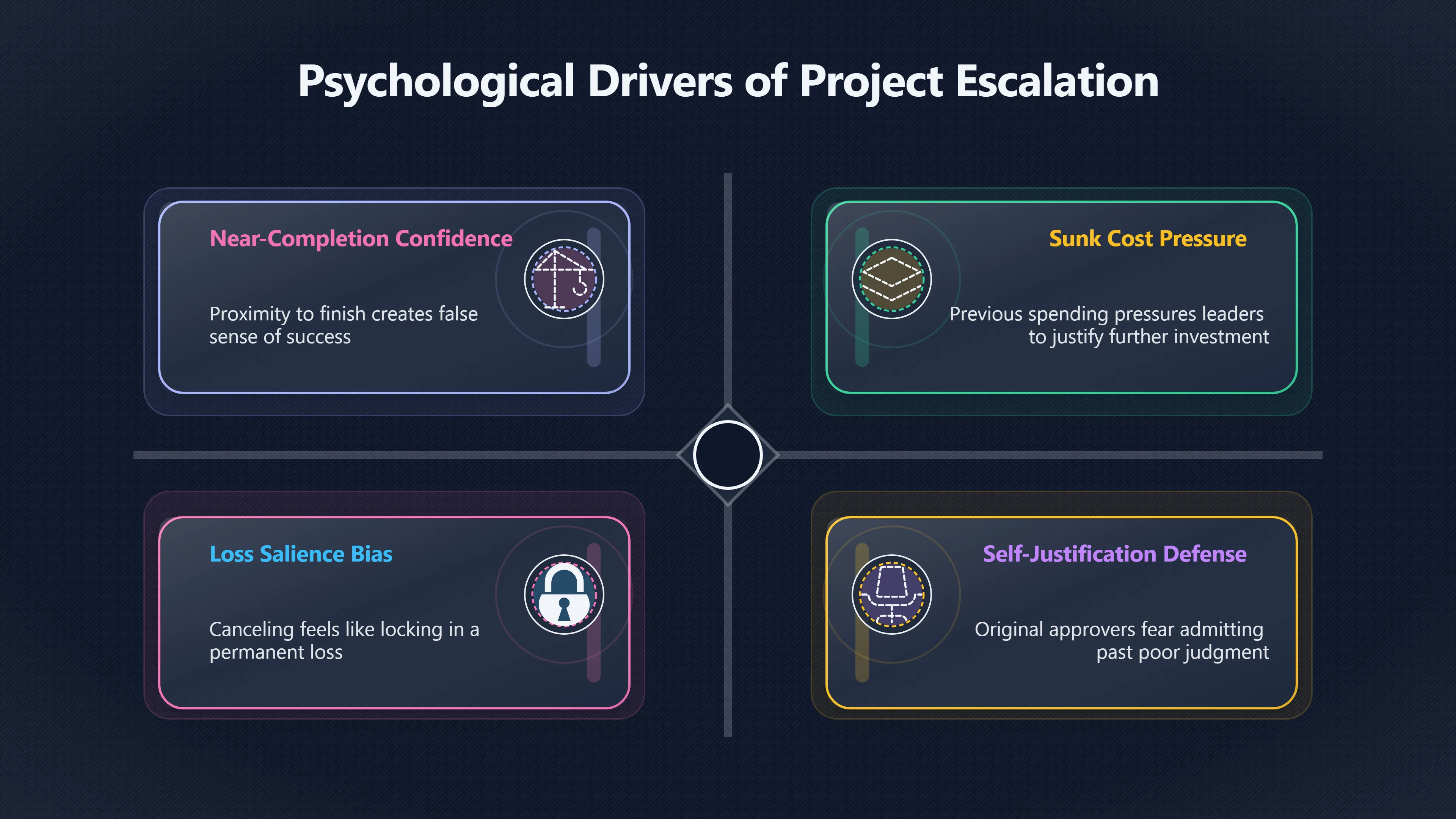
- Sunk costs become psychologically relevant. Previous spending cannot be recovered, but people naturally feel pressure to justify earlier investments. This makes further investment seem easier to defend than accepting that past costs cannot be changed. [The Decision Lab+2PMC]thedecisionlab.comThe Decision LabThe Sunk Cost FallacyThe sunk cost fallacy is our tendency to follow through with something that we've already invested h…
- Losses become more salient than gains. Cancelling often feels like locking in failure, whereas continuing preserves the possibility of eventual success. Prospect theory predicts greater willingness to accept risk when people perceive themselves as facing losses. [Wikipedia]WikipediaEscalation of commitmentEscalation of commitment
- Personal responsibility matters. Decision-makers who approved the original project may experience greater pressure to defend it because cancellation can feel like admitting poor judgement. Self-justification has been repeatedly identified as an important contributor to escalation of commitment. [Project Management Institute]pmi.orgpsychology project termination decision maker 5914Project Management InstituteThe psychology of project termination28 Oct 2013 — This paper presents recent research on the topic of escala…
- Near-completion creates false confidence. Projects often receive additional support simply because they appear “almost finished”, even when the remaining work is unusually expensive or when expected benefits have fallen. Studies have identified proximity to completion as one factor associated with continued commitment. [ResearchGate]researchgate.netResearchers described how managers believe the projects are most vulnerable until managers. choose wrong abandonment even though indeed t…
None of these mechanisms necessarily reflect deliberate irrationality. They emerge from ordinary attempts to appear consistent, responsible and dependable.
Signals that delivery framing has taken over
Delivery framing rarely announces itself directly. Instead, it changes the language surrounding decisions.
Common warning signs include:
- Meetings focus almost entirely on schedules, milestones and delivery plans rather than current strategic value.
- Questions such as “How do we finish?” replace “Should we still do this?”
- Business cases are rarely updated despite major external changes.
- New evidence is treated mainly as a delivery obstacle instead of decision-relevant information.
- Success becomes defined as project completion rather than achieving worthwhile outcomes.
- Teams discuss “protecting the investment” more often than comparing alternatives.
- Cancelling is described as wasting previous effort rather than avoiding future waste.
These shifts narrow attention. Once delivery becomes the unquestioned objective, alternatives receive less analysis even when they could create substantially greater value.
Why organisational momentum makes the trap stronger
Large organisations add structural forces to the psychological ones.
Projects typically involve multiple departments, contracts, budgets and public commitments. Each stakeholder may optimise for completing their own part of the programme, making collective reconsideration increasingly difficult.
Performance systems can unintentionally reinforce this pattern. Managers may be rewarded for delivering approved projects rather than for recommending timely termination. Procurement contracts, published roadmaps and political announcements can further raise the perceived cost of changing direction.
Research into project escalation identifies not only psychological factors but also project characteristics, organisational structures and social pressures that encourage continued investment. Large projects become difficult to stop because many systems are already organised around their completion. [Wikipedia]WikipediaEscalation of commitmentEscalation of commitment
This explains why weak projects often survive despite widespread private doubts. No single participant believes continuation is ideal, yet the framing of everyone’s role centres on delivery.

Reframes that reopen the decision
The most effective response is not simply encouraging scepticism. It is deliberately changing the frame.
Instead of asking:
- “How do we finish this project?”
Ask:
- “Knowing what we know today, would we choose to start this project again?”
Instead of:
- “How much have we already invested?”
Ask:
- “What future costs and future benefits remain?”
Instead of:
- “Can we avoid wasting the work already done?”
Ask:
- “Which option creates the greatest value from this point forward?”
Another useful reframe is to imagine that another organisation is offering to sell you the partially completed project at today’s remaining cost. If you would decline that offer, continuing simply because you already own the project deserves careful scrutiny.
Independent reviews can also weaken delivery framing by assigning fresh decision-makers who have less personal investment in previous commitments. Similarly, requiring periodic “continue or stop” decisions based on updated evidence prevents the original approval from becoming permanent authorisation.
Finishing is not always success
Completing a project is sometimes the correct decision. Many initiatives recover after temporary setbacks, and abandoning every struggling effort would be equally unwise.
The problem arises when delivery itself becomes the goal. Completion is a means to create value, not evidence that value still exists.
Strong decision-making separates the quality of today’s choice from yesterday’s commitment. A project deserves continued support because its expected future benefits justify its remaining costs—not because finishing has become the default frame through which every subsequent decision is viewed.
Amazon book picks
Further Reading
Books and field guides related to When finishing becomes the wrong goal. Use these as the next step if you want deeper reading beyond the article.
Escaping the Build Trap
Directly challenges delivery-focused thinking and reframes success around value rather than finishing work.
How Big Things Get Done
Explains why projects go wrong and how teams should reassess plans, forecasts, and execution assumptions.
The Goal
Teaches readers to question local progress metrics and reframe work around the real system goal.
The Lean Startup
Rating: 4.0/5 from 5 Google Books ratings
Encourages testing, pivoting, and stopping weak initiatives instead of blindly delivering original plans.
eBay marketplace picks
Marketplace Samples
Topic-anchored marketplace searches for visual, collectible, or second-hand items related to this page.




Endnotes
-
Source: assets.publishing.service.gov.uk
Title: UK A review of optimism bias, planning fallacy, sunk cost
Link: https://assets.publishing.service.gov.uk/media/5a821602ed915d74e3401a64/lit-review-exploration-of-behavioural-biases.pdfSource snippet
consequences: it is harder to admit a poor decision when we are personally... The effect of optimism bias on the decision to terminate f...
-
Source: Wikipedia
Title: Escalation of commitment
Link: https://en.wikipedia.org/wiki/Escalation_of_commitment -
Source: researchgate.net
Link: https://www.researchgate.net/publication/350479101_The_effect_of_sunk_cost_framing_effect_and_educational_background_on_the_escalation_of_commitmentSource snippet
Researchers described how managers believe the projects are most vulnerable until managers. choose wrong abandonment even though indeed t...
-
Source: Wikipedia
Title: Sunk cost
Link: https://en.wikipedia.org/wiki/Sunk_cost -
Source: researchgate.net
Link: https://www.researchgate.net/publication/335325457_The_effect_of_escalation_of_commitment_and_project_risk_in_resources_allocation_decisionSource snippet
poor initial project decision can...Read more...
-
Source: pmi.org
Title: psychology project termination decision maker 5914
Link: https://www.pmi.org/learning/library/psychology-project-termination-decision-maker-5914Source snippet
Project Management InstituteThe psychology of project termination28 Oct 2013 — This paper presents recent research on the topic of escala...
-
Source: thedecisionlab.com
Link: https://thedecisionlab.com/biases/the-sunk-cost-fallacySource snippet
The Decision LabThe Sunk Cost FallacyThe sunk cost fallacy is our tendency to follow through with something that we've already invested h...
Additional References
-
Source: linkedin.com
Link: https://www.linkedin.com/posts/rugastechnologies_itleadership-projectdelivery-digitaltransformation-activity-7429137893039960064-NPa3Source snippet
They fail because the conditions for success...
-
Source: academia.edu
Link: https://www.academia.edu/105907637/Escalating_IT_projects_A_text_analysis_of_risk_framing_effects_of_managersSource snippet
Escalating IT-projects: A text-analysis of risk-framing effects...This research uses text analysis to determine which types of framing a...
-
Source: pmc.ncbi.nlm.nih.gov
Link: https://pmc.ncbi.nlm.nih.gov/articles/PMC5904751/Source snippet
framing in the observed tendency to escalate commitment to a failing course of action.... Both results can be interpreted as consistent...
-
Source: youtube.com
Title: The Sunk Cost Fallacy: Why Smart People Make Expensive Mistakes
Link: https://www.youtube.com/watch?v=NM38AY8nD48Source snippet
Escalation of Commitment: Why We Struggle to Walk Away (90 Seconds)...
-
Source: youtube.com
Title: What is the Escalation of Commitment? | Psychology Facts
Link: https://www.youtube.com/watch?v=xBLQfDtKk7oSource snippet
The Sunk Cost Fallacy: Why Smart People Make Expensive Mistakes...
-
Source: youtube.com
Title: Escalation of Commitment: Why We Struggle to Walk Away (90 Seconds)
Link: https://www.youtube.com/watch?v=eeZ1xaD89pUSource snippet
Project Termination: How to Know When to Quit...
-
Source: journals.aom.org
Link: https://journals.aom.org/doi/10.5465/amj.2011.0869Source snippet
Competitors as Reference...Although larger [rivals]({{ 'rivals/' | relative_url }})' successful experience might still affect escalation behavior, such an influence is ex...
-
Source: youtube.com
Title: Project Termination: How to Know When to Quit
Link: https://www.youtube.com/watch?v=f3WX4u-FY9oSource snippet
Project Failing? Here's what to do next...
-
Source: youtube.com
Title: Project Failing? Here’s what to do next!
Link: https://www.youtube.com/watch?v=osSh3qkl8x8
Topic Tree