Within Alternatives
Make Alternatives Specific Enough To Matter
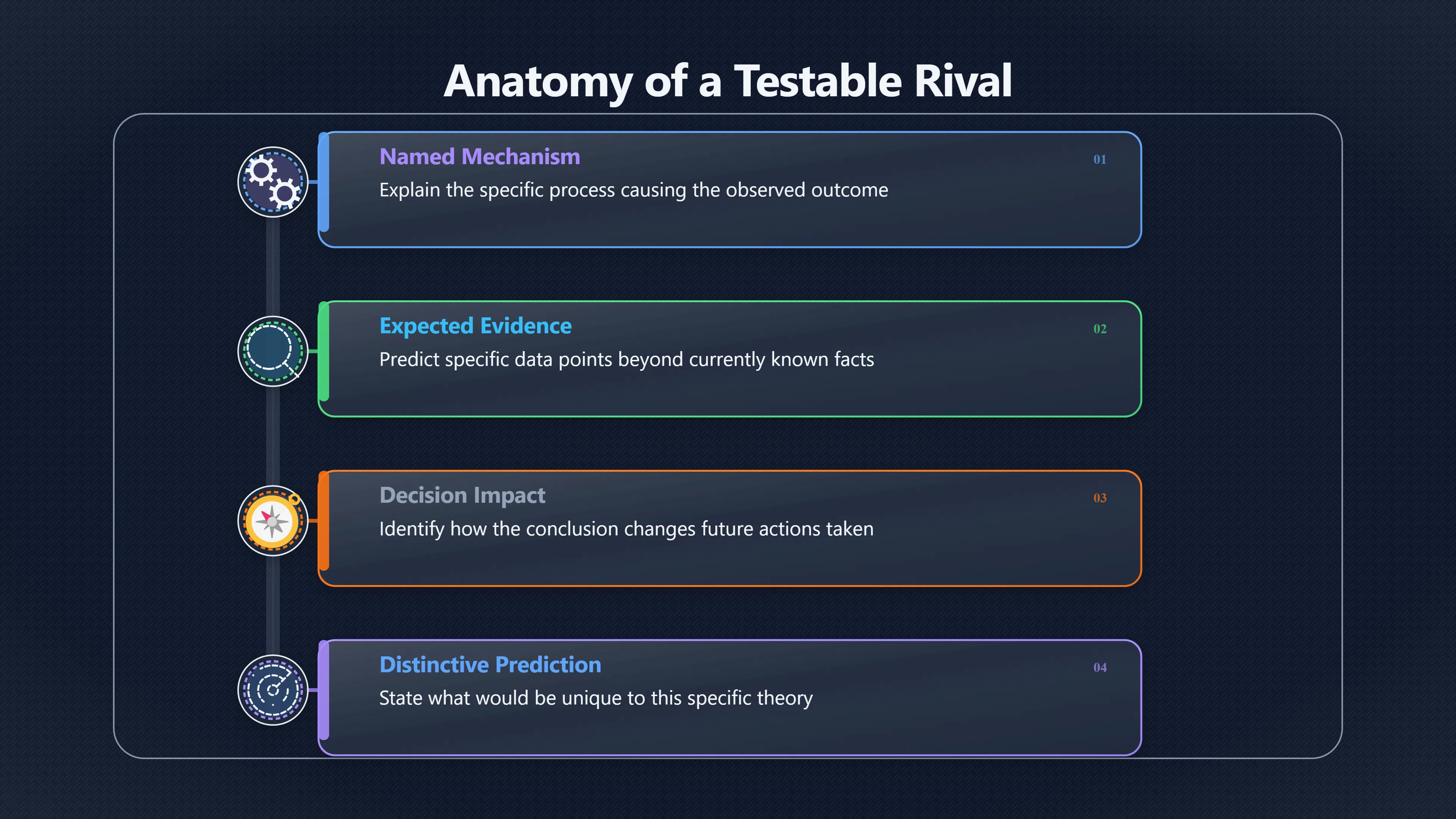
A useful alternative names a mechanism, predicts different evidence, and changes what you would check next.
On this page
- The difference between a live rival and vague doubt
- Mechanism, expectation, and decision impact tests
- How to rewrite weak alternatives into testable ones
Page outline Jump by section
Introduction
Keeping more than one explanation alive is only useful if those explanations are specific enough to compete. A vague alternative such as “something else caused it” does not improve thinking because it makes no distinctive predictions and gives you no guidance about what to investigate next. A useful rival explanation identifies a plausible mechanism, implies evidence that should exist if it is true, and changes what observations, records, or tests you would seek before reaching a conclusion. This approach reflects the logic of hypothesis testing and abductive reasoning: explanations become informative when they can be distinguished by evidence rather than defended through preference or intuition.[stats.org.uk+2Wikipedia]stats.org.ukConfirmation, Disconfirmation, and Information in Hypothesis…by J Klayman · Cited by 3328 — Strategies for hypothesis testing in scien…

The difference between a live rival and vague doubt
A weak alternative merely delays commitment. A live rival creates a genuine competition between explanations.
Consider these two responses to the same observation:
- Observation: Sales dropped after a product update.
- Vague alternative: “Perhaps something else happened.”
- Live rival: “A seasonal decline reduced demand independently of the update.”
The second explanation is useful because it immediately suggests different evidence. If seasonality is responsible, similar products or previous years should show comparable patterns. If the update caused the decline, the timing, affected customer groups, or complaint patterns should look different.
A practical question separates the two:
If this explanation were true, what would I expect to observe that I would not expect under my favourite explanation?
If no answer comes to mind, the rival is probably too vague to test.
Build every rival from three components
A practical rival explanation can usually be expressed in three parts.
1. Name the mechanism
A mechanism explains how the outcome occurred rather than simply assigning a label.
Compare these alternatives:
- Weak: “The manager made bad decisions.”
- Strong: “The manager delayed approval long enough for key suppliers to miss production deadlines.”
The second explanation identifies a process that could be checked through emails, approval records or project timelines.
Mechanisms prevent explanations from becoming empty descriptions disguised as causes.
2. State the expected evidence
Every explanation should predict evidence beyond the facts already known.
Instead of saying:
“The equipment failed because it was poorly maintained.”
Add expectations such as:
- maintenance logs contain missed inspections
- similar failures occurred previously
- worn components should be visible on inspection
- replacement schedules were exceeded
Predictions force explanations to take risks. An explanation that predicts nothing new cannot meaningfully be tested. This reflects a central principle of scientific reasoning: stronger explanations expose themselves to possible failure by making observable predictions.[Wikipedia]WikipediaHypothetico-deductive modelHypothetico-deductive model
3. Show why the decision would change
A useful rival should alter what happens next.
Suppose two explanations exist for a missed deadline:
- unrealistic planning
- unexpected supplier disruption
These lead to different actions:
- improve planning methods
- diversify suppliers and contracts
If two explanations produce exactly the same investigation and the same decision, they may not be meaningfully different.
Three tests for deciding whether a rival is specific enough
Before treating an alternative as “live”, ask three questions.
Mechanism test
Can I explain how this outcome happened step by step?
If the explanation consists only of labels such as “human error”, “communication problems” or “poor leadership”, it probably needs further detail.
Expectation test
Would this explanation make at least one observation more likely than competing explanations?
Good rivals predict:
- different records
- different witnesses
- different timing
- different measurements
- different future outcomes
If every explanation predicts the same evidence, they are not yet distinguishable.
Decision impact test
Would believing this explanation change what I investigate or what I decide?
If not, it adds complexity without increasing understanding.
Rewriting weak alternatives into testable ones
Many alternatives become useful after a small rewrite.
Weak alternativeTestable rival”The customer was unhappy.”“The customer expected a feature that marketing implied but the product did not provide.”“Staff lacked motivation.”“Recent changes to incentives reduced effort on low-visibility tasks.”“The experiment failed by chance.”“Random variation produced the observed result because the sample size was too small.”“The witness remembered incorrectly.”“The witness reconstructed details after discussing the event with others.”
Notice the pattern. Each improved version identifies:
- a mechanism
- observable consequences
- evidence that could distinguish it from competitors
Ask questions that separate explanations
Once rival explanations are specific, the next task is to search for information that discriminates between them.
Suppose a website’s conversion rate suddenly falls.
Favourite explanation:
The redesign confused users.
Rival explanation:
Advertising traffic changed and brought less interested visitors.
Instead of collecting general evidence about website performance, ask separating questions:
- Did existing users decline as much as first-time visitors?
- Did traffic sources change before conversion fell?
- Are support requests about navigation increasing?
- Did conversion decline equally across all devices?
Each question has the potential to favour one explanation over another.
Psychological research on hypothesis testing shows that people naturally tend to seek information consistent with their current theory. Designing questions that distinguish between competing explanations helps counter this tendency by making evidence more diagnostic rather than merely supportive.[stats.org.uk+2PMC]stats.org.ukConfirmation, Disconfirmation, and Information in Hypothesis…by J Klayman · Cited by 3328 — Strategies for hypothesis testing in scien…
Avoid explanations that can never lose
Some explanations survive every possible observation because they are continually adjusted after the fact.
For example:
“The policy worked, but hidden factors prevented the benefits from appearing.”
If no imaginable observation could count against the explanation, it has little practical value for deciding between alternatives.
A stronger version would specify in advance:
- what success should look like
- when it should appear
- what observations would count as failure
Making these commitments before examining new evidence reduces the temptation to reinterpret every outcome as confirmation. This principle underlies scientific approaches that emphasise falsifiable, risky predictions rather than explanations that can accommodate every result.[Wikipedia]WikipediaScientific theoryScientific theory
A practical template for creating testable rivals
When you notice yourself settling on one explanation, rewrite every serious alternative using the same structure.
Observation: What needs explaining?
Mechanism: How could this explanation produce the observation?
Expectation: What additional evidence should exist if it is true?
Distinctive prediction: What would I expect that competing explanations would not?
Decision impact: If this explanation proved correct, what would I investigate or do differently?
Using the same template for every candidate prevents your preferred explanation from receiving extra detail while rivals remain vague. Research on “consider the alternative” strategies suggests that generating meaningful competing explanations can reduce overconfidence and hindsight bias, but only when those alternatives are sufficiently concrete to influence judgement rather than serving as symbolic expressions of doubt.[communicationcache.com]communicationcache.commultiple explanation a consider an alternative strategy for debiasing judgmentsA Consider-an-Alternative Strategy for Debiasing Judgmentsby ER Hirt · 1995 · Cited by 469 — Previous research has suggested that an effe…
Amazon book picks
Further Reading
Books and field guides related to Make Alternatives Specific Enough To Matter. Use these as the next step if you want deeper reading beyond the article.
The Scout Mindset
Encourages constructing genuine alternatives rather than defending one view.
eBay marketplace picks
Marketplace Samples
Live-tested eBay searches with available results related to this page.




Endnotes
1.
Source: stats.org.uk
Link:https://stats.org.uk/statistical-inference/KlaymanHa1987.pdf
Source snippet
Confirmation, Disconfirmation, and Information in Hypothesis...by J Klayman · Cited by 3328 — Strategies for hypothesis testing in scien...
2.
Source: Wikipedia
Title: Hypothetico-deductive model
Link:https://en.wikipedia.org/wiki/Hypothetico-deductive_model
3.
Source: Wikipedia
Title: Scientific theory
Link:https://en.wikipedia.org/wiki/Scientific_theory
4.
Source: pmc.ncbi.nlm.nih.gov
Link:https://pmc.ncbi.nlm.nih.gov/articles/PMC9038198/
Source snippet
Humans actively sample evidence to support prior beliefs - PMCby P Kaanders · 2022 · Cited by 68 — Accordingly, we predict that confir...
5.
Source: Wikipedia
Title: Congruence bias
Link:https://en.wikipedia.org/wiki/Congruence_bias
6.
Source: communicationcache.com
Title: multiple explanation a consider an alternative strategy for debiasing judgments
Link:https://www.communicationcache.com/uploads/1/0/8/8/10887248/multiple_explanation-_a_consider-an-alternative_strategy_for_debiasing_judgments.pdf
Source snippet
A Consider-an-Alternative Strategy for Debiasing Judgmentsby ER Hirt · 1995 · Cited by 469 — Previous research has suggested that an effe...
Additional References
7.
Source: youtube.com
Link:https://www.youtube.com/watch?v=Y-J0FYOQRMY
Source snippet
Analysis of Competing Hypotheses (ACH): Finding Plausible Answers - YouTube Analysis of Competing Hypotheses (ACH): Finding Plausible Ans...
8.
Source: researchgate.net
Link:https://www.researchgate.net/publication/220480585_Seeking_Confirmation_Is_Rational_for_Deterministic_Hypotheses
Source snippet
hen those hypotheses are deterministic, each making a single prediction about...Read more...
9.
Source: papers.ssrn.com
Title: Improving Abductive Reasoning
Link:https://papers.ssrn.com/sol3/Delivery.cfm/6594299.pdf?abstractid=6594299&mirid=1
Source snippet
Abductive ReasoningAbstract: Abduction is a mode of reasoning that generates or refines plausible explanations for an observed empirical...
10.
Source: dan.sperber.fr
Title: fr Why do humans reason?
Link:https://www.dan.sperber.fr/wp-content/uploads/2009/10/MercierSperberWhydohumansreason.pdf
Source snippet
Arguments for an argumentative theoryby H Mercier · 2011 · Cited by 3557 — This explains the notorious confirmation bias. This bias is ap...
11.
Source: youtube.com
Title: This CIA Manual Trains the World’s Sharpest Analytical Minds
Link:https://www.youtube.com/watch?v=NMElghTG_kI
Source snippet
Intelligence Analysis Skills: Analysis of Competing Hypotheses (Part 1)...
12.
Source: youtube.com
Title: Analysis of Competing Hypotheses (ACH): Finding Plausible Answers
Link:https://www.youtube.com/watch?v=xt4EnzvGA4w
Source snippet
This CIA Manual Trains the World's Sharpest Analytical Minds...
13.
Source: hermanaguinis.com
Link:https://www.hermanaguinis.com/pdf/JOMForumtheory.pdf
Source snippet
JOM Forum: Theory Testing Is Theory Generationby M Ketokivi · 2026 · Cited by 1 — In this paper, we propose that theory- testing research...
14.
Source: repository.mdx.ac.uk
Link:https://repository.mdx.ac.uk/download/56199b865755f7ffe0f2e697a221094d9723cc68c1db2314d90d96fcdd117016/1342655/s41235-024-00560-y.pdf
Source snippet
For instance, the availability and relevance of...Read m...
15.
Source: youtube.com
Title: Analysis of Competing Hypotheses
Link:https://www.youtube.com/watch?v=t6GEvRYMIxs
Source snippet
(ACH): A Structured Analytic Technique (SAT) for FinCrime...
16.
Source: youtube.com
Title: Intelligence Analysis Skills: Analysis of Competing Hypotheses (Part 1)
Link:https://www.youtube.com/watch?v=J_eDCBf7R2I
Source snippet
Analysis of Competing Hypotheses...
Topic Tree