Within Evidence Tests
Why Mixed Evidence Can Make US More Certain
Mixed evidence can harden prior beliefs when supportive findings get a light check and opposing findings get a forensic audit.
On this page
- The Lord, Ross, and Lepper capital punishment study
- The asymmetry between friendly and hostile scrutiny
- Using result reversal to test your standard
Page outline Jump by section
Introduction
Mixed evidence should make us more cautious. Yet one of the most robust findings in psychology is that it can produce the opposite effect: people who begin with different beliefs often become more confident after seeing the same balanced evidence. This pattern is known as biased assimilation. Instead of evaluating all findings by the same standard, we tend to accept supportive evidence with relatively little scrutiny while inspecting contradictory evidence for every possible flaw. The result is not simply confirmation bias in what we seek, but a deeper distortion in how we judge the quality of evidence once we have found it. Understanding this trap is an important part of improving analytical thinking because it shifts attention from which evidence you read to whether you apply the same evidential standard regardless of which conclusion the evidence favours. [Frank Baumgartner]fbaum.unc.edujpsp 1979 Lord Ross LepperFrank BaumgartnerBiased Assimilation and Attitude Polarization: The Effects…by CG Lord · 1979 · Cited by 7332 — In the present experim…

Why mixed evidence can increase certainty instead of caution
Many real-world questions produce genuinely mixed results. Scientific studies disagree, witnesses conflict, economic forecasts diverge, and historical evidence is incomplete. Rationally, such situations should often reduce confidence rather than strengthen it.
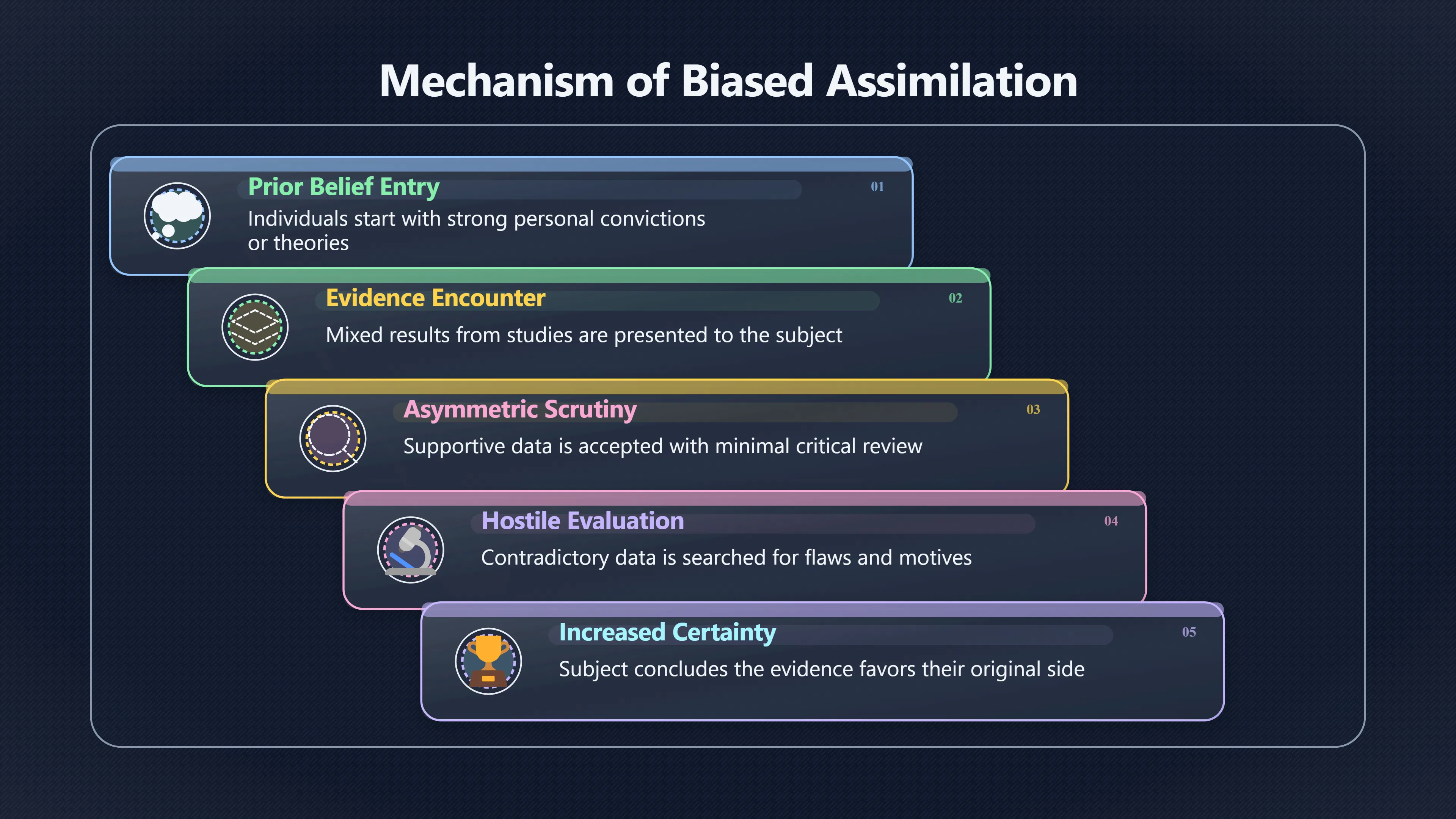
Biased assimilation changes that outcome. When confronted with competing findings, people do not usually perform one overall assessment of the evidence. Instead, they often perform two different evaluations:
- Supportive evidence is treated as broadly credible unless there is an obvious reason to reject it.
- Contradictory evidence is examined in much greater detail for weaknesses, alternative explanations, methodological flaws or hidden motives.
Because every study has imperfections, the hostile evaluation almost always discovers reasons for doubt. Meanwhile, the friendly evaluation leaves supportive evidence largely intact. After combining these unequal assessments, each person concludes that “the evidence favours my side”, even though everyone reviewed the same material. [Frank Baumgartner+2Wiley Online Library]fbaum.unc.edujpsp 1979 Lord Ross LepperFrank BaumgartnerBiased Assimilation and Attitude Polarization: The Effects…by CG Lord · 1979 · Cited by 7332 — In the present experim…
This is especially likely when issues are emotionally important, morally charged or connected to personal identity. The stronger the prior commitment, the greater the temptation to judge evidence asymmetrically rather than consistently. [PMC]pmc.ncbi.nlm.nih.govPMCHumans actively sample evidence to support prior beliefsby P Kaanders · 2022 · Cited by 68 — Confirmation bias is defined as the tendency of agents to seek out or overweight evidence that al…
The Lord, Ross and Lepper capital punishment study
The classic demonstration came from Charles Lord, Lee Ross and Mark Lepper’s 1979 experiment on attitudes towards capital punishment. Participants who either strongly supported or strongly opposed the death penalty were presented with summaries of two fictional research programmes. One appeared to support deterrence, while the other appeared to show that capital punishment did not deter murder. Both studies contained plausible strengths and weaknesses. [Frank Baumgartner]fbaum.unc.edujpsp 1979 Lord Ross LepperFrank BaumgartnerBiased Assimilation and Attitude Polarization: The Effects…by CG Lord · 1979 · Cited by 7332 — In the present experim…
The researchers found three striking patterns.
First, supporters rated the pro-deterrence study as methodologically stronger than opponents did, while opponents rated the anti-deterrence study as stronger than supporters did.
Second, participants generated many more criticisms of studies that challenged their existing views than of studies that supported them.
Third, instead of converging after seeing balanced evidence, both groups often became more convinced that their original position was correct. Exposure to mixed evidence therefore increased attitude polarisation rather than reducing disagreement. [Frank Baumgartner+2ResearchGate]fbaum.unc.edujpsp 1979 Lord Ross LepperFrank BaumgartnerBiased Assimilation and Attitude Polarization: The Effects…by CG Lord · 1979 · Cited by 7332 — In the present experim…
The importance of this experiment is not that it proves people never update their beliefs. Rather, it demonstrates that evaluating evidence is itself vulnerable to bias. If evidence quality is judged differently depending on whether the conclusion feels welcome, the appearance of objective reasoning can conceal a fundamentally uneven process.
The asymmetry between friendly and hostile scrutiny
The most useful lesson from biased assimilation is that the problem is usually not failing to notice opposing evidence. Many people read opposing arguments. The asymmetry appears afterwards.
Imagine two papers that use similar methods.
If the first reaches your preferred conclusion, you might think:
- “The design seems reasonable.”
- “No study is perfect.”
- “The findings fit other things I’ve seen.”
If the second reaches the opposite conclusion, your thinking may shift automatically:
- “The sample is too small.”
- “Perhaps there were uncontrolled variables.”
- “Who funded this?”
- “The statistics may be misleading.”
Each criticism may be individually reasonable. The problem arises when comparable flaws in the supportive study receive little attention. The standard has silently changed depending on the result rather than the quality of the evidence. [Wiley Online Library]compass.onlinelibrary.wiley.comj.1751 9004.2009.00203.xWiley Online LibraryBiased Assimilation: Effects of Assumptions and Expectations…23 Sept 2009 — Biased assimilation occurs when percep…
This explains why intelligent people can honestly believe they are being highly critical while actually applying criticism selectively. The bias lies less in conscious dishonesty than in unequal cognitive effort.
Later evidence: the pattern extends beyond one experiment
The 1979 study became highly influential, but researchers have also debated how general its findings are. Some later work has found weaker or more variable attitude polarisation than the original experiment, suggesting that polarisation is not an inevitable outcome in every setting. Reviews have argued that factors such as issue importance, prior commitment and the way evidence is presented influence whether people become more divided or instead moderate their views. [JSTOR]jstor.orgEffects of Evidence on Attitudes: Is Polarization the Norm?by D Kuhn · 1996 · Cited by 182 — Abstract-A 1979 study by Lord, Ross, an…
Nevertheless, later research has repeatedly supported the broader phenomenon of biased evaluation. Studies on controversial topics have shown that believers and sceptics often rate identical evidence differently depending on whether it agrees with their expectations, and that confidence in one’s position can increase even when the overall body of evidence remains mixed. [PMC+2Wiley Online Library]pmc.ncbi.nlm.nih.govPMCHow Biased Assimilation Increases the Perceived Gapby T Greitemeyer · 2014 · Cited by 56 — These results suggest that biased assimilation of new information leads believers and skeptics…
This distinction matters. The strongest conclusion is not that mixed evidence always creates polarisation, but that prior beliefs often influence how evidence is interpreted, making objective evaluation more difficult than most people realise.
Using result reversal to test your standard
One practical way to detect biased assimilation is result reversal.
Instead of asking whether a study is convincing, ask:
If this identical study had reached the opposite conclusion, would I judge its quality the same way?
Mentally reversing only the result exposes whether your evidential standards depend on methodology or on whether you like the answer.
Useful questions include:
- Would I accept this sample size if the findings contradicted my view?
- Would I trust these researchers if they reached the opposite conclusion?
- Would I call this evidence “suggestive” or “weak” if the result were reversed?
- Am I demanding replication only from findings I dislike?
- Have I suddenly discovered methodological expertise only because I disagree with the conclusion?
These questions do not require pretending to have no prior beliefs. They simply require holding those beliefs to a consistent evidential standard.
What should change your confidence when evidence is mixed?
When evidence genuinely points in different directions, the disciplined response is usually neither immediate acceptance nor outright rejection.
Instead, ask whether the disagreement reflects:
- differences in study quality;
- differences in populations or contexts;
- random variation;
- measurement problems;
- publication bias; or
- genuine uncertainty that has not yet been resolved.
The key analytical habit is separating uncertainty about reality from uncertainty about your preferred conclusion. Mixed evidence often means the underlying question is genuinely difficult, not that one side has obviously won.
Improving thinking therefore depends less on finding perfectly unbiased evidence than on preventing yourself from applying different rules to evidence depending on which answer it supports. The moment your standards remain unchanged after mentally reversing the result is the moment your reasoning becomes more reliable than your intuitions.
Amazon book picks
Further Reading
Books and field guides related to Why Mixed Evidence Can Make Us More Certain. Use these as the next step if you want deeper reading beyond the article.
The Scout Mindset
Directly addresses applying consistent evidential standards and avoiding motivated reasoning.
Mistakes Were Made (but Not by Me)
Explores self-justification, confirmation bias, and why people become more certain despite conflicting evidence.
The Demon-Haunted World
Rating: 4.5/5 from 43 Google Books ratings
Promotes consistent standards of evidence and critical evaluation of competing claims.
The Art of Thinking Clearly
Covers many reasoning errors that contribute to uneven evaluation of supporting and opposing evidence.
eBay marketplace picks
Marketplace Samples
Topic-anchored marketplace searches for visual, collectible, or second-hand items related to this page.


Endnotes
-
Source: compass.onlinelibrary.wiley.com
Title: j.1751 9004.2009.00203.x
Link: https://compass.onlinelibrary.wiley.com/doi/10.1111/j.1751-9004.2009.00203.xSource snippet
Wiley Online LibraryBiased Assimilation: Effects of Assumptions and Expectations...23 Sept 2009 — Biased assimilation occurs when percep...
-
Source: pmc.ncbi.nlm.nih.gov
Title: PMCHumans actively sample evidence to support prior beliefs
Link: https://pmc.ncbi.nlm.nih.gov/articles/PMC9038198/Source snippet
by P Kaanders · 2022 · Cited by 68 — Confirmation bias is defined as the tendency of agents to seek out or overweight evidence that al...
-
Source: researchgate.net
Link: https://www.researchgate.net/publication/232555483_Biased_assimilation_and_attitude_polarization_The_effects_of_prior_theories_on_subsequently_considered_evidenceSource snippet
Biased assimilation and attitude polarization: The effects of...Lord, Ross, and Lepper's (1979) foundational study of biased...
-
Source: jstor.org
Link: https://www.jstor.org/stable/40062922Source snippet
Effects of Evidence on Attitudes: Is Polarization the Norm?by D Kuhn · 1996 · Cited by 182 — Abstract-A 1979 study by Lord, Ross, an...
-
Source: pmc.ncbi.nlm.nih.gov
Title: PMCHow Biased Assimilation Increases the Perceived Gap
Link: https://pmc.ncbi.nlm.nih.gov/articles/PMC3983102/Source snippet
by T Greitemeyer · 2014 · Cited by 56 — These results suggest that biased assimilation of new information leads believers and skeptics...
-
Source: researchgate.net
Link: https://www.researchgate.net/publication/247689517_Biased_Assimilation_Effects_of_Assumptions_and_Expectations_on_the_Interpretation_of_New_EvidenceSource snippet
way as to be assimilated into preexisting assumptions and expectations...
-
Source: fbaum.unc.edu
Title: jpsp 1979 Lord Ross Lepper
Link: https://fbaum.unc.edu/teaching/articles/jpsp-1979-Lord-Ross-Lepper.pdfSource snippet
Frank BaumgartnerBiased Assimilation and Attitude Polarization: The Effects...by CG Lord · 1979 · Cited by 7332 — In the present experim...
-
Source: law.cornell.edu
Title: Legal Information Institutebiased assimilation | Wex
Link: https://www.law.cornell.edu/wex/biased_assimilationSource snippet
assimilation | Wex - Law.Cornell.EduBiased assimilation is the tendency to interpret information in a way that supports a desired conclus...
-
Source: Wikipedia
Title: Confirmation bias
Link: https://en.wikipedia.org/wiki/Confirmation_biasSource snippet
Confirmation biasConfirmation bias is the tendency to search for, interpret, favor and recall information in a way that confirms or su...
-
Source: bvanudgeconsulting.com
Title: confirmation bias
Link: https://www.bvanudgeconsulting.com/bias-of-the-week/confirmation-bias/Source snippet
Lord, C. G., Ross, L., & Lepper, M. R. (1979). Biased assimilation and attitude polarization: The effects of prior theories on subseq...
Additional References
-
Source: thedecisionlab.com
Link: https://thedecisionlab.com/biases/confirmation-bias?adw=true&gad_campaignid=12416110011&gad_source=1&gclid=Cj0KCQjwrJTGBhCbARIsANFBfgufBUlzke8kAJ1aphg8RjtY83eI7rcvenaOuU3kFLOq0-L6z2nwMWsaAi5OEALw_wcB&hsa_acc=8441935193&hsa_ad=500704987803&hsa_cam=12416110011&hsa_grp=121194112474&hsa_kw=confirmation+bias&hsa_mt=b&hsa_net=adwords&hsa_src=g&hsa_tgt=kwd-468373051&hsa_ver=3Source snippet
Confirmation BiasConfirmation bias describes our underlying tendency to notice, focus on, and give greater credence to evidence that alig...
-
Source: karunapsychologicalservices.com
Link: https://karunapsychologicalservices.com/confirmation-bias-relief/Source snippet
Confirmation Bias: Relieve Suffering Through AwarenessThe study demonstrated that the subjects in their experiment had a “biased assimila...
-
Source: scispace.com
Link: https://scispace.com/pdf/a-theory-of-rational-attitude-polarization-42266r9opb.pdfSource snippet
(1979) took two groups of subjects, one which believed in the deterrent effect of the death penalty and one which...Read more...
-
Source: econ.tau.ac.il
Link: https://econ.tau.ac.il/sites/economy.tau.ac.il/files/media_server/Economics/PDF/seminars2015/AttitudePolarizationFinal.pdfSource snippet
(1979) took two groups of subjects, one which believed in the deterrent effect of the death penalty and one which...Read more...
-
Source: studocu.com
Link: https://www.studocu.com/en-gb/document/university-college-london/introduction-to-psychology/jpsp-1979-lord-ross-lepper/21807450Source snippet
Prior Theories on Subsequently Considered Evidence. Charles G. Lord, Lee Ross, and Mark R. Lepper.Read more...
-
Source: youtube.com
Title: Cognitive biases in risk management
Link: https://www.youtube.com/watch?v=P3GfC2mOgZISource snippet
This video by Arthur Schopenhauer explores the psychology of opinions, including Lord, Ross & Lepper's (1979) landmark study on biased as...
-
Source: aura.american.edu
Link: https://aura.american.edu/articles/thesis/Consider_the_opposite_An_application_of_scientific_thinking_to_mitigate_assimilation_bias/23868252Source snippet
the opposite: An application of scientific thinking...by DD Laughlin · 2001 · Cited by 1 — In 1979, Lord, Ross and Lepper identified a p...
-
Source: youtube.com
Link: https://www.youtube.com/watch?v=cdxC_Ysy65sSource snippet
Yuan Chang Leong, PhD: An integrative view of motivated cognition...
-
Source: youtube.com
Title: Yuan Chang Leong, Ph D: An integrative view of motivated cognition
Link: https://www.youtube.com/watch?v=Kz-_lqCa8ocSource snippet
Cognitive biases in risk management - Confirmation bias - Alex Sidorenko...
-
Source: youtube.com
Title: Why Most People’s Opinions Are Worthless — Arthur Schopenhauer
Link: https://www.youtube.com/watch?v=WVHii535zb4Source snippet
Why "scout mindset" is crucial to [good judgment]({{ 'good-judgment/' | relative_url }}) | Julia Galef | TEDxPSU...
Topic Tree