Within Evidence Tests
Change Your Confidence Before Your Actions
Sometimes the right update is to raise or lower confidence while waiting for stronger evidence before changing behavior.
On this page
- Separating belief updates from immediate decisions
- Using confidence levels when evidence is suggestive
- Avoiding premature action from weak but interesting signals
Page outline Jump by section
Introduction
A common mistake in reasoning is assuming that every new piece of evidence should immediately change what you do. In reality, evidence often deserves a change in confidence long before it justifies a change in action. A claim may become more plausible without becoming plausible enough to spend money, accuse someone, alter a treatment plan, or abandon a successful strategy. Separating belief updates from decision thresholds helps you learn continuously while avoiding impulsive choices driven by weak but intriguing signals. This distinction lies at the heart of good judgement under uncertainty and is reflected in research on decision-making, confidence calibration, and statistical decision theory. [PMC+2Frontiers]pmc.ncbi.nlm.nih.govEvidence or Confidence: What Is Really Monitored during a…by DG Lee · 2023 · Cited by 52 — We pursue the alternative hypothesis tha…

Separate belief updates from decision thresholds
Updating your beliefs and choosing your actions are related, but they are not the same process.
A belief answers the question: How likely do I think this claim is? An action answers: Is the evidence now strong enough to justify doing something?
These questions usually have different thresholds. For example:
- Reading one well-designed study might increase your confidence that a new productivity method works.
- It may not yet justify reorganising an entire business around it.
- A witness’s statement may make a suspect more likely to have committed a crime.
- It does not by itself justify a criminal conviction.
Decision theory formalises this distinction. New evidence changes the estimated probability of a claim, while action depends on the expected costs, benefits and risks of acting too early versus waiting for more information. High-cost or irreversible decisions typically require much stronger evidence than low-cost, easily reversible ones. [Queen's University Belfast+2Academia]pure.qub.ac.ukQueen's University BelfastThreshold decisions in social work: using theory to support…by D Turney · 2024 · Cited by 11 — The foundatio…
Thinking this way prevents a common false choice between “believe everything immediately” and “ignore everything until absolute proof exists.” Most evidence belongs somewhere in between.
Why confidence should move before behaviour
Confidence is best understood as a continuously adjustable estimate rather than a simple yes-or-no judgement. Research on human confidence suggests that people naturally track varying degrees of certainty, even while delaying commitment until confidence reaches a desired threshold. [PMC+2ResearchGate]pmc.ncbi.nlm.nih.govEvidence or Confidence: What Is Really Monitored during a…by DG Lee · 2023 · Cited by 52 — We pursue the alternative hypothesis tha…
This produces a healthier pattern of reasoning:
- weak evidence produces a small confidence update;
- repeated independent evidence produces larger updates;
- only when confidence crosses a decision threshold does behaviour change.
This gradual approach has several advantages.
First, it preserves learning. Ignoring all uncertain evidence means missing genuine early signals. Updating confidence allows you to accumulate information instead of repeatedly starting from scratch.
Second, it reduces overreaction. Individual studies, anecdotes or surprising news stories often reverse or weaken after further investigation. A modest confidence adjustment acknowledges the evidence without giving it more weight than it deserves.
Third, it makes future revisions easier. If your confidence moves from 40% to 55% rather than from “false” to “true”, additional evidence can naturally move it higher or lower without requiring dramatic reversals.
Using confidence levels when evidence is suggestive
Many situations involve evidence that is genuinely informative but not yet decisive.
Instead of asking whether the evidence “proves” something, ask how much it should change your estimate.
For example:
- Health research. A single randomised trial with encouraging results may increase confidence that a treatment works, but replication, independent confirmation and safety evidence are usually needed before changing clinical practice.
- Hiring decisions. One impressive interview should increase confidence in a candidate without automatically outweighing work samples, references and structured assessments.
- Investing. A promising quarterly report may justify increased attention but not necessarily a large portfolio shift until a broader pattern emerges.
- Everyday troubleshooting. One successful fix suggests a likely cause but may not establish it if several explanations remain plausible.
The key idea is proportionality. Confidence should change roughly in proportion to the diagnostic value of the evidence, while actions depend additionally on their consequences if you are wrong.
Why action thresholds differ across decisions
Not every decision deserves the same evidential standard.
The threshold should reflect factors such as:
- Irreversibility. Permanent decisions deserve stronger evidence than reversible experiments.
- Potential harm. Accusing someone, performing surgery or making large financial commitments requires more certainty than trying a new notebook or recipe.
- Cost of delay. Waiting for more evidence may itself carry costs, especially during emergencies.
- Cost of false positives and false negatives. Different mistakes matter differently in different settings.
For example, a software company may begin a small pilot after moderate evidence because reversing the decision is inexpensive. By contrast, approving a medicine for widespread use demands much stronger evidence because the consequences of error are far greater.
Signal detection theory and related models describe decisions as requiring both evidence and a threshold for acting. Different environments legitimately require different thresholds even when the underlying evidence is identical. [Queen's University Belfast+2ResearchGate]pure.qub.ac.ukQueen's University BelfastThreshold decisions in social work: using theory to support…by D Turney · 2024 · Cited by 11 — The foundatio…
Avoiding premature action from weak but interesting signals
Humans are naturally attracted to surprising information. Novel findings, dramatic anecdotes and vivid personal stories often feel more convincing than they deserve.
Several habits help prevent interesting evidence from triggering premature action.
Keep two separate records. Maintain one estimate for your current confidence and another for your intended action. Your confidence may increase from “unlikely” to “plausible” while your action remains “wait.”
Scale your response. Instead of making a full commitment, make proportionate adjustments. Monitor more closely, collect additional data or run a small experiment rather than changing everything immediately.
Expect regression. Early findings often appear stronger than later evidence because initial studies are smaller, more variable or selectively reported. Treat promising first results as reasons to investigate further rather than reasons to conclude the matter is settled.
Look for independent confirmation. Confidence should increase more when different methods, researchers or data sources converge on the same conclusion than when similar evidence comes from a single source.

A practical confidence scale
Using explicit confidence levels makes gradual updating easier than thinking only in terms of “believe” or “don’t believe.”
One simple framework is:
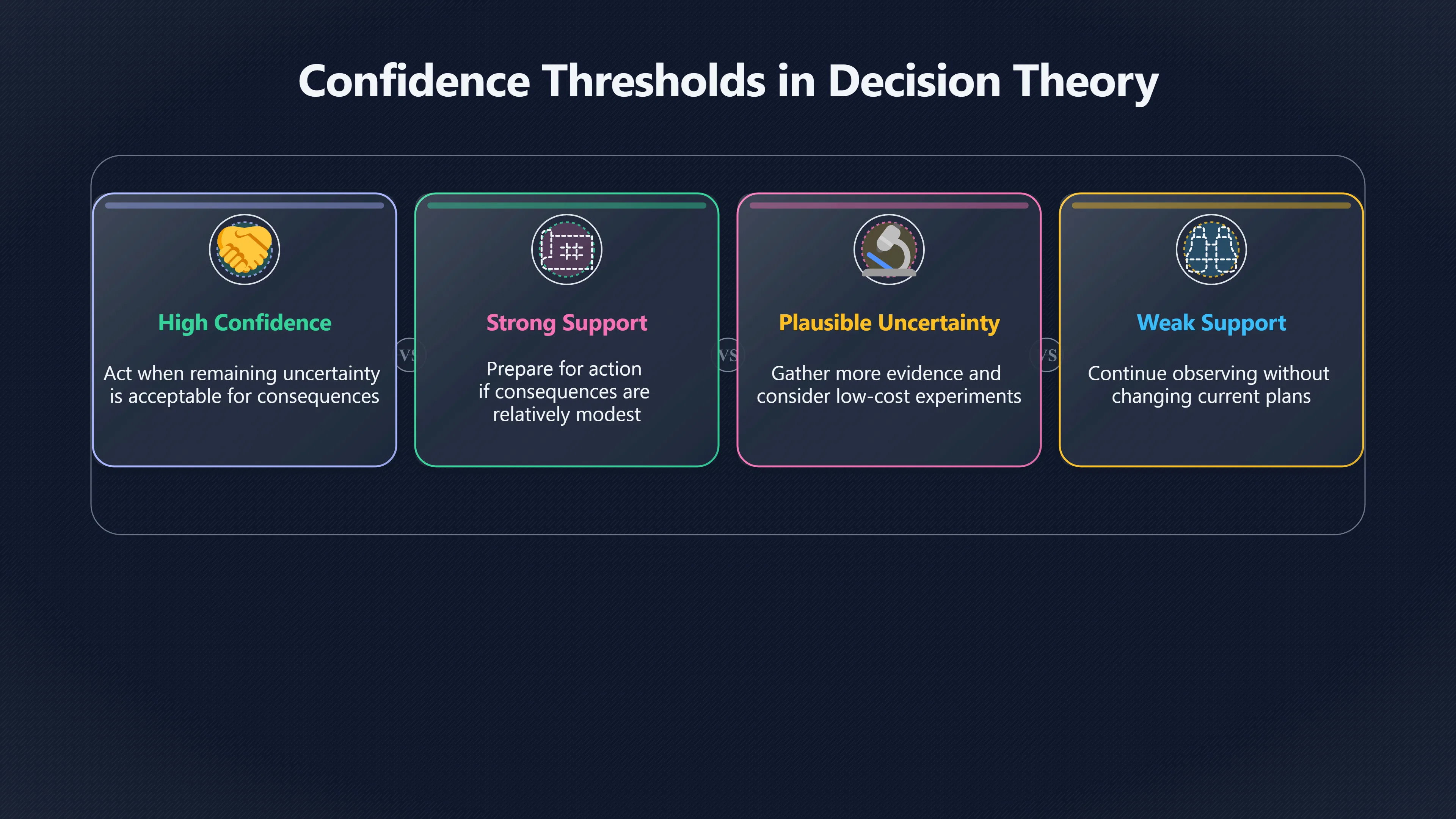
ConfidenceInterpretationTypical response10–30%Weak supportContinue observing; do not change plans.40–60%Plausible but uncertainGather more evidence; consider low-cost experiments.70–85%Strong but incompletePrepare for action if consequences are modest.Above 90%High confidenceAct if the remaining uncertainty is acceptable for the decision involved.
These percentages are not objective measurements. They are tools for expressing relative certainty and making belief updates visible rather than all-or-nothing.
The habit that improves judgement
One of the most valuable thinking habits is becoming comfortable with changing your mind in stages.
Instead of asking, “Has this evidence proved the claim?”, ask two separate questions:
- How much should this evidence change my confidence?
- Has my confidence crossed the threshold required for this particular action?
Keeping these questions separate allows you to learn continuously without becoming either stubborn or impulsive. Your beliefs remain responsive to new evidence, while your actions remain proportional to the quality of that evidence and the consequences of being wrong. This separation is one of the clearest ways to make evidence-based thinking both more accurate and more practical. [PMC+2Psyche]pmc.ncbi.nlm.nih.govEvidence or Confidence: What Is Really Monitored during a…by DG Lee · 2023 · Cited by 52 — We pursue the alternative hypothesis tha…
Amazon book picks
Further Reading
Books and field guides related to Change Your Confidence Before Your Actions. Use these as the next step if you want deeper reading beyond the article.
Thinking, Fast and Slow
Explains how people update beliefs, make decisions under uncertainty, and avoid common reasoning errors.
The Signal and the Noise
Shows how evidence should incrementally change confidence while accounting for uncertainty and risk.
How to Measure Anything
Demonstrates how uncertainty can be quantified before committing to costly actions.
Superforecasting: The Art and Science of Prediction
Focuses on calibrated confidence, evidence updates, and separating probabilities from decisions.
eBay marketplace picks
Marketplace Samples
Live-tested eBay searches with available results related to this page.




Endnotes
-
Source: pmc.ncbi.nlm.nih.gov
Link: https://pmc.ncbi.nlm.nih.gov/articles/PMC10482769/Source snippet
Evidence or Confidence: What Is Really Monitored during a...by DG Lee · 2023 · Cited by 52 — We pursue the alternative hypothesis tha...
-
Source: psyche.co
Title: how to think like a bayesian and make better decisions
Link: https://psyche.co/guides/how-to-think-like-a-bayesian-and-make-better-decisionsSource snippet
10 Jan 2024 — According to Bayes's Rule, your updated confidence in the hypothesis should be calculated from two factors: what your confi...
-
Source: academia.edu
Link: https://www.academia.edu/Documents/in/Bayesian_statistical_decision_theorySource snippet
Bayesian statistical decision theory Research PapersBayesian statistical decision theory is a framework for making decisions under uncert...
-
Source: researchgate.net
Link: https://www.researchgate.net/publication/5140657_Sequential_evidence_accumulation_in_decision_making_The_individual_desired_level_of_confidence_can_explain_the_extent_of_information_acquisitionSource snippet
ResearchGate(PDF) Sequential evidence accumulation in decision makingIn line with such theories, we conceptualize the evidence threshold...
-
Source: researchgate.net
Link: https://www.researchgate.net/publication/46180013Nurses%27_risk[assessmentSource snippet
ence and calibration of their self-confidence and judgement...Read more...
-
Source: frontiersin.org
Link: https://www.frontiersin.org/journals/psychology/articles/10.3389/fpsyg.2016.01559/fullSource snippet
FrontiersCognitive Abilities, Monitoring Confidence, and Control...by SA Jackson · 2016 · Cited by 71 — For example, holding a threshold...
-
Source: pure.qub.ac.uk
Link: https://pure.qub.ac.uk/files/606934557/Thresholds_theory-Final_accepted_19.4.24.pdfSource snippet
Queen's University BelfastThreshold decisions in social work: using theory to support...by D Turney · 2024 · Cited by 11 — The foundatio...
-
Source: pmc.ncbi.nlm.nih.gov
Link: https://pmc.ncbi.nlm.nih.gov/articles/PMC12881443/Source snippet
misinformation through plausibility estimation and...by V Guigon · 2026 — Reaching accuracy, therefore, requires good calibration, under...
Additional References
-
Source: papers.nips.cc
Link: https://papers.nips.cc/paper_files/paper/2016/file/96c5c28becf18e71190460a9955aa4d8-Reviews.htmlSource snippet
nips.ccReviews: Threshold Learning for Optimal Decision MakingIn a nutshell, this paper proposes that thresholds are determined by solvin...
-
Source: novakkevin.medium.com
Link: https://novakkevin.medium.com/the-confidence-calibration-problem-why-self-assessment-fails-us-at-the-worst-possible-moments-87a6cd9ec11dSource snippet
Confidence Calibration Problem: Why Self-Assessment...The core insight is deceptively simple: the skills required to produce excellent w...
-
Source: itad.com
Title: bayesian confidence updating 3 lessons from applying this technique
Link: https://www.itad.com/article/bayesian-confidence-updating-3-lessons-from-applying-this-technique/Source snippet
Bayesian Confidence Updating: 3 lessons from applying...12 Sept 2022 — Bayesian Confidence Updating is an innovative approach to robustl...
-
Source: socialsci.libretexts.org
Title: 10.08: Threshold of Decision Making
Link: https://socialsci.libretexts.org/Bookshelves/Communication/Argument_and_Debate/Arguing_Using_Critical_Thinking_%28Marteney%29/10%3A_Decision_Making_-_Judging_an_Argument/10.08%3A_Threshold_of_Decision_MakingSource snippet
libretexts.org10.8: Threshold of Decision Making3 Dec 2020 — The Threshold is that point on the continuum where a person is sure enough o...
-
Source: discovery.ucl.ac.uk
Link: https://discovery.ucl.ac.uk/id/eprint/10178726/Source snippet
ratings increase response thresholds in...by B Li · 2024 · Cited by 21 — The results showed that CRs led to enhanced decision accuracy...
-
Source: openreview.net
Title: Don’t Think Twice!
Link: https://openreview.net/forum?id=e7G5aeMOUPSource snippet
Over-Reasoning Impairs Confidence...by R Lacombe · Cited by 2 — Extended reasoning leads to systematic overconfidence that worsens with...
-
Source: arxiv.org
Link: https://arxiv.org/html/2601.15778v1Source snippet
Agentic Confidence Calibration22 Jan 2026 — An early, low-confidence decision-such as erroneously selecting a tool, can “poison” the enti...
-
Source: nature.com
Link: https://www.nature.com/articles/s41467-020-15581-6Source snippet
Confidence reports in decision-making with multiple...by HH Li · 2020 · Cited by 116 — We found that confidence reports are best explain...
-
Source: brookbushinstitute.com
Link: https://brookbushinstitute.com/articles/using-research-for-better-practice-a-decision-theory-and-information-theory-approachSource snippet
Using Research for Better Practice: A Decision Theory and...by B Brookbush · 2026 — Knee valgus is a practical case where heterogeneous...
-
Source: youtube.com
Title: Why “scout mindset” is crucial to [good judgment]({{ ‘good-judgment/’ | relative_url }}) | Julia Galef | TEDx PSU
Link: https://www.youtube.com/watch?v=3MYEtQ5Zdn8Source snippet
Expected Value of Perfect Information (EVPI) Explained...
Topic Tree