Within Explain It
Can You Draw the Idea From Memory?
Drawing a concept from memory tests whether you understand its structure, causes, stages, or trade-offs.
On this page
- When a diagram beats a paragraph
- What arrows and stages reveal
- How to compare the sketch with the source
Page outline Jump by section
Introduction
Some ideas are difficult to explain because they are not simply lists of facts. They involve sequences, feedback loops, cause-and-effect chains, competing influences, or systems whose parts change one another. For these concepts, drawing a diagram from memory is often a better test of understanding than writing a paragraph. A successful sketch shows not only that you remember the components, but also that you know how they interact.
 Within a no-notes learning routine, memory diagrams act as retrieval practice. Instead of copying a figure from a textbook, you reconstruct it from memory and then compare it with a trusted source. That process exposes missing links, incorrect directions, forgotten stages, and oversimplified explanations that ordinary rereading often hides. Research on retrieval practice consistently shows that reconstructing knowledge from memory produces stronger long-term learning than studying alone, even for complex scientific concepts. [PubMed]pubmed.ncbi.nlm.nih.govPub Med Retrieval practice produces more learning than elaborative studyingRetrieval practice produces more learning than elaborative studying…February 11, 2011 — Here, we show that practicing retrieval…
When a diagram beats a paragraph
Paragraphs work well for definitions and descriptions. Diagrams become more useful when the central question is “How do these parts influence one another?”
A memory diagram is particularly valuable when the concept includes:
- A sequence of stages, such as a scientific process or decision workflow.
- Multiple causes leading to one outcome.
- One cause producing several downstream effects.
- Feedback loops where outputs influence earlier stages. [youtube.com]youtube.comUnderstanding Feedback LoopsRetrieval Cues and Memory (Priming, Context, State-Dependent Memory) - YouTube Retrieval Cues and Memory (Priming, Context, State-Depende…
- Trade-offs between competing objectives.
- Relationships that cannot easily be understood in a linear sentence.
For example, imagine explaining the water cycle. A paragraph may mention evaporation, condensation and precipitation. A diagram immediately reveals whether you remember which processes feed into others, whether energy from the Sun belongs at the start, and whether runoff returns water to the oceans. The relationships become visible rather than implied.
This matters because understanding many concepts depends more on structure than vocabulary. Remembering the right terms without remembering how they connect often creates an illusion of understanding.
What arrows and stages reveal
The greatest value of a memory diagram is not artistic quality but relational accuracy.
When reconstructing a concept, focus on four elements.
The main components. Begin with the essential objects, events or ideas. If you cannot decide what belongs in the diagram, that uncertainty often signals that the boundaries of the concept are not yet clear.
The connections. Draw arrows only where one element genuinely affects another. Every arrow should answer a question such as “causes”, “depends on”, “feeds into”, “enables”, or “constrains”.
The direction of influence. Reversed arrows frequently expose misunderstandings. In economics, biology, engineering and history alike, knowing that two ideas are related is not enough—you must know which influences which.
The missing pieces. Blank spaces are useful evidence. If you find yourself drawing a disconnected box because you cannot remember how it links to the rest of the system, you have identified a specific gap to revisit rather than a vague feeling that you “need more revision”.
Unlike copied notes, a memory diagram forces you to rebuild the mechanism yourself.
Draw relationships, not artwork
Many learners assume that better diagrams require artistic skill. They do not.
Simple boxes, circles and arrows are usually enough. The goal is to externalise your mental model.
Useful conventions include:
- Boxes for important concepts.
- Arrows for causal or directional relationships.
- Numbered stages for sequences.
- Different arrow styles for positive versus negative influences if needed.
- Short labels rather than full sentences.
Avoid decorating the page. Every extra visual feature should help explain the concept rather than make the page look attractive.
A sketch that takes two minutes to draw but accurately represents the system is far more valuable than an elaborate copied diagram that required no retrieval.

How to compare the sketch with the source
The comparison stage is where much of the learning happens.
Rather than asking, “Did mine look similar?”, compare systematically.
- Check whether every essential component appears.
- Verify that every connection points in the correct direction.
- Look for missing causes, feedback loops or exceptions. [youtube.com]youtube.comUnderstanding Feedback LoopsRetrieval Cues and Memory (Priming, Context, State-Dependent Memory) - YouTube Retrieval Cues and Memory (Priming, Context, State-Depende…
- Notice whether you invented links that the original does not contain.
- Redraw the diagram from memory after correcting it.
Pay particular attention to relationships rather than labels. Learners often discover that they remembered every keyword while misunderstanding the underlying mechanism.
Research on retrieval-based concept mapping illustrates this distinction. Creating diagrams while viewing the source material mainly becomes another form of elaborative study. Creating the diagram entirely from memory transforms the activity into retrieval practice, producing substantially stronger learning than simply studying with concept maps in front of you. [Cognition and Learning Lab]learninglab.psych.purdue.eduproduces greater gains in meaningful learning than elaborative studying with concept mapping…
Why moving parts expose false confidence
People commonly believe they understand systems until asked to explain how they work.
Psychologists describe this as the illusion of explanatory depth: familiarity with a concept can create confidence that disappears once someone attempts a detailed causal explanation. Diagrams are especially good at revealing this illusion because they demand explicit connections rather than vague descriptions. [Wikipedia]WikipediaIllusion of explanatory depthIllusion of explanatory depth
Suppose you claim to understand how inflation affects interest rates, investment and consumer spending. A short verbal explanation may sound convincing. A causal sketch quickly reveals whether you actually know:
- which variables influence others;
- whether the effects are direct or indirect;
- where delays occur;
- whether any relationships work in both directions.
The same principle applies to biological pathways, engineering systems, software architecture and historical chains of events.
Common mistakes when drawing from memory
Several errors appear repeatedly.
Turning the diagram into a list. If every item is disconnected, you are recalling vocabulary rather than understanding relationships.
Using arrows without meaning. Every arrow should represent a specific relationship. Random connectors create the appearance of structure without conveying one.
Copying immediately after forgetting. Resist checking the source too early. The productive struggle involved in retrieval is part of what strengthens learning.
Making the diagram too detailed. Begin with the core mechanism. Once that is stable, add secondary influences or exceptions.
Ignoring uncertainty. Question marks are useful. Marking uncertain links helps direct later review far more effectively than pretending certainty.
Making memory diagrams part of your explanation practice
Memory diagrams work best as short, repeated exercises rather than one-off assignments.
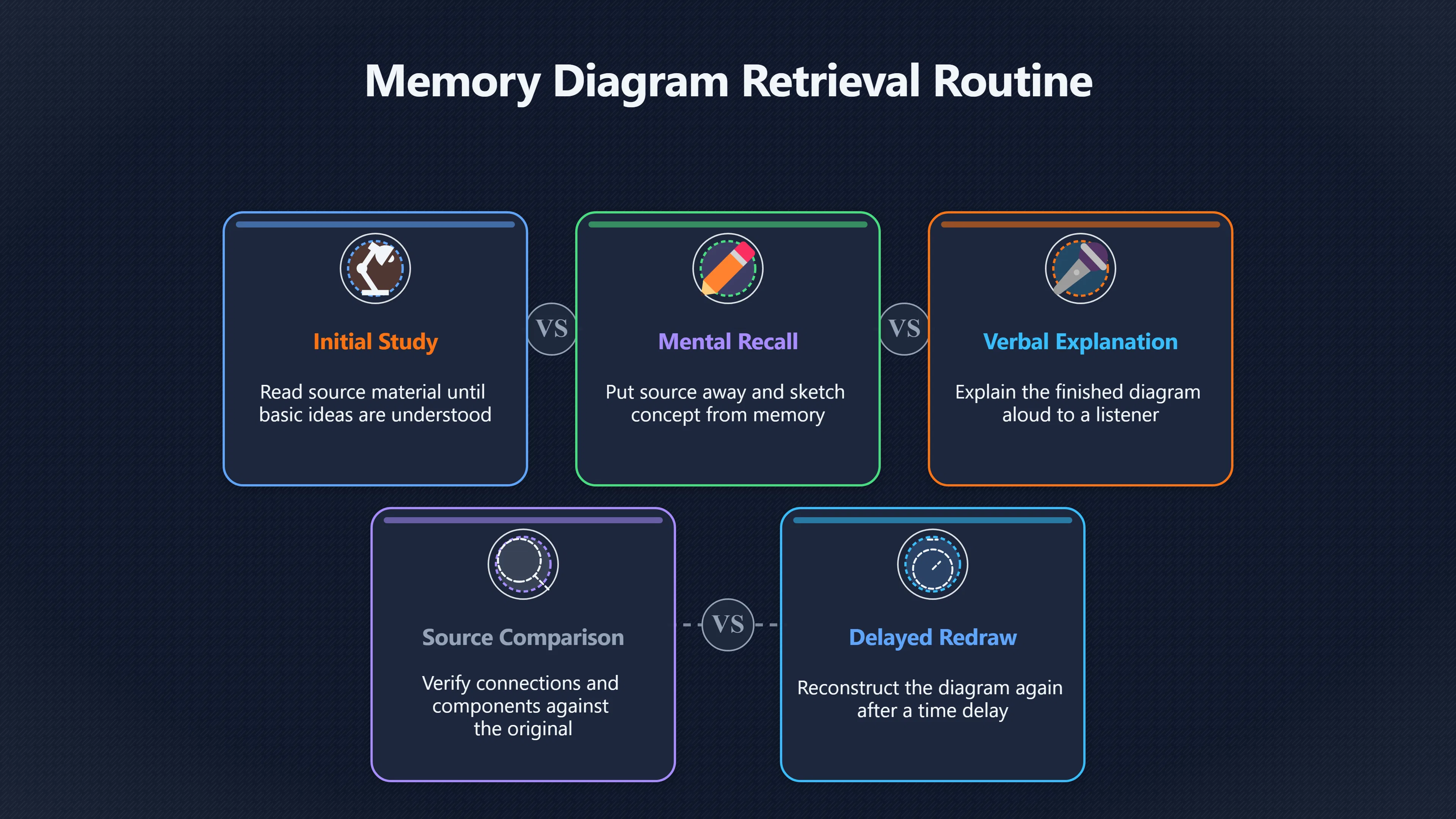
A practical routine is:
- Read the material until you understand the basic idea.
- Put the source away.
- Draw the concept from memory in two to five minutes.
- Explain the finished diagram aloud as if teaching someone else.
- Compare it carefully with the original.
- Redraw it from memory later, after a delay.
This combines retrieval practice with self-explanation, encouraging both accurate recall and deeper understanding of relationships.
Evidence also suggests that drawing and reconstructing information encourages multiple forms of processing—including visual, semantic and motor processing—which can strengthen memory compared with passive review alone, although the benefits depend on how the drawing task is designed and whether it requires genuine reconstruction rather than copying. [Edutopia]edutopia.orgThe Science of Drawing and MemoryThe Science of Drawing and Memory - EdutopiaMarch 14, 2019 — Researchers found drawing information to be a powerful way to boost…
For concepts built from interacting parts rather than isolated facts, a memory diagram answers a more demanding question than “Can I recognise this?” It asks, “Can I rebuild the system from memory?” That makes it one of the most effective ways to test whether an explanation reflects genuine understanding rather than familiarity.
eBay marketplace picks
Marketplace Samples
Live-tested eBay searches with available results related to this page.



Endnotes
-
Source: Wikipedia
Title: Illusion of explanatory depth
Link: https://en.wikipedia.org/wiki/Illusion_of_explanatory_depth -
Source: edutopia.org
Title: The Science of Drawing and Memory
Link: https://www.edutopia.org/article/science-drawing-and-memory/Source snippet
The Science of Drawing and Memory - EdutopiaMarch 14, 2019 — Researchers found drawing information to be a powerful way to boost...
Published: March 14, 2019
-
Source: pubmed.ncbi.nlm.nih.gov
Title: Pub Med Retrieval practice produces more learning than elaborative studying
Link: https://pubmed.ncbi.nlm.nih.gov/21252317/Source snippet
Retrieval practice produces more learning than elaborative studying...February 11, 2011 — Here, we show that practicing retrieval...
Published: February 11, 2011
-
Source: learninglab.psych.purdue.edu
Link: https://learninglab.psych.purdue.edu/downloads/2011/2011_Karpicke_Blunt_Science.pdfSource snippet
produces greater gains in meaningful learning than elaborative studying with concept mapping...
Additional References
-
Source: bates.edu
Title: [PDF] Retrieval Practice Produces More Learning than Elaborative
Link: https://www.bates.edu/research/files/2018/07/science.1199327.full_.pdfSource snippet
July 11, 2018 — Here, we show that practicing retrieval produces greater gains in meaningful learning than elaborative studying with conc...
Published: July 11, 2018
-
Source: semanticscholar.org
Link: https://www.semanticscholar.org/paper/Retrieval-Practice-Produces-More-Learning-than-with-Karpicke-Blunt/88b3b10c0f0d08e0445f6846ab141a029c09837bSource snippet
ngful learning than elaborative studying with concept mapping, and this support the...
-
Source: frontiersin.org
Title: Retrieval-based concept mapping makes a difference as
Link: https://www.frontiersin.org/journals/education/articles/10.3389/feduc.2024.1287744/fullSource snippet
FrontiersResults revealed that coupling concept mapping and free recall did not improve learning as compared to repeated retrieval alone...
-
Source: huskiecommons.lib.niu.edu
Link: https://huskiecommons.lib.niu.edu/allgraduate-thesesdissertations/7617/Source snippet
wings and causal drawings on memory and [transfer]({{ 'transfer/' | relative_url }}) for scientific explanations...
-
Source: youtube.com
Link: https://www.youtube.com/watch?v=LR_sIGHj-iISource snippet
February 11, 2024 — An explanation of the study that proves Retrieval Practice Produces More Learning than Elaborative Studying with Conc...
Published: February 11, 2024
-
Source: learningscientists.org
Title: The Learning Scientists Retrieval Mapping
Link: https://www.learningscientists.org/blog/2020/11/19-1Source snippet
The Learning ScientistsRetrieval Mapping - The Learning ScientistsRetrieval mapping: students created concept maps from their own memory...
-
Source: docmadhattan.fieldofscience.com
Title: retrieval learning practice
Link: https://docmadhattan.fieldofscience.com/2011/05/retrieval-learning-practice.htmlSource snippet
learning practice - Doc MadhattanMay 25, 2011 — Retrieval is a process of recalling what we have in memory. So retrieval practice is the...
Published: May 25, 2011
-
Source: youtube.com
Title: Understanding Feedback Loops
Link: https://www.youtube.com/watch?v=UiJFZKN0NcsSource snippet
Retrieval Cues and Memory (Priming, Context, State-Dependent Memory) - YouTube Retrieval Cues and Memory (Priming, Context, State-Depende...
-
Source: youtube.com
Title: Systems Thinking: Causal Loop Diagrams
Link: https://www.youtube.com/watch?v=LgnBSdcxPD0Source snippet
Systems Thinking and Causal Loop Diagrams in the Real World...
-
Source: youtube.com
Title: Systems Thinking and Causal Loop Diagrams in the Real World
Link: https://www.youtube.com/watch?v=E-DQ5Kk8vtQSource snippet
How to Create a Concept Map...
Topic Tree