Within Source Quality
What Strong Corroboration Actually Looks Like
Agreement becomes stronger when different kinds of sources reach the same answer through separate evidence paths.
On this page
- Primary records, data, and direct witnesses
- Why different evidence types matter
- A checklist for testing independent routes
Page outline Jump by section
Introduction
Strong corroboration is not simply a matter of finding several sources that agree. It comes from finding independent evidence routes: different kinds of evidence gathered through different processes that nevertheless point to the same conclusion. This distinction is central to good analytical thinking because apparent agreement can be misleading when multiple reports ultimately trace back to a single document, witness, press release or social media post. By contrast, confidence increases when records, measurements, eyewitnesses, direct observation and independent investigations converge without depending on one another. Research on scientific reproducibility, investigative journalism and evidence evaluation all emphasises that independent confirmation is more informative than repeated assertion.[playbook.n-ost.org]playbook.n-ost.orgrowd-sourcing to help reporters confirm the accuracy and authenticity of their content.Read more…
 This idea builds on the distinction between source quality and source agreement. High-quality sources remain important, but agreement becomes substantially stronger when those sources arrive at similar conclusions through genuinely separate evidence pathways.
What strong corroboration actually looks like
The key question is not “How many sources agree?” but rather “How many independent routes lead to this conclusion?”
Imagine a claim that a factory has permanently closed.
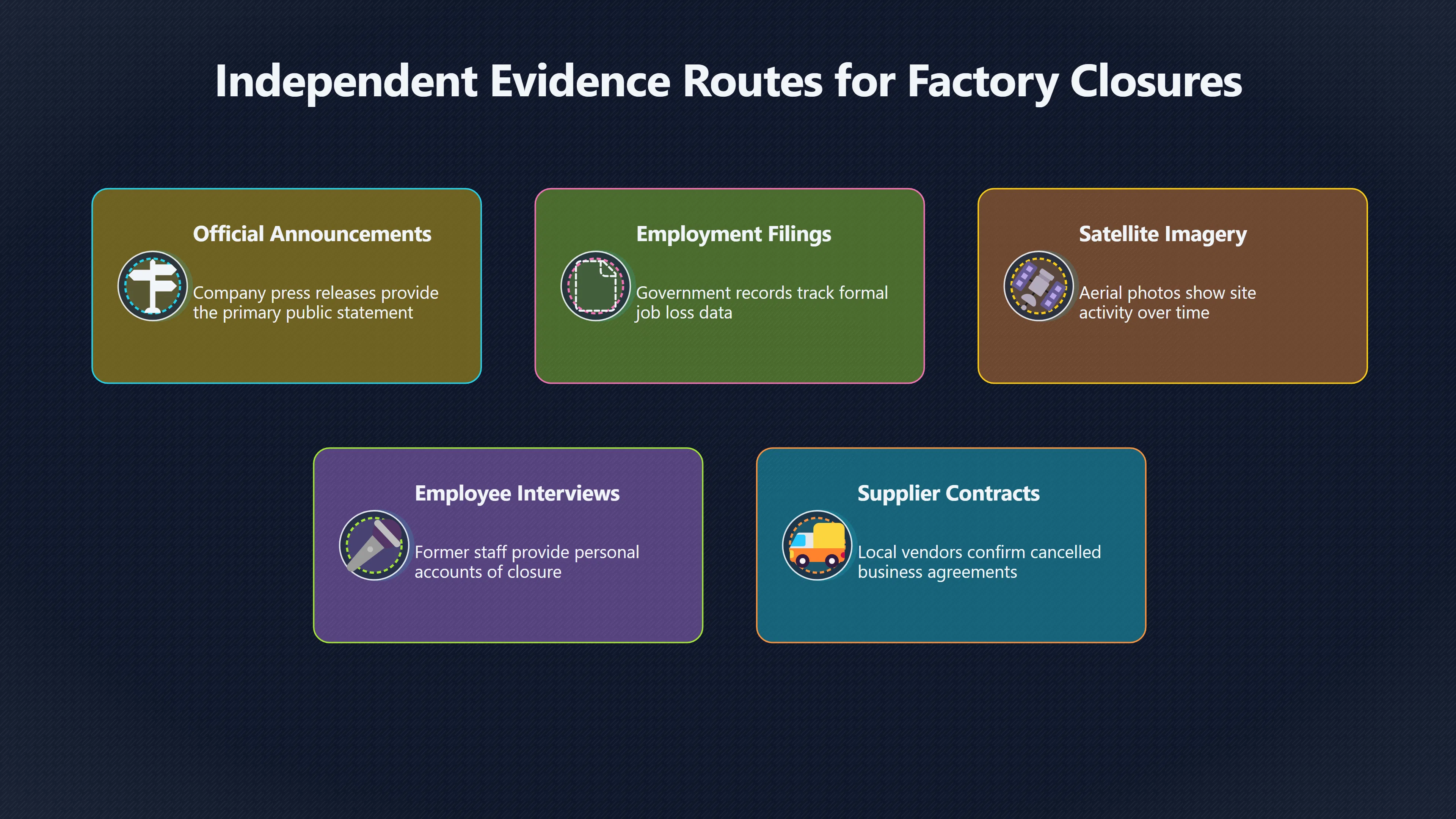
Three news sites publishing identical stories is only one route if each relied on the same company press release. The evidential picture becomes much stronger if independent evidence includes:
- the official company announcement;
- government employment filings;
- satellite or street-level imagery showing the site emptied over time;
- interviews with former employees;
- local suppliers confirming cancelled contracts; and
- financial records showing production has ceased.
Each source type contributes different information while also checking the weaknesses of the others. A company announcement may frame events favourably. Employee testimony may reflect personal experience rather than the whole picture. Government records may lag behind reality. When these independent forms of evidence converge, the probability that they are all mistaken for unrelated reasons falls substantially.
This is the mechanism behind strong corroboration: agreement produced by different methods rather than repeated transmission.
Primary records, data and direct witnesses
Different evidence types answer different questions. Strong analysis deliberately combines them instead of allowing one category to dominate.
Primary records
Primary documents are created as part of the underlying event rather than written later to describe it. Examples include:
- court judgments;
- legislation;
- regulatory filings;
- company accounts;
- contracts;
- scientific datasets;
- meeting minutes;
- official correspondence.
These records often provide the closest available connection to the event itself. They can still contain mistakes or selective presentation, but they reduce the number of intermediaries between the event and the analyst.
Measured data
Quantitative evidence provides another independent route.
Examples include:
- sensor measurements;
- satellite imagery;
- financial transactions;
- weather records;
- census data;
- laboratory results;
- traffic counts.
Measured data often allows claims to be checked without relying entirely on someone’s interpretation. Modern investigative reporting increasingly combines documentary evidence with data analysis to test whether reported events match observable patterns.[OSINT Academy]os-intelligent.comOSINT Academy How Investigative Journalists Use OSINT (Real-WorldOSINT AcademyHow Investigative Journalists Use OSINT (Real-World…April 10, 2026 — 10 Apr 2026 — This post walks through six real-world…
Direct witnesses
People who directly observed an event provide information unavailable elsewhere.
However, eyewitness testimony should rarely stand alone. Human memory is vulnerable to stress, expectation, selective attention and later suggestion. Multiple witnesses become especially valuable when:
- they were interviewed independently;
- they observed different aspects of the event;
- their accounts contain overlapping facts without suspiciously identical wording;
- they disagree on minor details while agreeing on central facts.
Complete verbal uniformity is often less persuasive than natural variation around the same underlying event.
Why different evidence types matter
Independent evidence routes reduce several common reasoning errors.
They reduce shared error
Many apparent confirmations are actually repetitions of one original mistake.
For example:
- hundreds of articles may quote the same news agency dispatch;
- dozens of blogs may rely on one academic paper;
- numerous social media accounts may copy one misleading video;
- several organisations may reuse the same government statistics.
Although many publications appear to agree, only one underlying evidential pathway exists.
Analysts sometimes describe this as a problem of dependence rather than disagreement. The number of visible sources can greatly exceed the number of genuinely independent observations.

They compensate for different weaknesses
Every evidence type has characteristic limitations.
Official statements may contain institutional incentives.
Documents may omit informal decisions.
Statistics may overlook important context.
Eyewitnesses may misremember timing.
Photographs capture only selected moments.
Because these weaknesses differ, combining evidence often produces a stronger overall picture than relying heavily on any single category.
They make deception more difficult
Independent routes also raise the cost of fabrication.
Creating one forged document is possible.
Creating forged documents that remain consistent with:
- satellite imagery,
- financial records,
- independent witnesses,
- historical timelines,
- publicly observable behaviour,
is dramatically harder.
For this reason, investigative journalism, forensic investigations and human rights documentation increasingly combine documentary evidence, geospatial analysis, public records and witness testimony rather than depending on any single source alone.[OSINT Academy+2Scribd]os-intelligent.comOSINT Academy How Investigative Journalists Use OSINT (Real-WorldOSINT AcademyHow Investigative Journalists Use OSINT (Real-World…April 10, 2026 — 10 Apr 2026 — This post walks through six real-world…

Independence is more than different names
Analysts often mistake diversity of publishers for diversity of evidence.
These are not equivalent.
A useful way to think about independence is to ask:
- Where did this information originate?
- Could these sources have influenced one another?
- Are they drawing from separate observations?
- Would one source still exist if the others disappeared?
Suppose five newspapers publish the same leaked memo.
The newspapers are independent organisations.
The evidence route is not.
By contrast, if the memo is supported by payroll data, interviews with affected staff, procurement records and regulatory filings collected independently, multiple evidence routes now exist.
The important unit of analysis is the underlying chain of evidence rather than the number of publications.
Practical examples of converging evidence
Many of the strongest modern investigations rely on convergence rather than any single “smoking gun”.
Open-source investigations frequently combine publicly available video, satellite imagery, mapping data, weather records, shadows, landmarks and official documents to establish where and when events occurred. Individual pieces may remain uncertain, but together they produce a coherent evidential network that others can independently examine and reproduce.[OSINT Academy+2Scribd]os-intelligent.comOSINT Academy How Investigative Journalists Use OSINT (Real-WorldOSINT AcademyHow Investigative Journalists Use OSINT (Real-World…April 10, 2026 — 10 Apr 2026 — This post walks through six real-world…
Scientific knowledge develops similarly. Confidence grows not merely because researchers repeat previous claims, but because different laboratories, datasets, methods and analytical approaches obtain compatible results. Independent replication is therefore treated as stronger evidence than simple repetition of earlier findings.[library.oapen.org]library.oapen.orgOpen Source Investigations in the Age of GoogleWhether you are starting in OSINT or online investigations or a veteran, this book will gi…
A checklist for testing independent routes
When assessing whether agreement genuinely strengthens a conclusion, ask:
- Can I identify the original evidence? Trace claims back to their earliest available source.
- How many evidence routes exist? Count independent observations rather than publications.
- Do different methods point in the same direction? Look for convergence between documents, measurements, reporting and direct observation.
- Could all the sources share the same hidden dependency? Check whether multiple reports ultimately rely on one witness, dataset or announcement.
- Do the sources explain how they obtained their information? Transparent methods make independence easier to evaluate.
- Would one route remain persuasive if another proved false? Truly independent evidence should retain value on its own.
- Are disagreements concentrated in details or in the central claim? Minor differences often reflect genuine independence, whereas identical wording may suggest copying.
Using these questions shifts attention away from simply counting agreeing voices and towards understanding how knowledge is actually built. Strong corroboration is less about volume than about independently gathered evidence arriving at the same conclusion through separate and testable routes.
Amazon book picks
Further Reading
Books and field guides related to What Strong Corroboration Actually Looks Like. Use these as the next step if you want deeper reading beyond the article.
Calling Bullshit
Teaches scrutiny of claims, data, and evidential support rather than accepting repeated assertions.
The Demon-Haunted World
Rating: 4.5/5 from 43 Google Books ratings
Stresses independent testing, corroboration, and the discipline of evidence-based belief.
Factfulness
Encourages checking claims through reliable data and multiple grounded indicators.
The Data Detective
Helps readers evaluate evidence quality, uncertainty, and whether data really support a claim.
eBay marketplace picks
Marketplace Samples
Live-tested eBay searches with available results related to this page.




Endnotes
1.
Source: playbook.n-ost.org
Link:https://playbook.n-ost.org/research/fact-checking/tools-and-resources/
Source snippet
rowd-sourcing to help reporters confirm the accuracy and authenticity of their content.Read more...
2.
Source: library.oapen.org
Link:https://library.oapen.org/bitstream/handle/20.500.12657/92864/9781800614079.pdf?isAllowed=y&sequence=1
Source snippet
Open Source Investigations in the Age of GoogleWhether you are starting in OSINT or online investigations or a veteran, this book will gi...
3.
Source: scribd.com
Link:https://www.scribd.com/document/676741407/Digital-Witness-Using-Open-Source-Information-for-Human-Rights-Investigation-Documentation-and-Accountability-Sam-Dubberley-Alexa-Koenig-Daragh-Mur
4.
Source: os-intelligent.com
Title: OSINT Academy How Investigative Journalists Use OSINT (Real-World
Link:https://os-intelligent.com/blog/15-how-journalists-use-osint/
Source snippet
OSINT AcademyHow Investigative Journalists Use OSINT (Real-World...April 10, 2026 — 10 Apr 2026 — This post walks through six real-world...
Published: April 10, 2026
Additional References
5.
Source: warintelhub.com
Link:https://warintelhub.com/methodology/
Source snippet
OSINT Verification Methodology — How We Source IntelligenceOur verification methodology classifies every event through three tiers — Veri...
6.
Source: ccdcoe.org
Title: CyCon 2026 Securing Tomorrow Proceedings
Link:https://ccdcoe.org/uploads/2026/05/CyCon_2026_Securing_Tomorrow_Proceedings.pdf
Source snippet
18th International Conference on Cyber Conflict: Securing...29 May 2026 — Volunteer cyber forces open-source intelligence (OSINT) collec...
Published: May 2026
7.
Source: irregularwarfarecenter.org
Link:https://irregularwarfarecenter.org/wp-content/uploads/2026-VOL11-NO2-PRISM.pdf
Source snippet
JA Hastey · 2026 — Such data can be extracted from communications intelligence even open-source intelligence (OSINT), but it requires col...
8.
Source: youtube.com
Title: The Facts about Fact Checking: Crash Course Navigating Digital Information #2
Link:https://www.youtube.com/watch?v=EZsaA0w_0z0
Source snippet
4 Open-Source Intelligence (OSINT) Basics You Can Use Now...
9.
Source: youtube.com
Title: Evaluating Sources & Fact Checking: Crash Course Scientific Thinking #6
Link:https://www.youtube.com/watch?v=Fm0MpfKIs5w
Source snippet
2 Triangulation In Research (Definition & Easiest Explanation)...
10.
Source: youtube.com
Title: Triangulation In Research (Definition & Easiest Explanation)
Link:https://www.youtube.com/watch?v=81aXPBtBQTs
Source snippet
3 The Facts about Fact Checking: Crash Course Navigating Digital Information #2...
11.
Source: Wikipedia
Title: BBC Verify
Link:https://en.wikipedia.org/wiki/BBC_Verify
Source snippet
BBC VerifyAccording to the BBC "BBC Verify is a specialist team of journalists using open-source intelligence (OSINT), satellite image...
12.
Source: youtube.com
Title: Open-Source Intelligence (OSINT) Basics You Can Use Now
Link:https://www.youtube.com/watch?v=3FB_fcP_9lM
Source snippet
5 Mixed Research Methods with Triangulation (16 Minutes)...
13.
Source: youtube.com
Title: Mixed Research Methods with Triangulation (16 Minutes)
Link:https://www.youtube.com/watch?v=ktlWAsY1WQM
Topic Tree