Within Weakest Link
Which Assumption Would Actually Change the Decision?
The most important assumption is not the shakiest one, but the one whose failure would force a different choice.
On this page
- Dependency, uncertainty and consequence
- The 'so what if false?' test
- Ranking weak link candidates before more research
Page outline Jump by section
Introduction
Weakest-link thinking is not about finding the most doubtful statement in an argument. It is about identifying the assumption that carries the greatest share of the conclusion. A load-bearing assumption is one whose failure would force you to make a different decision, abandon a plan, or substantially revise your confidence. Many decisions contain dozens of assumptions, but only a few determine whether the conclusion still stands. Distinguishing these from merely uncertain details allows you to direct investigation where it has the highest value, reducing wasted analysis while increasing the chance of catching critical mistakes before they become expensive. This idea underpins structured methods such as the Key Assumptions Check and Assumption-Based Planning, both of which treat assumptions as objects to be identified, challenged and monitored rather than invisible background beliefs. [Department of Statistics+2RAND Corporation]stat.berkeley.eduDepartment of StatisticsStructured Analytic Techniques for Improving Intelligence…April 28, 2009 — by AT Primer · 2009 · Cited by 62 —…

Which assumptions actually carry the decision?
Not every assumption deserves equal attention. Some can prove false without materially changing the outcome. Others are so central that, if they fail, the decision itself should change.
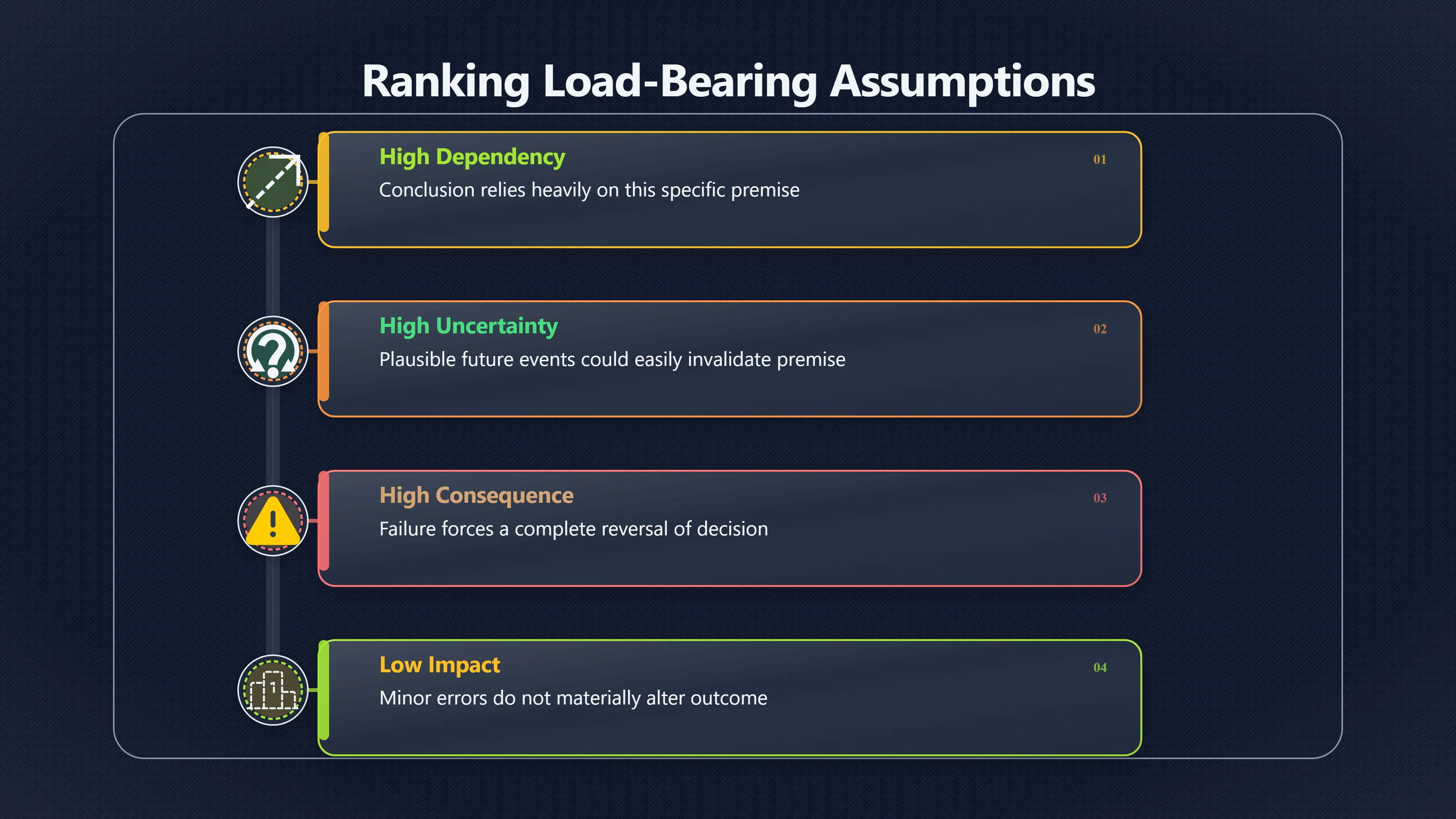
A useful way to distinguish them is to consider three factors together:
- Dependency: How much does the conclusion rely on this assumption?
- Uncertainty: How plausible is it that the assumption could be wrong?
- Consequence: If it were false, would the decision materially change?
The interaction of these three dimensions matters more than any one of them individually. A highly uncertain assumption with little influence may deserve less attention than a moderately uncertain assumption on which the entire recommendation depends.
For example, a company deciding whether to build a new factory may assume:
- demand will grow by at least 15%;
- construction costs will remain within budget;
- key regulations will not change.
Suppose market demand proves slightly lower than expected. The investment might still make sense. However, if the regulatory assumption fails and the factory cannot legally operate as planned, the entire project changes. The regulatory assumption is therefore more load-bearing even if, today, it appears reasonably likely to hold.
This logic appears explicitly in Assumption-Based Planning, which defines an important assumption as one whose negation would require significant changes to the plan. The method then asks which important assumptions are also vulnerable to plausible future events. [betterevaluation.org+2Cat Directory]betterevaluation.orgAssumption-Based planning (ABP)1Identify important assumptions: An assumption is an assertion about some characteristics of the future that underlies the current operati…
The “so what if false?” test
The simplest way to identify a load-bearing assumption is not to ask whether it is believable, but whether its failure would change your choice.
Instead of asking:
[> "Is this assumption reasonable?"]rand.orgRAND CorporationAssumption-Based PlanningThe challenges in this approach are to identify the critical assumptions underlying an organizat…
ask:
“If this assumption turned out to be false tomorrow, would I still make the same decision?”
This question shifts attention from probability to decision relevance.
The answers usually fall into three groups:
- No change: The conclusion still holds. The assumption is not load-bearing.
- Some adjustment: The decision survives but requires modification.
- Decision reversal: The recommendation should change entirely. This assumption deserves priority.
This test often exposes assumptions that have become psychologically invisible because everyone has accepted them without discussion. Intelligence analysts use Key Assumptions Checks precisely because unnoticed assumptions frequently become embedded as apparent facts over the course of an investigation. The technique recommends making these assumptions explicit before collecting further evidence or committing to major judgments. Department of Statistics+2JIPS - Joint IDP Profiling Service [stat.berkeley.edu]stat.berkeley.eduDepartment of StatisticsStructured Analytic Techniques for Improving Intelligence…April 28, 2009 — by AT Primer · 2009 · Cited by 62 —…
Why the most uncertain assumption is not always the most important
People naturally focus on assumptions that look speculative. That instinct is understandable but incomplete.
Imagine evaluating a business acquisition.
AssumptionChance of being wrongEffect if wrongOffice renovation costsModerateMinorExchange-rate forecastHighModerateLargest customer renews contractModerateDecision collapses
The customer-renewal assumption deserves the greatest attention, even if exchange rates are objectively harder to predict.
The mistake is treating uncertainty alone as the criterion for investigation. Effective weakest-link thinking asks where uncertainty intersects with dependency.
In practice, analysts often discover that highly visible uncertainties attract excessive discussion, while quiet assumptions hidden inside forecasts, definitions or causal claims receive little scrutiny despite determining the outcome.
Hidden assumptions often carry the most weight
Explicit assumptions are usually easier to challenge because people know they exist. Implicit assumptions are more dangerous because they disappear into everyday language.
Statements such as:
- “Customers will adopt it quickly.”
- “The market will recognise the improvement.”
- “Training will solve the problem.”
- “The current trend will continue.”
appear factual but often contain multiple unstated assumptions.
For example:
“We should automate customer support.”
may quietly assume:
- customers primarily value response speed;
- automation will not reduce trust;
- complex enquiries remain manageable;
- labour savings exceed implementation costs.
None of these assumptions appears in the recommendation itself, yet one may determine whether automation succeeds.
James Dewar’s work on Assumption-Based Planning argues that planners should actively search for these implicit, load-bearing assumptions because explicit assumptions are often not the ones most likely to create strategic surprises. [thelaterallens.substack.com+2Cat Directory]thelaterallens.substack.comAssumption-Based PlanningExplicit assumptions, the assumptions that are easy to talk about, are usually not…Read more…
Ranking weak-link candidates before gathering more evidence
Once several candidate assumptions have been identified, prioritise them before investing time in research.
A practical sequence is:
- List every assumption supporting the decision.
- Ask whether the decision survives if each assumption fails.
- Eliminate assumptions whose failure changes little.
- Rank the remaining assumptions by:
how much the conclusion depends on them; how uncertain they currently are; how costly it would be if they proved false.
- Investigate the highest-ranked assumptions first.
This prevents a common analytical error: spending weeks refining details that cannot materially affect the recommendation while leaving genuinely decisive assumptions almost untouched.
The Key Assumptions Check is designed to perform exactly this kind of prioritisation early in an analytical project and then revisit assumptions as new information emerges. Department of Statistics+2JIPS - Joint IDP Profiling Service [stat.berkeley.edu]stat.berkeley.eduDepartment of StatisticsStructured Analytic Techniques for Improving Intelligence…April 28, 2009 — by AT Primer · 2009 · Cited by 62 —…
Looking for evidence that could overturn the decision
Research becomes more efficient once the load-bearing assumptions are known.
Rather than asking:
- “What evidence supports my conclusion?”
ask:
- “What evidence would convince me this assumption is false?”
This produces targeted information searches instead of indiscriminate evidence gathering.
For instance:
- If hiring depends on interview performance predicting future success, seek evidence comparing interview scores with later job performance.
- If a policy depends on public compliance, look for behavioural evidence rather than additional theoretical arguments.
- If an investment depends on continued demand growth, prioritise leading indicators that would reveal weakening demand early.
The objective is not to attack every assumption equally but to test those capable of changing the decision.
Monitoring assumptions after the decision
Load-bearing assumptions remain important even after a decision has been made.
Plans rarely fail because every assumption becomes false simultaneously. More often, one critical assumption gradually erodes while organisations continue acting as though it still holds.
Assumption-Based Planning therefore recommends identifying observable “signposts”—events or indicators that suggest an important assumption is becoming less reliable. Monitoring these signposts provides early warning that a decision should be revisited before failure becomes unavoidable. [betterevaluation.org+2Cambridge Assets]betterevaluation.orgAssumption-Based planning (ABP)1Identify important assumptions: An assumption is an assertion about some characteristics of the future that underlies the current operati…
For example:
- declining customer enquiries may challenge a demand assumption;
- new draft legislation may threaten a regulatory assumption;
- unexpected competitor behaviour may invalidate pricing assumptions.
Treating assumptions as actively monitored hypotheses rather than permanent truths makes decisions more adaptable under uncertainty.
Common mistakes when identifying load-bearing assumptions
Several recurring errors reduce the effectiveness of weakest-link thinking:
- Confusing evidence with assumptions. Evidence supports a conclusion; assumptions connect evidence to the conclusion.
- Testing the easiest assumption rather than the decisive one. Convenience is not importance.
- Ignoring assumptions that feel obvious. Widely shared beliefs often escape examination precisely because everyone accepts them.
- Focusing only on probability. An unlikely event with catastrophic consequences may deserve more attention than a likely event with trivial effects.
- Assuming one review is enough. As circumstances change, assumptions that were once safe can become the weakest link.
The discipline is therefore continuous rather than one-off: identify the assumptions, rank them by dependency, uncertainty and consequence, test the ones capable of overturning the decision, and continue watching them as the environment changes. This approach keeps attention on the premises that genuinely carry the weight of the conclusion rather than those that merely attract the most discussion.
Amazon book picks
Further Reading
Books and field guides related to Which Assumption Would Actually Change the Decision?. Use these as the next step if you want deeper reading beyond the article.
The Art of Thinking Clearly
Covers common thinking errors that lead people to rely on weak or unsupported assumptions.
Decisive
Provides practical frameworks for stress-testing assumptions before committing to decisions.
The Black Swan
Highlights how hidden assumptions and neglected uncertainties can overturn major decisions.
Superforecasting: The Art and Science of Prediction
Focuses on identifying critical uncertainties, updating beliefs, and testing key assumptions.
eBay marketplace picks
Marketplace Samples
Topic-anchored marketplace searches for visual, collectible, or second-hand items related to this page.



Endnotes
-
Source: rand.org
Link: https://www.rand.org/content/dam/rand/pubs/monograph_reports/2005/MR114.pdfSource snippet
RAND CorporationAssumption-Based PlanningThe challenges in this approach are to identify the critical assumptions underlying an organizat...
-
Source: betterevaluation.org
Title: Assumption-Based planning (ABP)1
Link: https://www.betterevaluation.org/sites/default/files/abp.pdfSource snippet
Identify important assumptions: An assumption is an assertion about some characteristics of the future that underlies the current operati...
-
Source: assets.cambridge.org
Link: https://assets.cambridge.org/97805218/06534/index/9780521806534_index.pdfSource snippet
cambridge.orgAssumption-Based Planning: A Tool for Reassessment of, 167–68 assumptions and, 1, 28 definition of, 86, 233 insurable, 147 o...
-
Source: jips.org
Link: https://www.jips.org/uploads/2021/10/JIPS-JointStructuredAnalysisTechniques-JSAT-Oct2021-1.pdfSource snippet
Joint IDP Profiling ServiceJoint Structured Analysis Techniques (JSAT)The Key Assumptions Check in particular is recommended for a...
-
Source: thelaterallens.substack.com
Title: Assumption-Based Planning
Link: https://thelaterallens.substack.com/p/assumption-based-planningSource snippet
Explicit assumptions, the assumptions that are easy to talk about, are usually not...Read more...
-
Source: stat.berkeley.edu
Link: https://www.stat.berkeley.edu/~aldous/157/Papers/Tradecraft%20Primer-apr09.pdfSource snippet
Department of StatisticsStructured Analytic Techniques for Improving Intelligence...April 28, 2009 — by AT Primer · 2009 · Cited by 62 —...
Published: April 28, 2009
-
Source: catdir.loc.gov
Link: https://catdir.loc.gov/catdir/samples/cam033/2002073460.pdfSource snippet
Cat DirectoryAssumption-Based PlanningFirst, in using ABP techniques for identifying assumptions underlying an organization's plans, we h...
Additional References
-
Source: oecd.org
Link: https://www.oecd.org/content/dam/oecd/en/topics/policy-issues/future-of-education-and-skills/learning-compass-constructs/Critical%20Thinking.pdfSource snippet
Critical ThinkingCritical thinking “comprises the mental processes, strategies, and representations people use to solve problems, make de...
-
Source: researchgate.net
Link: https://www.researchgate.net/figure/Steps-in-Assumption-Based-Planning_fig7_339917639Source snippet
1 Steps in Assumption-Based PlanningA load-bearing assumption is one that, if broken by one or more plausible future events or set of con...
-
Source: thedecisionlab.com
Link: https://thedecisionlab.com/reference-guide/philosophy/[critical-thinkingSource snippet
Critical Thinking SkillsCritical thinking skills are the mental processes and strategies individuals use to assess and integrate informat...
-
Source: scribd.com
Link: https://www.scribd.com/document/346823863/Tradecraft-primer-structured-analytic-techniques-pdfSource snippet
offensive operation. Or when economists. List and review the key working assess the prospects for...Read more...
-
Source: researchgate.net
Title: 338425319 Critical Thinking as a Qualified Decision Making Tool
Link: https://www.researchgate.net/publication/338425319_Critical_Thinking_as_a_Qualified_Decision_Making_ToolSource snippet
(PDF) Critical Thinking as a Qualified Decision Making Toolby U Turan · 2019 · Cited by 113 — In this study, the concepts of decision-mak...
-
Source: researchgate.net
Link: https://www.researchgate.net/publication/337154064_Structured_Analytic_Techniques_Taxonomy_and_Technique_Selection_for_Information_and_Intelligence_Analysis_PractitionersSource snippet
taxonomy of structured analytic techniques. Diagnostic. Techniques. Key Assumptions Check. Quality of Information. Check. Indicators or S...
-
Source: artpetty.com
Title: For Better Decision-Making, Unpack and Stress Test
Link: https://artpetty.com/2017/10/17/better-decision-making/Source snippet
Art Petty17 Oct 2017 — You can jump-start strengthening your planning and decision-making processes by learning to unpack and stress test...
-
Source: themindcollection.com
Link: https://themindcollection.com/structured-analytic-techniques/Source snippet
Assumptions are dangerous knowledge; ideas we...Read more...
-
Source: greydynamics.com
Link: https://greydynamics.com/a-guide-to-structured-analytic-techniques-sats-for-intelligence/Source snippet
This can also be offset by using “What...Read more...
-
Source: grafium.co
Title: What is a key assumptions check?
Link: https://grafium.co/glossary/key-assumptions-checkSource snippet
A key assumptions check is a structured review of the assumptions behind a plan, assessing each for validity, sensitivity and cons...
Topic Tree