Within Critical Skills
Why Critical Thinking Does Not Always Transfer
Critical thinking does not travel automatically because people need enough subject knowledge to spot relevant facts and weak assumptions.
On this page
- Why generic prompts are not enough
- How background knowledge changes judgement
- Designing practice across different contexts
Page outline Jump by section
Introduction
Critical thinking does not automatically transfer from one subject or situation to another because effective judgement depends on more than general reasoning habits. People need enough background knowledge to recognise which facts matter, identify weak assumptions, interpret evidence correctly and notice when familiar reasoning patterns apply in a new context. Without that knowledge, even someone who has learned general critical thinking strategies may overlook crucial details or apply the wrong standards of evidence. Research in cognitive science consistently shows that transfer is possible, but it is difficult, selective and heavily influenced by what learners already know about the domain in which they are reasoning. [danielwillingham.com+2American Federation of Teachers]danielwillingham.comfer, and the research literature evaluating how well critical thinking skills transfer to new problems is.Read more…
Why generic prompts are not enough
Advice such as “question assumptions”, “consider other viewpoints” or “evaluate the evidence” sounds broadly useful because it is. The difficulty is that these prompts do not tell someone what counts as a reasonable assumption, a credible source or relevant evidence in a particular field.
Consider the same question asked in different settings:
- A medical trial requires understanding randomisation, statistical significance and sources of bias.
- A historical claim requires judging primary sources, context and authorship.
- A financial forecast requires recognising economic assumptions and uncertainty.
The thinking routine may appear similar, but the knowledge needed to carry it out differs substantially. Someone can faithfully follow a generic checklist while still reaching poor conclusions because they cannot distinguish meaningful information from irrelevant detail. Daniel Willingham argues that critical thinking is intertwined with the content being considered rather than functioning as a completely general mental skill that operates independently of knowledge. [NSW Education]education.nsw.gov.auNSW Education How to Teach Critical ThinkingNSW EducationHow to Teach Critical ThinkingFebruary 13, 2025 — by DT Willingham · Cited by 153 — This aspect of critical thinking is call…
This explains why students sometimes perform well on classroom exercises yet struggle to apply the same reasoning in everyday life. The problem is often not that they forgot the thinking strategy, but that they failed to recognise that the strategy was relevant in the new situation. [American Federation of Teachers]aft.orgAmerican Federation of TeachersAsk the Cognitive Scientist: How Can Educators Teach…by DT Willingham · Cited by 42 — The problem in tr…
How background knowledge changes judgement
Background knowledge contributes to critical thinking in several different ways. [tipsforteachers.co.uk]tipsforteachers.co.ukResearch: Critical thinkingwhy is it so hard to teach?This collection of articles explores the challenges of teaching critical thinking, particularly in the context…
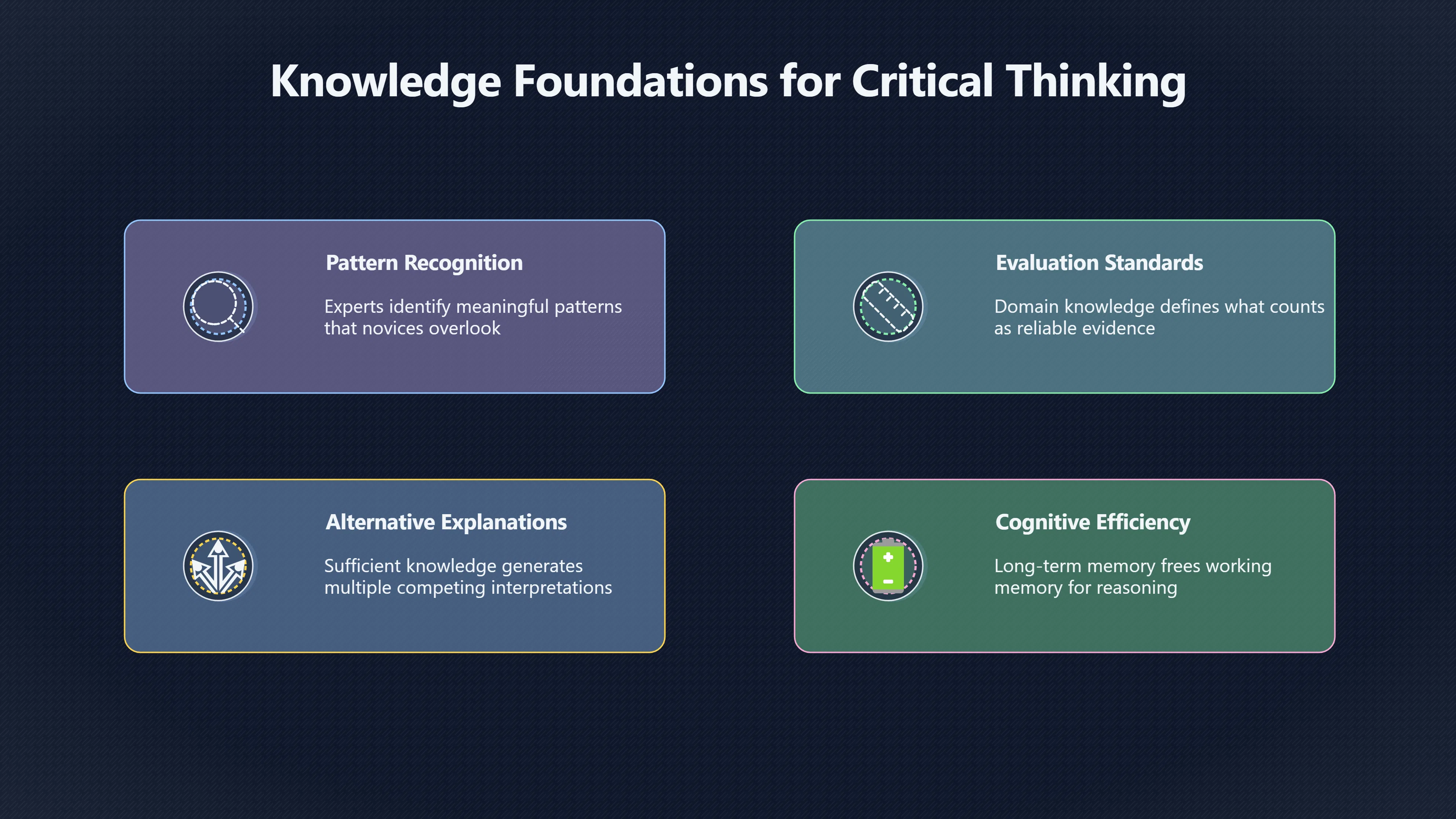
It helps identify what is important. Experts notice meaningful patterns that novices simply cannot see. An experienced doctor immediately recognises symptoms that deserve attention, while a beginner may focus on superficial features.
It provides standards for evaluation. Judging whether evidence is strong depends on knowing what counts as reliable within a discipline. A single eyewitness account may be valuable in one historical investigation but weak evidence for a medical treatment.
It supports alternative explanations. Critical thinking requires comparing competing interpretations rather than accepting the first plausible answer. Without enough knowledge, people often generate only one explanation and therefore have nothing meaningful to compare against.
It reduces cognitive load. Familiar knowledge stored in long-term memory frees working memory to examine arguments rather than merely trying to understand basic concepts. Cognitive psychologists have long shown that reasoning quality depends partly on how efficiently people can retrieve relevant knowledge while solving problems. [NSW Education]education.nsw.gov.auNSW Education How to Teach Critical ThinkingNSW EducationHow to Teach Critical ThinkingFebruary 13, 2025 — by DT Willingham · Cited by 153 — This aspect of critical thinking is call…
The result is that knowledge does not compete with critical thinking. It makes critical thinking possible.
Why recognising the right problem is often the hardest step
One of the most important findings from transfer research is that people frequently fail before reasoning even begins. They do not recognise that a previously learned principle applies to the current situation.
Classic experiments on analogy-based problem solving found that participants often failed to apply a solution they had just encountered because the new problem looked different on the surface. When researchers explicitly suggested that the earlier example might help, success rates increased dramatically. The reasoning itself was not beyond participants’ abilities; recognising the connection was the obstacle. [American Federation of Teachers]aft.orgAmerican Federation of TeachersAsk the Cognitive Scientist: How Can Educators Teach…by DT Willingham · Cited by 42 — The problem in tr…
This distinction matters because transfer depends on recognising deep structure rather than superficial appearance.
For example:
- A debate about social media misinformation and a discussion about nutrition myths may involve the same underlying question about evaluating evidence.
- A legal argument and a scientific explanation may both require distinguishing correlation from causation.
- Two scenarios can appear unrelated while sharing the same logical structure.
Experts become better at transfer largely because repeated experience teaches them to see these deeper similarities across different situations. [The Learning Scientists]learningscientists.orgThe Learning ScientistsDepth Structure and Transfer in Critical Thinking…23 Sept 2021 — How do this recognition of depth and domain-sp…

Why knowing facts is not the same as thinking well
Emphasising background knowledge does not mean that memorising facts automatically creates critical thinkers.
People can possess extensive factual knowledge while reasoning poorly because they:
- accept evidence uncritically;
- ignore alternative explanations;
- rely on confirmation bias;
- fail to evaluate source quality; or
- overestimate their own certainty.
Research therefore rejects both extremes. Critical thinking is neither a completely general skill that floats free of subject matter nor an automatic consequence of accumulating facts. High-quality judgement requires both domain knowledge and explicit reasoning strategies working together. [NSW Education]education.nsw.gov.auNSW Education How to Teach Critical ThinkingNSW EducationHow to Teach Critical ThinkingFebruary 13, 2025 — by DT Willingham · Cited by 153 — This aspect of critical thinking is call…
This also explains why experts sometimes make mistakes outside their own specialism. Expertise usually transfers only where the underlying knowledge structures remain relevant.
Designing practice across different contexts
If transfer is difficult, instruction must deliberately prepare learners for it rather than assuming it will happen naturally.
Research highlights several practices that improve the chances of transfer.
Teach thinking inside subject knowledge. Students learn reasoning more effectively when critical thinking is embedded within authentic disciplinary problems instead of being separated into abstract exercises. [NSW Education]education.nsw.gov.auNSW Education How to Teach Critical ThinkingNSW EducationHow to Teach Critical ThinkingFebruary 13, 2025 — by DT Willingham · Cited by 153 — This aspect of critical thinking is call…
Compare different examples with the same underlying structure. Presenting problems that look different but rely on the same reasoning encourages learners to focus on deep principles rather than surface details. [The Learning Scientists]learningscientists.orgThe Learning ScientistsDepth Structure and Transfer in Critical Thinking…23 Sept 2021 — How do this recognition of depth and domain-sp…
Make transfer explicit. Teachers should regularly ask where else a reasoning strategy might apply instead of assuming students will make the connection themselves. Even simple prompts directing learners to compare situations can substantially improve transfer. [American Federation of Teachers]aft.orgAmerican Federation of TeachersAsk the Cognitive Scientist: How Can Educators Teach…by DT Willingham · Cited by 42 — The problem in tr…
Provide varied practice. Encountering the same thinking process across multiple contexts helps learners build flexible mental representations that are easier to recognise later. Authentic problems, discussion, modelling and guided practice have all been associated with stronger transfer than isolated drills. [Lirias]lirias.kuleuven.beSystematic design of domain-specific instruction on near…by DT Tiruneh · 2018 · Cited by 62 — The literature on transfer of lear…
The practical lesson
The failure of critical thinking to transfer is not evidence that critical thinking cannot be taught. Instead, it reflects how human memory and reasoning work. People think with knowledge they already possess, and they apply reasoning strategies only when they recognise that those strategies fit the situation.
For anyone aiming to improve thinking beyond school, the implication is straightforward: learn the habits of good reasoning, but build them alongside deep knowledge of the subjects that matter. General principles provide direction, while background knowledge supplies the material needed to judge claims accurately. Transfer becomes more reliable not because thinking grows independent of knowledge, but because knowledge makes recognising and applying good thinking increasingly automatic. [NSW Education+2American Federation of Teachers]education.nsw.gov.auNSW Education How to Teach Critical ThinkingNSW EducationHow to Teach Critical ThinkingFebruary 13, 2025 — by DT Willingham · Cited by 153 — This aspect of critical thinking is call…
Amazon book picks
Further Reading
Books and field guides related to Why Critical Thinking Does Not Always Transfer. Use these as the next step if you want deeper reading beyond the article.
Why Don't Students Like School?
Directly explains why thinking depends on background knowledge and why skills do not automatically transfer across domains.
Make It Stick
Explains durable learning, retrieval, varied practice, and conditions that support transfer.
How We Learn
Covers the cognitive mechanisms behind learning, expertise, and applying knowledge in new situations.
The Art of Thinking Clearly
Introduces common reasoning mistakes that complement discussions of critical thinking and domain knowledge.
eBay marketplace picks
Marketplace Samples
Live-tested eBay searches with available results related to this page.




Endnotes
-
Source: danielwillingham.com
Link: https://www.danielwillingham.com/uploads/5/0/0/7/5007325/willingham_2019_nsw_critical_thinking2.pdfSource snippet
fer, and the research literature evaluating how well critical thinking skills transfer to new problems is.Read more...
-
Source: aft.org
Link: https://www.aft.org/ae/fall2020/willinghamSource snippet
American Federation of TeachersAsk the Cognitive Scientist: How Can Educators Teach...by DT Willingham · Cited by 42 — The problem in tr...
-
Source: lirias.kuleuven.be
Link: https://lirias.kuleuven.be/retrieve/7bdad7dd-02ee-49af-b74b-73adbf8de3d8Source snippet
Systematic design of domain-specific instruction on near...by DT Tiruneh · 2018 · Cited by 62 — The literature on transfer of lear...
-
Source: education.nsw.gov.au
Title: NSW Education How to Teach Critical Thinking
Link: https://education.nsw.gov.au/content/dam/main-education/teaching-and-learning/education-for-a-changing-world/media/documents/How-to-teach-critical-thinking-Willingham.pdfSource snippet
NSW EducationHow to Teach Critical ThinkingFebruary 13, 2025 — by DT Willingham · Cited by 153 — This aspect of critical thinking is call...
Published: February 13, 2025
-
Source: learningscientists.org
Link: https://www.learningscientists.org/blog/2021/9/23-1Source snippet
The Learning ScientistsDepth Structure and Transfer in Critical Thinking...23 Sept 2021 — How do this recognition of depth and domain-sp...
-
Source: tipsforteachers.co.uk
Title: Research: Critical thinking
Link: https://tipsforteachers.co.uk/research-critical-thinking-why-is-it-so-hard-to-teach/Source snippet
why is it so hard to teach?This collection of articles explores the challenges of teaching critical thinking, particularly in the context...
Additional References
-
Source: peterellerton.substack.com
Title: critical thinking skills are not
Link: https://peterellerton.substack.com/p/critical-thinking-skills-are-notSource snippet
substack.com(Critical) Thinking skills are not domain specificBut there are cases of complex content that do is domain specific, critical...
-
Source: people.bath.ac.uk
Title: Willingham 2008 AEPR
Link: https://people.bath.ac.uk/edspd/Weblinks/MA_ULL/Resources/Learning%20to%20Learn/Willingham%202008%20AEPR.pdfSource snippet
University of Bath Personal HomepagesCritical Thinking: Why Is It So Hard to Teach?7 Aug 2010 — Just as it makes of critical thinking wit...
-
Source: youtube.com
Title: Evaluating Evidence: Crash Course Navigating Digital Information #6
Link: https://www.youtube.com/watch?v=hxhbOvR2TGkSource snippet
Critical Thinking; Evidence:- 21. #evidence #critical_thinking...
-
Source: youtube.com
Title: Real Confidence Is Built From a Body of Evidence: A Goju Meandering Episode
Link: https://www.youtube.com/watch?v=vWm2BiPoqLcSource snippet
What is Systematic Reviews by Helen Worthington...
-
Source: researchgate.net
Link: https://www.researchgate.net/post/Although-students-have-domain-knowledge-they-are-still-unable-to-think-critically-nor-solve-problemsSource snippet
Some believe that solving problems...
-
Source: youtube.com
Title: Critical Thinking Making evidence-based decisions
Link: https://www.youtube.com/watch?v=vypkOQU1rq8Source snippet
Real Confidence Is Built From a Body of Evidence: A Goju Meandering Episode...
-
Source: youtube.com
Title: Critical Thinking; Evidence:- 21. #evidence #critical_thinking
Link: https://www.youtube.com/watch?v=jbrAe9GSBjASource snippet
Critical Thinking Making evidence-based decisions...
-
Source: youtube.com
Title: What is Systematic Reviews by Helen Worthington
Link: https://www.youtube.com/watch?v=3dyp7R_su7ESource snippet
You Don’t Need to Read Studies to Teach With Evidence — Start Here...
-
Source: youtube.com
Title: You Don’t Need to Read Studies to Teach With Evidence — Start Here
Link: https://www.youtube.com/watch?v=Luosvs-iqrk
Topic Tree