Within Better Questions
How Framing Changes What Evidence Means
The same facts can support different choices when the question highlights losses, gains, failure, success, or access.
On this page
- Loss frames, gain frames, and preference shifts
- Project failure versus project success questions
- Why public problems change with their frame
Page outline Jump by section
Introduction
Framing effects occur when different descriptions of the same underlying facts produce different judgments, preferences, or decisions. The information itself does not change; what changes is the perspective through which people interpret it. A treatment described as “saving 90% of patients” often feels more attractive than one described as having a “10% mortality rate”, despite both statements conveying identical statistical information. Likewise, a public policy framed around preventing losses can evoke different reactions from the same policy framed around producing gains.
 For anyone seeking to improve analytical thinking, framing effects matter because they operate before evidence is weighed. The wording of a question influences which facts appear relevant, what counts as success or failure, how uncertainty is interpreted, and which risks receive attention. Better reasoning therefore requires examining not only the evidence but also the frame through which the evidence is presented. Research spanning more than four decades demonstrates that framing effects are robust across health, finance, public policy, consumer behaviour and everyday decision-making, although their size varies with context and individual differences. [PubMed]pubmed.ncbi.nlm.nih.govThe dependence of preferences on the…
Why identical facts can produce different conclusions
The classic demonstration of framing was published by Amos Tversky and Daniel Kahneman in 1981. Participants considered an outbreak of a disease expected to kill 600 people and chose between two intervention programmes. In one version, outcomes were described in terms of lives saved; in another, mathematically identical outcomes were described in terms of lives lost.
Under the gain frame, most participants preferred the certain option that guaranteed saving 200 lives. Under the loss frame, preferences reversed: most participants preferred a risky option offering a one-third chance that nobody would die and a two-thirds chance that everyone would die. Nothing about the probabilities changed. Only the wording changed, yet preferences shifted dramatically. Tversky and Kahneman argued that people evaluate options relative to a psychological reference point rather than through purely objective calculation. [PubMed]pubmed.ncbi.nlm.nih.govThe dependence of preferences on the…
This finding challenged the assumption that rational preferences should remain stable when equivalent information is merely reworded. Instead, people often respond to the perceived meaning created by the frame rather than to the underlying numerical equivalence.
Loss frames, gain frames and changing attitudes to risk
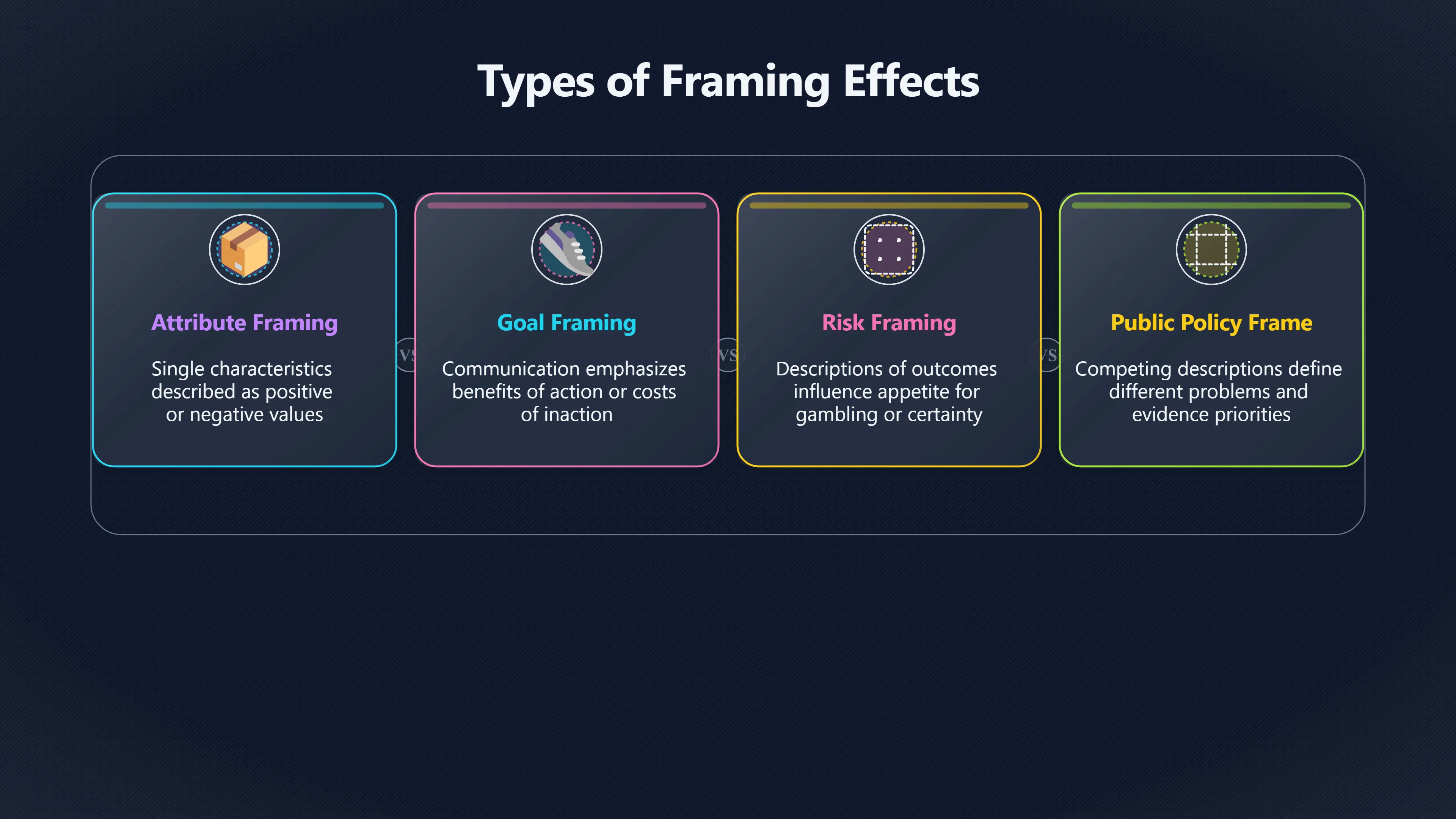
One of the most reliable findings in framing research is that gains and losses alter people’s appetite for risk.
When outcomes are presented as gains, people tend to become relatively risk-averse. Securing a guaranteed benefit often feels preferable to gambling for a larger one.
When outcomes are presented as losses, many people become more willing to gamble. Faced with a certain loss, a risky alternative offering even a small chance of avoiding that loss becomes psychologically attractive.
This pattern follows the broader principles of prospect theory. Losses generally carry greater psychological weight than equivalent gains—a phenomenon often described as loss aversion. Rather than evaluating outcomes in absolute terms, individuals compare them with a reference point and react differently depending on whether they perceive themselves as gaining or losing relative to that point. [PMC]pmc.ncbi.nlm.nih.govRead moreExplaining Risky Choices with Judgments: Framing, the Zero…by VF Reyna · 2021 · Cited by 29 — The original theory of framing effect…
Importantly, this does not mean people always become risk-seeking under loss frames. The magnitude of the framing effect depends on factors such as the probabilities involved, familiarity with the domain, expertise, emotional involvement and whether the equivalence between frames is made explicit. A recent systematic review concludes that risky-choice framing effects are robust but heterogeneous, with considerable variation across experimental conditions and populations. [PMC]pmc.ncbi.nlm.nih.govPMCA systematic review of risky-choice framing effectsNIHby A Kühberger · 2023 · Cited by 31 — Classic explanations of goal-framing effects are inspired by Prospect theory (PT, see belo…
Project failure versus project success questions
Framing does not merely influence final decisions; it changes which evidence people search for and how they interpret the same project.
Consider two apparently similar management questions:
- “How can we maximise the chance this project succeeds?”
- “What is most likely to make this project fail?”
The first frame encourages attention towards opportunities, resources, enabling conditions and examples of success.
The second frame directs attention towards vulnerabilities, bottlenecks, hidden assumptions and failure modes.
Neither question is objectively superior. However, each activates a different mental model. Teams discussing project success frequently generate optimistic evidence about benefits, while teams examining possible failure often identify operational risks that were previously overlooked.
This difference has practical consequences in domains ranging from engineering to healthcare. Safety engineering frequently uses “premortem” thinking—imagining that a project has already failed and asking what caused the failure—not because failure is expected, but because the failure frame reveals evidence that a success frame can suppress. The value comes from expanding the evidence considered rather than replacing one frame with another.
For analytical thinking, the lesson is not to choose one frame permanently but to deliberately compare both before reaching conclusions.
Attribute framing changes evaluations without changing facts
Not every framing effect concerns risky choices. [pmc.ncbi.nlm.nih.gov]pmc.ncbi.nlm.nih.govRead moreExplaining Risky Choices with Judgments: Framing, the Zero…by VF Reyna · 2021 · Cited by 29 — The original theory of framing effect…
Researchers distinguish attribute framing, in which a single characteristic is described positively or negatively despite representing identical information.
Examples include:
- “75% lean beef” versus “25% fat beef.”
- “90% survival rate” versus “10% mortality rate.”
- “95% employment” versus “5% unemployment.”
Although these statements communicate mathematically equivalent information, evaluations often become more favourable under the positive description. Systematic reviews have found consistent evidence that positive attribute framing tends to improve evaluations of products, medical treatments and other objects without altering their underlying characteristics. [PMC]pmc.ncbi.nlm.nih.govIn goal framing, a negatively‐framed messageFraming of health information messages - PMC - NIHby EA Akl · 2011 · Cited by 248 — In attribute framing, attributes are judged more f…
This matters because evaluations often occur before careful numerical analysis. Positive wording can create an initial impression that shapes later interpretation even when people subsequently encounter identical statistics.
Goal framing and behavioural decisions
A related but distinct phenomenon is goal framing, which concerns the consequences of acting or failing to act.
Instead of changing the description of an existing outcome, goal framing changes whether communication emphasises the benefits of performing a behaviour or the costs of failing to perform it.
Examples include:
- “Exercise improves cardiovascular health.”
- “Not exercising increases cardiovascular disease risk.”
Research suggests that gain and loss goal frames do not have universal effects. Their influence depends on the behaviour being promoted. Preventive behaviours such as sunscreen use or healthy eating sometimes respond better to gain frames, whereas detection behaviours such as disease screening may respond differently depending on perceived risk, efficacy and audience characteristics. Reviews of health communication therefore recommend matching the frame to the behavioural context rather than assuming that either positive or negative wording is always superior. [PMC]pmc.ncbi.nlm.nih.govIn goal framing, a negatively‐framed messageFraming of health information messages - PMC - NIHby EA Akl · 2011 · Cited by 248 — In attribute framing, attributes are judged more f…
This illustrates an important analytical principle: framing is not merely persuasive language; it changes which consequences become psychologically salient.
Why public problems change with their frame
Public debates frequently revolve around competing frames rather than disagreements over facts.
A policy may be described as:
- expanding access,
- increasing regulation,
- protecting consumers,
- limiting choice,
- improving public safety,
- reducing individual freedom.
Each description emphasises a different aspect of the same policy.
Consequently, participants often argue using different evidence because each frame implicitly defines a different problem. A discussion framed around public safety naturally prioritises accident statistics and risk reduction. The same discussion framed around personal freedom instead highlights autonomy, proportionality and government intervention.
Political communication researchers therefore distinguish between factual disagreement and framing disagreement. The latter concerns which aspects of reality deserve emphasis, which values become relevant and which comparisons appear appropriate. Behavioural economics similarly notes that framing influences public attitudes towards policies by directing attention towards selected dimensions of complex issues. [BehavioralEconomics.com | The BE Hub]behavioraleconomics.comBehavioral Economics.com | The BE Hub Framing effectThe BE HubFraming effect - BehavioralEconomics.com | The BE Hub4 Dec 2024 — Research has considered how framing affects public opinions o…
Recognising this distinction improves critical thinking because it becomes possible to ask whether people disagree about evidence or merely about which frame they have adopted.
Why framing changes what evidence feels relevant
Framing affects more than preferences; it alters information processing.
Several mechanisms contribute:
- Reference points. People judge outcomes relative to an expected baseline rather than in absolute terms. A gain or loss is experienced relative to that baseline rather than purely numerically. [PMC]pmc.ncbi.nlm.nih.govRead moreExplaining Risky Choices with Judgments: Framing, the Zero…by VF Reyna · 2021 · Cited by 29 — The original theory of framing effect…
- Attention allocation. Frames highlight particular aspects of a situation while leaving others in the background. Once attention is directed towards loss, safety or fairness, supporting evidence for that dimension becomes easier to notice.
- Risk perception. Positive descriptions often encourage preserving certainty, whereas negative descriptions can make uncertain alternatives appear worth pursuing.
- Interpretive shortcuts. Frames provide an immediate story about what matters before detailed analysis begins. People often accept that initial interpretation unless they deliberately examine alternatives.
Modern experimental work continues to investigate these mechanisms, including how experience, repeated decisions and individual differences moderate framing effects. Although framing remains one of the most replicated findings in decision research, researchers increasingly recognise that its magnitude varies with task design, expertise and contextual factors rather than representing an unavoidable bias of identical strength in every situation. [PMC]pmc.ncbi.nlm.nih.govInvestigating and Modeling the Effect of Framing, Experience…by S Uttrani · 2022 — One example of preference reversal is the framin…
How to reduce framing errors during evidence gathering
Framing effects cannot be eliminated completely, but they can be reduced through disciplined question design.
A practical approach is to ask the same question under multiple equivalent frames before collecting evidence.
Instead of asking only:
- “What are the benefits?”
also ask:
- “What losses are we trying to avoid?”
Instead of asking:
- “Why is this policy effective?”
also ask:
- “Under what circumstances would this policy fail?”
Similarly, whenever percentages are presented, convert between complementary descriptions. Translate “95% success” into “5% failure”, or vice versa, to check whether your emotional reaction changes despite identical statistics.
Another useful technique is to identify the hidden reference point. Ask:
- Compared with what?
- Relative to which alternative?
- Success for whom?
- Loss relative to which baseline?
These questions expose assumptions embedded within the frame before they influence interpretation.
Finally, separate evidence from presentation. If changing only the wording changes your preferred option, the decision may be responding to framing rather than to genuinely new information.

What framing teaches about analytical thinking
Framing effects demonstrate that evidence never arrives in a psychological vacuum. Facts acquire meaning through the questions used to present them, the comparisons implied by those questions and the reference points they establish. Two mathematically equivalent descriptions can lead thoughtful people towards different conclusions because they highlight different risks, values and expectations.
For analytical thinking, the central lesson is therefore not to eliminate framing but to inspect it deliberately. Before deciding which evidence is convincing, examine how the question defines success, failure, gains, losses and comparison points. Reframing the same evidence from multiple perspectives does not weaken analysis; it strengthens it by revealing assumptions that a single frame leaves invisible.
Amazon book picks
Further Reading
Books and field guides related to How Framing Changes What Evidence Means. Use these as the next step if you want deeper reading beyond the article.
Thinking, Fast and Slow
Explains framing effects, heuristics, and judgment under uncertainty central to the page.
The Art of Thinking Clearly
Includes practical discussions of framing and other biases that distort evidence evaluation.
The Undoing Project
Tells the story of Kahneman and Tversky, whose work established framing effects.
Nudge
Shows how presentation and choice architecture influence decisions through framing and related effects.
eBay marketplace picks
Marketplace Samples
Live-tested eBay searches with available results related to this page.



Endnotes
-
Source: pmc.ncbi.nlm.nih.gov
Title: Read more
Link: https://pmc.ncbi.nlm.nih.gov/articles/PMC8563093/Source snippet
Explaining Risky Choices with Judgments: Framing, the Zero...by VF Reyna · 2021 · Cited by 29 — The original theory of framing effect...
-
Source: pmc.ncbi.nlm.nih.gov
Title: In goal framing, a negatively‐framed message
Link: https://pmc.ncbi.nlm.nih.gov/articles/PMC12926860/Source snippet
Framing of health information messages - PMC - NIHby EA Akl · 2011 · Cited by 248 — In attribute framing, attributes are judged more f...
-
Source: behavioraleconomics.com
Title: Behavioral Economics.com | The BE Hub Framing effect
Link: https://www.behavioraleconomics.com/resources/mini-encyclopedia-of-be/framing-effect/Source snippet
The BE HubFraming effect - BehavioralEconomics.com | The BE Hub4 Dec 2024 — Research has considered how framing affects public opinions o...
-
Source: pmc.ncbi.nlm.nih.gov
Link: https://pmc.ncbi.nlm.nih.gov/articles/PMC9115510/Source snippet
Investigating and Modeling the Effect of Framing, Experience...by S Uttrani · 2022 — One example of preference reversal is the framin...
-
Source: pubmed.ncbi.nlm.nih.gov
Link: https://pubmed.ncbi.nlm.nih.gov/7455683/Source snippet
The dependence of preferences on the...
-
Source: pmc.ncbi.nlm.nih.gov
Title: PMCA systematic review of risky-choice framing effects
Link: https://pmc.ncbi.nlm.nih.gov/articles/PMC10620856/Source snippet
NIHby A Kühberger · 2023 · Cited by 31 — Classic explanations of goal-framing effects are inspired by Prospect theory (PT, see belo...
-
Source: pmc.ncbi.nlm.nih.gov
Link: https://pmc.ncbi.nlm.nih.gov/articles/PMC10508293/Source snippet
the influence of message framing in persuasive...by NR Gier · 2023 · Cited by 24 — Message framing (or goal framing), meaning to present...
-
Source: dictionary.cambridge.org
Link: https://dictionary.cambridge.org/dictionary/english/attributeSource snippet
English meaning - Cambridge DictionaryATTRIBUTE definition: 1. a quality or characteristic that someone or something has: 2. a quality...
-
Source: Wikipedia
Link: https://en.wikipedia.org/wiki/AttributeSource snippet
AttributeAttribute (computing), a specification that defines a property of an object, element, or file; Attribute (knowledge represent...
-
Source: vocabulary.com
Link: https://www.vocabulary.com/dictionary/attributeSource snippet
Definition, Meaning & SynonymsAn attribute is a quality or characteristic given to a person, group, or some other thing. Your best attrib...
Additional References
-
Source: researchgate.net
Link: https://www.researchgate.net/publication/233894741_An_Examination_of_Consumer_Responses_Toward_Attribute-_and_Goal-Framed_MessagesSource snippet
An Examination of Consumer Responses Toward AttributeThe combined results of four independent studies show that positive attribute frames...
-
Source: pure.uva.nl
Link: https://pure.uva.nl/ws/files/63249396/Prospect_Theory_in_Times_of_a_Pandemic_The_Effects_of_Gain_versus_Loss_Framing_on_Risky_Choices_and_Emotional_Responses_during_the_2020_Coronavirus.pdfSource snippet
effects of gain versus loss framing on risky choices and...Prospect theory (Kahneman & Tversky, 1979; Tversky & Kahneman, 1981) specifi...
-
Source: unitesi.unive.it
Link: https://unitesi.unive.it/retrieve/f5e2e059-c157-43f8-9e89-0fea03362e74/886804-1271456.pdfSource snippet
case of the Covid-19 pandemicDifferent types of framing. There are mainly three kind of framing effects, that are: the primacy effect, th...
-
Source: merriam-webster.com
Link: https://www.merriam-webster.com/dictionary/attribute -
Source: blogs.lse.ac.uk
Link: https://blogs.lse.ac.uk/politicsandpolicy/changing-the-message-to-change-the-response-psychological-framing-effects-during-covid-19/Source snippet
framing effects during COVID-1917 Jul 2020 — While preventing death and saving life are two sides of the same coin, 'prevent a death' tri...
-
Source: asahp.org
Title: obtainable resources knwnz atye7 zwrsl 82t7d ac9ac td6e8 el4zw 3sft8 l4zea cnajl
Link: https://www.asahp.org/trends-test-1/2021/5/18/obtainable-resources-knwnz-atye7-zwrsl-82t7d-ac9ac-td6e8-el4zw-3sft8-l4zea-cnajlSource snippet
IMPORTANCE OF ACCURATE FRAMINGAug 18, 2021 —... lives saved and in the other by the number of lives lost. Kahneman's doctorate is from B...
-
Source: fermatslibrary.com
Link: https://fermatslibrary.com/s/the-framing-of-decisions-and-the-psychology-of-choiceSource snippet
Tversky. and Daniel Kahneman; people's choices, in everyday life as well. as in the social sciences, are often found-. ed on the assumpt...
-
Source: psicothema.com
Link: https://www.psicothema.com/pii?pii=3107Source snippet
the latter does not involve risk manipulation, and the task goal does not consist...
-
Source: simplypsychology.org
Link: https://www.simplypsychology.org/framing-effect.htmlSource snippet
y to a particular decision depending on how it's presented.Read more...
-
Source: collinsdictionary.com
Link: https://www.collinsdictionary.com/dictionary/english-korean/attributeSource snippet
tion. ~에 원인을 돌리다. The quarterback attributes the...Read more...
Topic Tree