Within Sharper Thinking
Practice Thinking on Real Problems
Analytical skill grows faster when practice uses real problems with consequences, constraints, and feedback.
On this page
- Why realistic problems teach more
- Choosing problems worth analysing
- Getting feedback from real outcomes
Page outline Jump by section
Introduction
Real-problem practice means improving analytical skill by working on problems that resemble the situations where the skill will actually be used: incomplete information, trade-offs, deadlines, consequences, stakeholders and feedback. Thinking exercises still have a place, because they can teach useful moves such as spotting assumptions or comparing explanations. But analytical skill grows faster when those moves are repeatedly used on live or realistic problems where the answer is not pre-labelled and where later evidence can show whether the reasoning held up.
The practical lesson is simple: do not practise “thinking” only as a detached mental puzzle. Practise making judgements, explaining them, acting on them where appropriate, and reviewing what happened. Research on learning transfer, problem-based learning, critical-thinking instruction and expert judgement all points in the same direction: skills become usable when learners connect knowledge to context, receive feedback, and revisit decisions rather than merely completing isolated exercises. The National Academies’ learning research defines transfer as the ability to extend what is learned in one context to new contexts, which is exactly the gap that real-problem practice is meant to close.[National Academies]nationalacademies.orgNational AcademiesChapter: 3 Learning and TransferProcesses of learning and the transfer of learning are central to understanding how peo…
Why realistic problems teach more
A thinking exercise can train a narrow subskill: identify a fallacy, solve a logic puzzle, summarise an argument, or list pros and cons. Those drills can be useful, especially for beginners. Their weakness is that they often remove the very features that make real analysis hard: ambiguous goals, missing data, social pressure, competing values, noisy feedback and the possibility of being wrong in a consequential way.
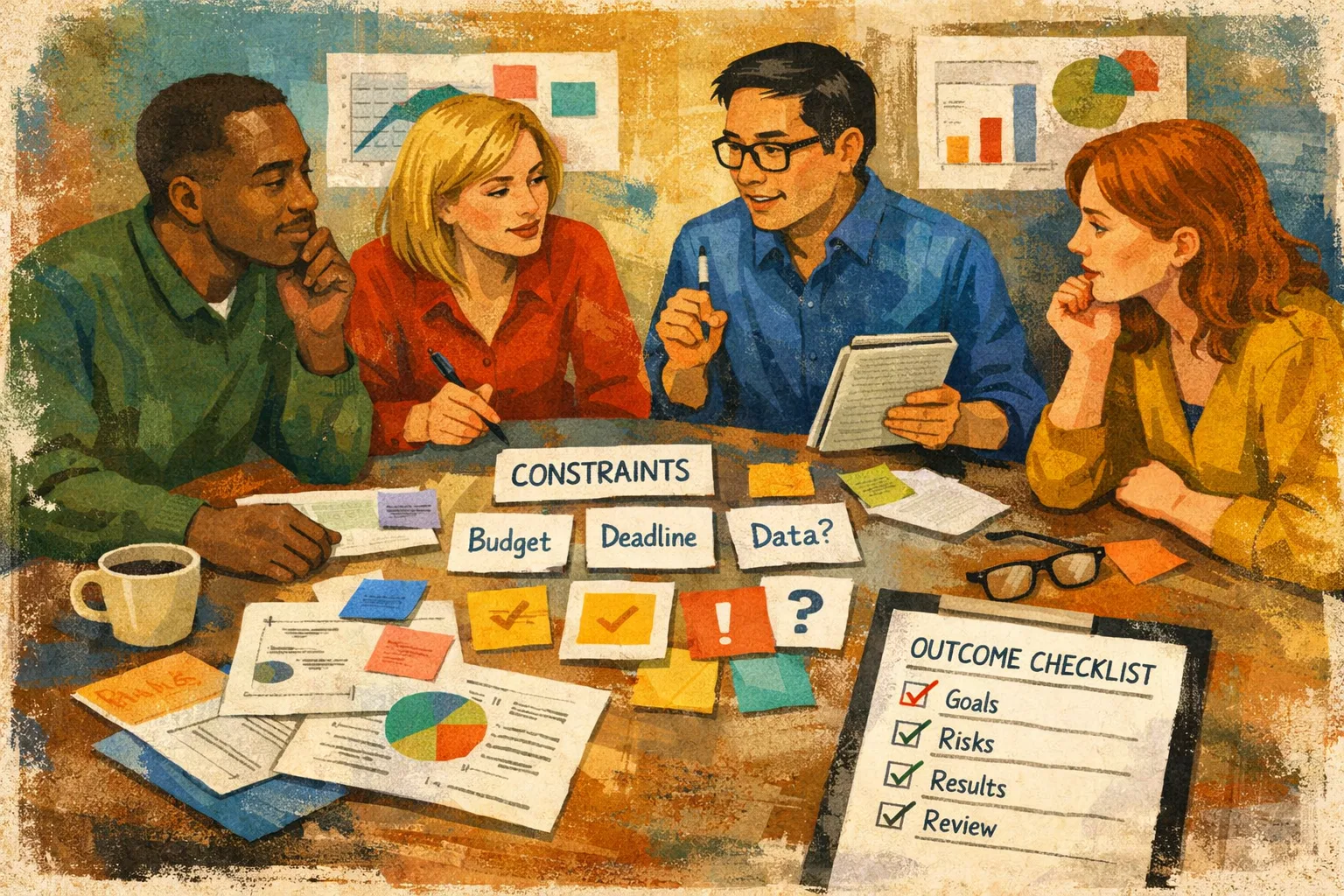
Realistic problems force the learner to practise the full chain of analysis. A manager deciding whether to delay a product launch must define the real question, separate evidence from reassurance, weigh customer harm against commercial pressure, decide what information is still worth collecting, and later compare the outcome with the original reasoning. A student investigating a local environmental issue must decide which data are trustworthy, what alternative explanations exist, and how uncertainty should affect recommendations. These are not just “thinking skills” in the abstract; they are thinking skills under constraint.
Learning science helps explain why this matters. The National Academies’ work on learning and transfer emphasises that people do not automatically apply something learned in one setting to another; transfer depends on depth of understanding, relevant context and the ability to recognise when prior knowledge applies.[National Academies]nationalacademies.orgNational AcademiesChapter: 3 Learning and TransferProcesses of learning and the transfer of learning are central to understanding how peo… A learner who has only practised tidy exercises may know the vocabulary of good reasoning but fail to recognise the same reasoning demand in a messy meeting, a data dashboard, a budget choice or a public claim.
Problem-based learning is one major educational response to this issue. Maastricht University describes its problem-based learning model as students working in small groups to solve complex, real-world problems, with guidance, feedback and assessment built into the process.[Maastricht University]maastrichtuniversity.nlMaastricht UniversityProblem-Based LearningAt Maastricht University, students learn by working in small groups to solve complex, real-wor… A 2023 systematic review in Frontiers in Education found that adaptations of problem-based learning aimed at critical thinking commonly use real or realistic problems, structured collaboration, questioning and reflection to make the thinking process more explicit.[Frontiers]frontiersin.orgFrontiers The critical thinking-oriented adaptations of problem-basedFrontiers The critical thinking-oriented adaptations of problem-based The point is not that every exercise must become a large project. It is that analytical practice becomes more powerful when it resembles the conditions under which the skill must later perform.
The missing ingredient is feedback from reality
Real problems are useful not merely because they feel more authentic, but because they can produce feedback. Without feedback, people can become more fluent at explaining themselves without becoming more accurate. They may learn to sound analytical while protecting the same weak assumptions.
Daniel Kahneman and Gary Klein’s influential paper on intuitive expertise drew a boundary between trustworthy expertise and overconfident judgement. They argued that professional intuition is more likely to be reliable in environments with valid cues and opportunities for timely feedback; without those conditions, experience can produce confidence without skill.[PubMed]pubmed.ncbi.nlm.nih.govConditions for intuitive expertise: a failure to disagreeby D Kahneman · 2009 · Cited by 4056 — This article reports on an effort t… That insight applies directly to analytical practice. A person improves faster when they can compare “what I expected” with “what actually happened” and then inspect the gap.
The strongest practice loop has four parts:
- Make a prediction or judgement before the outcome is known. Write down the expected result, the key reasons and the confidence level.
- Act or recommend under real constraints. Include time, cost, uncertainty and stakeholder limits instead of pretending the problem is frictionless.
- Collect outcome feedback. Look for what happened, what changed, and which assumptions mattered.
- Review the reasoning, not just the result. A good outcome can come from poor reasoning, and a bad outcome can follow a reasonable decision under uncertainty.
This is where real-problem practice differs from simply “getting experience”. Experience alone may repeat the same habits. Deliberate practice research stresses focused goals and feedback rather than repetition for its own sake. Ericsson’s account of deliberate practice emphasises tasks designed to improve performance, often with repeated attempts and feedback on specific weaknesses.[Frontiers]frontiersin.orgOpen source on frontiersin.org. For analytical skills, that means designing practice around decisions where the learner can later ask: Was the question framed well? Did the evidence support the conclusion? Were alternatives considered? Did the strongest assumption survive contact with reality?
A useful example comes from physics education. Holmes, Wieman and Bonn argued that quantitative critical thinking requires repeated practice in making decisions based on data, with feedback on those decisions. In their introductory physics lab intervention, students repeatedly made and acted on comparisons between datasets and models; after support was faded, they were far more likely than a control group to improve experimental methods and identify limitations in a model using data.[PubMed]pubmed.ncbi.nlm.nih.govOpen source on nih.gov. The lesson travels beyond physics: learners need repeated chances to make evidence-based judgements, not just hear that evidence-based judgement is important.

Choosing problems worth analysing
Not every real problem is a good practice problem. Some are too vague, too political, too risky, or too slow to produce useful feedback. Good real-problem practice sits in the middle: realistic enough to matter, bounded enough to analyse, and feedback-rich enough to learn from.
A strong practice problem usually has these features:
- A real decision or recommendation. The output should be more than an opinion. It might be a prioritised plan, a diagnosis of a failure, a forecast, a policy recommendation, a design choice or a risk assessment.
- Visible constraints. Time, budget, ethics, data access, competing goals and implementation limits should be part of the problem, not added afterwards.
- Multiple plausible explanations. If the answer is obvious, the task becomes execution rather than analysis.
- A feedback path. The learner should be able to check later whether the judgement was useful, incomplete, misleading or overtaken by new information.
- A safe level of consequence. Practice should matter, but early practice should not expose people to irreversible harm.
This is why authentic assessment has become important in education. A systematic review of authentic assessment in higher education describes it as using real-world tasks to evaluate knowledge, skills and attitudes in ways that replicate situations where those abilities would be used.[Erasmus University Rotterdam]eur.nlOpen source on eur.nl. The University of Hull similarly describes authentic assessment as open-ended tasks requiring learners to produce a response, performance or product in a real-world or realistic context.[University of Hull]hull.ac.ukOpen source on hull.ac.uk. For analytical skill, the assessment format matters because the assessment tells learners what kind of thinking is valued. If tests reward only recall or formula selection, learners may not practise framing, judgement and evidence use.
The best practice problems often come from ordinary work and study rather than special training material. Examples include:
- Before a meeting: analyse the decision that is actually being made, list the live options, and identify the evidence that would change the recommendation.
- After a project delay: compare at least three possible causes, distinguish controllable from uncontrollable factors, and identify one process change to test.
- When reading a report: write a short “confidence note” stating which claims are well supported, which rely on assumptions, and what would weaken the conclusion.
- When choosing between tools or vendors: define decision criteria before comparing options, then revisit whether the chosen criteria predicted satisfaction.
- When studying a subject: replace some end-of-chapter questions with an applied case where the learner must decide which concepts are relevant.
These are small interventions, but they change the nature of practice. The learner is no longer just completing a task; they are rehearsing the kind of judgement they want to improve.
Thinking exercises still help, but they should feed real use
The choice is not “real problems or thinking exercises”. The better distinction is between exercises that remain detached and exercises that prepare the learner for real analysis. Thinking routines, logic drills, argument maps and checklists can all be useful when they make reasoning visible and reduce avoidable errors.
Harvard Project Zero describes thinking routines as short sequences of questions or steps that help reveal thinking and make particular “thinking moves” more available in other contexts.[Project Zero]pz.harvard.eduOpen source on harvard.edu. Routines such as “What do you see? What do you think? What do you wonder?” are not substitutes for real-world judgement, but they can slow down observation and interpretation before a learner jumps to a conclusion.[Project Zero]pz.harvard.eduOpen source on harvard.edu. Used well, such routines become scaffolding: they support real-problem practice until the learner can apply the moves without the prompt.
The risk is that exercises become a performance of thoughtfulness. A group can fill in a template, name assumptions and produce a neat reflection without ever testing whether the analysis improves decisions. This is a common weakness of generic critical-thinking training: learners may enjoy the language of reasoning but fail to transfer it to the messy contexts where it matters. Abrami and colleagues’ meta-analysis of critical-thinking instruction found positive effects overall, but the broader message is that instruction works best when critical thinking is explicitly taught and practised rather than merely hoped for.[Sage Journals]journals.sagepub.comOpen source on sagepub.com.
A useful implementation rule is: teach the move in a simple exercise, then require it in a real problem soon afterwards. For example, do not stop at teaching “consider alternatives” through a worksheet. Apply it to a real hiring decision, a project risk, a research interpretation or a personal finance choice. Do not stop at “identify assumptions” in an argument. Apply it to a forecast where those assumptions can be checked later.
How to build real-problem practice into a week
Real-problem practice works best when it is ordinary and repeated. A person does not need a dramatic life decision every week. The aim is to create a steady rhythm of small analytical bets, feedback and review.
One practical weekly structure is:
- Pick one live problem. Choose something real but bounded: a decision, a confusing result, a stalled plan, a claim worth checking, or a trade-off you actually face.
- Write the question precisely. Replace “What should we do?” with “Which option is most likely to achieve this outcome within these constraints?”
- State the current best answer. Include the evidence, the alternatives and the weakest assumption.
- Decide what feedback would count. Define what you will review later: cost, time saved, error rate, stakeholder response, forecast accuracy, learning gained or another relevant signal.
- Review after the outcome. Ask what you got right, what you missed, and what you would do differently next time.
The review should be short but honest. A useful format is: “I expected X because Y. What happened was Z. The main difference was A. Next time I will check B earlier.” This turns experience into a learning loop.
Workplaces can make this routine more powerful by normalising after-action reviews rather than treating review as blame. The CIPD’s evidence review on performance feedback stresses that feedback should be prepared, actionable and responsive to how people receive it.[CIPD]cipd.orgPerformance feedback: an evidence reviewPerformance feedback: an evidence review For analytical development, feedback is most useful when it addresses the reasoning process: framing, evidence, alternatives, uncertainty and follow-through. “Good job” and “that was wrong” are too blunt to teach much.
Education settings can do the same by replacing some artificial tasks with authentic outputs: policy briefs, design proposals, data-based recommendations, case analyses, public explanations, portfolios and reflective decision logs. The RAND Corporation’s work on deeper learning notes that project-based learning asks students to investigate real-world problems over extended periods and is commonly used to cultivate skills such as critical thinking.[RAND Corporation]rand.orgCorporation Encouraging Deeper Learning in Middle and High SchoolCorporation Encouraging Deeper Learning in Middle and High School The implementation challenge is to keep projects analytically disciplined. A project that is creative but never asks students to justify evidence, compare alternatives or revise conclusions may be engaging without being strong analytical practice.
The common failure modes
Real-problem practice can fail if “real” becomes an excuse for unstructured activity. Messy problems teach more only when learners have enough support to notice what they are supposed to learn.
One failure mode is too much complexity too soon. Beginners can drown in a real problem if they lack basic concepts or examples. The solution is not to retreat entirely to abstract exercises, but to scaffold the real problem: narrow the question, provide initial data, model one analysis, or focus on one decision point.
Another failure mode is feedback that arrives too late or too noisily. Some important decisions, such as career choices or long-term investments, may take years to evaluate and have many confounding factors. For practice, it helps to choose shorter feedback loops: forecasts over weeks rather than years, pilot projects rather than full roll-outs, draft recommendations before final decisions, or small experiments before major commitments.
A third failure mode is confusing outcome quality with reasoning quality. Real outcomes contain luck. A poor decision can work out, and a strong decision can fail. That is why review should examine both process and result: Did the reasoning use the best available evidence? Were uncertainties stated? Were alternatives fairly compared? Was the decision updated when new information appeared?
A fourth failure mode is using real problems only to confirm status or authority. In organisations, “real-world experience” can become a shield against challenge: “I know because I’ve done this for years.” Kahneman and Klein’s boundary condition matters here. Experience is most trustworthy where the environment gives valid cues and good feedback; otherwise, repeated exposure can reinforce confident error.[PubMed]pubmed.ncbi.nlm.nih.govConditions for intuitive expertise: a failure to disagreeby D Kahneman · 2009 · Cited by 4056 — This article reports on an effort t…
What changes when practice becomes real
The main benefit of real-problem practice is transfer. Learners stop treating analytical thinking as a school-like performance and start using it as a way to handle uncertainty. They become more likely to ask better questions before gathering evidence, notice when a problem has been framed too narrowly, compare live alternatives, make uncertainty explicit, and learn from outcomes.
This also changes motivation. Abstract thinking exercises can feel like hygiene: useful, but detached. Real problems carry stakes. A better analysis may save time, prevent a bad decision, improve a design, clarify a dispute, or protect people from avoidable harm. That does not mean every practice task should be high-pressure. It means the learner can see why the thinking matters.
The most effective approach is therefore a blend. Use thinking exercises to teach specific moves. Use realistic cases to combine those moves. Use real problems to test whether the skill survives constraints, consequences and feedback. Analytical skill is not built by thinking about thinking alone; it is built by repeatedly bringing thought into contact with the world and learning from the collision.
Amazon book picks
Further Reading
Books and field guides related to Practice Thinking on Real Problems. Use these as the next step if you want deeper reading beyond the article.
Superforecasting
Demonstrates how repeated prediction, feedback and real-world evaluation improve judgement.
Thinking, Fast and Slow
Explains common reasoning errors and how better judgement develops through practice and reflection.
How to Solve It
Provides enduring methods for approaching unfamiliar real problems systematically.
The Art of Thinking Clearly
Introduces practical cognitive biases that arise in everyday decisions.
eBay marketplace picks
Marketplace Samples
Live-tested eBay searches with available results related to this page.



Endnotes
1.
Source: pz.harvard.edu
Link:https://pz.harvard.edu/thinking-routines
2.
Source: pz.harvard.edu
Link:https://pz.harvard.edu/resources/see-think-wonder
3.
Source: cipd.org
Title: Performance feedback: an evidence review
Link:https://www.cipd.org/globalassets/media/knowledge/knowledge-hub/evidence-reviews/performance-feedback-evidence-review_tcm18-111378.pdf
4.
Source: rand.org
Title: Corporation Encouraging Deeper Learning in Middle and High School
Link:https://www.rand.org/content/dam/rand/pubs/research_reports/RRA900/RRA956-28/RAND_RRA956-28.pdf
5.
Source: pz.harvard.edu
Title: i used think now i think
Link:https://pz.harvard.edu/resources/i-used-think-now-i-think
6.
Source: americanenglish.state.gov
Title: 17.2 presentation slides final version for website
Link:https://americanenglish.state.gov/files/ae/resource_files/17.2presentation_slides-_final_version_for_website.pdf
7.
Source: nationalacademies.org
Link:https://www.nationalacademies.org/read/9853/chapter/6
Source snippet
National AcademiesChapter: 3 Learning and TransferProcesses of learning and the transfer of learning are central to understanding how peo...
8.
Source: maastrichtuniversity.nl
Link:https://www.maastrichtuniversity.nl/over-de-um/onderwijs-aan-de-um/problem-based-learning
Source snippet
Maastricht UniversityProblem-Based LearningAt Maastricht University, students learn by working in small groups to solve complex, real-wor...
9.
Source: frontiersin.org
Title: Frontiers The critical thinking-oriented adaptations of problem-based
Link:https://www.frontiersin.org/journals/education/articles/10.3389/feduc.2023.1139987/full
Published: May 24, 2023
10.
Source: pubmed.ncbi.nlm.nih.gov
Link:https://pubmed.ncbi.nlm.nih.gov/19739881/
Source snippet
Conditions for intuitive expertise: a failure to disagreeby D Kahneman · 2009 · Cited by 4056 — This article reports on an effort t...
11.
Source: frontiersin.org
Link:https://www.frontiersin.org/journals/psychology/articles/10.3389/fpsyg.2019.02396/full
12.
Source: pubmed.ncbi.nlm.nih.gov
Link:https://pubmed.ncbi.nlm.nih.gov/26283351/
13.
Source: eur.nl
Link:https://www.eur.nl/media/124635
14.
Source: hull.ac.uk
Link:https://www.hull.ac.uk/asset-library/docs/authentic-assessment-copy.pdf
15.
Source: journals.sagepub.com
Link:https://journals.sagepub.com/doi/abs/10.3102/0034654314551063
16.
Source: pmc.ncbi.nlm.nih.gov
Link:https://pmc.ncbi.nlm.nih.gov/articles/PMC8059994/
17.
Source: pmc.ncbi.nlm.nih.gov
Link:https://pmc.ncbi.nlm.nih.gov/articles/PMC6460682/
18.
Source: pmc.ncbi.nlm.nih.gov
Link:https://pmc.ncbi.nlm.nih.gov/articles/PMC12246200/
19.
Source: pmc.ncbi.nlm.nih.gov
Link:https://pmc.ncbi.nlm.nih.gov/articles/PMC10646338/
20.
Source: pmc.ncbi.nlm.nih.gov
Link:https://pmc.ncbi.nlm.nih.gov/articles/PMC13056334/
21.
Source: pmc.ncbi.nlm.nih.gov
Link:https://pmc.ncbi.nlm.nih.gov/articles/PMC7461852/
22.
Source: pmc.ncbi.nlm.nih.gov
Link:https://pmc.ncbi.nlm.nih.gov/articles/PMC9868728/
23.
Source: structural-learning.com
Title: deliberate practice
Link:https://www.structural-learning.com/post/deliberate-practice
24.
Source: frontiersin.org
Link:https://www.frontiersin.org/journals/education/articles/10.3389/feduc.2026.1689765/full
25.
Source: web.mit.edu
Link:https://web.mit.edu/6.969/www/readings/expertise.pdf
Additional References
26.
Source: youtube.com
Link:https://www.youtube.com/watch?v=1hbbaId69i8
Source snippet
How to find simplicity on the other side of complexity: The cognitive theory of multimedia learning...
27.
Source: youtube.com
Title: What Is the Importance of Problem-Based Learning in Adult Education?
Link:https://www.youtube.com/watch?v=HS5VTsJlX0Y
Source snippet
Lesson 6 | Problem-Based vs Project-Based Learning | Technology for Teaching and Learning II...
28.
Source: youtube.com
Link:https://www.youtube.com/watch?v=tUY21SiZON4
Source snippet
Webinar: Find and Fix Skills Gaps with Inbox Simulations...
29.
Source: youtube.com
Title: CE The Big Shift: From Schooling to Authentic Learning
Link:https://www.youtube.com/watch?v=yzVSTVZ5XaQ
Source snippet
What Is the Importance of Problem-Based Learning in Adult Education?...
30.
Source: researchgate.net
Link:https://www.researchgate.net/publication/26798603_Conditions_for_Intuitive_Expertise
31.
Source: researchgate.net
Link:https://www.researchgate.net/publication/387979612_Critical_Thinking_in_Authentic_Assessment_An_Exploration_into_Argumentative_Writing_Non-English_Department_in_Higher_Education
32.
Source: researchgate.net
Link:https://www.researchgate.net/publication/390649459_John_D_Bransford_Ann_L_Brown_Rodney_R_Cocking_How_People_Learn_Vol_11_Washington_DC_Publisher_National_Academy_Press_2000
33.
Source: researchgate.net
Link:https://www.researchgate.net/publication/396256382_Problem-Based_Learning_PBL_in_Action_Fostering_Critical_Thinking_Among_Middle_School_Students
34.
Source: aft.org
Link:https://www.aft.org/ae/fall2020/willingham
35.
Source: learningfocused.com
Link:https://learningfocused.com/blogs/lesson-planning/increasing-critical-thinking-in-education-a-pathway-to-preparing-students-for-the-future?srsltid=AfmBOooDStFd_y3_BBCIi4z3pJbBbPL5xp2wX_ye7xSue1-0OWkCwIxl
Topic Tree
Follow this branch
Parent topic
Sharper ThinkingRelated pages 29
- Assessment Assess the thinking you actually want
- Feedback Loops Why feedback turns practice into better judgement
- Good Problems What makes a problem worth practising on?
- Prediction Notes Write predictions before the outcome arrives
- Problem Based Learning How problem based learning trains judgement
- +1 more in sidebar