Within Real Practice
How problem based learning trains judgement
Problem-based learning uses complex, real-world tasks to make reasoning visible through collaboration, questioning and feedback.
On this page
- Start with a realistic problem rather than a lecture
- Use group questioning to expose assumptions
- Build reflection and feedback into the task
Page outline Jump by section
Introduction
Problem-based learning (PBL) trains judgement by making learners practise thinking inside realistic problems rather than after a lecture has already simplified the situation. A PBL task starts with an open-ended case, asks students to work out what they know and do not know, and uses group questioning, self-directed research and feedback to make reasoning visible. That matters because analytical skill is not just knowing concepts; it is recognising which concepts apply when evidence is incomplete, goals conflict and assumptions need testing.
 PBL began as a response to abstract, memorisation-heavy professional education, especially in medicine, and has since spread across universities, schools and professional training. Its strongest value is not that it magically replaces instruction, but that it gives learners structured practice in applying knowledge to messy situations. Reviews and trials generally find benefits for problem-solving, self-directed learning, collaboration and critical thinking, while also showing that outcomes depend on design, facilitation and learner readiness. [Springer+2PLOS]link.springer.comEffectiveness of problem-based learning methodology in undergraduate medical education: a scoping review | BMC Medical Education…
Start with a realistic problem rather than a lecture
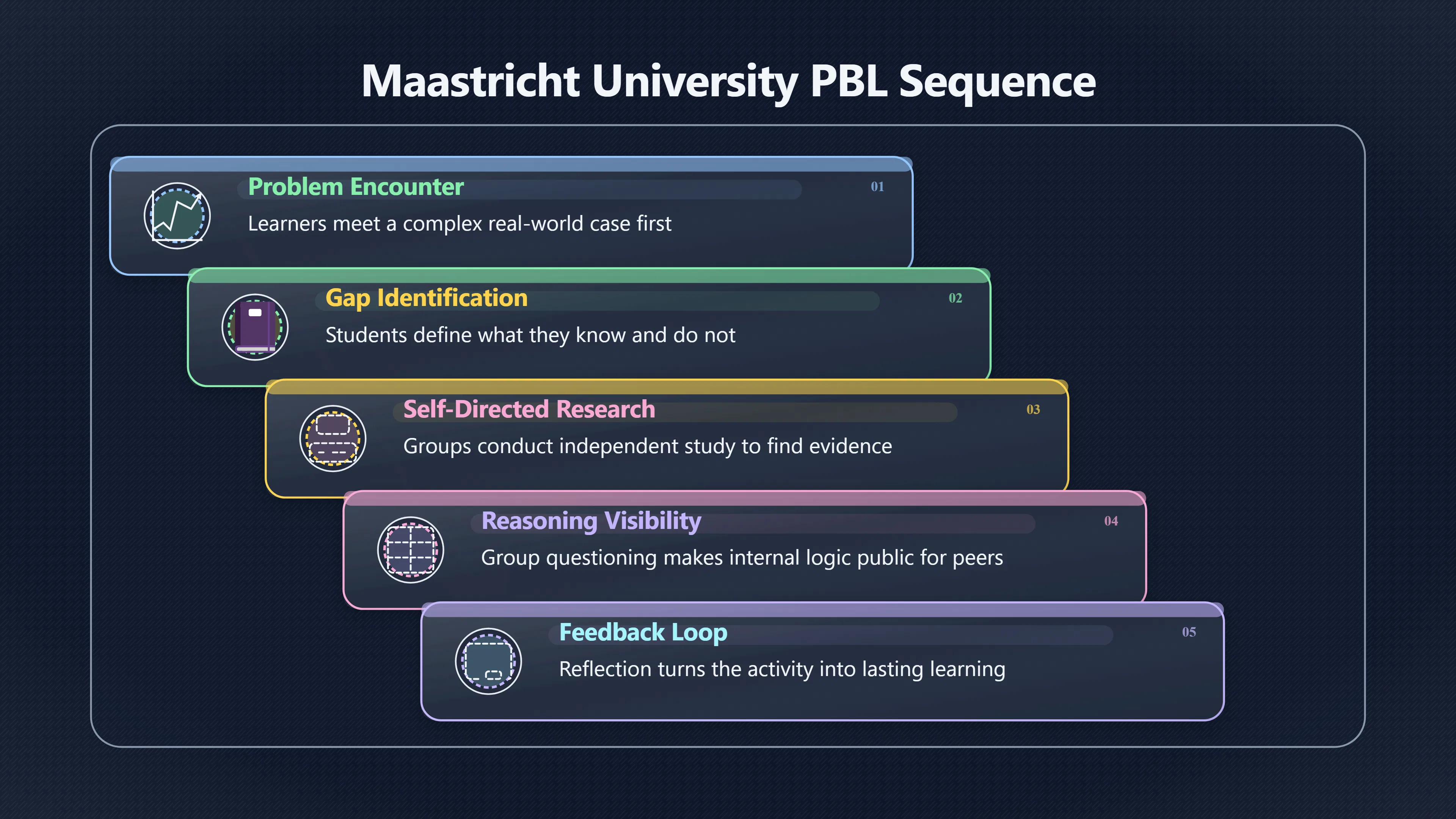
In traditional teaching, students often receive the explanation first and the application later. PBL reverses that order. Learners meet a problem before they have been handed all the relevant concepts, so they must define the issue, generate questions, identify knowledge gaps and decide what evidence would help.
That sequence is the point. Maastricht University, one of the best-known institutional users of PBL, describes its model as built on constructive, contextual, collaborative and self-directed learning; students work with complex, real-world problems and are expected to analyse sources, compare viewpoints, ask critical questions and use logical reasoning. [Maastricht University]maastrichtuniversity.nlMaastricht University Problem-Based LearningMaastricht University Problem-Based Learning
A good PBL problem is not just a word problem with a story attached. It should be realistic enough to force judgement. A medical student may be given a patient case with ambiguous symptoms. A public policy class may investigate why a local service is failing despite apparently adequate funding. A business ethics class may have to recommend an action when legal, reputational and human consequences pull in different directions.
The analytical practice comes from the uncertainty:
- learners must separate facts from assumptions;
- they must decide which missing information matters most;
- they must compare explanations rather than grab the first plausible one;
- they must justify recommendations to other people; and
- they must update their view when new evidence appears.
This is why PBL belongs within real-problem practice rather than thinking exercises alone. It does not merely ask students to “think critically” as an abstract instruction. It gives them a concrete situation in which weak definitions, hidden assumptions and unsupported claims become visible because they block progress.
Group questioning exposes hidden assumptions
The small-group discussion is not a decorative feature of PBL. It is one of the main mechanisms by which judgement is trained. When learners explain their thinking to peers, they have to make their reasoning public. Other people can then ask whether the evidence really supports the claim, whether an alternative explanation fits better, or whether the group has ignored a stakeholder or constraint.
Cindy Hmelo-Silver’s widely cited review argues that PBL aims to develop flexible knowledge, problem-solving skill, self-directed learning, collaboration and motivation. It also stresses that the facilitator is critical: good problems are necessary, but not sufficient. The facilitator models useful thinking strategies, asks metacognitive questions and encourages students to justify and reflect on their reasoning. [Springer]link.springer.comOpen source on springer.com.
This is where PBL differs from unguided group work. In a weak version, confident students dominate, the group rushes to a solution, and assumptions go unchallenged. In a strong version, the facilitator repeatedly redirects attention to reasoning:
- “What evidence makes that explanation more likely?”
- “What would we expect to see if the opposite were true?”
- “Which part of this answer are we least sure about?”
- “Are we solving the stated problem or the easier problem we prefer?”
- “What should we learn before making a recommendation?”
These questions matter because they teach learners to monitor their own thought process. Over time, the external questioning of the tutor or group can become an internal habit: before accepting a conclusion, the learner checks assumptions, evidence and alternatives.
Reflection and feedback turn activity into learning
PBL is sometimes misunderstood as “learning by doing”. Doing alone is not enough. The learning comes from a cycle: attempt the problem, make reasoning explicit, seek information, test explanations, receive feedback and reflect on what changed.
This feedback loop is especially important for analytical skills. A learner can sound persuasive while being wrong. PBL reduces that risk when it requires students to compare their early hypotheses with later evidence, inspect why their thinking changed, and notice whether they overlooked a cue, trusted a weak source or framed the problem too narrowly.
In pharmacy education, a 2024 randomised controlled trial and meta-analysis found that PBL students scored higher than lecture-based students on problem-solving, self-directed learning, communication skills and critical thinking, while the meta-analysis found significant gains in problem-solving and self-directed learning but no significant difference in final exam scores. That distinction is useful: PBL may be strongest for applied judgement and learning behaviours, not necessarily for every conventional test outcome. [PLOS]journals.plos.orgThe effect of problem-based learning on improving problem-solving, self-directed learning, and critical thinking ability for the phar…
A 2022 scoping review of undergraduate medical education reached a similarly cautious position. It noted that PBL is widely used and often valued, but that its effectiveness remains debated partly because studies differ in design, outcomes and comparisons with lecture-based curricula. The review looked not only at academic performance but also at skills such as communication, problem-solving and self-learning. [Springer]link.springer.comEffectiveness of problem-based learning methodology in undergraduate medical education: a scoping review | BMC Medical Education…
The practical implication is clear: PBL should not end with a presentation. It should include reflection prompts such as:
- What did we think at the start?
- Which assumption changed most?
- Which evidence was decisive?
- Where did the group reason poorly?
- What would we do differently on a similar problem?
Without this review step, PBL can become busy collaboration. With it, the task becomes realistic thinking practice.
The evidence is promising, but not a blank cheque
The evidence for PBL is strongest when outcomes match what PBL is designed to train: applied problem-solving, self-directed learning, collaboration, communication and critical thinking. It is weaker or more mixed when judged only by short-term factual recall or standard examination performance.
That does not mean PBL should replace explicit teaching everywhere. One major criticism of problem-based and inquiry approaches is that novices can become overloaded if they are asked to solve complex problems without enough guidance. Kirschner, Sweller and Clark’s influential critique argued that minimally guided instruction is often less effective and less efficient for learners because it ignores limits on working memory, especially for beginners. [Tandfonline]tandfonline.coms15326985ep4102 1s15326985ep4102 1
Supporters of PBL have responded that well-designed PBL is not the same as leaving students to discover everything alone. Hmelo-Silver, Duncan and Chinn argue that PBL and inquiry learning use scaffolding: facilitators, prompts, structured problems, group roles and staged support that make complex tasks manageable while still preserving authentic reasoning. [Tandfonline]tandfonline.comOpen source on tandfonline.com.
The fairest conclusion is that PBL works best as guided realism. The problem should be authentic enough to require judgement, but structured enough that learners are not simply guessing. Beginners may need clearer prompts, worked examples, vocabulary support or short teaching inputs before and during the problem. More advanced learners can handle greater ambiguity.
What good PBL changes about thinking
The core benefit of PBL is that it changes the learner’s relationship to knowledge. Facts are no longer stored as isolated material for later recall; they become tools for explaining, deciding and revising.
A well-run PBL task trains several analytical habits at once:
- Problem framing: learners practise defining the real issue rather than accepting the first wording of the task.
- Assumption checking: group discussion reveals claims that were being treated as facts.
- Evidence seeking: students learn to ask what information would actually reduce uncertainty.
- Causal reasoning: learners compare explanations and look for mechanisms, not just surface similarities.
- Judgement under constraint: recommendations must account for time, resources, risk and stakeholders.
- Reflection: feedback turns the completed task into a source of improved future judgement.
This is why PBL is best understood as realistic thinking practice. It does not teach analytical skill by telling learners to be analytical. It places them in a structured version of the situations where good analysis is needed, then makes the quality of their reasoning visible enough to question, improve and reuse.
Amazon book picks
Further Reading
Books and field guides related to How problem-based learning trains judgement. Use these as the next step if you want deeper reading beyond the article.
How We Think
Foundational work on reflective thinking and learning through inquiry, closely aligned with problem-based learning.
Teaching for Critical Thinking
Focuses on cultivating judgement, questioning assumptions and reflective discussion in teaching.
Make It Stick
Explains evidence-based learning strategies that complement problem-based learning and judgement development.
Mindset: The New Psychology of Success
Supports the persistence, reflection and learning orientation that help learners benefit from problem-based learning.
eBay marketplace picks
Marketplace Samples
Live-tested eBay searches with available results related to this page.



Endnotes
-
Source: link.springer.com
Link: https://link.springer.com/article/10.1186/s12909-022-03154-8Source snippet
Effectiveness of problem-based learning methodology in undergraduate medical education: a scoping review | BMC Medical Education...
-
Source: journals.plos.org
Link: https://journals.plos.org/plosone/article?id=10.1371%2Fjournal.pone.0314017Source snippet
The effect of problem-based learning on improving problem-solving, self-directed learning, and critical thinking ability for the phar...
-
Source: link.springer.com
Link: https://link.springer.com/article/10.1023/B%3AEDPR.0000034022.16470.f3 -
Source: tandfonline.com
Title: s15326985ep4102 1
Link: https://www.tandfonline.com/doi/abs/10.1207/s15326985ep4102_1 -
Source: tandfonline.com
Link: https://www.tandfonline.com/doi/abs/10.1080/00461520701263368 -
Source: journals.plos.org
Link: https://journals.plos.org/plosone/article?id=10.1371%2Fjournal.pone.0277339 -
Source: maastrichtuniversity.nl
Title: Maastricht University Problem-Based Learning
Link: https://www.maastrichtuniversity.nl/over-de-um/onderwijs-aan-de-um/problem-based-learning -
Source: maastrichtuniversity.nl
Link: https://www.maastrichtuniversity.nl/four-learning-principles-pbl -
Source: cris.maastrichtuniversity.nl
Title: savelberg 2005 revitalising PBL groups evaluation PBL
Link: https://cris.maastrichtuniversity.nl/files/69061476/savelberg_2005_revitalising_PBL_groups_evaluation_PBL.pdf -
Source: ejpbl.org
Link: https://ejpbl.org/journal/view.php?number=68 -
Source: scholarworks.iu.edu
Link: https://scholarworks.iu.edu/journals/index.php/ijpbl/article/view/28984
Additional References
-
Source: pubmed.ncbi.nlm.nih.gov
Link: https://pubmed.ncbi.nlm.nih.gov/36413532/Source snippet
The effectiveness of problem based learning in improving...by IBAP Manuaba · 2022 · Cited by 149 — The present study concluded tha...
-
Source: youtube.com
Title: Problem-based learning design
Link: http://www.youtube.com/watch?v=4C1kaZ-SC0MSource snippet
"Problem-Based Learning" critical thinking analytical skills Inquiry-Based Learning: Developing Student-Driven Questions Edutopia...
-
Source: youtube.com
Title: What is Problem-Based Learning? How to use it in your classroom
Link: http://www.youtube.com/watch?v=RGoJIQYGpYkSource snippet
Problem-Based Learning as a Critical Thinking Strategy - Essay Example...
-
Source: youtube.com
Title: Problem-Based Learning at Maastricht University
Link: http://www.youtube.com/watch?v=cMtLXXf9SkoSource snippet
What is Problem-Based Learning? How to use it in your classroom...
-
Source: researchgate.net
Link: https://www.researchgate.net/publication/43952434_Validity_and_Problem-Based_Learning_Research_A_Review_of_Instruments_Used_to_Assess_Intended_Learning_Outcomes -
Source: researchgate.net
Link: https://www.researchgate.net/publication/277452339_Scaffolding_and_Achievement_in_Problem-Based_and_Inquiry_Learning_A_Response_to_Kirschner_Sweller_and_Clark_2006 -
Source: researchgate.net
Link: https://www.researchgate.net/publication/365667493_The_effectiveness_of_problem_based_learning_in_improving_critical_thinking_problem-solving_and_self-directed_learning_in_first-year_medical_students_A_meta-analysis -
Source: researchgate.net
Link: https://www.researchgate.net/publication/392768648_The_effectiveness_of_problem-based_learning_PBL_in_enhancing_critical_thinking_skills_in_medical_education_a_systematic_review_and_meta-analysis -
Source: researchgate.net
Link: https://www.researchgate.net/publication/305276491_A_Systematic_Review_of_Research_on_the_Use_of_Problem-Based_Learning_in_the_Preparation_and_Development_of_School_Leaders -
Source: iamse.org
Link: https://www.iamse.org/mse-article/assessing-students-during-the-problem-based-learning-pbl-process/
Topic Tree