Within Domain Knowledge
When Critical Thinking Is Too Generic
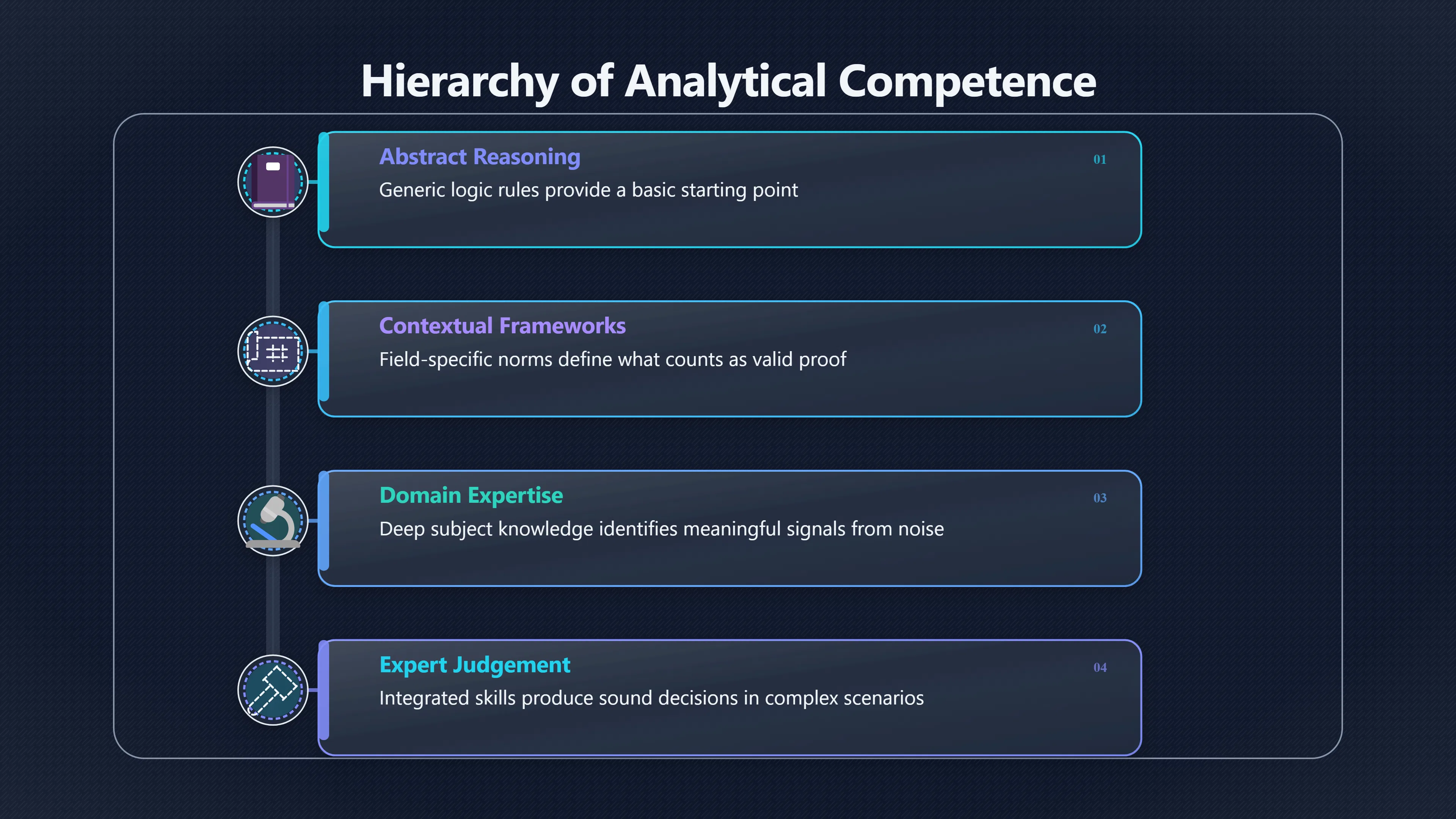
General reasoning rules help, but they can mislead when the thinker lacks the field knowledge needed to apply them well.
On this page
- Why reasoning rules do not transfer automatically
- How domain context changes the evidence
- Practical ways to attach thinking tools to content
Page outline Jump by section
Introduction
General critical thinking skills—such as checking evidence, questioning assumptions and comparing alternative explanations—are valuable, but they are not self-sufficient. They help people reason about a subject; they do not supply the subject knowledge needed to recognise which facts matter, which evidence is reliable, or which questions are worth asking. As a result, the same reasoning checklist can produce sound judgement in one field and poor judgement in another if the thinker lacks the necessary background knowledge.
 This is one of the most common failures in analytical thinking. People often learn generic reasoning frameworks before they know enough about the topic they are evaluating. The problem is not that critical thinking is useless. Rather, it is that good reasoning depends on domain knowledge to interpret evidence correctly, distinguish meaningful signals from noise and recognise when familiar reasoning patterns do not apply. Research on expertise and learning consistently shows that deep understanding arises from the interaction of reasoning skills with organised subject knowledge rather than from generic thinking techniques alone.[ResearchGate]researchgate.netDomain-Specific Knowledge and Why Teaching Generic…June 1, 2013 — An emphasis on domain-general knowledge may be misplaced…
Why reasoning rules do not transfer automatically
Many critical thinking guides present advice that appears universally applicable:[Wikipedia]WikipediaCritical thinkingCritical thinking
- Question assumptions.
- Seek evidence.
- Consider alternative explanations.
- Avoid logical fallacies.
- Be sceptical of confident claims.
All of these are sensible. The difficulty comes in applying them to real-world problems.
Knowing that evidence should be evaluated is different from knowing what counts as strong evidence in medicine, economics, engineering or history. Each discipline has developed its own standards for evaluating claims because different kinds of problems require different kinds of proof. Scientific experiments, legal testimony, archaeological artefacts and financial indicators each have distinct strengths, limitations and common sources of error. Critical thinking therefore requires understanding the norms of the field, not merely abstract reasoning principles.[Wikipedia]WikipediaCritical thinkingCritical thinking
Research in educational psychology has repeatedly found that expert performance depends heavily on large, well-organised bodies of domain knowledge stored in long-term memory. Generic reasoning strategies alone cannot substitute for this knowledge because they provide no guidance about recognising relevant patterns or selecting appropriate concepts.[ResearchGate]researchgate.netDomain-Specific Knowledge and Why Teaching Generic…June 1, 2013 — An emphasis on domain-general knowledge may be misplaced…
How domain context changes the evidence
The same piece of information can carry very different weight depending on the field in which it appears.
A historical source may seem convincing until the historian asks who produced it, for what audience and under what political circumstances.
A medical study may appear persuasive until someone familiar with clinical research notices inadequate randomisation, weak statistical power or poorly chosen outcome measures.
An economic forecast may look rigorous until an economist recognises unrealistic assumptions about incentives or market behaviour.
A legal argument may appear logically consistent while overlooking binding precedent or statutory interpretation.
None of these problems can be solved by generic scepticism alone. They require knowledge about how evidence functions within that discipline.
This explains why newcomers often focus on information that looks impressive while overlooking information that experts immediately recognise as decisive. Domain knowledge changes not only what counts as evidence but also how different pieces of evidence should be combined and interpreted.[Wikipedia]WikipediaHow People LearnHow People Learn
Why novices often ask the wrong questions
Generic critical thinking encourages asking questions, but domain knowledge determines whether those questions are useful.
Without sufficient background knowledge, people frequently:
- investigate issues that experienced practitioners already know are irrelevant;
- overlook variables that dominate outcomes;
- compare situations that are only superficially similar;
- misunderstand specialised terminology;
- assume simple causal relationships where multiple interacting mechanisms exist.
For example, someone evaluating a pharmaceutical study may spend considerable effort examining whether researchers appear trustworthy while failing to examine dosage selection, patient recruitment or statistical methodology. The reasoning process may be careful, but it is directed towards the wrong features.
In this sense, ignorance can produce confidently reasoned but poorly targeted analysis.
Generic thinking can even reinforce mistakes
Ironically, reasoning skills sometimes make errors more persuasive when they operate without adequate knowledge.
A person may construct coherent arguments from incorrect premises, identify genuine logical inconsistencies that are actually explained by established theory, or dismiss expert consensus because they misunderstand the technical evidence supporting it.
This creates an illusion of independent thinking. The reasoning appears disciplined, yet the underlying model of the subject is incomplete.
Educational researchers have long argued that the teachable aspects of problem solving depend largely on acquiring organised knowledge within particular domains rather than expecting broad thinking skills to solve unfamiliar problems by themselves.[ResearchGate]researchgate.netDomain-Specific Knowledge and Why Teaching Generic…June 1, 2013 — An emphasis on domain-general knowledge may be misplaced…

Why experts still need critical thinking
Recognising the importance of domain knowledge does not imply that expertise alone guarantees sound judgement.
Experts can become overconfident, overlook novel evidence or rely too heavily on familiar patterns. They remain vulnerable to confirmation bias, motivated reasoning and institutional pressures.
General critical thinking therefore continues to play an essential role by helping experts:
- question routine assumptions;
- recognise weak arguments within their own field;
- evaluate competing explanations;
- remain open to revision when evidence changes.
The relationship is complementary rather than competitive. Domain knowledge supplies the content; critical thinking regulates how that content is examined.
Some researchers argue that explicit reasoning skills transfer more broadly than critics claim, while others emphasise the central importance of subject knowledge. The practical consensus is narrower than the debate sometimes suggests: transferable reasoning skills exist, but they become substantially more effective when combined with sufficient understanding of the domain in which they are applied.[peterellerton.substack.com+2Learnlets]peterellerton.substack.comCritical) Thinking skills are not domain specificNovember 4, 2025 — Critical thinking is an emergent property of developing deep content knowledge within a domain (and only that), so cri…
Practical ways to attach thinking tools to content
Rather than treating critical thinking as a universal checklist, it is more effective to connect reasoning habits to specific subject matter.
Learn the field before judging the field
Acquire enough background knowledge to understand the major concepts, terminology and standard methods before attempting to evaluate controversial claims.
Without this foundation, it is difficult to distinguish genuinely surprising evidence from material that merely appears surprising because important context is missing.
Ask domain-specific questions
Instead of relying on broad questions like “Is there evidence?”, ask questions that reflect the standards of the discipline.
For example:
- In medicine: Was the study appropriately designed?
- In history: How reliable is the source in its historical context?
- In economics: What assumptions drive the model?
- In engineering: Under what operating conditions does this solution fail?
These questions arise from understanding how the field works rather than from generic reasoning alone.

Compare your reasoning with expert practice
Observe how experienced practitioners justify conclusions.
Pay attention not only to what they conclude but also to:
- which evidence they prioritise;
- which objections they dismiss quickly;
- which uncertainties they consider important;
- which distinctions they repeatedly make.
This helps develop domain-specific judgement instead of merely accumulating isolated facts.
Build concepts, not just information
Lists of facts rarely improve analysis by themselves.
Useful domain knowledge becomes organised around underlying principles, causal mechanisms and recurring patterns. As these conceptual structures develop, reasoning becomes more efficient because important relationships become easier to recognise.
Research on expertise consistently shows that experts organise knowledge around deep conceptual structures rather than isolated facts, allowing them to identify meaningful similarities that novices often miss.[Wikipedia]WikipediaHow People LearnHow People Learn
The real limitation of generic critical thinking
Generic critical thinking fails not because reasoning principles are wrong but because they are incomplete. They provide methods for evaluating claims without supplying the knowledge needed to understand those claims.
Good analysis therefore depends on two forms of competence working together. General reasoning helps prevent common errors in judgement, while domain knowledge determines what evidence matters, how concepts relate to one another and which interpretations are genuinely plausible. Remove either component, and analytical quality suffers. The strongest thinkers are not simply skilled at reasoning in the abstract; they know enough about the subject to apply those reasoning skills where they actually count.
Amazon book picks
Further Reading
Books and field guides related to When Critical Thinking Is Too Generic. Use these as the next step if you want deeper reading beyond the article.
The Knowledge Illusion
Directly explores the limits of individual knowledge and the importance of domain understanding.
Thinking, Fast and Slow
Explains why generic thinking shortcuts succeed or fail and why expertise and context matter.
How to Read a Book
Focuses on building deep subject knowledge rather than relying on superficial reasoning techniques.
Range
Examines the relationship between broad thinking skills and domain-specific expertise across fields.
eBay marketplace picks
Marketplace Samples
Live-tested eBay searches with available results related to this page.



Endnotes
1.
Source: researchgate.net
Link:https://www.researchgate.net/publication/258162628_Domain-Specific_Knowledge_and_Why_Teaching_Generic_Skills_Does_Not_Work
Source snippet
Domain-Specific Knowledge and Why Teaching Generic...June 1, 2013 — An emphasis on domain-general knowledge may be misplaced...
Published: June 1, 2013
2.
Source: Wikipedia
Title: How People Learn
Link:https://en.wikipedia.org/wiki/How_People_Learn
3.
Source: Wikipedia
Title: Critical thinking
Link:https://en.wikipedia.org/wiki/Critical_thinking
4.
Source: peterellerton.substack.com
Title: (Critical) Thinking skills are not domain specific
Link:https://peterellerton.substack.com/p/critical-thinking-skills-are-not
Source snippet
November 4, 2025 — Critical thinking is an emergent property of developing deep content knowledge within a domain (and only that), so cri...
Published: November 4, 2025
5.
Source: blog.learnlets.com
Title: generic thinking skills
Link:https://blog.learnlets.com/2022/02/generic-thinking-skills/
Source snippet
Thinking Skills?15 Feb 2022 — On the other hand, prominent psychologists like John Sweller and Paul Kirschner have said that domain-speci...
Additional References
6.
Source: medium.com
Link:https://medium.com/%40mahjabeentauqir_/ai-without-domain-knowledge-creates-noise-not-development-18ad04b1aeaf
Source snippet
AI Without Domain Knowledge: Creates Noise, Not...One of the primary reasons for this failure is the underutilization of domain expertis...
7.
Source: facebook.com
Link:https://www.facebook.com/Chalkbeat/posts/experts-say-that-critical-thinking-still-rests-on-a-broad-base-of-knowledge/1574209538048063/
Source snippet
Does AI mean basic facts are less important for students to learn?Read more...
8.
Source: eclass.uoa.gr
Title: 04. Domain Specific Knowledge and teaching
Link:https://eclass.uoa.gr/modules/document/file.php/PSYCH139/%CE%95%CF%81%CE%B3%CE%B1%CF%83%CE%AF%CE%B5%CF%82%2018//11//24%3A%20%CE%86%CF%81%CE%B8%CF%81%CE%B1%20%CE%BA%CE%B1%CE%B9%20%CE%9F%CE%B4%CE%B7%CE%B3%CE%AF%CE%B5%CF%82/04.%20Domain%20Specific%20Knowledge%20and%20teaching.pdf
Source snippet
uoa.grDomain-Specific Knowledge and Why Teaching Generic...26 Oct 2013 — We will argue that teachable aspects of problem solving skill a...
9.
Source: publikationen.bibliothek.kit.edu
Link:https://publikationen.bibliothek.kit.edu/1000180298
Source snippet
Low-Quality Domain Knowledge in Knowledge...by P Bielski · 2025 — Low-quality domain knowledge can arise for several reasons: (1) Diffic...
10.
Source: medium.productcoalition.com
Title: why product managers dont need domain knowledge to be effective a0b5deefc9ab
Link:https://medium.productcoalition.com/why-product-managers-dont-need-domain-knowledge-to-be-effective-a0b5deefc9ab
Source snippet
Domain knowledge ends up as a top 'must-have'.Read more...
11.
Source: youtube.com
Link:https://www.youtube.com/watch?v=its-aeXUmak
Source snippet
Natalie Wexler and The Science of Learning...
12.
Source: youtube.com
Title: Natalie Wexler’s Critique of the “Knowledge Gap” in Schools
Link:https://www.youtube.com/watch?v=UtDGjiGdwcs
Source snippet
Schools Teach 'Critical Thinking' — But It's 2,500 Years Out of Date...
13.
Source: dl.acm.org
Link:https://dl.acm.org/doi/10.1145/3706598.3713778
Source snippet
Impact of Generative AI on Critical ThinkingWe find that GenAI tools reduce the perceived effort of critical thinking while also encourag...
14.
Source: youtube.com
Title: Natalie Wexler and The Science of Learning
Link:https://www.youtube.com/watch?v=L3pf7wAJWlw
Source snippet
Natalie Wexler's Critique of the “Knowledge Gap” in Schools...
15.
Source: youtube.com
Title: Schools Teach ‘Critical Thinking’ — But It’s 2,500 Years Out of Date
Link:https://www.youtube.com/watch?v=cqW3FzEPzcA
Topic Tree