Within Search Bias
When Should You Stop Searching?
The moment a person stops searching can matter as much as the sources they choose, especially when the first results feel satisfying.
On this page
- Why fast satisfaction is a warning sign
- Practical stopping rules for contested claims
- When extra search is worth the effort
Page outline Jump by section
Introduction
Knowing when to stop searching is one of the least discussed parts of online research, yet it often determines the quality of the conclusion. Many people stop not because they have examined the available evidence, but because they have found an answer that feels convincing enough. This sense of completion can arrive long before the evidence justifies confidence, especially on contested topics where supporting information is easier to find than balanced information. Research on the “narrow search effect” suggests that once people begin with belief-consistent search terms, they are likely to encounter reinforcing results and update their beliefs less than they otherwise would. [PNAS]pnas.orgThe narrow search effect and how broadening…24 Mar 2025 — We demonstrate that the combination of users' prior beliefs influencing…
 For improving analytical thinking, the goal is not to search indefinitely. It is to replace unconscious stopping rules—such as “I’ll stop when I find proof I’m right”—with deliberate ones that are linked to evidence quality rather than emotional satisfaction.
Why fast satisfaction is a warning sign
Search engines and AI-assisted search tools are designed to satisfy queries efficiently. That is usually helpful, but it creates a subtle problem: the feeling of having found an answer is not the same as having tested an answer.
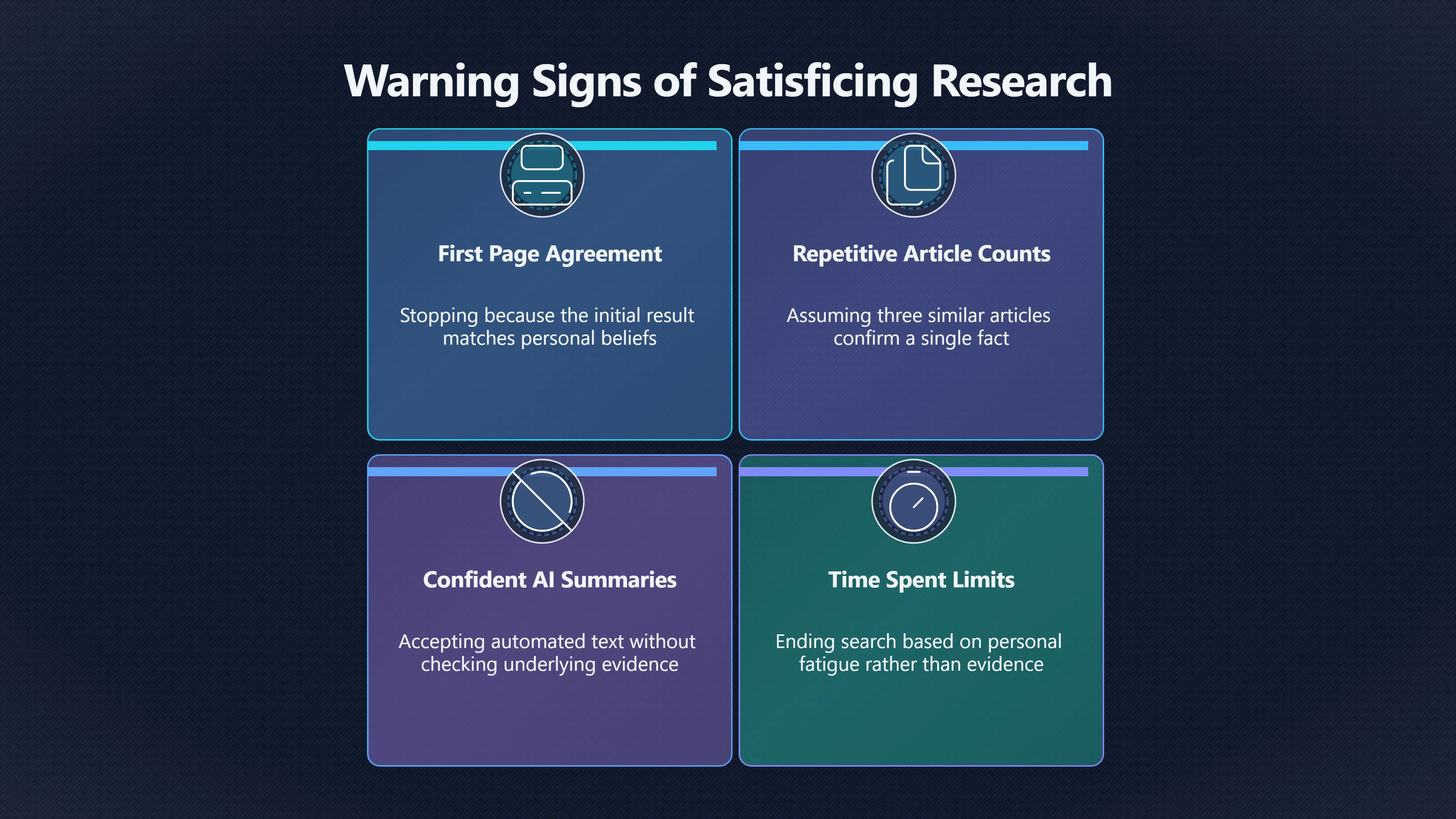
Psychologists often describe people as “satisficing”—accepting an option that seems good enough rather than continuing to search for the best-supported conclusion. In everyday online research, satisficing can become a hidden stopping rule:
- “The first page agrees with me.”
- “Three articles say the same thing.”
- “The AI summary sounds confident.”
- “I’ve spent enough time already.”
None of these tells you whether the conclusion has survived meaningful challenge.
The danger becomes greater when the original query already assumes a preferred answer. The 2025 PNAS research on the narrow search effect found that prior beliefs influence search wording, which narrows retrieved information and limits later belief revision across both conventional search engines and AI-assisted systems. If the search ends immediately after those reinforcing results appear, the user experiences confidence without genuine testing. [PNAS]pnas.orgThe narrow search effect and how broadening…24 Mar 2025 — We demonstrate that the combination of users' prior beliefs influencing…
This helps explain why two people investigating the same controversial issue can honestly believe they have “done the research” while reaching opposite conclusions. Their searches did not merely begin differently—they also ended under different stopping rules.
Practical stopping rules for contested claims
Better thinking does not require endless searching. It requires deciding in advance what counts as “enough”.
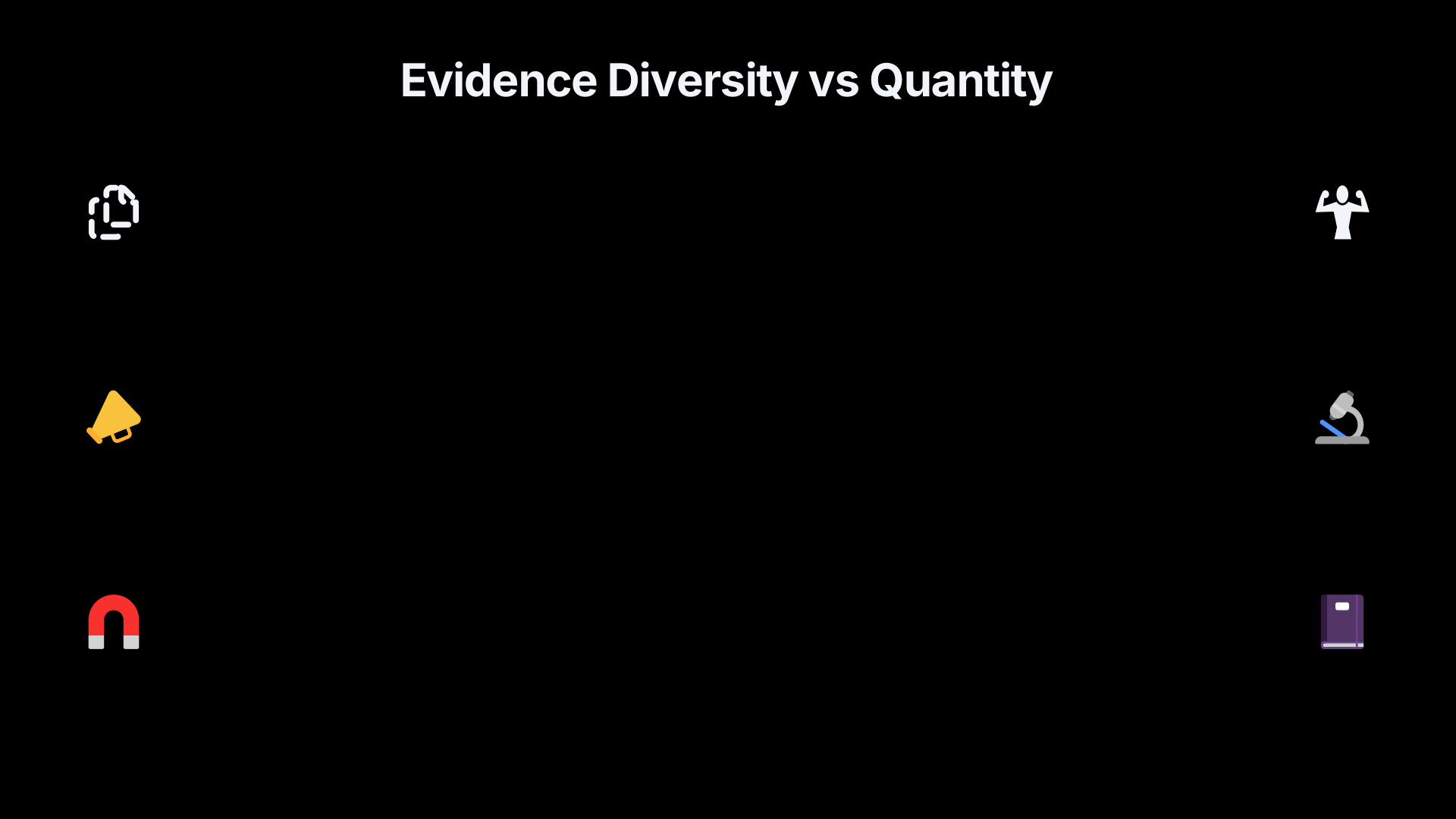
A useful stopping rule is based on evidence diversity, not evidence quantity. Rather than asking, “Have I found enough supporting articles?”, ask whether the search has exposed you to the strongest competing explanations.
For disputed factual claims, practical stopping rules include:
- Find at least one serious opposing explanation. If you cannot accurately describe the strongest counterargument, you probably have not searched broadly enough.
- Use neutral search terms before concluding. Replace advocacy-oriented searches with descriptive ones. For example, instead of searching for reasons a claim is true, search for evidence, systematic reviews, criticism or competing explanations.
- Look beyond repeated summaries. Multiple websites may simply repeat the same original source. Independent confirmation is more informative than repetition.
- Stop only after checking source quality. Ask whether the evidence comes from primary research, recognised institutions, or reporting that identifies its sources.
- Distinguish settled from contested questions. A straightforward factual question may need little further searching. A politically, scientifically or socially disputed claim generally deserves broader checking.
These rules shift the stopping decision away from emotional certainty and towards evidential completeness.

When extra search is worth the effort
Not every question deserves an hour of investigation. Good stopping rules also recognise when additional searching is unlikely to change the answer.
Extra search is usually worthwhile when:
- the decision has important personal, financial or health consequences;
- reliable sources disagree;
- the available evidence is mostly opinion rather than direct evidence;
- the claim would substantially change your existing understanding;
- the first results appear unusually unanimous despite the issue being publicly disputed.
Conversely, further searching often has diminishing value when multiple independent, high-quality sources converge on the same factual conclusion and no credible competing evidence emerges.
The key distinction is between repeated agreement and independent corroboration. Ten articles derived from the same press release add less confidence than three independent investigations reaching the same conclusion.
Use search completion as a decision, not a feeling
Professional fact-checkers rarely stop because a source “looks convincing”. Instead, they use structured habits that interrupt the natural urge to accept the first satisfying answer.
One widely taught approach is the SIFT method:
- Stop before accepting or sharing the information.
- Investigate the source.
- Find better coverage from independent reporting. [hapgood.us]hapgood.usSIFT (The Four Moves19 Jun 2019 — We call the “things to do” moves and there are four of them: The four moves: Stop, Investigate the source, find bett…
- Trace claims back to their original context or evidence. [UChicago Library Guides+2Hapgood]guides.lib.uchicago.eduLibrary Guides The SIFT MethodUChicago Library GuidesThe SIFT Method - Evaluating Resources and Misinformation30 Jun 2025 — Trace Claims, use lateral reading to see if…
Notice that the first instruction is literally to stop—but not to stop searching. It is to stop believing until verification begins. This reverses the common online pattern in which belief comes first and checking, if it happens at all, comes afterwards.
Lateral reading follows the same principle. Instead of reading ever more deeply within one article, researchers open new tabs to compare what unrelated sources say about the same claim. This changes the stopping rule from “I’ve read enough here” to “I’ve compared enough independent evidence.” [UChicago Library Guides]guides.lib.uchicago.eduLibrary Guides The SIFT MethodUChicago Library GuidesThe SIFT Method - Evaluating Resources and Misinformation30 Jun 2025 — Trace Claims, use lateral reading to see if…
Turning stopping rules into a thinking habit
Research on information search shows that stopping behaviour is not random. People consistently rely on heuristics—mental rules for deciding when enough information has been gathered—and different stopping rules produce different search outcomes. Studies of information seeking have found that more systematic stopping strategies are associated with gathering higher-quality information than stopping simply because enough supporting material appears. [Enlighten Publications]eprints.gla.ac.ukEnlighten Publications An Analysis of Stopping Rules and StrategiesEnlighten PublicationsAn Analysis of Stopping Rules and StrategiesJanuary 6, 2016 — by D Maxwell · 2015 · Cited by 83 — In this paper, we…
A practical personal policy can therefore be simple:
- Decide what evidence would change your mind before you begin.
- Search for that evidence deliberately.
- Check whether your sources are genuinely independent.
- Stop only after your question has been tested, not merely answered.
The important shift is psychological rather than technical. Satisfaction is a poor indicator that a search is complete. A stronger indicator is that you have deliberately looked for reasons your preferred conclusion might be wrong and found that the best available evidence still supports it.
Amazon book picks
Further Reading
Books and field guides related to When Should You Stop Searching?. Use these as the next step if you want deeper reading beyond the article.
The Scout Mindset
Focuses on seeking truth over confirmation and updating beliefs based on evidence.
Calling Bullshit
Teaches readers how to evaluate evidence quality instead of accepting convincing-looking claims.
The Art of Thinking Clearly
Covers many cognitive biases that influence premature search stopping and overconfidence.
How to Read a Book
Encourages systematic evaluation of information rather than accepting the first satisfactory answer.
eBay marketplace picks
Marketplace Samples
Live-tested eBay searches with available results related to this page.


Endnotes
-
Source: pnas.org
Link: https://www.pnas.org/doi/10.1073/pnas.2408175122Source snippet
The narrow search effect and how broadening...24 Mar 2025 — We demonstrate that the combination of users' prior beliefs influencing...
-
Source: guides.lib.uchicago.edu
Title: Library Guides The SIFT Method
Link: https://guides.lib.uchicago.edu/c.php?g=1241077&p=9082322Source snippet
UChicago Library GuidesThe SIFT Method - Evaluating Resources and Misinformation30 Jun 2025 — Trace Claims, use lateral reading to see if...
-
Source: hapgood.us
Title: SIFT (The Four Moves)
Link: https://hapgood.us/2019/06/19/sift-the-four-moves/Source snippet
19 Jun 2019 — We call the “things to do” moves and there are four of them: The four moves: Stop, Investigate the source, find bett...
-
Source: eprints.gla.ac.uk
Title: Enlighten Publications An Analysis of Stopping Rules and Strategies
Link: https://eprints.gla.ac.uk/112731/1/112731.pdfSource snippet
Enlighten PublicationsAn Analysis of Stopping Rules and StrategiesJanuary 6, 2016 — by D Maxwell · 2015 · Cited by 83 — In this paper, we...
Published: January 6, 2016
-
Source: libguides.ucmerced.edu
Title: sift method
Link: https://libguides.ucmerced.edu/news/evaluation/sift-methodSource snippet
Both can be used. In fact, "Stop, Investigate, Find Better Coverage, and Trace Claims (SIFT)...Read more...
-
Source: libguides.clackamas.edu
Link: https://libguides.clackamas.edu/research-help/siftSource snippet
Research help18 May 2026 — Use lateral reading. When investigating a source, fact-checkers read “laterally” across many websites, rather...
Published: May 2026
-
Source: researchguides.austincc.edu
Link: https://researchguides.austincc.edu/c.php?g=612891&p=9815507Source snippet
SIFT Method - Fake News and Alternative Facts27 Mar 2026 — Use the SIFT skills employed by many fact checkers to determine if a news sour...
Additional References
-
Source: catalogofbias.org
Link: https://catalogofbias.org/biases/early-stopping-bias/Source snippet
Early Stopping BiasStopping rules for benefit should be very strict in the magnitude of evidence and plausibility, e.g. before 500 events...
-
Source: academia.edu
Link: https://www.academia.edu/Documents/in/Stopping_rules/MostCitedSource snippet
Stopping rules Research PapersStopping rules are predetermined criteria or guidelines used in research and statistical analysis to decide...
-
Source: researchgate.net
Link: https://www.researchgate.net/profile/Marcelo-Machado-6/publication/386252966_Identifying_Confirmation_Bias_in_a_Search_as_Learning_Task_A_Study_on_The_Use_of_Artificial_Intelligence_in_Education/links/674b471aa7fbc259f1a1a789/Identifying-Confirmation-Bias-in-a-Search-as-Learning-Task-A-Study-on-The-Use-of-Artificial-Intelligence-in-Education.pdfSource snippet
Identifying Confirmation Bias in a Search as Learning Taskby M Machado · 2024 · Cited by 2 — Confirmation bias, the tendency to favor inf...
-
Source: semanticscholar.org
Link: https://www.semanticscholar.org/paper/Stopping-Rule-Use-During-Web-Based-Search-Browne-Pitts/3239f5f44199a5b93138d4a561e7b34fd9142ff3Source snippet
Stopping Rule Use During Web-Based SearchThis work investigates the heuristics, or stopping rules, that people use to end search behavior...
-
Source: communicationcache.com
Link: https://www.communicationcache.com/uploads/1/0/8/8/10887248/confirmation_bias_in_sequential_information_search_after_preliminary_decisions-_an_expansion_of_dissonance_theoretical_research_on_selective_exposure_to_information.pdfSource snippet
Confirmation Bias in Sequential Information Search After...by E Jonas · 2001 · Cited by 1185 — Research on selective exposure to informa...
-
Source: linkedin.com
Link: https://www.linkedin.com/posts/stefanopuntoni_this-week-we-hosted-the-amazing-oleg-urminsky-activity-7376785446883782656-fFMT -
Source: moodle2.units.it
Link: https://moodle2.units.it/pluginfile.php/744548/mod_resource/content/4/Jonas%20et%20al.%2C%202001_Confirmation-Bias-in-Sequential-Information-Search-After-Preliminary-Decisions-An-Expansion-of-Dissonance-Theoretical-Research-on-Selective-Exposure-to-Information.pdfSource snippet
Bias in Sequential Information Search After...by E Jonas · 2001 · Cited by 1185 — In the present research the authors show that an even...
-
Source: phys.org
Title: 2025 03 narrowminded algorithms polarized perceptions
Link: https://phys.org/news/2025-03-narrowminded-algorithms-polarized-perceptions.htmlSource snippet
Do narrow‑minded search algorithms cause polarized...26 Mar 2025 — Search engines optimized for relevance reinforce confirmation bias, r...
-
Source: pubmed.ncbi.nlm.nih.gov
Link: https://pubmed.ncbi.nlm.nih.gov/40127267/Source snippet
The narrow search effect and how broadening...by E Leung · 2025 · Cited by 13 — We demonstrate that the combination of users' prio...
-
Source: pages.ucsd.edu
Title: nickerson Confirmation Bias
Link: https://pages.ucsd.edu/~mckenzie/nickersonConfirmationBias.pdfSource snippet
Bias: A Ubiquitous Phenomenon in Many...by RS Nickerson · 1998 · Cited by 12458 — Confirmation bias, as the term is typically used in th...
Topic Tree