Within Source Quality
Why Friendly Sources Feel More Reliable
Agreement can feel more reliable simply because it supports what the reader already wanted to believe.
On this page
- How prior beliefs shape source judgment
- The difference between consensus and comfort
- A pause routine for agreeable evidence
Page outline Jump by section
Introduction
When a source agrees with what you already believe, it often feels more trustworthy before you have examined its evidence. That feeling is a common expression of confirmation bias: the tendency to seek, interpret and remember information in ways that support existing beliefs or expectations rather than challenge them. The result is that agreement itself can become a shortcut for judging credibility, even though a source’s quality depends on its evidence, methods and accountability—not whether it reaches a comforting conclusion. [Sage Journals]journals.sagepub.comSage JournalsConfirmation Bias: A Ubiquitous Phenomenon in Many…Confirmation bias is perhaps the best known and most widely accepted n…
 Within the broader question of source quality versus source agreement, the key risk is subtle. People do not merely prefer friendly conclusions; they often judge friendly sources as better sources. Understanding how this happens makes it easier to separate genuine evidence from the reassuring feeling of being told what you already expected to hear.
How prior beliefs shape source judgment
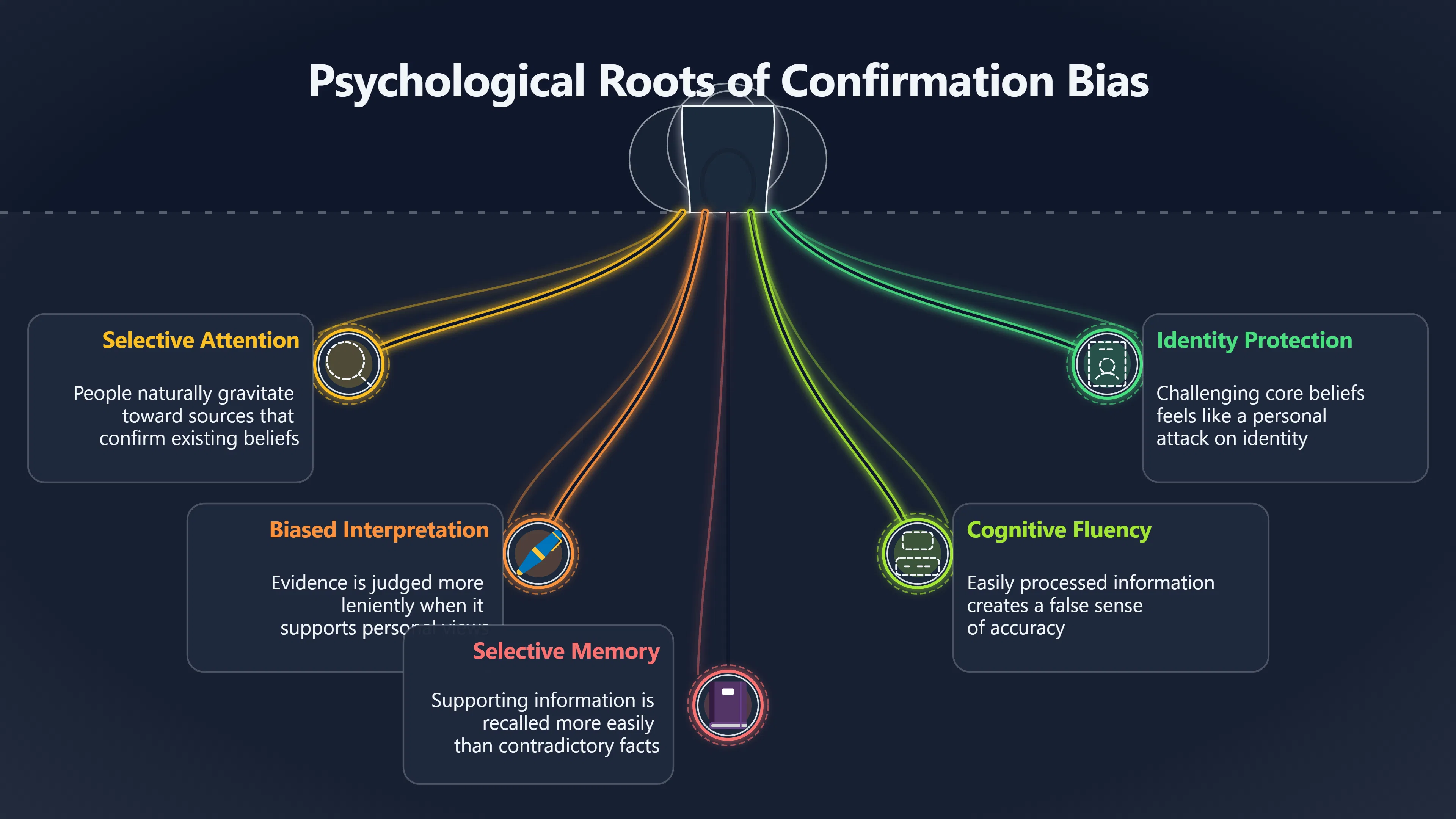
Confirmation bias is often described as selective exposure to supportive information, but the mechanism goes further. Prior beliefs influence several stages of reasoning at once.
First, they affect which sources attract attention. When faced with many articles, videos or experts, people naturally gravitate towards those that seem likely to confirm what they already think. This can happen without any conscious intention to avoid opposing evidence. [Sage Journals]journals.sagepub.comSage JournalsConfirmation Bias: A Ubiquitous Phenomenon in Many…Confirmation bias is perhaps the best known and most widely accepted n…
Second, prior beliefs influence how evidence is interpreted. The same study, report or statistic may appear convincing when it supports an existing view and flawed when it challenges it. Research in psychology has repeatedly found that people apply stricter standards to disagreeable evidence than to agreeable evidence, often identifying weaknesses only when the conclusion feels unwelcome. [Sage Journals]journals.sagepub.comSage JournalsConfirmation Bias: A Ubiquitous Phenomenon in Many…Confirmation bias is perhaps the best known and most widely accepted n…
Third, beliefs shape memory. Supporting information is often recalled more easily, while contradictory information fades or is remembered as weaker than it actually was. Over time this creates the impression that “all the evidence” points in one direction, even when the original information was more mixed. [Sage Journals]journals.sagepub.comSage JournalsConfirmation Bias: A Ubiquitous Phenomenon in Many…Confirmation bias is perhaps the best known and most widely accepted n…
The important point is that none of these processes necessarily involve dishonesty. They arise because human reasoning tends to interpret new information through existing mental models rather than from a completely neutral starting point.
The difference between consensus and comfort
Agreement should not be confused with confirmation.
A genuine consensus develops when multiple independent investigations, using transparent methods and different evidence, converge on the same conclusion. The confidence comes from the quality and independence of the evidence.
Comfort, by contrast, comes from psychological fit. A claim feels credible because it matches expectations, values or previous commitments. The source may still be correct, but the feeling of confidence comes from familiarity rather than from evaluating its reliability.
One practical test is to ask which sentence better explains your reaction:
- “This source is persuasive because it shows strong evidence.”
- “This source is persuasive because it says what I already suspected.”
If the second explanation fits better, confirmation bias may be contributing to your confidence.
This distinction becomes especially important in contested topics. Two articles may each cite studies and expert opinion, yet readers often describe the article supporting their position as “balanced” while dismissing the other as “biased”. In many cases the difference reflects not only differences in evidence but also differences in how the reader evaluates evidence that feels congenial. Experimental research has repeatedly demonstrated that people can scrutinise unfriendly evidence far more critically than equally strong friendly evidence. [Wikipedia]WikipediaConfirmation biasConfirmation bias

Why agreeable evidence feels especially convincing
Several psychological processes reinforce one another.
Fluency. Information consistent with existing beliefs is easier to process. Because it requires less mental effort, it can create a mistaken impression that it is also more accurate.
Reduced cognitive tension. Evidence that fits existing beliefs avoids the discomfort that arises when new information challenges an established view. Accepting agreeable evidence therefore feels emotionally easier than resolving contradiction. [Simply Psychology]simplypsychology.orgconfirmation biasSimply PsychologyConfirmation Bias In Psychology: Definition & Examples22 Jun 2023 — Confirmation bias is the tendency to look for inform…
Identity protection. Some beliefs are closely connected to personal identity, political affiliation, professional reputation or social group membership. Challenging the belief may feel like challenging the person or group, making supportive sources seem unusually trustworthy regardless of their actual quality. [arXiv]arxiv.orgThe Fake News Effect: Experimentally Identifying Motivated Reasoning Using Trust in NewsDecember 3, 2020…
These mechanisms help explain why simply presenting additional facts does not always change minds. People are often evaluating not just the information itself but also whether accepting it would disrupt an existing worldview.
A pause routine for agreeable evidence
The goal is not to distrust evidence that supports your beliefs. Sometimes your existing view is well supported. The aim is to avoid letting agreement substitute for evaluation.
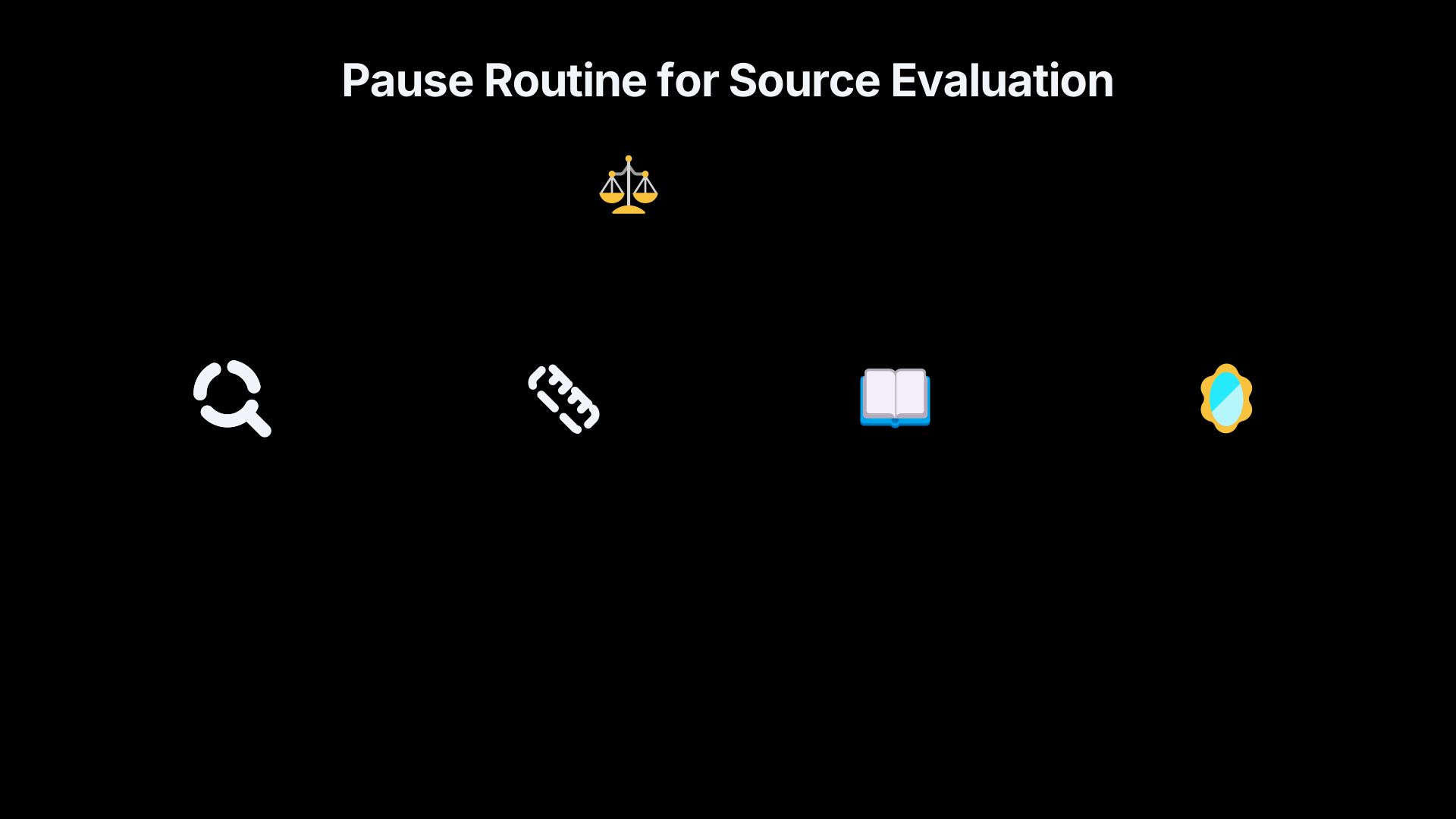
When a source immediately feels “obviously right”, pause and ask:
- Would I judge this evidence equally strong if it reached the opposite conclusion?
- What specific evidence makes the source reliable apart from agreeing with me?
- Has the source shown its methods, data or reasoning clearly?
- Have I looked for at least one credible source that reaches a different conclusion?
- If I changed my mind after reading this, what evidence would have persuaded me?
These questions interrupt the automatic link between agreement and credibility. They shift attention back towards the qualities that actually determine whether a source deserves confidence.
Recognising the warning signs
[Confirmation bias]WikipediaConfirmation bias is especially likely when you notice reactions such as:
- Feeling immediate certainty before examining the evidence.
- Reading only headlines that reinforce an existing opinion.
- Calling supportive sources “objective” while dismissing opposing ones without comparable scrutiny.
- Sharing information because it feels satisfying rather than because its evidence has been checked.
- Becoming unusually confident after reading several sources that all rely on the same original claim.
These are signals to slow down, not proof that your conclusion is wrong.
Better thinking means separating comfort from credibility
Agreement is not evidence of poor quality, but neither is it evidence of good quality. Friendly sources can be excellent, mediocre or unreliable; unfriendly sources can be wrong or they can reveal genuine weaknesses in your current understanding.
The most reliable habit is to treat the pleasant feeling of agreement as a prompt for closer inspection rather than as confirmation that the source is trustworthy. Once source quality is assessed independently of personal agreement, confidence rests on evidence instead of familiarity, making analytical thinking more resilient in areas where beliefs are strongly held or emotionally important.
Amazon book picks
Further Reading
Books and field guides related to Why Friendly Sources Feel More Reliable. Use these as the next step if you want deeper reading beyond the article.
The Scout Mindset
Directly addresses how to seek truth rather than defend comfortable beliefs.
Mistakes Were Made (but Not by Me)
Explores cognitive dissonance, self-justification, and why people resist contrary evidence.
Calling Bullshit
Helps readers inspect evidence and claims rather than relying on whether a source feels aligned.
The Righteous Mind
Explains why people reason defensively around group identity and prior commitments.
eBay marketplace picks
Marketplace Samples
Live-tested eBay searches with available results related to this page.


Endnotes
-
Source: Wikipedia
Title: Confirmation bias
Link: https://en.wikipedia.org/wiki/Confirmation_bias -
Source: arxiv.org
Link: https://arxiv.org/abs/2012.01663Source snippet
The Fake News Effect: Experimentally Identifying Motivated Reasoning Using Trust in NewsDecember 3, 2020...
Published: December 3, 2020
-
Source: youtube.com
Title: Confirmation Bias Explained: Why Facts Don’t Change Minds
Link: https://www.youtube.com/watch?v=vDN62xSTXfUSource snippet
Why You'll Never Change Your Mind (Science)...
-
Source: youtube.com
Title: How to Overcome Confirmation Bias
Link: https://www.youtube.com/watch?v=oWRhKPcZG_0Source snippet
Confirmation Bias and The Scientific Method I: How to Avoid Confirmation Bias...
-
Source: youtube.com
Title: Confirmation Bias and The Scientific Method I: How to Avoid Confirmation Bias
Link: https://www.youtube.com/watch?v=tOZLL7CsHCUSource snippet
How Our Own Reasoning Can Deceive Us in Everyday Life | Paz Garcia-Blanch Echeverria | TEDxASM Youth...
-
Source: journals.sagepub.com
Link: https://journals.sagepub.com/doi/10.1037/1089-2680.2.2.175Source snippet
Sage JournalsConfirmation Bias: A Ubiquitous Phenomenon in Many...Confirmation bias is perhaps the best known and most widely accepted n...
-
Source: britannica.com
Title: confirmation bias
Link: https://www.britannica.com/science/confirmation-biasSource snippet
Encyclopedia BritannicaConfirmation bias | Definition, Examples, Psychology, & Facts11 Jun 2026 — Confirmation bias, people's tendency to...
-
Source: simplypsychology.org
Title: confirmation bias
Link: https://www.simplypsychology.org/confirmation-bias.htmlSource snippet
Simply PsychologyConfirmation Bias In Psychology: Definition & Examples22 Jun 2023 — Confirmation bias is the tendency to look for inform...
-
Source: populismstudies.org
Link: https://www.populismstudies.org/Vocabulary/confirmation-bias/Source snippet
Confirmation BiasAmerican Psychological Association (APA) defines 'confirmation bias' as a tendency to gather evidence that confirms pree...
Additional References
-
Source: facebook.com
Link: https://www.facebook.com/AmericanPsychologicalAssociation/posts/one-critical-skill-in-the-fight-against-misinformation-is-understanding-how-conf/1204406885054314/ -
Source: pmc.ncbi.nlm.nih.gov
Title: PMCOpinion Dynamics with Confirmation Bias
Link: https://pmc.ncbi.nlm.nih.gov/articles/PMC4090078/Source snippet
NIHby AE Allahverdyan · 2014 · Cited by 190 — Confirmation bias is the tendency to acquire or process new information in a way that...
-
Source: researchgate.net
Title: 340798496 What Is the Function of Confirmation Bias
Link: https://www.researchgate.net/publication/340798496_What_Is_the_Function_of_Confirmation_BiasSource snippet
(PDF) What Is the Function of Confirmation Bias?20 May 2026 — Confirmation bias evolved because it helps us influence people and social s...
Published: May 2026
-
Source: findresearcher.sdu.dk
Title: dk What Is the Function of Confirmation Bias?
Link: https://findresearcher.sdu.dk/ws/files/202631503/Peters2022_Article_WhatIsTheFunctionOfConfirmatio.pdfSource snippet
Peters, Uweby U Peters · 2022 · Cited by 417 — Confirmation bias is one of the most widely discussed epistemically problematic cognitions...
-
Source: youtube.com
Link: https://www.youtube.com/watch?v=OgUdmNqJp7w -
Source: youtube.com
Title: Why You’ll Never Change Your Mind (Science)
Link: https://www.youtube.com/watch?v=dJy6CCaO5wgSource snippet
How to Overcome Confirmation Bias...
Topic Tree