Within Expert Gut
Why Firefighters Sometimes Know Before They Explain
Gary Klein's fireground research shows how experts act fast by recognising patterns, then testing the first workable action.
On this page
- How recognition primed decision making works
- Why mental simulation is not the same as guessing
- What everyday decisions can borrow from fireground expertise
Page outline Jump by section
Introduction
Fireground commanders have become one of the most influential case studies in the science of expert intuition because they routinely make life-or-death decisions in seconds without appearing to compare multiple alternatives. Gary Klein’s field research showed that experienced commanders do not simply rely on instinctive hunches. Instead, they recognise familiar patterns, retrieve an action that has worked in similar situations, and then mentally test whether that action will succeed in the current conditions. This process, known as the Recognition-Primed Decision (RPD) model, explains why some forms of rapid judgement deserve trust: they are built on extensive experience and are checked through deliberate mental simulation rather than blind guesswork.[Sage Journals+2ResearchGate]journals.sagepub.comSage Journals Rapid Decision Making on the Fire GroundGA Klein · 1986 · Cited by 1008 — A Recognition Primed Decision (RPD) model is proposed which emphasizes the use of recogniti…
How recognition-primed decision-making works
Klein’s original studies examined experienced urban fireground commanders managing fast-moving emergencies. Classical decision theory suggested that effective decisions should come from generating several options, comparing their strengths and weaknesses, and selecting the best one. That was not what researchers observed in practice.
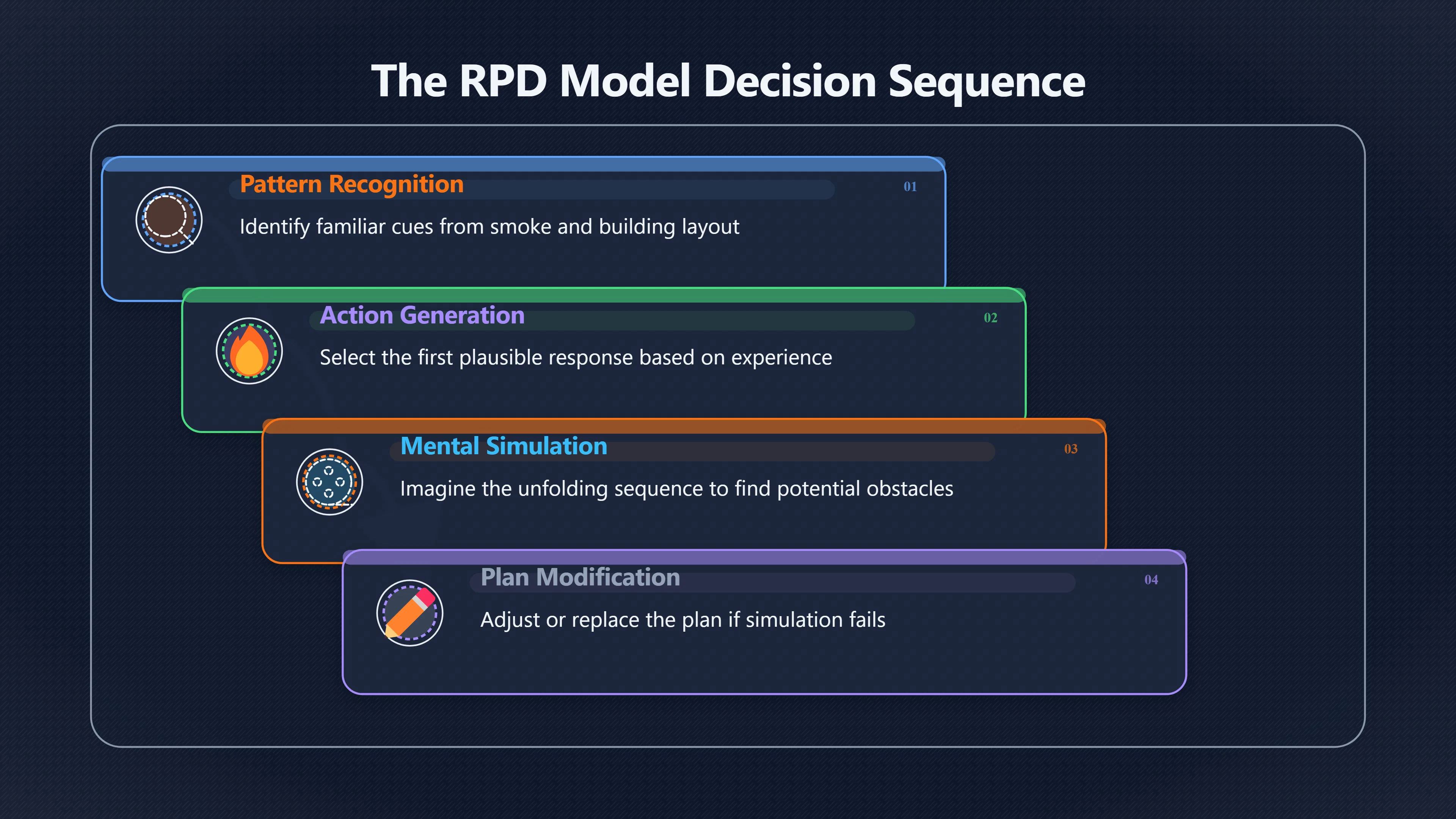
Instead, experienced commanders typically followed a different sequence:
- Recognise the situation. They rapidly identified familiar patterns from smoke, fire behaviour, building layout, weather, crew positioning, and other cues.
- Generate the first workable action. Rather than producing a long list of possibilities, experience suggested a plausible response almost immediately.
- Mentally simulate the action. Before giving the order, they imagined how events would unfold, looking for obstacles, contradictions, or warning signs.
- Modify or replace if necessary. If the mental simulation exposed problems, they adjusted the plan or moved to another familiar response instead of mechanically following the first idea. ResearchGate+2Sage Journals
The important point is that recognition does not end the decision process. Recognition starts it by narrowing the search to a promising option. Evaluation still occurs, but it happens through a rapid simulation of the unfolding situation rather than through formal comparison tables or explicit probability calculations.
One striking finding from Klein’s early work was that simultaneous comparison of multiple options appeared in only a small minority of decision points—less than about 12% in the observed incidents. Most experienced commanders focused on determining whether their first recognised option would work rather than searching exhaustively for a theoretically optimal solution. Sage Journals
Why mental simulation is not the same as guessing
The RPD model is often misunderstood as a defence of “going with your gut”. Klein has repeatedly argued that this interpretation misses half of the process.
Pattern recognition is largely automatic. Years of experience allow experts to notice meaningful configurations that novices either overlook or cannot interpret correctly. However, recognising a familiar pattern does not guarantee that the obvious response fits the current situation.
Mental simulation provides the safeguard.
Instead of asking, “Is this the best option among five alternatives?”, commanders ask questions such as:
- What happens if we enter through this doorway?
- How will the fire likely spread over the next minute?
- Will this crew become trapped?
- Does anything about this situation violate my expectations?
If the imagined sequence breaks down—for example, because smoke movement suggests hidden fire or structural collapse seems imminent—the plan changes before action begins. This deliberate evaluation distinguishes expert intuition from impulsive reaction. ResearchGate+2Psychology Today
This combination of fast recognition and conscious evaluation also helps explain why experts can often describe their reasoning only after the event. The recognition stage is largely automatic, while the mental simulation is more accessible to conscious reflection.
Why firefighters can rely on intuition more than many professionals
Firefighting provides unusually favourable conditions for developing skilled intuition.
Experienced commanders repeatedly encounter similar classes of emergencies while receiving relatively direct feedback about whether their tactical choices succeeded. Fires obey physical principles, smoke carries information about combustion, buildings exhibit recurring structural features, and mistakes often become visible quickly. These characteristics allow experience to build reliable mental patterns over time. ResearchGate+2US Forest Service
This does not mean every fire is predictable or that experienced commanders are infallible. Novel building materials, unusual layouts, rare weather conditions, or incomplete information can all produce situations where familiar patterns become misleading. Klein and later researchers have consistently treated RPD as a description of expert performance under suitable conditions rather than proof that intuition is always trustworthy. ResearchGate
What everyday decisions can borrow from fireground expertise
Most people are not commanding emergency crews, but several lessons transfer surprisingly well to everyday thinking.
Recognise before analysing. If an experienced professional immediately notices a familiar pattern, that recognition deserves attention. It should become the starting point for reasoning, not the final answer.
Test the first idea mentally. Before acting, imagine the sequence of events. Ask what could fail, what assumptions are being made, and what evidence would contradict the plan. This mirrors the commander’s mental simulation.
Aim for a workable solution before an optimal one. In time-pressured situations, finding the first action that safely meets the objective is often more valuable than delaying while searching for perfection.
Separate expertise from confidence. Confidence alone is a poor indicator of judgement quality. The value of rapid intuition depends on whether it was built through repeated exposure to valid patterns with corrective feedback.
Know when the model no longer applies. Fireground expertise transfers well within firefighting because many situations share meaningful similarities. It transfers much less reliably into unfamiliar or highly unpredictable domains, where recognised patterns may not reflect reality.
Why the fireground remains a landmark example
The study of fireground commanders reshaped research on decision-making because it challenged the assumption that good judgement always requires comparing numerous alternatives. Klein’s work demonstrated that experts operating under severe time pressure often succeed by recognising meaningful patterns, generating a promising action immediately, and stress-testing it through mental simulation.
Rather than opposing careful thinking, recognition-primed decision-making shows how expertise compresses analysis without eliminating it. The lesson for improving thinking is not that intuition replaces reasoning, but that in the right environment, experience can make reasoning faster by allowing the mind to begin with a strong candidate and then consciously check whether it fits the situation at hand. ResearchGate+2Sage Journals
Amazon book picks
Further Reading
Books and field guides related to Why Firefighters Sometimes Know Before They Explain. Use these as the next step if you want deeper reading beyond the article.
Sources of Power
Directly explains the fireground studies and Recognition-Primed Decision model featured on the page.
The Power of Intuition
Expands on when intuitive judgments are trustworthy and how expertise develops.
Thinking, Fast and Slow
Provides the broader scientific framework for intuitive versus analytical thinking discussed alongside Klein's work.
Streetlights and Shadows
Explores adaptive expertise, uncertainty, and why conventional decision models often fail in practice.
eBay marketplace picks
Marketplace Samples
Live-tested eBay searches with available results related to this page.


Endnotes
2.
Source: gary-klein.com
Link:https://www.gary-klein.com/rpd
Source snippet
RPD | garykleinThe Recognition-Primed Decision (RPD) model to explain how experienced fireground commanders could use their expertise to...
3.
Source: researchgate.net
Title: Research Gate(PDF) Conditions for Intuitive Expertise
Link:https://www.researchgate.net/publication/26798603_Conditions_for_Intuitive_Expertise
Source snippet
ResearchGate(PDF) Conditions for Intuitive ExpertiseSeptember 1, 2009 — Fireground commanders are required to make decisions under condit...
Published: September 1, 2009
4.
Source: journals.sagepub.com
Title: Sage Journals Rapid Decision Making on the Fire Ground
Link:https://journals.sagepub.com/doi/10.1177/154193128603000616
Source snippet
GA Klein · 1986 · Cited by 1008 — A Recognition Primed Decision (RPD) model is proposed which emphasizes the use of recogniti...
5.
Source: journals.sagepub.com
Link:https://journals.sagepub.com/doi/10.1518/155534310X12844000801203
Source snippet
Sage JournalsRapid Decision Making on the Fire Groundby G Klein · 2010 · Cited by 462 — This is an edited version of the original, unpubl...
6.
Source: psychologytoday.com
Title: the rpd model criticisms and confusions
Link:https://www.psychologytoday.com/us/blog/seeing-what-others-dont/202102/the-rpd-model-criticisms-and-confusions
Source snippet
Psychology TodayThe RPD Model: Criticisms and ConfusionsFeb 9, 2021 — The RPD model explains how fireground commanders can make good deci...
7.
Source: fs.usda.gov
Link:https://www.fs.usda.gov/eng/pubs/htmlpubs/htm95512855/page13.htm
Source snippet
This has many implications for...Read more...
8.
Source: psychologytoday.com
Title: the rpd model criticisms and confusions
Link:https://www.psychologytoday.com/gb/blog/seeing-what-others-dont/202102/the-rpd-model-criticisms-and-confusions
Source snippet
The RPD Model: Criticisms and Confusions9 Feb 2021 — The RPD model explains how fireground commanders can make good decisions within seco...
9.
Source: ambur.net
Title: Recognition-Primed Decision-Making
Link:https://ambur.net/rpd.pdf
Source snippet
Owen Ambur12 Jun 2004 — Klein's observes, “The part of intuition that involves pattern matching and recognition of familiar and typical c...
Additional References
10.
Source: decisionskills.com
Link:https://www.decisionskills.com/rpd.html
11.
Source: linkedin.com
Link:https://www.linkedin.com/pulse/summary-daniel-kahneman-gary-kleins-article-called-failure-herbert-zq9be
Source snippet
A summary of Daniel Kahneman and Gary Klein's article...Skilled intuition requires two conditions: adequate valid cues and the opportuni...
12.
Source: pacdeff.com
Link:https://pacdeff.com/pdfs/The%20Recognition%20Primed%20Decision%20Model.pdf
Source snippet
Klein, Roberta Calderwood, and Anne Clinton-Cirocco, “Rapid. Decisionmaking on the Fireground,” proceedings, Human Factors and Ergonomics...
13.
Source: hsdl.org
Link:https://www.hsdl.org/c/view?docid=695204
Source snippet
re ground commander can be adding to his or her experiences and draw on that...Read more...
14.
Source: shadowboxtraining.com
Title: a primer on recognition primed decision making rpd
Link:https://www.shadowboxtraining.com/news/2025/06/17/a-primer-on-recognition-primed-decision-making-rpd/
Source snippet
A Primer on Recognition Primed Decision-Making (RPD)17 Jun 2025 — In this article, I'll explain what RPD is, how it works, how it compare...
15.
Source: linkedin.com
Link:https://www.linkedin.com/posts/gary-klein-90b0a915_a-primer-on-recognition-primed-decision-making-activity-7340806779615735810-HyPo
Source snippet
our thinking in the defence force at #DSTO #DSTG Here's...Read more...
16.
Source: thinkinsights.net
Title: Recognition-Primed Decision (RPD) Model Dr
Link:https://thinkinsights.net/leadership/recognition-primed-decision-rpd-model
Source snippet
Gary Klein developed the model beginning in the mid-1980s by studying expert decision makers including firefighters, military commanders...
17.
Source: idtips.substack.com
Title: the recognition primed decision model
Link:https://idtips.substack.com/p/the-recognition-primed-decision-model
Source snippet
Army Research Institute gave Gary Klein's team a modest grant to study how fireground commanders made decisions under pressure...Read more...
18.
Source: commoncog.com
Title: putting mental models to practice
Link:https://commoncog.com/putting-mental-models-to-practice/
Source snippet
Mental Models: Expert Decision Making6 Jan 2019 — Kahneman wrote a paper with Klein on this topic, titled Conditions for Intuitive Expert...
19.
Source: thereader.mitpress.mit.edu
Title: when to consult your intuition
Link:https://thereader.mitpress.mit.edu/when-to-consult-your-intuition/
Source snippet
to Consult Your Intuition2 Nov 2022 — Kahneman wants you to use intuitive judgments after you collect the objective data, not before. My...
Topic Tree