Within Metacognition
Are You Grading Every Option Fairly?
Metacognitive fairness means checking whether favored and disliked options are being judged by the same burden of proof.
On this page
- How uneven scrutiny distorts comparisons
- Signs that one option is getting special treatment
- A repeatable same standard checklist for decisions
Page outline Jump by section
Introduction
When you compare two options, the quality of your decision depends not only on the evidence but also on whether you apply the same standard to each alternative. A common metacognitive mistake is to interrogate the option you dislike while giving the one you favour the benefit of the doubt, or vice versa. The result is not an evidence-based comparison but an uneven contest in which one side must clear a much higher bar.
 Applying the same standard means checking whether both options face the same burden of proof, the same level of scrutiny, and the same willingness to consider strengths and weaknesses. This simple habit is one of the most effective ways to notice your own assumptions because it exposes hidden preferences that may otherwise feel like objective judgement. Research on confirmation bias and motivated reasoning shows that people often evaluate identical evidence differently depending on whether it supports or threatens an existing belief. [UC San Diego Pages]pages.ucsd.eduAs already noted, this is not to.Read moreUC San Diego PagesConfirmation Bias: A Ubiquitous Phenomenon in Many…October 6, 2004 — by RS Nickerson · 1998 · Cited by 12458 — Peopl…
How uneven scrutiny distorts comparisons
Most biased comparisons do not begin with fabricated evidence. They begin with unequal questioning.
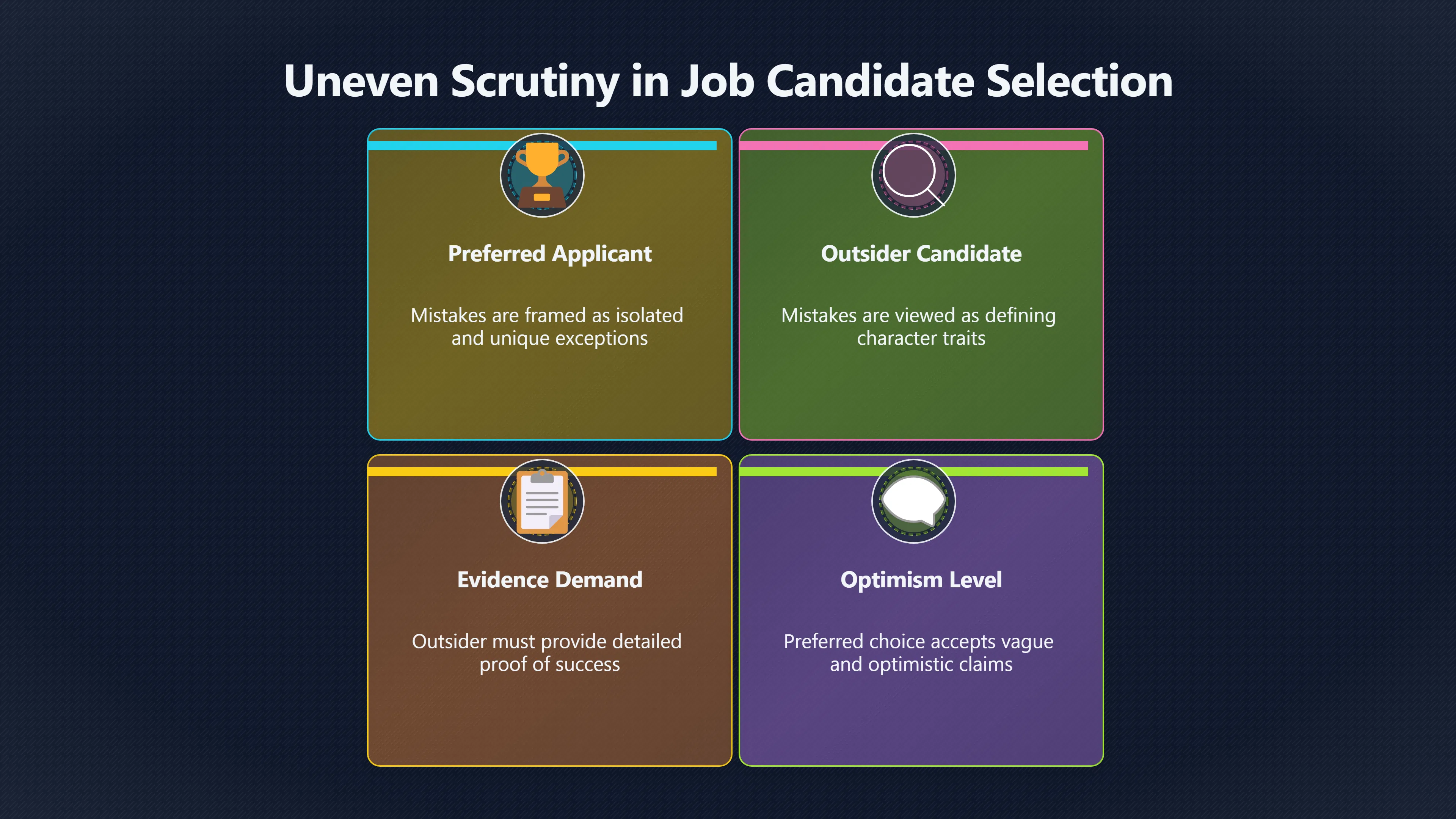
Imagine comparing two job candidates. One is your preferred applicant. The other is an outsider. Without noticing it, you might:
- Explain your preferred candidate’s mistakes as exceptions while treating the other candidate’s mistakes as defining traits.
- Demand detailed evidence that the outsider can succeed while accepting vague optimism about your preferred choice.
- Interpret ambiguous information generously for one candidate but sceptically for the other.
The comparison now reflects different rules rather than different evidence.
Psychologists distinguish between evaluating evidence and evaluating whether evidence is “good enough”. Confirmation bias affects not only which information people seek but also how they judge its quality. Evidence consistent with prior beliefs is often accepted more readily, while contradictory evidence faces greater criticism or is dismissed as flawed. [UC San Diego Pages]pages.ucsd.eduAs already noted, this is not to.Read moreUC San Diego PagesConfirmation Bias: A Ubiquitous Phenomenon in Many…October 6, 2004 — by RS Nickerson · 1998 · Cited by 12458 — Peopl…
This explains why people can sincerely believe they are being fair while consistently reaching conclusions that favour their existing preferences.
The hidden shift in burden of proof
An especially common pattern is silently changing the burden of proof.
For example:
- Favoured option: “Unless there is strong evidence against it, it deserves the benefit of the doubt.”
- Disliked option: “Unless there is overwhelming evidence for it, I remain unconvinced.”
Both statements may sound cautious, yet they impose different requirements.
The same problem appears when comparing investments, policy proposals, software tools, medical treatments, or competing explanations for an event. One possibility receives presumption of competence while the other must prove perfection.
A fair comparison asks whether identical evidence would have been considered sufficient regardless of which option it supported.
Signs that one option is getting special treatment
Because unequal standards usually operate automatically, it helps to recognise warning signs.
Different explanations for similar evidence
If similar facts receive different interpretations depending on whose side they support, scrutiny has become uneven.
For example:
Similar observationFavoured interpretationUnfavoured interpretationMissed deadlineUnusual circumstancesPoor reliabilitySuccessful outcomeEvidence of skillMere luckFailed predictionHonest mistakeProof of incompetence
The issue is not whether either explanation is impossible. The question is whether both explanations are considered equally available for competing options.
One side gets exceptions, the other gets patterns
People naturally excuse isolated failures by those they trust while treating identical failures by competitors as evidence of a lasting flaw.
Ask yourself:
- Am I calling this “an exception” only because I already liked the person or idea?
- Would I describe the same event differently if the roles were reversed?
Different standards for evidence quality
Another warning sign is requiring different levels of evidence.
Examples include:
- accepting anecdotes for one claim but demanding large studies for another;
- trusting expert opinion only when it agrees with your position;
- treating uncertainty as acceptable for one option but unacceptable for another.
Research on motivated reasoning shows that people often ask “Can I believe this?” when encountering desirable information but “Must I believe this?” when confronting unwelcome information. The standard of evaluation changes with the desired conclusion rather than remaining constant. [Wikipedia]WikipediaMotivated reasoningMotivated reasoning
A repeatable same-standard checklist for decisions
Metacognitive fairness becomes easier when you ask the same questions of every option before reaching a conclusion.
1. Define the evaluation criteria first
Before looking closely at individual options, write down the criteria you intend to use.
For example:
- expected benefits;
- costs;
- uncertainty;
- supporting evidence;
- practical risks.
Defining criteria in advance reduces the temptation to invent new standards that conveniently favour whichever option currently seems most attractive.
2. Reverse the identities
A powerful test is to swap the names mentally.
Ask:
- If these two proposals exchanged labels, would I still judge them the same way?
- Would identical evidence change my confidence equally?
If the answer changes simply because the source changes, your reasoning may be driven more by prior attitudes than by the evidence itself.
3. Match the questions exactly
Ask every competing option identical questions.
For example:
- What evidence supports it?
- What evidence challenges it?
- What assumptions does it depend upon?
- Under what circumstances would it fail?
- What evidence would make me change my mind?
Using parallel questions prevents one option from receiving an informal interview while the other undergoes a cross-examination.
4. Compare uncertainty consistently
Every realistic option contains unknowns.
Instead of asking whether uncertainty exists, ask whether comparable uncertainty is being tolerated equally.
Questions include:
- Am I treating uncertainty as acceptable only when it favours my preferred option?
- Am I exaggerating uncertainty only for alternatives I dislike?
5. Look for asymmetric language
Your wording often reveals different standards before your reasoning does.
Compare statements such as:
- “This proves it.”
- “That merely suggests it.”
or:
- “This mistake was understandable.”
- “That mistake was irresponsible.”
If the underlying situations are similar, differences in language may signal differences in judgement rather than differences in evidence.
Why this habit improves analytical thinking
Applying the same standard does not guarantee correct conclusions. Different options genuinely deserve different evaluations when the evidence differs.
Its value lies elsewhere: it separates evidence from preference.
Once you consistently ask whether competing options have faced the same burden of proof, hidden assumptions become easier to detect. Comparisons become more reliable because conclusions depend less on which option felt familiar or attractive and more on whether each option survived an equivalent test.
That is a practical form of metacognition. Instead of asking only, “Which option is better?”, you also ask, “Did I judge every option by the same rules?” The second question often determines whether the first answer deserves confidence.
Amazon book picks
Further Reading
Books and field guides related to Are You Grading Every Option Fairly?. Use these as the next step if you want deeper reading beyond the article.
Decisive
Provides structured methods for evaluating options more fairly and avoiding biased comparisons.
The Scout Mindset
Focuses on recognizing motivated reasoning and applying consistent standards to evidence.
Thinking, Fast and Slow
Explains confirmation bias, inconsistent evaluation, and systematic errors in judging alternatives.
The Art of Thinking Clearly
Highlights biases that cause people to judge favored and disfavored options differently.
eBay marketplace picks
Marketplace Samples
Live-tested eBay searches with available results related to this page.


Endnotes
-
Source: Wikipedia
Title: Motivated reasoning
Link: https://en.wikipedia.org/wiki/Motivated_reasoning -
Source: Wikipedia
Title: Confirmation bias
Link: https://en.wikipedia.org/wiki/Confirmation_biasSource snippet
Confirmation biasConfirmation bias is the tendency to search for, interpret, favor and recall information in a way that confirms or su...
-
Source: pages.ucsd.edu
Title: (As already noted, this is not to.Read more
Link: https://pages.ucsd.edu/~mckenzie/nickersonConfirmationBias.pdfSource snippet
UC San Diego PagesConfirmation Bias: A Ubiquitous Phenomenon in Many...October 6, 2004 — by RS Nickerson · 1998 · Cited by 12458 — Peopl...
Published: October 6, 2004
Additional References
-
Source: scholarworks.sjsu.edu
Link: https://scholarworks.sjsu.edu/cgi/viewcontent.cgi?article=8295&context=etd_thesesSource snippet
Study on Beliefs and Motivated Reasoningby ZA Caddick · 2016 · Cited by 7 — Motivated reasoning is intrinsically related to, but distinct...
-
Source: newslit.org
Title: in brief confirmation bias motivated reasoning
Link: https://newslit.org/news-and-research/in-brief-confirmation-bias-motivated-reasoning/Source snippet
News Literacy ProjectIn brief: Confirmation bias and motivated reasoning20 Jul 2022 — Confirmation bias is an innate, unconscious tendenc...
-
Source: researchgate.net
Title: Why Is It So Hard to Change Our Minds?
Link: https://www.researchgate.net/publication/399856432_Why_Is_It_So_Hard_to_Change_Our_Minds_Confirmation_Bias_and_the_Competencies_of_Belief_RevisionSource snippet
Confirmation Bias...18 Jan 2026 — Confirmation bias, motivated reasoning, and [biased assimilation]({{ 'mixed-evidence-accf68/' | relative_url }})... Drawing on converging empirical ev...
-
Source: youtube.com
Link: http://www.youtube.com/watch?v=nq1Uw069J-0Source snippet
Why you think you're right -- even if you're wrong | Julia Galef...
-
Source: youtube.com
Title: The psychology behind irrational decisions
Link: http://www.youtube.com/watch?v=V2EMuoM5IX4Source snippet
Motivated reasoning confirmation bias decision making The Confirmation Bias Sprouts...
-
Source: pmc.ncbi.nlm.nih.gov
Link: https://pmc.ncbi.nlm.nih.gov/articles/PMC11393549/Source snippet
of misinformation as motivational and cognitive...by Y Zhou · 2024 · Cited by 25 — Confirmation bias, is the tendency to seek, interpret...
-
Source: alignmentforum.org
Link: https://www.alignmentforum.org/posts/QpgmEhBvJQxAfFMP2/motivated-reasoning-confirmation-bias-and-ai-risk-theorySource snippet
Motivated reasoning, confirmation bias, and AI risk theory5 May 2026 — Studies have demonstrated confirmation bias in selecting evidence...
Published: May 2026
-
Source: fs.blog
Link: https://fs.blog/confirmation-bias/Source snippet
This cognitive bias is...Read more...
-
Source: youtube.com
Title: The Confirmation Bias
Link: http://www.youtube.com/watch?v=Kho5KvPBDSwSource snippet
Decoding Motivated Reasoning: The Psychology Behind Confirmation Bias and How to Overcome it...
-
Source: youtube.com
Title: How to make smart decisions more easily
Link: http://www.youtube.com/watch?v=X7j8F16eSqsSource snippet
The psychology behind irrational decisions - Sara Garofalo...
Topic Tree