Within Source Quality
The Wrong Expert Can Still Sound Right
A source's credentials matter only when its expertise fits the specific claim being evaluated.
On this page
- General prestige versus relevant competence
- Examples of mismatched expertise
- How to match source authority to a claim
Page outline Jump by section
Introduction
When assessing whether a source is trustworthy, one of the most important questions is not “Is this person an expert?” but “Are they an expert on this specific claim?” Expertise is highly specialised. A distinguished physicist is not automatically a reliable guide to nutrition, and a respected surgeon is not necessarily qualified to interpret economic policy. Good critical thinking therefore focuses on the fit between the source’s expertise and the claim being evaluated, rather than on prestige, fame or impressive credentials alone.
 This distinction helps avoid two common mistakes. The first is accepting claims because they come from someone with status, even when the topic lies outside their competence. The second is dismissing relevant experts simply because they are less famous than commentators from unrelated fields. Sound source evaluation begins by asking whether the source is genuinely positioned to know.
General prestige is not the same as relevant competence
People often use credentials as a shortcut for judging reliability. This is understandable because expertise usually does increase the chances of being right. However, expertise is domain-specific, not universal.
A person may have extensive training, years of experience and an impressive reputation while still lacking the knowledge needed for a different subject. Accepting a claim solely because it comes from a respected figure outside the relevant field is a classic form of misplaced authority. Logic texts describe this as an appeal to an unqualified authority rather than a legitimate use of expert testimony. [Scribbr]scribbr.co.ukScribbr Appeal to Authority Fallacy | Definition & ExamplesAppeal to Authority Fallacy | Definition & Examples - ScribbrJune 16, 2023 — 16 Jun 2023 — Appeal to authority fallacy occurs when…
Instead of asking:
- Is this person intelligent?
- Are they famous?
- Do they have advanced qualifications?
Ask:
- What exactly is their area of expertise?
- Does this claim fall within that area?
- Would professionals in that speciality normally be expected to know the answer?
The narrower and more technical the claim, the more important this matching becomes.
The wrong expert can still sound convincing
People frequently mistake confidence, reputation or academic status for relevant expertise. Several common situations illustrate why this is risky.
A Nobel Prize winner commenting outside their discipline. Winning the highest honour in chemistry does not automatically make someone’s views on constitutional law, psychology or public health equally authoritative.
A medical doctor discussing climate modelling. Medical training provides expertise in diagnosis and treatment, not atmospheric science or climate simulation.
An engineer offering legal advice. Engineers understand technical systems, but interpreting legislation requires different training, methods and professional standards.
A celebrity promoting nutrition products. Public recognition can create perceived authority even when there is no relevant scientific knowledge behind the recommendation.
In each example, the speaker may be highly capable within their own profession. The problem is not intelligence but mismatch between expertise and the claim.
Match authority to the actual question
Many disagreements disappear once the claim is made more precise.
Consider these examples.
ClaimMost relevant expertiseIs this medicine effective?Clinical researchers, physicians specialising in the condition, systematic evidence reviewsIs this bridge structurally safe?Structural engineers with relevant design or inspection expertiseDoes this law permit a particular action?Lawyers or judges specialising in that area of lawWhat caused a cybersecurity breach?Digital forensics specialists and cybersecurity investigatorsWill this economic policy reduce inflation?Economists working in macroeconomics, supported by empirical evidence
Notice that even broad professions contain specialisations. An emergency physician, a psychiatrist and an epidemiologist are all doctors, yet each has different expertise. Similarly, a computer scientist specialising in machine learning is not automatically an authority on cryptography or software safety.
The more narrowly defined the claim, the more narrowly relevant the expertise usually becomes.

Why institutions often matter more than famous individuals
Many important questions are too broad or technically complex for any single expert to answer reliably. This is why scientific academies, professional societies, regulatory agencies and systematic evidence reviews often provide stronger guidance than individual opinions.
These organisations typically combine expertise from multiple specialists, review available evidence, document uncertainty and update conclusions when new evidence appears. Their authority comes less from the prestige of one individual than from transparent methods and collective evaluation.
For example, when evaluating vaccine safety, the most relevant sources are generally organisations responsible for reviewing large bodies of clinical evidence rather than isolated opinions from individual doctors speaking outside established evidence reviews. This reflects the difference between expertise exercised through systematic assessment and personal opinion.
Signs that expertise genuinely matches the claim
Several practical questions help determine whether expertise is relevant.
- Does the person’s training directly relate to the claim?
- Do they regularly work on this type of problem?
- Have they published or conducted recognised work in this area?
- Would other specialists regard this as part of their field?
- Are they explaining evidence within their competence rather than speculating beyond it?
No single answer guarantees reliability, but together these questions help distinguish genuine authority from superficial credibility.
Be careful with titles that hide important differences
Professional titles can create an illusion of interchangeable expertise.
For example:
- “Scientist” includes thousands of different disciplines.
- “Doctor” covers surgeons, psychiatrists, radiologists, pathologists and many other specialties.
- “Professor” describes an academic position, not a specific subject.
- “Researcher” says little unless the research area is known.
A title tells you that someone has expertise somewhere. It does not tell you whether they are qualified to answer the particular question in front of you.
Whenever possible, identify the person’s actual speciality rather than relying on a broad label.
Relevant expertise is necessary but not sufficient
Matching expertise to a claim improves the odds of receiving accurate information, but it does not guarantee correctness.
Relevant experts can still:
- misunderstand evidence;
- make reasoning errors;
- speak outside the available evidence;
- have conflicts of interest;
- disagree with other qualified experts.
For that reason, expertise should be treated as one part of source evaluation rather than the final answer. Good analysis also considers the quality of evidence, transparency about methods, acknowledgement of uncertainty and whether other independent experts working in the same field reach similar conclusions. Journalism guidance similarly emphasises evaluating whether a source is genuinely in a position to know while recognising that reporters must still judge credibility, evidence and accountability rather than relying on credentials alone. [reutersinstitute.politics.ox.ac.uk]reutersinstitute.politics.ox.ac.uknew vocabulary journalisms growing problem expertiseA new vocabulary for journalism's growing problem with…20 Jan 2026 — Journalists are structurally epistemically inferior to the expert…
A practical decision process
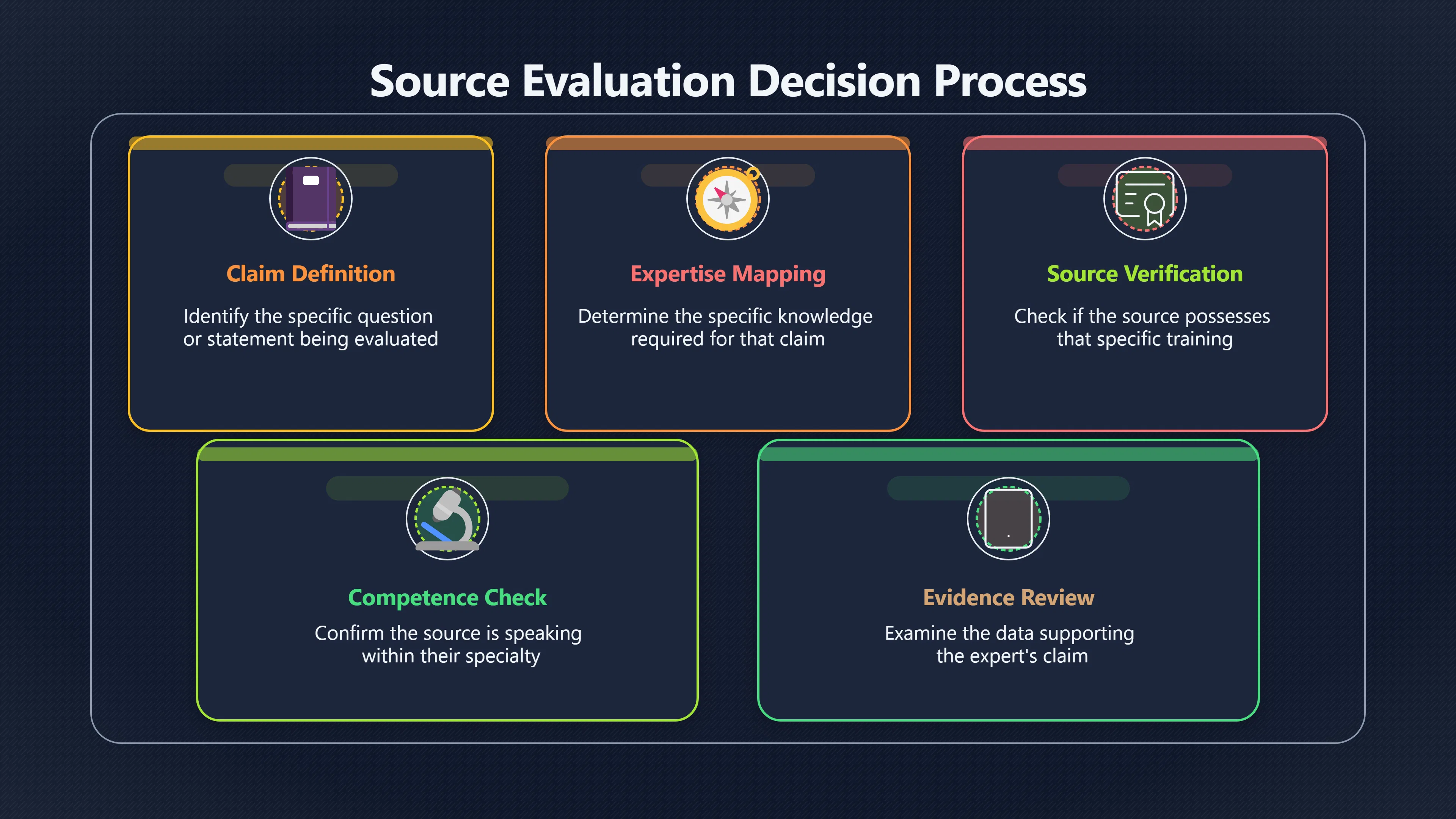
When evaluating an expert source, work through these questions in order:
- What exactly is the claim? Define it as precisely as possible.
- What kind of expertise would someone need to know this? Think about the specific knowledge required rather than broad status.
- Does the source actually possess that expertise? Look beyond titles to training, experience and professional work.
- Are they speaking within that expertise? Experts are often strongest when discussing their own speciality.
- What evidence accompanies the claim? Expertise supports credibility, but evidence ultimately carries the argument.
This approach keeps attention on the connection between the source and the claim instead of being distracted by reputation alone. The result is a more reliable way of judging information—one that values the right expertise, not simply the most impressive-looking expert.
Amazon book picks
Further Reading
Books and field guides related to The Wrong Expert Can Still Sound Right. Use these as the next step if you want deeper reading beyond the article.
The Death of Expertise
Directly addresses misuse, dismissal, and misunderstanding of expertise in public reasoning.
Calling Bullshit
Helps readers test whether impressive claims are supported by evidence and relevant competence.
The Scout Mindset
Encourages judging claims by evidence and fit rather than prestige, identity, or comfort.
Expert Political Judgment
Shows that expert judgement depends on domain fit, methods, feedback, and intellectual style.
eBay marketplace picks
Marketplace Samples
Live-tested eBay searches with available results related to this page.




Endnotes
-
Source: scribbr.co.uk
Title: Scribbr Appeal to Authority Fallacy | Definition & Examples
Link: https://www.scribbr.co.uk/fallacy/the-appeal-to-authority-fallacy/Source snippet
Appeal to Authority Fallacy | Definition & Examples - ScribbrJune 16, 2023 — 16 Jun 2023 — Appeal to authority fallacy occurs when...
Published: June 16, 2023
-
Source: reutersinstitute.politics.ox.ac.uk
Title: new vocabulary journalisms growing problem expertise
Link: https://reutersinstitute.politics.ox.ac.uk/new-vocabulary-journalisms-growing-problem-expertiseSource snippet
A new vocabulary for journalism's growing problem with...20 Jan 2026 — Journalists are structurally epistemically inferior to the expert...
Additional References
-
Source: thinkingispower.com
Link: https://thinkingispower.com/logical-fallacies/Source snippet
Guide to the Most Common Logical FallaciesLogical fallacies are flaws in reasoning that weaken or invalidate an argument. Learning how to...
-
Source: yourlogicalfallacyis.com
Link: https://yourlogicalfallacyis.com/appeal-to-authoritySource snippet
Your logical fallacy is appeal to authorityAppeals to authority are not valid arguments, but nor is it reasonable to disregard the claims...
-
Source: yourlocalepidemiologist.substack.com
Link: https://yourlocalepidemiologist.substack.com/p/5-more-logical-fallacies-in-the-eraSource snippet
substack.com5 (more) logical fallacies in the era of RFK Jr.The appeal to authority fallacy says that authority figures (experts) are alw...
-
Source: facebook.com
Title: Why some people think our chart is from Harvard (it’s not)
Link: https://www.facebook.com/adfontesmedia/posts/why-some-people-think-our-chart-is-from-harvard-its-not-and-what-that-can-teach-/1225779949570420/Source snippet
citing an authority's expertise to support a claim isn't a logical fallacy. These are known as legitimate appeals to authority. The post...
-
Source: Wikipedia
Title: Argument from authority
Link: https://en.wikipedia.org/wiki/Argument_from_authoritySource snippet
Argument from authorityAn argument from authority is a form of argument in which the opinion of an authority figure (or figures) is us...
-
Source: read.aupress.ca
Title: Chapter 16
Link: https://read.aupress.ca/read/critical-thinking-logic-and-argument/section/37569f83-38fb-40e0-9575-ede2c97e5753Source snippet
Fallacies of Expertise | Critical Thinking, Logic...The appeal to authority is a fallacy where we take something as fact just because an...
-
Source: youtube.com
Title: Critical Thinking: The Fallacy of Argument From Authority
Link: https://www.youtube.com/watch?v=RsbG04ki2iASource snippet
Appeal to Unqualified Authority (Logical Fallacy)...
-
Source: youtube.com
Title: Ballantyne: Epistemic Trespassing
Link: https://www.youtube.com/watch?v=cvTnw6nu4rsSource snippet
Evaluating Sources: Understanding Authority...
-
Source: youtube.com
Title: Appeal to Unqualified Authority (Logical Fallacy)
Link: https://www.youtube.com/watch?v=_mEfVIftnR0Source snippet
Ballantyne: Epistemic Trespassing...
-
Source: youtube.com
Title: Evaluating Sources: Understanding Authority
Link: https://www.youtube.com/watch?v=1WddY_ppllM
Topic Tree