Within Search Bias
Is Your Search Query Already Taking Sides?
The words in a search box can quietly decide which evidence appears before the reader has clicked a single result.
On this page
- Directional words that smuggle in a conclusion
- Neutral rewrites that widen the evidence base
- Testing the same claim with opposing search language
Page outline Jump by section
Introduction
The words you type into a search box are not a neutral description of what you want to know. They are instructions that help determine which evidence appears first. A search such as “Why is intermittent fasting unhealthy?” asks for a different information landscape from “Evidence on the health effects of intermittent fasting”. Before you have read a single result, the wording has already narrowed the range of answers you are likely to see.
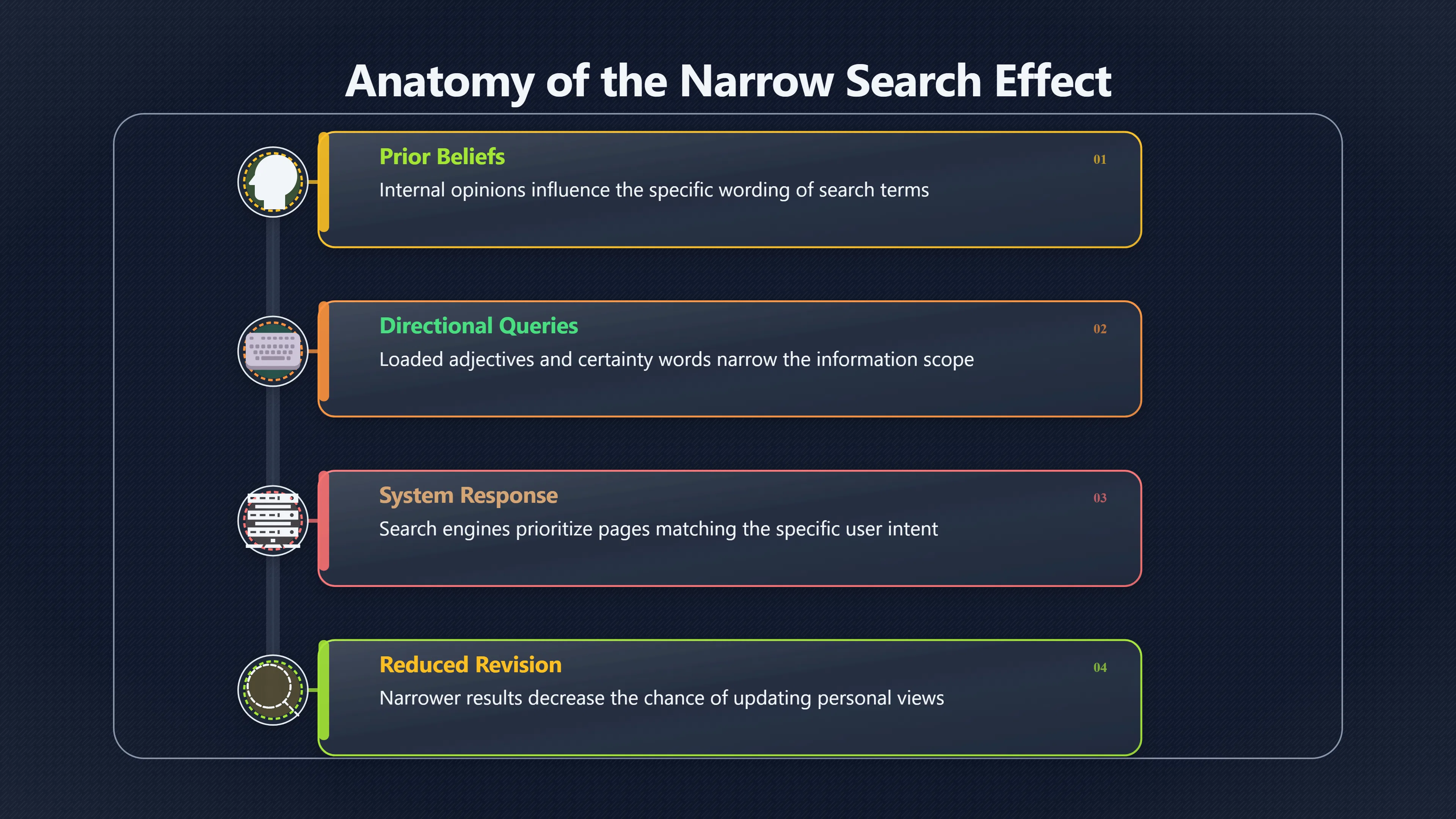
 This is one of the simplest ways confirmation bias enters online research. Rather than deliberately ignoring opposing evidence, people often build a conclusion into the query itself. Recent research calls this the narrow search effect: prior beliefs influence the wording of search terms, those terms produce narrower search results, and narrower results reduce the chance that people revise their views. This pattern has been observed across conventional search engines and AI-assisted search systems. [PNAS]pnas.orgThe narrow search effect and how broadening…24 Mar 2025 — Directionally narrow search terms are a modern manifestation of the long…
Directional words that smuggle in a conclusion
Many search queries contain hidden assumptions. They appear to ask for information, but they actually ask for confirmation.
Common examples include:
- “Why electric cars are bad for the environment”
- “Evidence that remote working reduces productivity”
- “Proof vaccines are unsafe”
- “Why teenagers are addicted to social media”
Each query embeds a preferred explanation before the search begins. Search systems are designed to satisfy user intent, so they naturally prioritise pages that appear relevant to those words. This does not necessarily mean the search engine is biased; it is responding to the request it was given. [PNAS]pnas.orgThe narrow search effect and how broadening…24 Mar 2025 — Directionally narrow search terms are a modern manifestation of the long…
Directional wording often appears through small linguistic choices:
- Assumed causes: “What causes…” instead of “What factors are associated with…”
- Loaded adjectives: “dangerous”, “miracle”, “corrupt”, “fake”, “proven”
- Certainty words: “proof”, “debunked”, “exposed”
- One-sided framing: “benefits of…” without ever searching for risks, or vice versa.
These subtle choices can dramatically change which pages appear near the top of the results.
Neutral rewrites that widen the evidence base
One of the easiest ways to improve analytical thinking is to rewrite a directional query into one that invites multiple explanations rather than assuming one.
Directional queryBroader alternativeWhy is nuclear energy dangerous?Evidence on the risks and benefits of nuclear energyWhy does coffee raise blood pressure?Research on coffee and blood pressureWhy does remote work fail?Evidence comparing remote and office productivityWhy are smartphones harming children?Research on the effects of smartphone use in childrenProof that AI replaces jobsEvidence on AI’s effects on employment
Notice that the neutral versions do not pretend every claim has equal support. Instead, they avoid telling the search engine which conclusion to favour before the evidence has been examined.
Research suggests that deliberately broadening search terms helps people encounter a wider range of information and increases belief updating compared with naturally generated directional searches. Experimental interventions encouraging broader search wording reduced the influence of prior beliefs on what people ultimately concluded. [PNAS]pnas.orgThe narrow search effect and how broadening…24 Mar 2025 — Directionally narrow search terms are a modern manifestation of the long…
Testing the same claim with opposing search language
A practical way to detect hidden bias is to search the same topic using deliberately different wording.
Suppose you want to investigate whether caffeine is beneficial.
Instead of relying on one search, try three:
- Positive framing: “Health benefits of caffeine”
- Negative framing: “Health risks of caffeine”
- Neutral framing: “Systematic reviews on caffeine health effects”
Comparing the first page of results often reveals that each search highlights different evidence, organisations and summaries. The contrast reminds you that your query is influencing what you see rather than merely uncovering a fixed set of facts.
The 2025 studies on the narrow search effect demonstrated this experimentally. Participants randomly assigned opposite directional search terms reached measurably different post-search beliefs, even though they were investigating the same underlying issue. Similar effects appeared when participants queried AI systems, despite AI-generated answers acknowledging opposing viewpoints. [PNAS]pnas.orgThe narrow search effect and how broadening…24 Mar 2025 — Directionally narrow search terms are a modern manifestation of the long…
Why this mechanism is easy to overlook
Biased query wording is difficult to notice because it feels like ordinary curiosity.
People rarely think:
“I want evidence that supports my existing belief.”
Instead they often think:
“I’m just searching for information.”
Yet their existing opinion influences the verbs, adjectives and assumptions built into the query. The resulting search feels objective because it comes from a familiar search engine, even though the starting instruction was already directional.
Earlier research on web search reached a similar conclusion. When confirming and disconfirming evidence tend to be described using different language, the wording of a query can substantially affect which evidence is retrieved, making confirmation easier even without any conscious intention to ignore opposing information. [CORE]core.ac.ukals' tendency to seek confirming evidence should have biased their search queries through framing or…
Research on academic search engines also suggests that biased queries can produce systematically different scholarly results, indicating that this issue is not confined to general web searches. Technology-related topics showed particularly noticeable differences between positively and negatively framed academic queries. [arXiv]arxiv.orgExamining bias perpetuation in academic search engines: an algorithm audit of Google and Semantic ScholarNovember 16, 2023…
Practical habits that reduce query bias
You cannot remove all bias from searching, but you can reduce its influence by treating your first query as a draft rather than a final investigation.
Useful habits include:
- Rewrite emotionally loaded searches into descriptive ones.
- Replace “why” with “what evidence” when investigating disputed claims.
- Search for systematic reviews or evidence summaries before individual anecdotes.
- Deliberately perform one search that challenges your initial expectation.
- Compare whether changing only a few words produces substantially different results.
These habits shift the search from proving a belief towards testing it. That small change in wording widens the evidence base and makes it less likely that the search box quietly decides the answer before you begin reading.
Amazon book picks
Further Reading
Books and field guides related to Is Your Search Query Already Taking Sides?. Use these as the next step if you want deeper reading beyond the article.
The Scout Mindset
Directly supports rewriting questions to seek evidence instead of confirmation.
Super Thinking
Helps readers frame questions more objectively and avoid predictable reasoning traps.
The Art of Thinking Clearly
Includes practical examples of biased thinking relevant to search query formulation.
Calling Bullshit
Promotes neutral investigation and careful interpretation of evidence from online sources.
eBay marketplace picks
Marketplace Samples
Live-tested eBay searches with available results related to this page.




Endnotes
-
Source: pnas.org
Link: https://www.pnas.org/doi/10.1073/pnas.2408175122Source snippet
The narrow search effect and how broadening...24 Mar 2025 — Directionally narrow search terms are a modern manifestation of the long...
-
Source: core.ac.uk
Link: https://core.ac.uk/download/pdf/301367349.pdfSource snippet
als' tendency to seek confirming evidence should have biased their search queries through framing or...
-
Source: arxiv.org
Link: https://arxiv.org/abs/2311.09969Source snippet
Examining bias perpetuation in academic search engines: an algorithm audit of Google and Semantic ScholarNovember 16, 2023...
Published: November 16, 2023
-
Source: arxiv.org
Link: https://arxiv.org/pdf/2311.09969Source snippet
More research is...
-
Source: Wikipedia
Title: Confirmation bias
Link: https://en.wikipedia.org/wiki/Confirmation_biasSource snippet
Confirmation biasConfirmation bias is the tendency to search for, interpret, favor and recall information in a way that confirms or su...
Additional References
-
Source: semanticscholar.org
Link: https://www.semanticscholar.org/paper/Confirmation-Bias%3A-Roles-of-Search-Engines-and-Kayhan/3fd009f1c0edd137969aa6d3f943f1a4f0ff2e7cSource snippet
[PDF] Confirmation Bias: Roles of Search Engines and...Results of two studies show that search engines may exacerbate confirmation bias...
-
Source: researchgate.net
Link: https://www.researchgate.net/publication/390140594_The_narrow_search_effect_and_how_broadening_search_promotes_belief_updatingSource snippet
The narrow search effect and how broadening...24 Mar 2025 — Studies 1 to 5 show that users' prior beliefs influence the direction of the...
-
Source: infodocket.com
Title: journal article search engine results and confirmation bias
Link: https://www.infodocket.com/2025/03/24/journal-article-search-engine-results-and-confirmation-bias/Source snippet
Journal Article: Search Engine Results and Confirmation Bias24 Mar 2025 — Studies 1 to 5 show that users' prior beliefs influence the dir...
-
Source: youtube.com
Link: https://www.youtube.com/watch?v=SwxT4_IfDKQSource snippet
Understand human psychology to get your users to do what you want – with Sarah Pokorná Presch...
-
Source: youtube.com
Link: https://www.youtube.com/watch?v=7PmX-oHndtYSource snippet
[Critical Thinking]({{ 'critical-skills/' | relative_url }}) Is On Decline, And I Figured Out Why...
-
Source: pmc.ncbi.nlm.nih.gov
Link: https://pmc.ncbi.nlm.nih.gov/articles/PMC12412720/Source snippet
artificial intelligence–mediated confirmation bias in...by E Lopez‐Lopez · 2025 · Cited by 35 — Online information ecosystems can amplif...
-
Source: youtube.com
Title: Critical Thinking Is On Decline, And I Figured Out Why
Link: https://www.youtube.com/watch?v=zXxVhcBiJV0Source snippet
The Search Engine Manipulation Effect (SEME) and Its Unparalleled Power...
-
Source: dl.acm.org
Link: https://dl.acm.org/doi/10.1145/3635034Source snippet
to Mitigate Confirmation Bias during Web Search...To alleviate cognitive demand, searchers might tend to adopt biased search behaviors...
-
Source: youtube.com
Link: https://www.youtube.com/watch?v=j91-yrhaGNY
Topic Tree