Within Expert Gut
When Experience Teaches the Wrong Lesson
Intuition improves when the world gives stable cues and clean correction, but wicked settings can train confident mistakes.
On this page
- What makes a learning environment kind
- How wicked environments mislead intuition
- Questions that reveal which world you are in
Page outline Jump by section
Introduction
Experience is not automatically a good teacher. Whether your gut judgement becomes more accurate or more misleading depends on the type of environment in which it was formed. Psychologist Robin Hogarth described this distinction as the difference between kind and wicked learning environments. In kind environments, the world provides stable patterns and clear, timely feedback, allowing intuition to improve through experience. In wicked environments, feedback is delayed, ambiguous, incomplete, or distorted, so confidence can grow even while accuracy does not. This distinction explains why experienced firefighters, chess players, and skilled mechanics often develop dependable intuition, whereas experienced investors, political commentators, or hiring managers may become increasingly confident without becoming substantially better at prediction. The central lesson is not to distrust intuition, but to ask whether the environment has actually trained it well. [PubMed]pubmed.ncbi.nlm.nih.govConditions for intuitive expertise: a failure to disagreeby D Kahneman · 2009 · Cited by 4015 — This article reports on an effort t…
What makes a learning environment kind?
A kind learning environment is one in which repeated experience reliably teaches useful lessons because the information available during learning closely matches the information needed when making future decisions. According to Hogarth, this close match between learning and application is what allows intuition to become calibrated rather than merely familiar. [Sage Journals]journals.sagepub.comSage JournalsThe Two Settings of Kind and Wicked Learning Environmentsby RM Hogarth · 2015 · Cited by 255 — Inference involves two settin…
Several characteristics usually appear together:
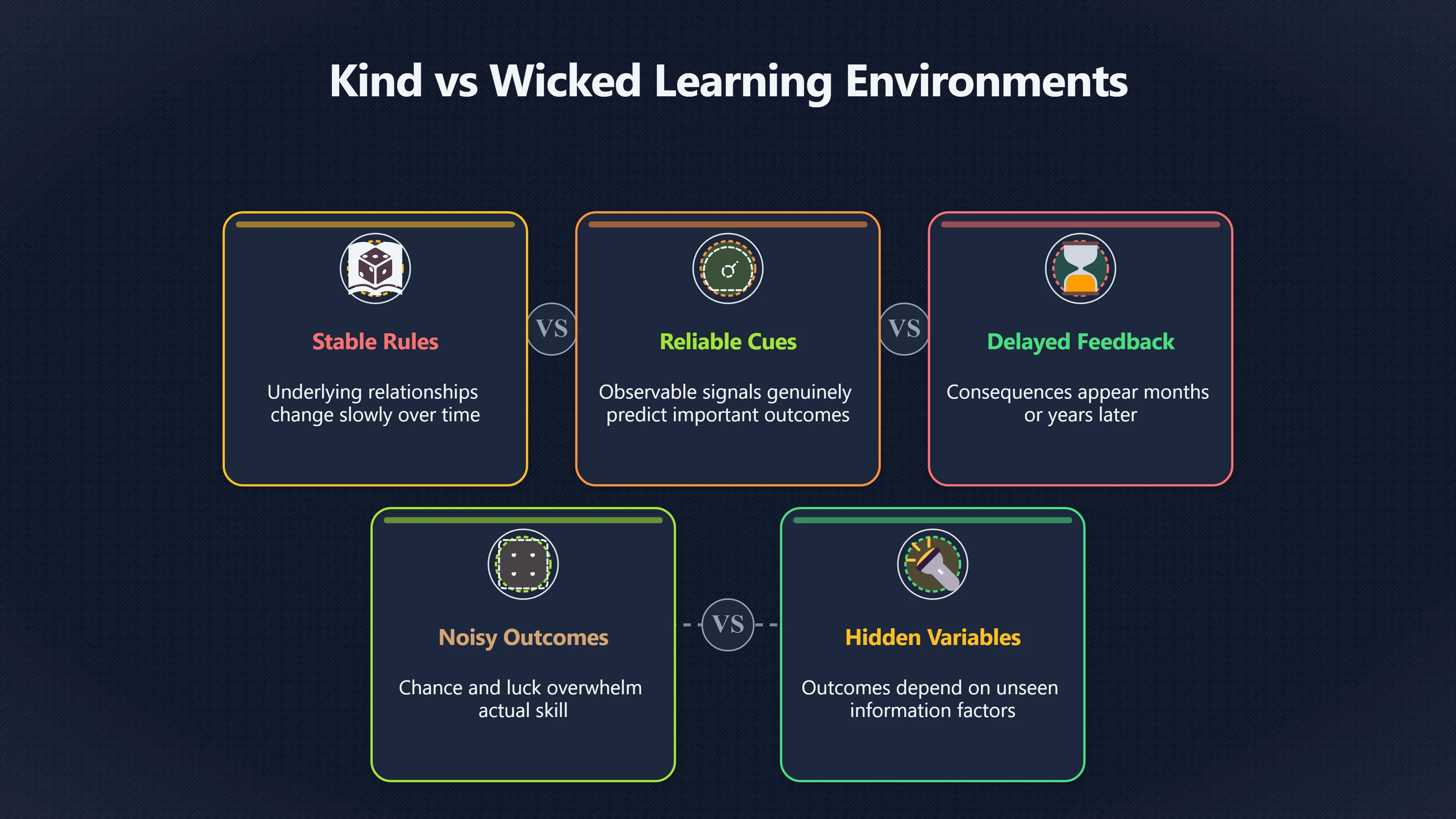
- Stable rules. The underlying relationships change slowly, so patterns learned yesterday still apply tomorrow.
- Reliable cues. Observable signals genuinely predict important outcomes instead of merely correlating by chance.
- Frequent repetition. Many similar cases allow the brain to distinguish genuine regularities from isolated anecdotes.
- Clear and prompt feedback. Successes and mistakes become visible quickly enough for incorrect mental models to be corrected.
- Opportunities for correction. Learners repeatedly compare expectations with reality rather than simply accumulating years of experience.
Chess illustrates nearly every one of these conditions. Positions follow fixed rules, every move produces immediate consequences, mistakes can be analysed afterwards, and thousands of comparable situations build pattern recognition. Likewise, experienced electricians, aircraft technicians, or emergency clinicians often receive enough repeated, informative feedback to refine their instincts over many years. [Sage Journals]journals.sagepub.comSage JournalsThe Two Settings of Kind and Wicked Learning Environmentsby RM Hogarth · 2015 · Cited by 255 — Inference involves two settin…
Importantly, “kind” does not mean easy. Chess is extraordinarily difficult, but it remains kind because the environment consistently rewards learning from mistakes. Difficulty and learnability are different properties.
How wicked environments mislead intuition
A wicked environment breaks one or more of the conditions that normally educate intuition. The world still produces outcomes, but those outcomes fail to teach the right lesson.
Several mechanisms make this happen.
Delayed feedback. When months or years pass before the consequences of a judgement become clear, it becomes difficult to connect outcome with cause. Investment decisions, strategic business choices, and many policy decisions suffer from this problem.
Noisy outcomes. Chance can overwhelm skill. A poor decision may succeed through luck, while a sound decision fails because of unpredictable events. Without many observations, people naturally mistake luck for ability.
Hidden variables. Outcomes often depend on information unavailable at the time of the decision. Because these factors remain unseen, decision-makers create explanations that fit the visible evidence, reinforcing false confidence.
Changing environments. Even if experience once reflected reality, shifting technology, incentives, markets, or social behaviour can make old patterns obsolete. Experience then teaches yesterday’s world instead of today’s.
Selective feedback. People often learn only from surviving cases. A manager may remember successful hires while never discovering the long-term performance of rejected candidates. A physician may rarely discover diagnoses that patients sought elsewhere. Missing information prevents genuine calibration.
In these settings, intuition can become fluent without becoming accurate. Familiarity produces confidence, but confidence is no guarantee that experience reflects reality. Kahneman and Klein argued that intuitive expertise requires not only repeated exposure but also an environment regular enough to permit genuine learning. [PubMed]pubmed.ncbi.nlm.nih.govConditions for intuitive expertise: a failure to disagreeby D Kahneman · 2009 · Cited by 4015 — This article reports on an effort t…
Why experience can increase confidence without increasing skill
One of the most counterintuitive findings in judgement research is that years of experience are not, by themselves, evidence of expertise.
People naturally build stories linking actions to outcomes. If positive outcomes occasionally follow a preferred strategy, the brain strengthens that association even when the relationship is largely coincidental. Because humans experience only one version of history—the decision actually taken—they rarely observe the alternatives that might have produced similar or better results.
This helps explain why experienced professionals sometimes disagree strongly while each sincerely believes their experience has proved them right. In wicked environments, different individuals encounter different samples of events, receive incomplete feedback, and construct different mental models that all feel well supported by experience.
Hogarth argued that many intuitions are therefore products not simply of repetition but of the quality of the learning environment itself. Experience teaches something in every environment; the question is whether it teaches the correct lesson. [Sage Journals]journals.sagepub.comSage JournalsThe Two Settings of Kind and Wicked Learning Environmentsby RM Hogarth · 2015 · Cited by 255 — Inference involves two settin…
Questions that reveal which world you are in
Before trusting a gut judgement, it is often more useful to evaluate the environment than the feeling itself.
Ask questions such as:
- Are the rules reasonably stable, or do they change frequently?
- Do similar situations usually produce similar outcomes?
- Will I receive clear feedback if I am wrong?
- Is the feedback prompt enough to connect cause and effect?
- Can luck easily disguise bad decisions or punish good ones?
- Have I seen many genuinely comparable cases, or only memorable ones?
- Can I verify my beliefs independently, or only through personal experience?
The more “yes” answers to the first four questions and “no” answers to the last three, the more likely intuition deserves weight. The reverse suggests that analytical methods, external evidence, structured decision processes, or statistical models should receive greater emphasis.

Practical implications for better thinking
The distinction between kind and wicked environments does not imply abandoning intuition. Instead, it suggests matching intuition to the conditions under which it developed.
In relatively kind environments, intuition often provides rapid recognition of meaningful patterns that analysis may only confirm afterwards. In wicked environments, intuition is better treated as a hypothesis generator than a decision maker. A strong feeling can identify where to investigate, but not where to stop thinking.
One practical response is to make wicked environments more kind wherever possible. Decision journals, systematic outcome tracking, regular post-mortems, deliberate practice with immediate feedback, and objective performance metrics all improve the quality of learning. By creating clearer feedback loops, they help distinguish genuine expertise from accumulated confidence.
Research has increasingly reinforced this perspective. Recent work suggests that flexible movement between intuitive and analytical thinking performs better in difficult, “wicked” environments than relying rigidly on either style alone. Rather than asking whether intuition is good or bad, the more useful question is whether the environment has earned your trust. [bpspsychub.onlinelibrary.wiley.com+2PubMed]bpspsychub.onlinelibrary.wiley.comChallenging the doctrine of “non‐discerning” decision‐making…20 Sept 2023 — When making decisions in stable or “kind” learning environ…
Amazon book picks
Further Reading
Books and field guides related to When Experience Teaches the Wrong Lesson. Use these as the next step if you want deeper reading beyond the article.
Educating Intuition
Direct source for understanding when experience teaches accurate or misleading lessons.
Sources of Power
Provides contrasting examples of environments where experience genuinely builds expertise.
Superforecasting
Demonstrates how structured feedback improves prediction in difficult environments.
eBay marketplace picks
Marketplace Samples
Live-tested eBay searches with available results related to this page.



Endnotes
-
Source: pubmed.ncbi.nlm.nih.gov
Link: https://pubmed.ncbi.nlm.nih.gov/19739881/Source snippet
Conditions for intuitive expertise: a failure to disagreeby D Kahneman · 2009 · Cited by 4015 — This article reports on an effort t...
-
Source: journals.sagepub.com
Link: https://journals.sagepub.com/doi/abs/10.1177/0963721415591878Source snippet
Sage JournalsThe Two Settings of Kind and Wicked Learning Environmentsby RM Hogarth · 2015 · Cited by 255 — Inference involves two settin...
-
Source: bpspsychub.onlinelibrary.wiley.com
Link: https://bpspsychub.onlinelibrary.wiley.com/doi/10.1111/joop.12467Source snippet
Challenging the doctrine of “non‐discerning” decision‐making...20 Sept 2023 — When making decisions in stable or “kind” learning environ...
-
Source: dictionary.cambridge.org
Link: https://dictionary.cambridge.org/zht/%E8%A9%9E%E5%85%B8/%E8%8B%B1%E8%AA%9E-%E6%BC%A2%E8%AA%9E-%E7%B9%81%E9%AB%94/kindSource snippet
cambridge.orgKIND中文(繁體)翻譯:劍橋詞典KIND翻譯:寬容的;有益的;體貼的, 溫和的;無害的, 種類。了解更多。...
-
Source: dictionary.cambridge.org
Title: in kind
Link: https://dictionary.cambridge.org/zht/%E8%A9%9E%E5%85%B8/%E8%8B%B1%E8%AA%9E-%E6%BC%A2%E8%AA%9E-%E7%B9%81%E9%AB%94/in-kindSource snippet
KIND中文(繁體)翻譯:劍橋詞典in kind的翻譯... 以实物支付,以货代款, 以服务偿付, 以同样方法(或手段)…... 需要一個翻譯器嗎? 獲得快速、免費的翻譯!... in kind的發音是什麼?Read more...
-
Source: jstor.org
Link: https://www.jstor.org/stable/44318900Source snippet
Kind learning environments are a necessary condition for accurate intuitive judgments, whereas intuitions...
-
Source: ehanlin.com.tw
Link: https://www.ehanlin.com.tw/app/keyword/%E5%9C%8B%E4%B8%AD/%E8%8B%B1%E8%AA%9E/kind.htmlSource snippet
國中英語kind(adj) · 音標: [kaɪnd] · 解釋: 親切的 · 例句: The boss is always kind to the customers. 翻譯: 這位老闆對顧客總是很親切。 · 變化: 原形: kind [kaɪnd]. 比較級:...R...
Additional References
-
Source: linkedin.com
Link: https://www.linkedin.com/posts/yuliia-drobot_pdf-conditions-for-intuitive-expertise-activity-7137409442857259008-4_mXSource snippet
(PDF) Conditions for Intuitive Expertise A Failure to DisagreeGary Klein and Daniel Kahneman defined conditions for situations where intu...
-
Source: linkedin.com
Link: https://www.linkedin.com/pulse/kind-wicked-learning-software-channing-walton-mthreSource snippet
Kind and Wicked Learning in SoftwareKind learning environments are those where the rules are clear and feedback is immediate and accurate...
-
Source: researchgate.net
Link: https://www.researchgate.net/publication/283828207_The_Two_Settings_of_Kind_and_Wicked_Learning_EnvironmentsSource snippet
The Two Settings of Kind and Wicked Learning EnvironmentsThese wicked environments simulate realworld scenarios, requiring athletes to in...
-
Source: researchgate.net
Link: https://www.researchgate.net/publication/26798603_Conditions_for_Intuitive_Expertise -
Source: connectedpapers.com
Link: https://www.connectedpapers.com/main/f1a5fb0c4b9703b3213bc3bd2dfe1f79ee35d511/Conditions-for-intuitive-expertise%3A-a-failure-to-disagree./graphSource snippet
D. Kahneman, Gary Klein. 2009, American Psychologist. PDF · S2 logo Semantic Scholar · doi logo...Read more...
-
Source: driverlesscrocodile.com
Link: https://driverlesscrocodile.com/books-and-recommendations/learning-environments-kind-wicked-and-fiendish/Source snippet
fiendish?31 Jan 2021 — These games are kind learning environments in that they share high levels of constraint, unambiguous success crite...
-
Source: davidepstein.substack.com
Title: kind and wicked learning environments
Link: https://davidepstein.substack.com/p/kind-and-wicked-learning-environmentsSource snippet
substack.com"Kind" and "Wicked" Learning EnvironmentsIn what Hogarth called “kind” learning environments, experience led to predictable i...
-
Source: commoncog.com
Title: ill structured domains not wicked
Link: https://commoncog.com/ill-structured-domains-not-wicked/Source snippet
Ill-Structured Domains Aren't Necessarily Wicked23 Feb 2022 — In his 2001 book Educating Intuition, psychologist Robin Hogarth introduced...
-
Source: commoncog.com
Title: putting mental models to practice
Link: https://commoncog.com/putting-mental-models-to-practice/Source snippet
Mental Models: Expert Decision MakingJan 6, 2019 — In 2009, Kahneman wrote a paper with Klein on this topic, titled Conditions for Intuit...
Topic Tree
Follow this branch
Parent topic
Expert Gut When Should You Trust Your Gut?Related pages 5
- Chess Patterns What Chess Masters See That Beginners Miss
- Fire Decisions Why Firefighters Sometimes Know Before They Explain
- Forecast Feedback How Forecasting Makes Confidence Accountable
- Medical Gut When Doctors Should Trust Their First Impression
- Stats vs Experts When Simple Models Beat Expert Judgement