Within Real Practice
What makes a problem worth practising on?
The best practice problems are realistic enough to matter, bounded enough to analyse and safe enough to learn from.
On this page
- Use real decisions instead of loose opinions
- Include constraints that shape the answer
- Avoid problems that are too vague or too risky
Page outline Jump by section
Introduction
The most useful practice problems are neither artificial brainteasers nor high-stakes real-life crises. They sit in the middle: realistic enough that the reasoning matters, but constrained enough that you can analyse your choices, receive feedback and improve. When the goal is to strengthen analytical skill rather than simply accumulate experience, the quality of the problem often matters more than its difficulty.
 Good practice problems mirror the kinds of decisions you expect to face while limiting unnecessary complexity. They force you to weigh evidence, work within genuine constraints and make trade-offs, yet they remain safe enough that mistakes become learning opportunities rather than costly failures. Research on problem-based learning and learning transfer consistently finds that authentic, contextual problems produce stronger long-term application of knowledge when they include opportunities for reflection and feedback.[PMC]pmc.ncbi.nlm.nih.govPMCEffective Learning Behavior in Problem-Based Learningby ASA Ghani · 2021 · Cited by 299 — Problem-based learning (PBL) emphasizes learning behavior that leads to critical thinking, proble…
Use real decisions instead of loose opinions
Many exercises ask questions such as, “What do you think about remote work?” or “Should governments regulate artificial intelligence?” These encourage discussion but often fail to develop analytical judgement because they lack a concrete decision.
A better practice problem requires choosing an action under defined circumstances. For example:
- Which supplier should a small business choose given three competing bids?
- Should a local charity spend £20,000 on fundraising or programme expansion?
- Is this medical screening programme worth expanding with a fixed budget?
- Should a software team delay a product release after discovering a moderate defect?
Each question has a decision, competing objectives and incomplete information. The learner must identify relevant evidence instead of simply expressing preferences.
Problem-based learning research has repeatedly found that authentic tasks improve the ability to apply knowledge because learners must integrate facts, judgement and context rather than recall isolated information.[PMC]pmc.ncbi.nlm.nih.govPMCEffective Learning Behavior in Problem-Based Learningby ASA Ghani · 2021 · Cited by 299 — Problem-based learning (PBL) emphasizes learning behavior that leads to critical thinking, proble…
Include constraints that shape the answer
Real analytical work rarely asks for the theoretically perfect solution. It asks for the best solution within limits.
Useful constraints include:
- Limited time. Decide within thirty minutes rather than after unlimited research.
- Budget limits. Assume only a fixed amount of money is available.
- Incomplete information. Some evidence remains uncertain or unavailable.
- Conflicting objectives. Improve one outcome without causing unacceptable harm elsewhere.
- Stakeholder needs. Different people value different outcomes.
- Rules or regulations. Work within legal, ethical or organisational requirements.
These constraints prevent unrealistic optimisation. They also reveal whether your reasoning changes appropriately when circumstances change.
For example, choosing between two transport projects becomes a richer exercise if the available budget covers only one project, construction must finish within two years and environmental impact must remain below a specified threshold. Those restrictions force prioritisation rather than wishful thinking.
The best constraints remove freedom without removing judgement
There is a balance between an over-specified exercise and an impossibly open one.
A poor problem may specify every calculation and leave almost no decisions for the learner. Another poor problem may ask something so broad that almost any answer can be defended.
A strong practice task leaves genuine room for judgement while fixing enough conditions that different solutions can be compared fairly.
One practical test is to ask:
- What decision must be made?
- What cannot be changed?
- What information is available?
- What information is missing?
- How will success be measured?
If these questions have clear answers, the exercise is usually well bounded.
Choose problems with observable feedback
Not every real-world decision is suitable for practice. Some outcomes take decades to emerge or depend heavily on chance, making it difficult to learn whether the original reasoning was sound.
Better practice problems provide relatively clear feedback, such as:
- forecasting weekly sales
- estimating project completion times
- evaluating hiring decisions after several months
- comparing investment assumptions with actual market outcomes
- predicting election results from publicly available polling
- analysing completed engineering or business case studies where the eventual outcome is already known
The important feature is not that every prediction succeeds, but that later evidence allows comparison between expectations and reality.
Research on judgement and expertise argues that experience improves performance only in environments that provide reasonably valid cues and opportunities for timely feedback. Without those conditions, people may become more confident without becoming more accurate.[PMC]pmc.ncbi.nlm.nih.govPMCEffective Learning Behavior in Problem-Based Learningby ASA Ghani · 2021 · Cited by 299 — Problem-based learning (PBL) emphasizes learning behavior that leads to critical thinking, proble…

Avoid problems that are too vague
Some practice exercises fail because they never require a clear conclusion.
Examples include:
- “Discuss the future of education.”
- “Analyse modern society.”
- “Evaluate leadership.”
These topics may support interesting conversations, but they often lack decision points, measurable outcomes or meaningful constraints.
Instead, narrow the scope.
Rather than asking, “How should schools use technology?”, ask:
A secondary school has £150,000 to improve mathematics outcomes over three years. Should it prioritise teacher development, tutoring or classroom technology?
The narrower version creates evidence needs, trade-offs and criteria for success while remaining realistic.
Avoid problems that are too risky
Authenticity should not mean exposing learners to unnecessary consequences.
Poor practice choices include:
- making irreversible financial commitments solely for experience
- experimenting with patient care beyond one’s competence
- giving legal advice without appropriate supervision
- running cybersecurity tests against live systems without permission
- making employment decisions affecting real people purely as learning exercises
Instead, use safer alternatives:
- historical cases where outcomes are already known
- simulations with realistic constraints
- supervised workplace decisions
- small pilot projects before major commitments
- personal decisions where the downside is manageable
The aim is to experience genuine analytical pressure without creating unacceptable harm if the reasoning proves flawed.

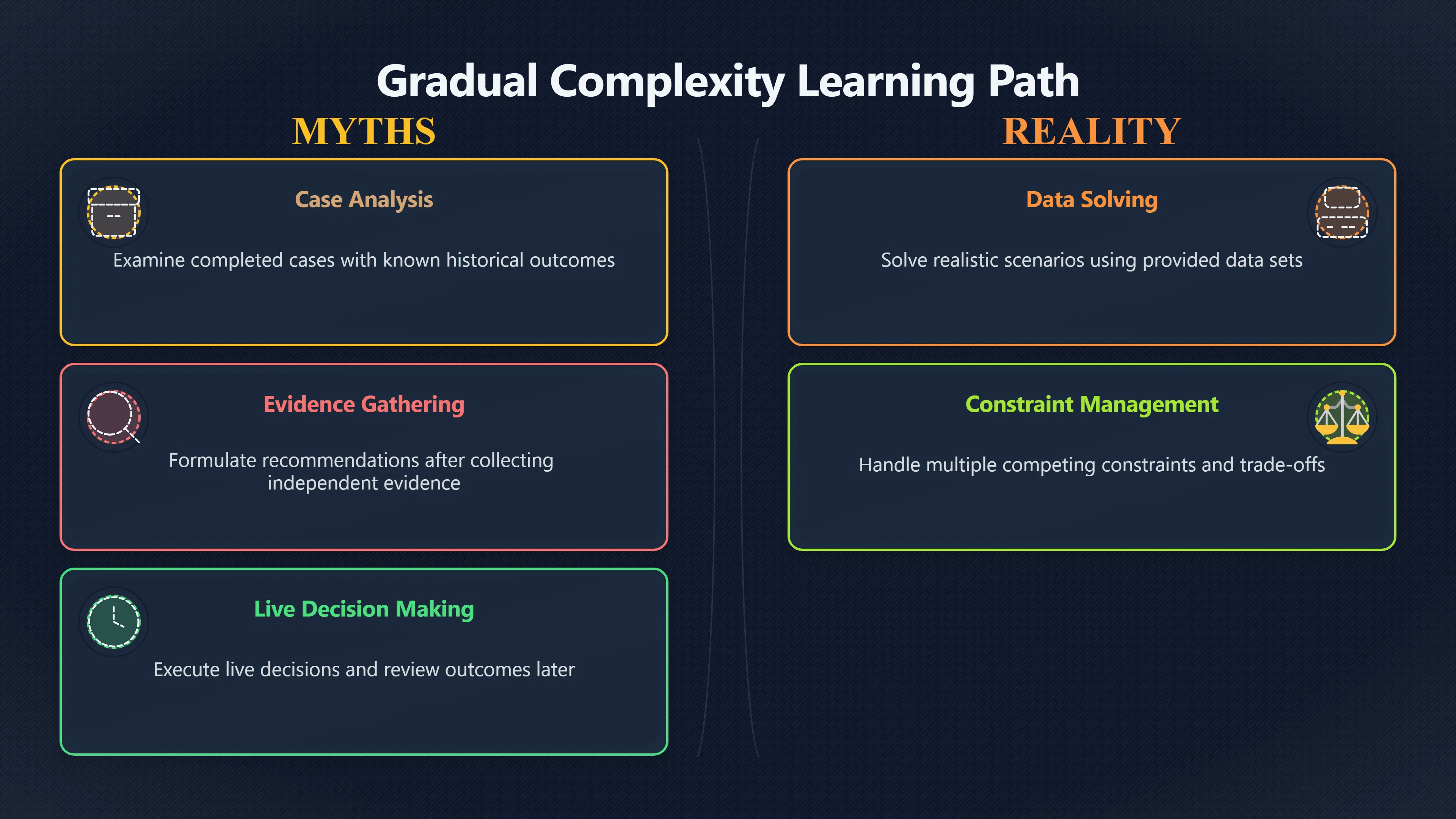
Increase complexity gradually
A common mistake is jumping immediately into highly complex problems.
Learning research suggests that novices often benefit from guidance before tackling fully open-ended problems. As expertise grows, support can gradually fade while task complexity increases.[Wikipedia]WikipediaProblem-based learningProblem-based learning
One progression might look like this:
- Analyse a completed case with known outcomes.
- Solve a realistic scenario using provided data.
- Make a recommendation after gathering your own evidence.
- Handle multiple competing constraints.
- Make live decisions in your own work or personal projects and review the outcomes later.
Each stage preserves realism while matching the learner’s current capability.
Examples of well-constrained practice problems
Strong practice tasks often resemble decisions professionals actually make.
DomainGood practice problemPersonal financeChoose between three mortgage offers with different interest rates, fees and expected time in the property.BusinessAllocate a limited marketing budget across competing campaigns with uncertain returns.HealthcarePrioritise patients for limited appointment slots using predefined clinical criteria.Public policyRecommend one of several transport investments within a fixed budget and environmental target.SoftwareDecide whether to release a product given known defects, customer deadlines and engineering capacity.EducationRecommend interventions for declining attendance while remaining within staffing and funding limits.
Each example requires balancing competing objectives rather than finding a single textbook answer.
A quick checklist for selecting worthwhile practice problems
Before investing time in an exercise, ask whether it has these characteristics:
- It requires a genuine decision, not merely an opinion.
- The constraints resemble those found in real situations.
- The scope is narrow enough to analyse carefully.
- Success can later be evaluated using observable evidence.
- Mistakes are affordable and ethically acceptable.
- Different reasonable solutions can be compared using explicit criteria.
- The difficulty stretches your current ability without becoming overwhelming.
Problems with these features create repeated opportunities to practise weighing evidence, managing uncertainty and making justified decisions—the core habits that transfer most effectively from practice into everyday analytical work.
Amazon book picks
Further Reading
Books and field guides related to What makes a problem worth practising on?. Use these as the next step if you want deeper reading beyond the article.
How to Solve It
Directly addresses choosing, structuring and solving worthwhile problems.
The Pyramid Principle
Shows how to structure complex problems and communicate analytical reasoning.
Thinking, Fast and Slow
Provides the cognitive foundation for analysing realistic decisions.
Superforecasting
Illustrates selecting meaningful real-world questions and learning from outcomes.
eBay marketplace picks
Marketplace Samples
Live-tested eBay searches with available results related to this page.




Endnotes
1.
Source: pmc.ncbi.nlm.nih.gov
Title: PMCEffective Learning Behavior in Problem-Based Learning
Link:https://pmc.ncbi.nlm.nih.gov/articles/PMC8059994/
Source snippet
by ASA Ghani · 2021 · Cited by 299 — Problem-based learning (PBL) emphasizes learning behavior that leads to [critical thinking]({{ 'critical-skills/' | relative_url }}), proble...
2.
Source: Wikipedia
Title: Problem-based learning
Link:https://en.wikipedia.org/wiki/Problem-based_learning
Additional References
3.
Source: i.ntnu.no
Link:https://i.ntnu.no/documents/portlet_file_entry/1305837853/Dolmans.pdf/b8bfcb7b-0c3f-89e3-d365-e7bf3574a5c3?download=true&status=0
Source snippet
Problem-based learning: future challenges for educational...PURPOSE The aim of this paper is to demonstrate that PBL has the potential t...
4.
Source: feedbackfruits.com
Link:https://feedbackfruits.com/pedagogies/project-based-learning-problem-based-learning
Source snippet
Project-/Problem-Based Learning supported by...Implementing PBL with FeedbackFruits is straightforward: create authentic problem stateme...
5.
Source: eu-jer.com
Title: tutors and students views on learning and feedback in problem based learning
Link:https://www.eu-jer.com/tutors-and-students-views-on-learning-and-feedback-in-problem-based-learning
Source snippet
Tutors' and Students' Views on Learning and Feedback in...by EAG Lillo · 2023 · Cited by 12 — The successful application of the problem...
6.
Source: tonybates.ca
Title: how problem based learning can help develop innovation skills
Link:https://www.tonybates.ca/2014/02/10/how-problem-based-learning-can-help-develop-innovation-skills/
Source snippet
How problem-based learning can help develop innovation...10 Feb 2014 — Problem-based learning can be an effective way to develop differe...
7.
Source: youtube.com
Title: CASE-BASED LEARNING: THE STEPS, THE PREPARATION, THE STRENGTHS AND CHALLENGES
Link:http://www.youtube.com/watch?v=bjtw4tzYv0E
Source snippet
"Problem-based learning" case study analysis method A Case Study for Problem-based Learning Education in Fault Diagnosis [Assessment]({{ 'assessment/' | relative_url }}) Giaco...
8.
Source: hastingsschool.com
Title: problem based learning
Link:https://www.hastingsschool.com/blog/problem-based-learning/
Source snippet
What does Problem-based Learning consist of?9 May 2024 — Problem-based learning is an educational methodology that was developed by McMas...
Published: May 2024
9.
Source: structural-learning.com
Link:https://www.structural-learning.com/post/problem-based-learning-a-teachers-guide
Source snippet
Problem-Based Learning: A Complete Guide10 Dec 2021 — To start, teachers should present a complex, authentic problem that allows learners...
10.
Source: youtube.com
Title: Take a Seat in the Harvard MBA Case Classroom
Link:http://www.youtube.com/watch?v=p7iwXvBnbIE
Source snippet
Case-Based Learning & Problem-Based Learning | Your Life at Med School...
11.
Source: journals.uclpress.co.uk
Link:https://journals.uclpress.co.uk/lre/article/2543/galley/16712/view/
Source snippet
uclpress.co.ukProblem-based learning: a critical rationalist perspectiveby G Parton · 2008 · Cited by 66 — This paper explores epistemolo...
12.
Source: ijhss.thebrpi.org
Link:https://ijhss.thebrpi.org/journals/Vol_4_No_12_October_2014/3.pdf
Source snippet
thebrpi.orgProblem-Based Learning in Teacher Educationby C De Simone · Cited by 139 — Together, they analyze problems, discuss options, a...
Topic Tree