Within Domain Knowledge
Build The Map Before Judging Claims
A field map gives analysis its bearings by linking vocabulary, mechanisms, cases and common traps in one usable structure.
On this page
- Vocabulary and measures that define the field
- Mechanisms and representative cases
- Common traps that distort judgement
Page outline Jump by section
Introduction
Before judging whether a claim is true, it helps to know what kind of territory you are standing in. A field map is a practical representation of how a subject fits together: its core vocabulary, important measurements, underlying mechanisms, representative cases and recurring mistakes. Rather than collecting isolated facts, you build a structure that shows how ideas relate to one another. That structure gives later analysis direction and helps you recognise which questions matter and which comparisons are misleading. Research on concept mapping and expert knowledge consistently shows that organising knowledge into connected concepts improves understanding, recall and problem solving because information is interpreted as part of a meaningful system rather than as disconnected fragments. [SAGE Research Methods]methods.sagepub.comSAGE Research Methods Encyclopedia of Case Study ResearchThese concept meanings are pictorially arranged…
 A field map is not intended to prove or disprove claims. Its purpose is to establish orientation. Once you understand the landscape, individual claims can be judged against the concepts, evidence and causal relationships that define the field instead of against intuition or isolated anecdotes.
Why map the field before evaluating evidence?
People often begin analysis with a claim: “This policy reduced crime”, “This supplement improves memory”, or “This economic reform failed.” The temptation is to search immediately for supporting and opposing evidence. A better approach is to ask what the field itself looks like.
Without that preparation, it is easy to confuse surface similarities with meaningful comparisons. Two healthcare interventions may appear comparable while targeting different populations. Two economic indicators may move together despite measuring different phenomena. Two historical events may share obvious features while arising from entirely different institutional conditions.
Experts tend to avoid these mistakes because they organise knowledge around relationships rather than isolated facts. Concept mapping research similarly treats understanding as the construction of linked concepts instead of memorised lists, allowing later evidence to be interpreted within an organised framework. [PMC]pmc.ncbi.nlm.nih.govConcept Maps for Teaching, Training, Testing and Thinkingby P Eachempati · 2020 · Cited by 13 — Concept maps are evidence based pedago…
A useful field map therefore functions as a guide rather than a conclusion. It identifies what belongs in the discussion before deciding who is right.
Vocabulary and measures that define the field
Every field develops specialised language because ordinary language is often too vague to support precise reasoning. Building a field map begins by identifying the terms that experts use consistently.
Instead of compiling a glossary, ask four questions about every important term:
- What exactly does it refer to?
- How is it measured or recognised?
- What related concepts are commonly confused with it?
- What assumptions are built into the definition?
For example, in public policy, words such as effectiveness, efficiency, equity and cost-effectiveness sound similar but answer different questions. A programme can be highly effective while being economically inefficient, or efficient while distributing benefits inequitably.
Likewise, in medicine, distinguishing between risk, absolute risk reduction, relative risk reduction and incidence changes how evidence should be interpreted. Without understanding those measures, later claims become difficult to evaluate correctly.
The goal is not exhaustive terminology but a working vocabulary that lets you recognise what experts are actually discussing.
Identify the field’s key measurements
Every mature discipline has preferred ways of describing reality.
Ask:
- Which quantities matter most?
- Which measurements are considered reliable?
- Which indicators are merely proxies?
- Which measures are disputed?
Understanding the preferred metrics helps distinguish meaningful evidence from statistics that merely sound impressive.
Map mechanisms before collecting arguments
Claims rarely exist in isolation. Most depend on a chain of causes.
Instead of asking only whether something happened, ask:
- What process is supposed to produce the outcome?
- Which intermediate steps must occur?
- Under what conditions does the mechanism fail?
- Which competing mechanisms exist?
Mechanisms help determine whether evidence fits the broader understanding of the field.
For example, if a policy claims to improve educational outcomes by reducing class sizes, your map should include:
- teacher workload,
- classroom interaction,
- resource allocation,
- implementation costs,
- differences across age groups,
- possible unintended effects.
Evidence supporting or contradicting the policy can then be interpreted within those causal relationships instead of appearing as isolated studies.
Concept mapping methods encourage explicitly connecting concepts with labelled relationships such as “causes”, “depends on”, “increases” or “constrains”, making assumptions visible instead of implicit. [SAGE Research Methods]methods.sagepub.comSAGE Research Methods Encyclopedia of Case Study ResearchThese concept meanings are pictorially arranged…
Use representative cases to calibrate understanding
Abstract principles become easier to recognise when connected to concrete examples.
A field map benefits from identifying a small number of representative cases that illustrate:
- successful applications,
- well-known failures,
- edge cases,
- controversial examples,
- historical turning points.
These cases serve as anchors.
For instance, someone studying financial regulation might include both the global financial crisis of 2008 and examples of banking systems that remained comparatively resilient. Someone studying public health might compare vaccination campaigns with differing implementation strategies rather than treating all programmes as interchangeable.
Representative cases should not become templates that explain everything. Their purpose is to reveal recurring patterns, common exceptions and the practical meaning of abstract concepts.

Show relationships instead of collecting categories
Many beginners organise knowledge into disconnected folders.
For example:
- definitions,
- studies,
- statistics,
- experts,
- arguments.
This organisation is easy to build but difficult to use because it does not explain how ideas interact.
A stronger field map connects concepts through relationships such as:
- causes,
- influences,
- requires,
- measures,
- predicts,
- constrains,
- depends upon,
- contradicts.
These relationships allow new information to be inserted naturally. When encountering a new claim, the first question becomes, “Where does this fit?” rather than “Do I already agree with it?”
Knowledge representation research similarly emphasises maps and ontologies that capture relationships among concepts, providing a shared conceptual structure instead of isolated definitions. [dl.ifip.org]dl.ifip.orgUsing Concept Maps For Ontology DevelopmentThis paper presents a graphical-based knowledge representation approach using concept maps tow…
Common traps that distort judgement
A field map is valuable partly because it protects against predictable analytical errors.
Mistaking familiar words for shared meanings
Many disagreements arise because participants attach different meanings to the same vocabulary.
Before comparing arguments, confirm that identical terms describe identical concepts.
Overweighting dramatic examples
Vivid stories are memorable but often statistically unrepresentative.
Representative cases should illustrate the structure of the field rather than replace broader evidence.
Ignoring hidden assumptions
Claims frequently depend on assumptions that remain unstated.
Examples include assumptions about:
- stable institutions,
- consistent measurement,
- representative samples,
- rational behaviour,
- unchanged incentives.
Making these assumptions explicit improves later evaluation.
Confusing correlation with mechanism
Finding that two variables move together does not establish why.
A field map reminds you to ask whether a plausible causal pathway exists and whether competing explanations fit the evidence equally well.
Building maps that are too detailed
An effective map provides orientation rather than encyclopaedic completeness.
If every concept receives equal attention, genuinely important relationships disappear within unnecessary detail.
The map should remain usable: large enough to reveal structure, but compact enough that a reader can mentally navigate it.
A practical method for building a field map
A useful map can often be created before reading large numbers of competing arguments.
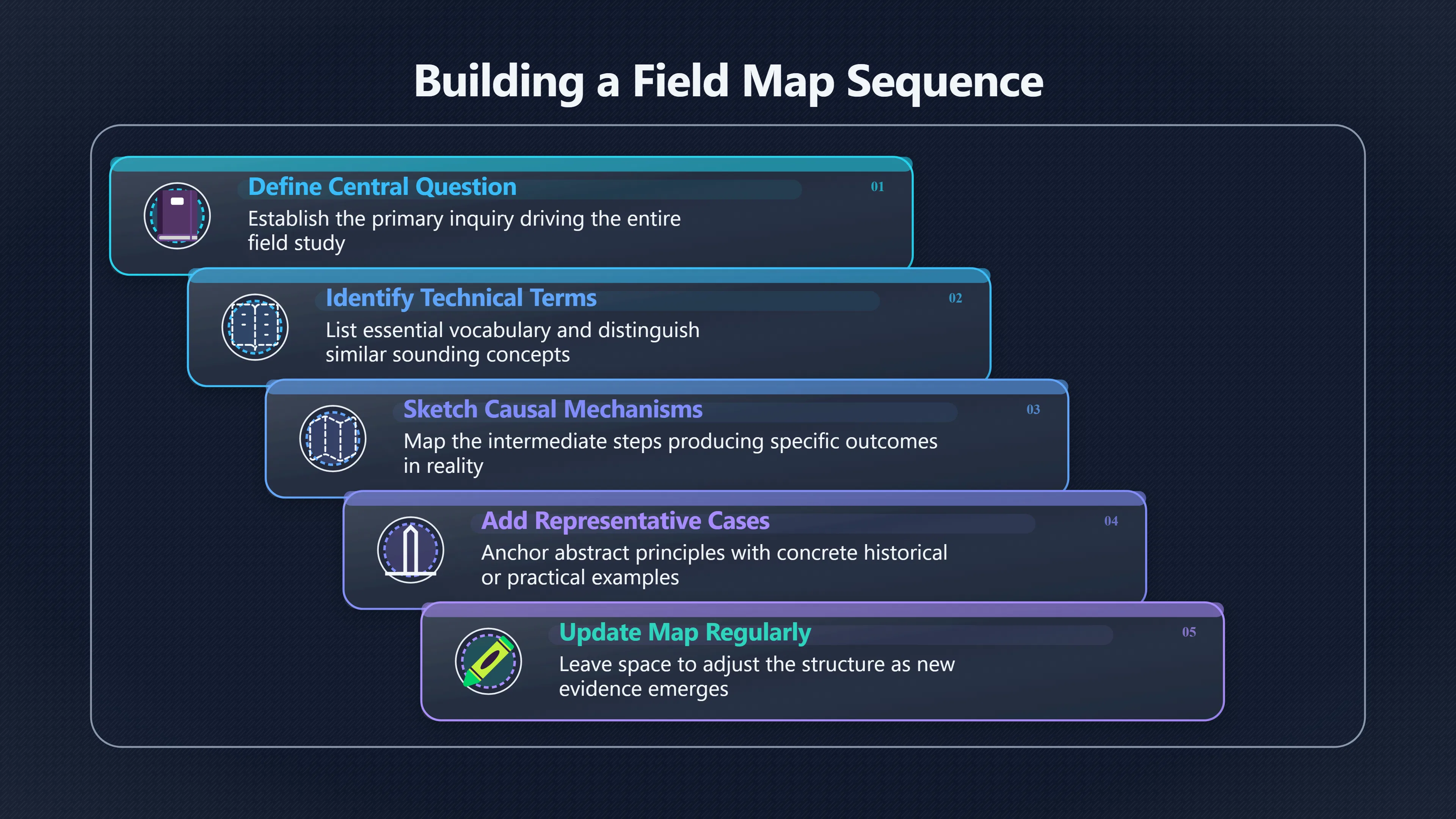
A practical sequence is:
- Define the field’s central question.
- List the essential technical terms and distinguish similar concepts.
- Identify the measurements and indicators regarded as important.
- Sketch the main causal mechanisms proposed within the field.
- Add several representative historical or practical cases.
- Note recognised controversies, boundary conditions and common misconceptions.
- Leave space to update the map as new evidence changes understanding.
This process creates a stable framework into which future evidence can be placed rather than forcing every new claim to redefine the structure from scratch.
How field maps improve analytical thinking
The greatest benefit of a field map is not that it makes analysis faster, but that it changes the questions you ask. Instead of reacting to individual claims, you begin asking where those claims fit within an organised body of knowledge, what assumptions they rely upon, how they connect to established mechanisms and whether they align with representative cases.
In this way, domain knowledge becomes more than accumulated information. It becomes an organised model of the field that supports clearer judgement, reveals missing pieces of evidence and reduces the risk of analysing arguments without first understanding the landscape in which they belong.
Amazon book picks
Further Reading
Books and field guides related to Build The Map Before Judging Claims. Use these as the next step if you want deeper reading beyond the article.
Thinking, Fast and Slow
Provides foundational concepts about reasoning, evidence and cognitive bias.
The Art of Thinking Clearly
Explains common cognitive traps that field mapping helps prevent before evaluating claims.
Make It Stick
Supports building durable conceptual knowledge through organised learning.
How to Read a Book
Teaches building structured understanding rather than collecting isolated facts.
eBay marketplace picks
Marketplace Samples
Live-tested eBay searches with available results related to this page.


Endnotes
-
Source: pmc.ncbi.nlm.nih.gov
Link: https://pmc.ncbi.nlm.nih.gov/articles/PMC10702656/Source snippet
Concept Maps for Teaching, Training, Testing and Thinkingby P Eachempati · 2020 · Cited by 13 — Concept maps are evidence based pedago...
-
Source: dl.ifip.org
Link: https://dl.ifip.org/db/conf/ifip5-3/basys2008/SoaresS08.pdfSource snippet
Using Concept Maps For Ontology DevelopmentThis paper presents a graphical-based knowledge representation approach using concept maps tow...
-
Source: methods.sagepub.com
Title: SAGE Research Methods Encyclopedia of Case Study Research
Link: https://methods.sagepub.com/ency/edvol/encyc-of-case-study-research/chpt/concept-mappingSource snippet
These concept meanings are pictorially arranged...
Additional References
-
Source: scitepress.org
Link: https://www.scitepress.org/Papers/2024/130602/130602.pdfSource snippet
or creating corporate atlas of knowledge maps – a visual guide of [diagrams]({{ 'diagrams/' | relative_url }}) describing the intellectual...
-
Source: asmedigitalcollection.asme.org
Title: Top Down Hierarchical Construction and Application
Link: https://asmedigitalcollection.asme.org/mechanicaldesign/article/147/3/031401/1206698/Top-Down-Hierarchical-Construction-and-ApplicationSource snippet
asme.orgTop-Down Hierarchical Construction and Application of a...18 Oct 2024 — This article introduces the concept of knowledge graph...
-
Source: researchgate.net
Link: https://www.researchgate.net/figure/A-Concept-Map-that-integrates-a-number-of-other-Concept-Maps-into-a-knowledge-model-about_fig4_228805307Source snippet
Maps into a knowledge model about the domain of bulk power operations...
-
Source: arxiv.org
Link: https://arxiv.org/pdf/2509.14554Source snippet
A Systematic Review of Concept Map Generationby X Zhai · 2025 · Cited by 3 — This review systematically synthesizes the emerging body of...
-
Source: youtube.com
Title: Charting the Thicket: Using Argument Mapping to Explore Controversial Topics
Link: https://www.youtube.com/watch?v=f833pHMlJjkSource snippet
Concept Maps and Mind Maps Tools for Research EP 1...
-
Source: link.springer.com
Link: https://link.springer.com/chapter/10.1007/978-3-031-54677-8_5Source snippet
Techniques and Application of Knowledge Mappingby A Okada · 2025 — This chapter introduces 19 distinct types of knowledge maps, illustrat...
-
Source: youtube.com
Title: Concept Maps and Mind Maps Tools for Research EP 1
Link: https://www.youtube.com/watch?v=b33rvFDEVdgSource snippet
SOLVE Complex Problems With The 7-Step McKinsey Framework...
-
Source: youtube.com
Title: How to Create a Literature Map?
Link: https://www.youtube.com/watch?v=0a8AZHdeTTESource snippet
Charting the Thicket: Using Argument Mapping to Explore Controversial Topics...
-
Source: youtube.com
Title: SOLVE Complex Problems With The 7-Step Mc Kinsey Framework
Link: https://www.youtube.com/watch?v=IFuD42ajzuQSource snippet
[Critical Thinking]({{ 'critical-skills/' | relative_url }}) with Argument Maps...
-
Source: youtube.com
Title: Critical Thinking with Argument Maps
Link: https://www.youtube.com/watch?v=cgbpsONQlYY
Topic Tree