Within Sharper Thinking
How to Break Down a Hard Problem
Analysis gets stronger when a messy issue is divided into causes, comparisons, evidence, and assumptions.
On this page
- Turning a vague issue into parts
- Finding causes, constraints, and comparisons
- Rebuilding the answer without losing context
Page outline Jump by section
Introduction
Breaking a hard problem into parts is the practical core of analytical thinking. A vague issue such as “this project is failing”, “I cannot decide whether to move jobs”, or “our team keeps missing deadlines” usually contains several different questions tangled together: what is happening, what is causing it, what evidence matters, what constraints cannot be changed, what options are realistic, and which assumptions are doing the most work. Analysis improves when those questions are separated before they are recombined.
This matters because people often search too quickly for one persuasive answer. Research and professional practice in problem-solving, decision-making and intelligence analysis point in the same direction: difficult problems are easier to handle when the thinker makes the structure visible, compares live alternatives, tests assumptions, and keeps sight of how the parts fit back into the whole. The aim is not to make every decision slow or mechanical. It is to stop a messy situation from being decided by the first frame that feels coherent.
Turning a Vague Issue Into Parts
A hard problem usually begins as a blur. “Should we launch?” sounds like one question, but it may contain a market question, a technical readiness question, a timing question, a cash-flow question, a reputational-risk question and a question about opportunity cost. Analytical thinking starts by refusing to treat the blur as the problem.
The OECD’s work on problem-solving defines the skill as the capacity to engage in cognitive processing to understand and resolve situations where the method of solution is not immediately obvious. That definition is useful because it places “understanding” before “resolving”: if the method is not obvious, the first task is not action but problem construction. The same OECD report notes that traditional education often breaks problems into manageable pieces, but modern problem-solving also requires synthesising disparate parts and making connections across fields. In other words, decomposition is necessary but not sufficient; the parts must later be reconnected.[OECD]oecd.orgThe Nature of Problem Solving (ENThe Nature of Problem Solving (EN)…
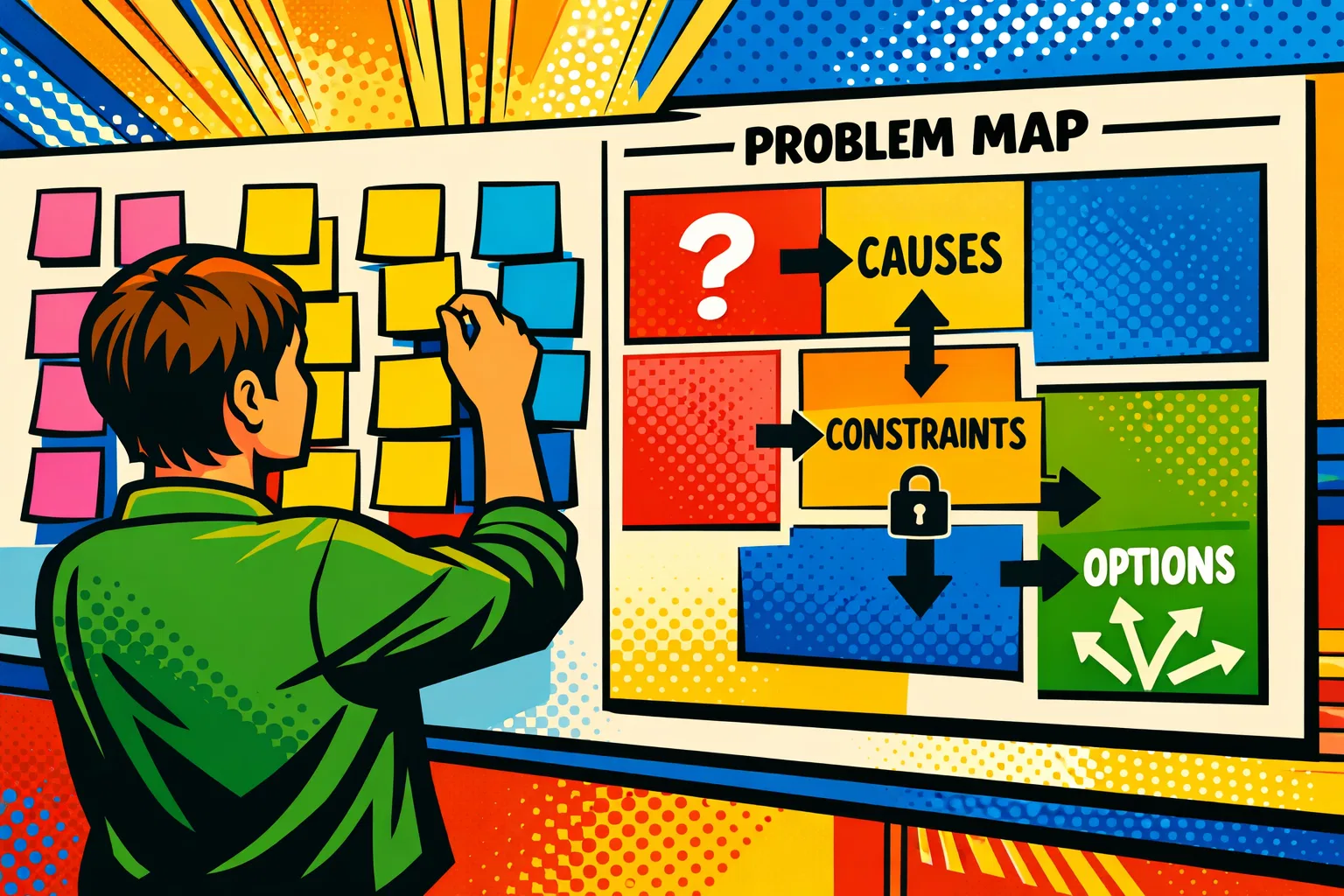
A useful first move is to split the issue into four working questions:
- What is the decision or judgement being made?
“What is wrong?” is too open. “Should we delay the product launch by four weeks?” or “Which of three causes best explains the drop in retention?” gives the analysis a target.
- What are the parts of the situation?
These may be people, processes, incentives, technical systems, costs, deadlines, evidence sources, stakeholder needs or risks.
- What kind of relationship links the parts?
Some parts are causes, some are constraints, some are symptoms, some are trade-offs, and some are assumptions.
- What would change the answer?
This prevents the analysis from becoming a list. A part matters most when a different reading of it would alter the conclusion.
This is why a good problem breakdown is not the same as a neat outline. A neat outline organises material. A good breakdown exposes leverage: the point where better evidence, a sharper comparison or a corrected assumption would change what you do next.
Finding Causes, Constraints and Comparisons
Once the problem has been separated into parts, the next step is to classify the parts by function. Three categories are especially useful: causes, constraints and comparisons.
Causes explain why the issue exists. If customer complaints have risen, the cause might be a product defect, a change in customer expectations, a support backlog, a misleading advert, a new competitor or a measurement change. Jumping straight to one favoured cause creates a false sense of progress. Root-cause methods such as fishbone diagrams are popular because they force people to generate possible causes across categories rather than treating the first explanation as sufficient; a 2024 medical-quality article describes the cause-and-effect, or fishbone, diagram as a tool for analysing possible root causes of quality-related problems.[PMC]pmc.ncbi.nlm.nih.govCause-and-Effect (Fishbone) Diagram: A Tool for Generating…by A Kumah · 2024 · Cited by 124 — A cause-and-effect diagram (fishbone…
Constraints are the limits within which a solution must work. These include money, time, law, staffing, trust, political feasibility, technical compatibility and ethical boundaries. Constraints are often mistaken for causes. “We do not have enough engineers” might be a cause of missed deadlines, but it might also be a constraint that rules out some solutions. The analytical difference matters: causes invite explanation; constraints shape option design.
Comparisons prevent the current frame from becoming invisible. In intelligence analysis, Richards Heuer’s work on Analysis of Competing Hypotheses argues that analysts should start with a full set of alternative possibilities rather than pick one likely answer and look for confirming evidence. Heuer emphasises evidence with “diagnostic value”: evidence that helps distinguish between hypotheses, not evidence that merely fits one of them.[CIA]cia.govPsychology of Intelligence AnalysisPsychology of Intelligence Analysis…
The comparison habit is useful outside intelligence work. Suppose a manager asks, “Why is this employee underperforming?” A weak analysis might collect evidence for one story: poor motivation. A stronger analysis compares at least four explanations: unclear expectations, insufficient skill, overload, misaligned incentives and low motivation. The best evidence is not “something that makes one story sound plausible”, because several stories may sound plausible. The best evidence is the observation that separates them.
A simple comparison grid can help:
Part of the problemQuestion to askExampleSymptomWhat do we observe?Sales dropped 18% in two monthsCandidate causeWhat might explain it? Price rise, competitor launch, poor lead qualityConstraintWhat cannot easily change?Budget, legal deadline, staff capacityEvidenceWhat would distinguish causes?Segment-level sales data before and after the price changeAssumptionWhat are we treating as true?Customers understand the product’s valueOptionWhat could we do?Reverse price rise, change messaging, target a different segment
The table is not the analysis itself. It is a way to stop different kinds of thinking from interfering with each other. If symptoms, causes, assumptions and options are all discussed at once, a group can sound busy while making little progress.
Why Assumptions Deserve Their Own Box
Assumptions are the hidden load-bearing beams of analysis. They are not always bad; every practical decision requires some beliefs that cannot be fully proven in time. The danger is that assumptions often feel like background reality rather than choices.
The CIA’s structured analytic techniques primer defines a key assumption as a hypothesis that analysts have accepted as true and that forms the basis of an assessment. It also warns that hidden assumptions are hard to identify because they are often held unconsciously and therefore rarely challenged.[CIA]cia.govOpen source on cia.gov.
That point is widely applicable. A person deciding whether to change careers may assume that a pay cut is temporary, that a new sector will value their existing skills, that their family will tolerate the disruption, or that staying put is the safer option. A team deciding whether to automate a process may assume that the process is stable, that the data are clean, that users will accept the new workflow, or that maintenance costs will be modest.
A practical way to isolate assumptions is to use three prompts:
- “For this answer to be right, what else must be true?”
- “Which belief are we treating as fact without checking?”
- “Which assumption would most damage the conclusion if it failed?”
The third prompt is especially powerful because not all assumptions deserve equal attention. Some are minor. Others hold the argument together. If a project plan assumes that a supplier will deliver in six weeks, and every downstream date depends on that, the supplier assumption is not a footnote. It is a central analytical object.
The same principle appears in Heuer’s Analysis of Competing Hypotheses: the point is not simply to collect more information, but to identify the evidence and assumptions that most discriminate between possible explanations. Heuer argues that conventional intuitive analysis often looks for support for a favoured hypothesis, while structured analysis gives competing alternatives a fairer test.[CIA]cia.govPsychology of Intelligence AnalysisPsychology of Intelligence Analysis…
Breaking Down Without Fragmenting the Problem
There is a trap in decomposition: the parts become so tidy that the real situation disappears. A person can analyse budget, schedule, risk and staffing separately, then miss the fact that the schedule risk is caused by staffing, the staffing problem is caused by budget, and the budget constraint is shaped by stakeholder trust.
This is why analytical thinking needs a rebuilding phase. After breaking the problem into parts, ask how the parts interact. Does one cause amplify another? Does solving one part worsen a different part? Does a constraint make an otherwise good option unrealistic? Does the same piece of evidence support more than one explanation?
Complex and “wicked” problems make this especially important. Work on wicked problems describes situations with incomplete, contradictory or changing requirements, where there may be no single correct solution and where attempts to solve one part can expose or create other problems.[Wikipedia]WikipediaWicked problemWicked problem In such cases, breaking the problem down is still useful, but only if the thinker remembers that the pieces are not independent components in a machine. They are connected parts of a changing system.
The practical test is whether the breakdown improves judgement or merely produces categories. A useful breakdown makes at least one of these things clearer:
- which cause is most plausible;
- which constraint is binding;
- which comparison matters;
- which evidence is missing;
- which assumption is riskiest;[stat.berkeley.edu]stat.berkeley.eduTradecraft Primer apr09Tradecraft Primer apr09
- which trade-off cannot be avoided;
- which next action would reduce uncertainty.
If the breakdown does none of these, it may be decorative rather than analytical.
A Worked Example: “Our Team Keeps Missing Deadlines”
Consider a common workplace problem: a team repeatedly misses deadlines. The vague version invites blame. A better analytical breakdown separates the issue.
First, define the judgement. The question is not “Why is the team bad at delivery?” but “Which factors most explain repeated deadline slips, and what change would reduce them without lowering quality?”
Next, separate symptoms from causes. The symptoms might be late handovers, last-minute rework and unclear progress reports. Candidate causes could include underestimation, shifting requirements, excessive work in progress, weak ownership, dependency delays, quality problems, or incentives that reward starting new work more than finishing current work.
Then identify constraints. Perhaps headcount cannot increase this quarter. Perhaps a regulatory deadline is fixed. Perhaps the team must keep supporting existing customers while delivering new work. These constraints rule out some apparently easy answers.
Now compare explanations. If the cause is underestimation, then tasks should be late even when requirements are stable. If the cause is shifting requirements, the project history should show frequent scope changes after commitments were made. If the cause is dependency delay, blocked time should cluster around handovers from other teams. If the cause is poor ownership, tasks may stall because no one has authority to make decisions.
The strongest evidence will be diagnostic. A delivery log showing that 70% of delays begin after late external inputs points in a different direction from a log showing that most delays occur after internal rework. The analysis should then surface assumptions: that the deadlines were realistic, that the team understood priorities, that estimates were based on comparable work, and that managers did not quietly add scope after planning.
Finally, rebuild the answer. The conclusion may be: “The missed deadlines are not mainly a motivation problem. They come from unstable requirements and unmanaged dependencies. The next intervention should be a change-control rule and a visible dependency tracker, not a motivational workshop.” The conclusion is stronger because it came from separating the parts and then reconnecting them.

Choosing the Right Level of Detail
Breaking a problem into parts can fail in two opposite ways. Too little decomposition leaves the issue vague. Too much decomposition creates analysis paralysis.
The right level of detail depends on stakes, reversibility and uncertainty. A low-stakes, reversible decision may need only a quick split into options, costs and risks. A high-stakes, hard-to-reverse decision needs more deliberate separation of evidence, assumptions, alternatives and constraints. Harvard Business Review’s classic account of decision traps notes that bad decisions are often traceable to process failures: alternatives were not clearly defined, the right information was not collected, or costs and benefits were not accurately weighed.[Harvard Business Review]hbr.orgHarvard Business Review The Hidden Traps in Decision MakingHarvard Business Review The Hidden Traps in Decision Making
A useful rule is to decompose until the next action becomes clearer. If the parts still do not suggest what to check, compare or decide, the problem is probably still too vague. If the parts are multiplying without changing the decision, the analysis has probably gone too far.
For everyday use, five questions are enough:
- What is the exact question?
- What parts are tangled together?
- Which parts are causes, constraints, evidence, assumptions or options?
- What comparisons would stop us from favouring the first plausible answer?
- How do the parts fit back together into a decision or explanation?
This keeps analytical thinking practical. The goal is not to produce a perfect model of the situation. The goal is to make the problem clear enough that the next judgement is less dependent on habit, pressure or a misleading first impression.
Rebuilding the Answer Without Losing Context
The final step is synthesis: turning the parts back into a coherent answer. This is where many analytical efforts weaken. People either stay fragmented, listing factors without judgement, or they collapse too quickly into a single neat story.
A good synthesis does three things. It states the best current answer, names the strongest reasons for it, and identifies what would change it. Heuer’s work is useful here again: he recommends identifying milestones for future observation that would indicate events are taking a different course than expected. That practice makes conclusions more resilient because it treats them as provisional rather than final.[CIA]cia.govPsychology of Intelligence AnalysisPsychology of Intelligence Analysis…
For a personal decision, this might sound like: “Taking the new job is the better option because it improves learning and long-term earning power, but the answer depends heavily on the assumption that the role really includes management responsibility. I should verify that before accepting.”
For a business problem, it might sound like: “The retention decline is most likely caused by onboarding confusion rather than product quality, because complaints cluster in the first two weeks and long-term users are stable. The conclusion would change if churn data showed the same pattern among experienced customers.”
For a policy or organisational problem, it might sound like: “No single cause explains the failure. The binding constraint is capacity, but the most fixable cause is unclear prioritisation. The next move should reduce work in progress before adding new reporting requirements.”
That is the value of breaking problems into parts. It does not remove uncertainty, and it does not guarantee the right answer. It makes the reasoning inspectable. It shows which part of the problem is evidence, which part is assumption, which part is constraint, and which part is choice. In practical analytical thinking, that visibility is often the difference between sounding reasonable and actually reasoning well.
Amazon book picks
Further Reading
Books and field guides related to How to Break Down a Hard Problem. Use these as the next step if you want deeper reading beyond the article.
The Pyramid Principle
Shows how to break complex problems into logical components and rebuild clear arguments.
Thinking, Fast and Slow
Explains common thinking errors and supports structured analysis before reaching conclusions.
Super Thinking
Provides practical frameworks for decomposing problems, comparing options, and testing assumptions.
The Art of Thinking Clearly
Highlights cognitive biases that interfere with effective problem breakdown and analysis.
eBay marketplace picks
Marketplace Samples
Live-tested eBay searches with available results related to this page.




Endnotes
1.
Source: oecd.org
Title: The Nature of Problem Solving (EN)
Link:https://www.oecd.org/content/dam/oecd/en/publications/reports/2017/04/the-nature-of-problem-solving_g1g787cf/9789264273955-en.pdf
Source snippet
The Nature of Problem Solving (EN)...
2.
Source: pmc.ncbi.nlm.nih.gov
Link:https://pmc.ncbi.nlm.nih.gov/articles/PMC11077513/
Source snippet
Cause-and-Effect (Fishbone) Diagram: A Tool for Generating...by A Kumah · 2024 · Cited by 124 — A cause-and-effect diagram (fishbone...
3.
Source: cia.gov
Title: Psychology of Intelligence Analysis
Link:https://www.cia.gov/resources/csi/static/Pyschology-of-Intelligence-Analysis.pdf
Source snippet
Psychology of Intelligence Analysis...
4.
Source: cia.gov
Link:https://www.cia.gov/resources/csi/static/Tradecraft-Primer-apr09.pdf
5.
Source: Wikipedia
Title: Wicked problem
Link:https://en.wikipedia.org/wiki/Wicked_problem
6.
Source: cia.gov
Title: Why Bad Things Happen
Link:https://www.cia.gov/resources/csi/static/Why-Bad-Things-Happen.pdf
7.
Source: cia.gov
Title: Future of Analysis
Link:https://www.cia.gov/resources/csi/static/Future-of-Analysis.pdf
8.
Source: cia.gov
Title: Developing a Taxonomy
Link:https://www.cia.gov/resources/csi/static/Developing-a-Taxonomy.pdf
9.
Source: cia.gov
Title: Remembering Richards J Heuer
Link:https://www.cia.gov/resources/csi/static/Remembering-Richards-J-Heuer.pdf
10.
Source: cia.gov
Link:https://www.cia.gov/resources/csi/static/Analytic-Culture-Intelligence-Community.pdf
11.
Source: cia.gov
Link:https://www.cia.gov/resources/csi/static/e228eea610f76862a05274ca88500679/analytic_pathologies_report.pdf
12.
Source: cia.gov
Link:https://www.cia.gov/library/abbottabad-compound/14/145C9D2CC61E91C8E3FD7A25EFD7E0B5_PENNSY~1.PDF
13.
Source: cia.gov
Title: Review1 Language Machinese Studies 70 1 Mar2026
Link:https://www.cia.gov/resources/csi/static/Review1-Language-Machinese-Studies-70-1-Mar2026.pdf
14.
Source: communicate.gse.harvard.edu
Title: file url
Link:https://communicate.gse.harvard.edu/file_url/273
15.
Source: hbsp.harvard.edu
Title: H060J3 PDF ENG
Link:https://hbsp.harvard.edu/product/H060J3-PDF-ENG
16.
Source: all.net
Title: Psychology of Intelligence Analysis
Link:https://www.all.net/journal/deception/ciabook2/www.cia.gov/csi/books/19104/art3.html
17.
Source: youtube.com
Title: Analytical Thinking | Psychology
Link:https://www.youtube.com/watch?v=NmyWfvHjtic
Source snippet
Difference between [Critical Thinking]({{ 'critical-skills/' | relative_url }}) Vs Analytical Thinking:- 6...
18.
Source: hbr.org
Title: Harvard Business Review The Hidden Traps in Decision Making
Link:https://hbr.org/1998/09/the-hidden-traps-in-decision-making-2
19.
Source: pmc.ncbi.nlm.nih.gov
Link:https://pmc.ncbi.nlm.nih.gov/articles/PMC11306497/
20.
Source: pmc.ncbi.nlm.nih.gov
Link:https://pmc.ncbi.nlm.nih.gov/articles/PMC10890380/
21.
Source: pmc.ncbi.nlm.nih.gov
Link:https://pmc.ncbi.nlm.nih.gov/articles/PMC12241059/
22.
Source: pmc.ncbi.nlm.nih.gov
Link:https://pmc.ncbi.nlm.nih.gov/articles/PMC9332318/
23.
Source: pmc.ncbi.nlm.nih.gov
Link:https://pmc.ncbi.nlm.nih.gov/articles/PMC8715817/
24.
Source: pmc.ncbi.nlm.nih.gov
Link:https://pmc.ncbi.nlm.nih.gov/articles/PMC7382331/
25.
Source: pmc.ncbi.nlm.nih.gov
Link:https://pmc.ncbi.nlm.nih.gov/articles/PMC8763848/
26.
Source: hbr.org
Link:https://hbr.org/2024/01/to-solve-a-tough-problem-reframe-it
27.
Source: stat.berkeley.edu
Title: Tradecraft Primer apr09
Link:https://www.stat.berkeley.edu/~aldous/157/Papers/Tradecraft%20Primer-apr09.pdf
28.
Source: linkedin.com
Link:https://www.linkedin.com/posts/harvard-business-review_how-you-define-the-problem-determines-whether-activity-6872126437667696640-PROI
Additional References
29.
Source: youtube.com
Title: Difference between Critical Thinking Vs Analytical Thinking:- 6
Link:https://www.youtube.com/watch?v=Z9vsxt4dqfo
Source snippet
Analytical Thinking and Problem Solving | Exclusive Lesson...
30.
Source: youtube.com
Title: Analytical Skills Everyone Should Know
Link:https://www.youtube.com/watch?v=mRsiPFJG2u4
Source snippet
How to Solve Any Complex Problem Like McKinsey: 4-Step Framework for Clear Thinking...
31.
Source: researchgate.net
Link:https://www.researchgate.net/publication/337154064_Structured_Analytic_Techniques_Taxonomy_and_Technique_Selection_for_Information_and_Intelligence_Analysis_Practitioners
32.
Source: researchgate.net
Link:https://www.researchgate.net/publication/331942237_The_analysis_of_competing_hypotheses_in_intelligence_analysis
33.
Source: madssingers.com
Link:https://madssingers.com/management/analytical-thinking/
34.
Source: researchgate.net
Link:https://www.researchgate.net/publication/380124761_Developing_Critical_Thinking_Skills_Encouraging_Analytical_and_Creative_Thinking
35.
Source: researchgate.net
Link:https://www.researchgate.net/publication/394803420_Teaching_and_Assessing_Abstraction_in_K-12_Computational_Thinking_Education_A_Systematic_Literature_Review
36.
Source: greydynamics.com
Link:https://greydynamics.com/a-guide-to-structured-analytic-techniques-sats-for-intelligence/
37.
Source: futuribles.com
Link:https://www.futuribles.com/wp-content/uploads/related-documents/analysis-of-competing-hypotheses.pdf?postId=73706
38.
Source: linkedin.com
Link:https://www.linkedin.com/top-content/future-of-work/up-skilling-online-courses/analytical-reasoning-and-critical-thinking/
Topic Tree
Follow this branch
Parent topic
Sharper ThinkingRelated pages 29
- Assumption Test Which assumption could break the plan?
- Causes vs Limits Is it a cause or a constraint?
- Competing Stories Do not stop at the first plausible story
- Decision Frame What decision are you really trying to make?
- Diagnostic Evidence What evidence would actually change your mind?
- +1 more in sidebar