Within Sharper Thinking
Predict First, Check Second
Making predictions before seeing results turns passive reading into a feedback-rich thinking exercise.
On this page
- Why prediction sharpens attention
- Everyday prediction exercises
- Reviewing surprises without defensiveness

Page outline Jump by section
Introduction
Predicting first and checking second is a simple habit: before you reveal an answer, result, solution, diagnosis, market move, exam mark or explanation, pause long enough to write down what you expect and why. That small delay turns passive consumption into a feedback loop. Instead of merely reading “the right answer”, you create a visible comparison between your mental model and reality.
The evidence is strongest in learning research. Studies on pretesting show that trying to answer before being taught, even when the first attempt is wrong, can improve later memory compared with simply studying the answer from the start. More recent reviews frame prediction as a learning strategy in its own right because it combines retrieval, attention, feedback and surprise. [Journal of Cognition+2Springer]journalofcognition.orgJournal of CognitionThe Pretesting Effect: Exploring the Impact of Feedback…by Y Mera · 2025 · Cited by 2 — The pretesting effect sugg…
For analytical skill, the point is broader than exam performance. A prediction habit trains calibration: the ability to notice when your confidence matches your accuracy. It also makes surprises less personal. When reality differs from your forecast, you have a concrete object to inspect: not “I am bad at this”, but “which cue did I overweight, which assumption failed, and what should I notice next time?”
Why prediction sharpens attention
Prediction changes the mental posture of reading. Without a prediction, an answer can feel obvious once you see it. With a prediction, the same answer becomes feedback: it confirms, corrects or complicates a claim you actually made.
This matters because much everyday “learning” is recognition disguised as understanding. Reading an explanation after the fact often produces a feeling of fluency: the words make sense, the answer seems familiar, and the mind concludes that it knew more than it did. Prediction interrupts that illusion. It asks for a commitment before the answer is available, which makes the gap between understanding and hindsight harder to ignore.
Research on the pretesting effect gives this habit a concrete base. In a widely discussed example, learners who first tried to guess a missing word pair before seeing the answer later remembered more than learners who spent the full time simply studying the correct pair. The benefit appeared even though the initial guesses were usually wrong. [Scientific American]scientificamerican.comScientific American The Pluses of Getting It WrongScientific AmericanThe Pluses of Getting It WrongMarch 1, 2010 — 1 Mar 2010 — In a way, this pretesting effect is counterintuitive: study…
The mechanism is not just “testing is good”. Prediction appears to work partly because it prepares attention. When you make a forecast, you activate relevant prior knowledge, create a question in the mind, and become more alert to the corrective information that follows. Brod’s review of predicting as a learning strategy argues that prediction differs from ordinary retrieval practice because incorrect predictions can produce surprise, and that surprise can direct attention to the correct answer. [Springer]link.springer.comPredicting as a learning strategy - Springer Natureby G Brod · 2021 · Cited by 77 — Predicting involves that learners generate a…
That makes the habit especially useful for improving thinking and analytical skills. Analytical thinking depends on noticing mismatches: between expectation and result, explanation and evidence, confidence and accuracy. Prediction gives those mismatches a clear before-and-after shape.
The habit is not “guess wildly”
A useful prediction is not a random guess. It is a small, testable statement that exposes how you are currently thinking. The ideal prediction is specific enough to be wrong in an informative way.
For example, before checking a worked solution, a student might write: “I think the answer will involve conservation of energy rather than force balance, because the question asks for final speed.” Before reading a policy result, an analyst might write: “I expect the intervention to help uptake but not retention, because it reduces initial friction without changing follow-up incentives.” Before checking a medical explainer, a reader might write: “I expect symptom X to be less diagnostic than symptom Y, because X appears in several unrelated conditions.”
The prediction has three useful parts:
- Expected answer: what you think will happen or be true.
- Confidence: how sure you are, even roughly.
- Reason: the cue, rule, analogy or assumption driving the forecast.
The reason is crucial. A bare guess only tells you whether you were right. A prediction with a reason tells you whether your mental model worked. If the answer differs from your expectation, you can ask whether the error came from a missing fact, a bad rule, a misleading analogy or an overconfident leap.
Metacognition research supports this emphasis on monitoring. Metacognition means awareness and control of one’s own thinking for learning, and educational research links stronger metacognitive skill with better performance because learners make better decisions about what to study, when to change strategy and how to evaluate understanding. [lifescied.org]lifescied.orgOpen source on lifescied.org.
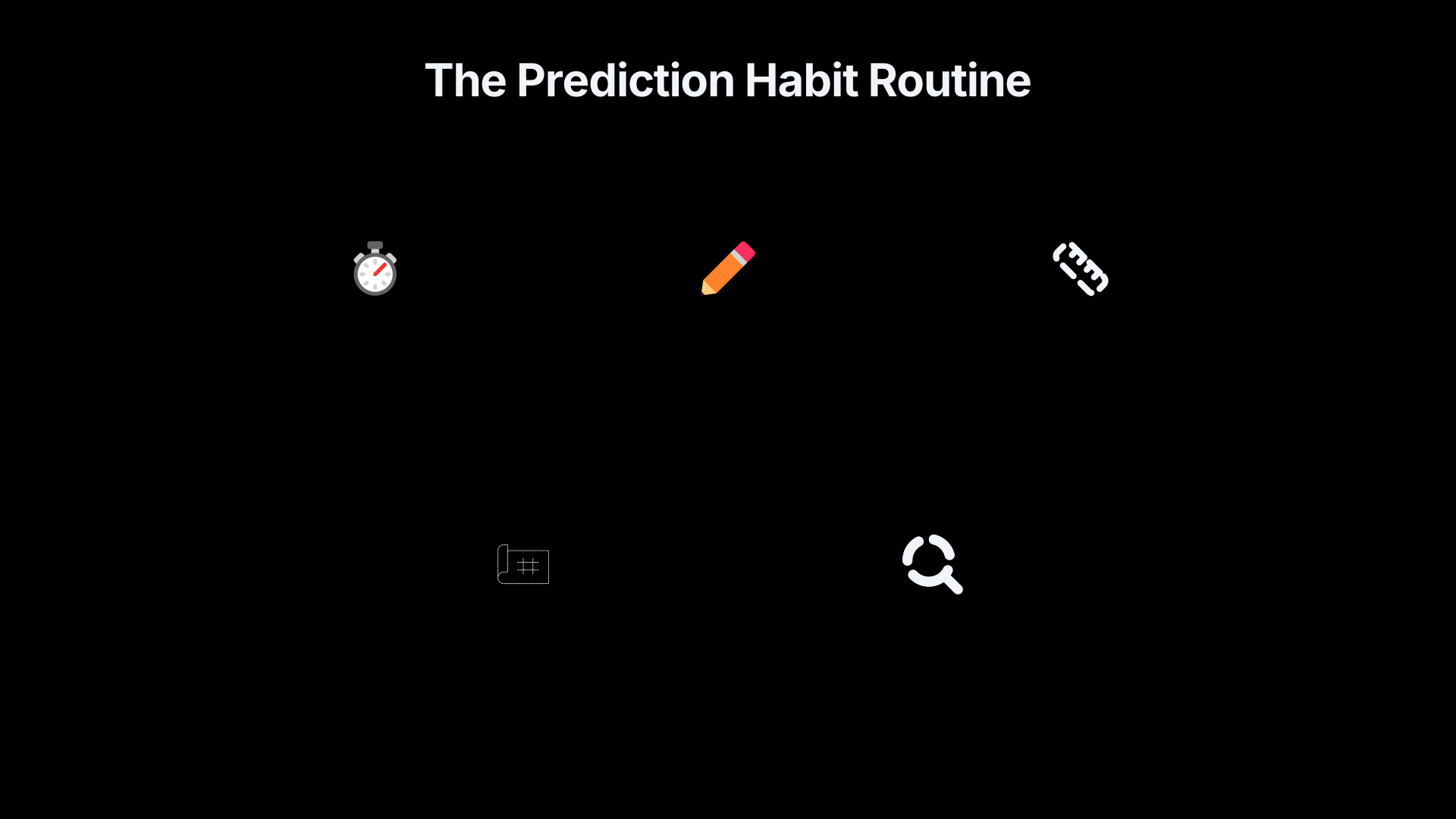
Everyday prediction exercises
Prediction habits work best when they are small enough to repeat. The aim is not to turn daily life into a formal experiment. It is to build many low-cost feedback moments so that your judgement gradually becomes more calibrated.
Before reading an explanation
When reading an article, textbook section or technical answer, pause at the heading or question and predict the main point. Do not spend long. One sentence is enough: “I think the key reason is…” or “I expect the answer to depend on…”
Then check the explanation and mark the result:
- Right for the right reason: your model is probably useful here.
- Right for the wrong reason: the answer matched, but your explanation needs repair.
- Wrong but close: refine the boundary condition.
- Wrong in a surprising way: slow down and identify the missed cue.
This is especially powerful when reading worked examples. Looking at a solution too early can make a difficult step seem natural. Predicting the next step first forces you to retrieve a principle, choose a method and notice where your current understanding breaks.
Before checking a score or answer key
Students often check answers as a pass-fail ritual. A stronger habit is to predict performance before revealing the score: “I think I got 7 out of 10, with low confidence on questions 3 and 8.” This turns the answer key into calibration data.
Research on judgments of learning suggests that retrieval practice can help people base future predictions on actual recall attempts rather than vague familiarity. In other words, trying to retrieve an answer gives a better cue about whether you really know it than simply rereading and asking whether it feels familiar. [Frontiers]frontiersin.orgOpen source on frontiersin.org.
The practical lesson is simple: do not only check whether you were correct. Check whether your confidence was appropriate. A wrong answer with low confidence is less concerning than a wrong answer held with certainty. A correct answer with shaky reasoning still deserves review.
Before opening analytics, results or feedback
Prediction is not only for school. Before checking website metrics, sales figures, experiment results, user feedback or a project update, write down what you expect and why. For example: “I expect sign-ups to rise after the homepage change, but paid conversions to stay flat because the pricing page did not change.”
This prevents post-hoc storytelling. Once the numbers are visible, the mind quickly invents reasons why the outcome “makes sense”. A prior prediction gives you a cleaner test of your assumptions.
The same routine helps in meetings. Before hearing the final decision, estimate the likely outcome and the decisive factor. Over time, you learn whether you understand the organisation’s incentives, constraints and evidence standards, or whether you are repeatedly surprised by the same kinds of considerations.
Why wrong predictions can help
A wrong prediction is useful when it is corrected quickly and reviewed well. The learning benefit depends on the feedback loop, not on error for its own sake.
The pretesting literature is important here because it challenges a common fear: that guessing before learning will merely reinforce mistakes. Studies generally find that pretesting can improve later recall when learners receive corrective feedback or subsequent study of the right answer. A 2025 Journal of Cognition paper found that pretesting produced higher recall than a read-only condition, with immediate feedback outperforming delayed feedback, while the benefit still persisted even when feedback or final testing was delayed. [Journal of Cognition]journalofcognition.orgJournal of CognitionThe Pretesting Effect: Exploring the Impact of Feedback…by Y Mera · 2025 · Cited by 2 — The pretesting effect sugg…
That does not mean all errors are good. An unsupported guess without feedback can leave misconceptions intact. A prediction habit needs an answer check, an explanation check and, when possible, a delayed re-check. The value comes from the sequence: commit, compare, correct, revisit.
There are also limits to the “surprise helps learning” story. Some research on prediction error and memory finds that surprise can influence later memory, but the effect depends on task design, age, encoding strategy and whether the learner can resolve the mismatch. A 2024 study on children and adults found little evidence for a robust word-learning boost from prediction error in its setting and suggested that variation in adult findings may partly reflect different encoding strategies. [Journal of Cognition]journalofcognition.orgOpen source on journalofcognition.org.
So the best practical rule is modest: use wrong predictions as attention-grabbing feedback, not as proof that confusion is automatically productive. If a surprise cannot be explained, it may remain noise. If it can be explained, it becomes a useful update.
Reviewing surprises without defensiveness
The hardest part of prediction is not writing the forecast. It is reviewing the miss without protecting your ego.
A good review separates three questions:
- What exactly did I predict? Keep the original wording visible. Do not quietly rewrite it after seeing the answer.
- What happened instead? State the difference plainly.
- What should change in my future attention? Identify one cue, rule or assumption to watch next time.
The tone matters. If every wrong prediction becomes a personal failure, people stop making predictions. If every wrong prediction is brushed aside as bad luck, the habit loses its corrective value. The useful middle is curiosity: “What did this error reveal about my model?”
Prediction research gives a helpful emotional clue. Brod’s review notes that incorrect predictions can evoke surprise, and that surprise may support attention to the correct answer. But surprise is only useful if it leads to processing rather than avoidance. [Springer]link.springer.comPredicting as a learning strategy - Springer Natureby G Brod · 2021 · Cited by 77 — Predicting involves that learners generate a…
A simple “surprise review” can be done in three lines:
- I expected: the original prediction.
- I missed: the key fact, cue or mechanism.
- Next time I will check: the specific signal to inspect earlier.
For example: “I expected the policy to fail because uptake was low. I missed that the target group was small but high-impact. Next time I will check whether the average effect hides a concentrated subgroup effect.”
This style keeps the review behavioural. It does not ask for shame or self-congratulation. It asks for a better next prediction.
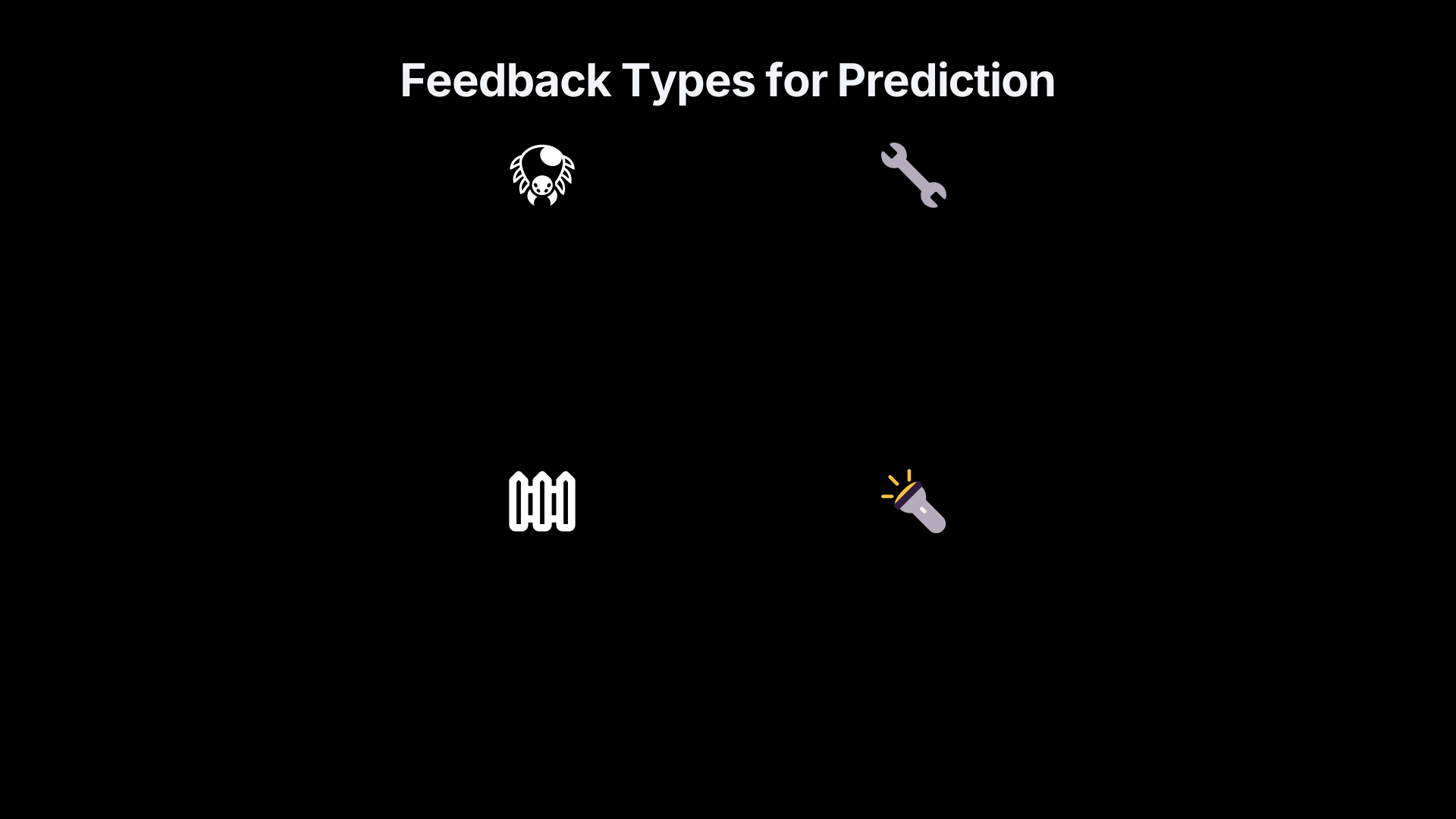
Confidence is part of the answer
A prediction without confidence is incomplete. Confidence turns a right-or-wrong check into calibration practice.
Calibration means that your stated confidence matches your actual accuracy. If you say you are 80% confident across many predictions, roughly eight out of ten should be right. Perfect calibration is not realistic in daily life, but better calibration is learnable because feedback gives you repeated chances to compare certainty with outcomes.
This is why a quick confidence rating is valuable. It can be as simple as low, medium or high. Over time, patterns emerge. You may discover that your “high confidence” predictions are reliable in familiar technical tasks but poor in social or strategic situations. You may find that you understate confidence in domains where you actually have strong experience. You may also find that fluency, authority or recent exposure makes you feel more certain than the evidence warrants.
Feedback type matters. Research on memory feedback suggests that corrective information can affect both accuracy and confidence, and that confidence in incorrect answers is an important part of what later learning must repair. [PMC]pmc.ncbi.nlm.nih.govOpen source on nih.gov.
In practical terms, review confidence separately from correctness:
- High confidence, wrong: inspect the assumption immediately.
- Low confidence, right: ask what cue you noticed but did not yet trust.
- High confidence, right: record the rule that worked.
- Low confidence, wrong: build the missing foundation rather than treating it as a careless slip.
This keeps confidence from becoming a vague feeling. It becomes evidence about how your thinking performs under uncertainty.
Where prediction habits fit best
Prediction before checking is most useful when feedback is near enough, clear enough and repeated enough to shape judgement. It is especially strong in learning facts, solving problems, reading explanations, interpreting data, reviewing forecasts, analysing decisions and practising professional judgement.
It is weaker when the outcome is ambiguous, delayed or dominated by luck. Predicting the result of a single political event, investment move or interpersonal conversation may still be useful, but one result rarely proves much. In noisy domains, the habit works better when predictions accumulate and are reviewed as a set.
This distinction echoes broader judgement research: intuition improves most reliably in environments where cues are valid and feedback is timely. Prediction habits help create a small version of that environment. They make feedback more visible, even when the wider world is messy.
The habit also needs sensible stakes. For low-stakes learning, quick guesses are fine. For high-stakes decisions, predictions should be paired with deeper checks: alternative explanations, base rates, expert input, pre-mortems and explicit decision criteria. Prediction is a pillar of better thinking, not a replacement for evidence.
A practical routine
A durable prediction habit can be built around a short loop:
1. Pause before the reveal.
Before checking the answer, solution, result or feedback, stop for a few seconds.
2. Write one sentence.
State what you expect. Make it concrete enough to compare with reality.
3. Add confidence.
Use a rough scale: low, medium, high, or a percentage if that feels natural.
4. Give the reason.
Name the cue or assumption behind the prediction.
5. Check the answer.
Look at the result, but do not stop at right or wrong.
6. Review the mismatch.
Ask what the difference reveals about your model.
7. Re-test later.
For learning tasks, come back after a delay. The pretesting effect is about later retention, not just momentary recognition. [Journal of Cognition]journalofcognition.orgJournal of CognitionThe Pretesting Effect: Exploring the Impact of Feedback…by Y Mera · 2025 · Cited by 2 — The pretesting effect sugg…
A compact version looks like this:
I predict __ because __. [> Confidence: __.]</a>snitchnotes.comSource details in endnotes.</span> Actual result: __. Update: next time I will notice ___.
The power of the routine is its smallness. It does not require a new app, a long journal or a formal study plan. It asks you to stop giving your mind unlimited permission to explain things only after the answer is visible.

Common mistakes that weaken the habit
The first mistake is predicting too vaguely. “This will go well” is hard to learn from. “The trial group will complete the task faster but make more errors” creates a clearer test.
The second mistake is checking too soon. If you reveal the answer before making even a minimal commitment, you lose the feedback benefit. The prediction has to come first.
The third mistake is treating all wrong answers alike. A near miss, a lucky guess, a confident misconception and a wild guess each teach different things. Reviewing the reason behind the prediction matters more than tallying wins and losses.
The fourth mistake is becoming defensive. Prediction is not a performance of intelligence. It is a training method for attention, calibration and model repair. The people who benefit most are not those who are always right, but those who can bear to see exactly how they were wrong.
The fifth mistake is making prediction too elaborate. A prediction habit should be light enough to use often. If the routine becomes a burdensome worksheet, it will disappear. The minimum effective dose is usually one sentence, one confidence rating and one update.
The takeaway
Predicting before checking answers improves thinking because it creates feedback where passive reading creates only exposure. It makes attention sharper, confidence more measurable and surprise more useful. Research on pretesting, retrieval, metacognition and prediction-based learning supports the core idea: attempting an answer before seeing the correct one can improve later learning, especially when feedback follows and the learner reviews the mismatch. [lifescied.org+3Journal of Cognition+3Springer]journalofcognition.orgJournal of CognitionThe Pretesting Effect: Exploring the Impact of Feedback…by Y Mera · 2025 · Cited by 2 — The pretesting effect sugg…
The habit is small, but its effects accumulate. Each prediction records a snapshot of your current model. Each answer tests it. Each surprise shows where the model needs repair. Over time, the practice trains a valuable analytical reflex: do not merely ask, “What is the answer?” Ask, “What did I expect, why did I expect it, and what does the result teach me about how I think?”
eBay marketplace picks
Marketplace Samples
Live-tested eBay searches with available results related to this page.


Endnotes
-
Source: link.springer.com
Link: https://link.springer.com/article/10.3758/s13423-021-01904-1Source snippet
Predicting as a learning strategy - Springer Natureby G Brod · 2021 · Cited by 77 — Predicting involves that learners generate a...
-
Source: pmc.ncbi.nlm.nih.gov
Title: PMCPredicting as a learning strategy
Link: https://pmc.ncbi.nlm.nih.gov/articles/PMC8642250/Source snippet
NIHby G Brod · 2021 · Cited by 77 — Initial evidence suggests that predicting boosts surprise about unexpected answers, which leads...
-
Source: lifescied.org
Link: https://www.lifescied.org/doi/10.1187/cbe.20-12-0289 -
Source: pmc.ncbi.nlm.nih.gov
Link: https://pmc.ncbi.nlm.nih.gov/articles/PMC12292081/ -
Source: pmc.ncbi.nlm.nih.gov
Link: https://pmc.ncbi.nlm.nih.gov/articles/PMC9293038/ -
Source: pmc.ncbi.nlm.nih.gov
Link: https://pmc.ncbi.nlm.nih.gov/articles/PMC9839203/ -
Source: link.springer.com
Link: https://link.springer.com/article/10.1007/s10648-025-10103-6 -
Source: link.springer.com
Link: https://link.springer.com/article/10.3758/s13421-012-0274-5 -
Source: link.springer.com
Link: https://link.springer.com/article/10.1007/s10648-023-09814-5 -
Source: link.springer.com
Link: https://link.springer.com/article/10.3758/s13423-024-02517-0 -
Source: journalofcognition.org
Link: https://journalofcognition.org/articles/10.5334/joc.455Source snippet
Journal of CognitionThe Pretesting Effect: Exploring the Impact of Feedback...by Y Mera · 2025 · Cited by 2 — The pretesting effect sugg...
-
Source: scientificamerican.com
Title: Scientific American The Pluses of Getting It Wrong
Link: https://www.scientificamerican.com/article/the-pluses-of-getting-it-wrong/Source snippet
Scientific AmericanThe Pluses of Getting It WrongMarch 1, 2010 — 1 Mar 2010 — In a way, this pretesting effect is counterintuitive: study...
Published: March 1, 2010
-
Source: frontiersin.org
Link: https://www.frontiersin.org/journals/psychology/articles/10.3389/fpsyg.2019.00987/full -
Source: journalofcognition.org
Link: https://journalofcognition.org/articles/10.5334/joc.342 -
Source: pmc.ncbi.nlm.nih.gov
Link: https://pmc.ncbi.nlm.nih.gov/articles/PMC9170123/ -
Source: pmc.ncbi.nlm.nih.gov
Link: https://pmc.ncbi.nlm.nih.gov/articles/PMC11868466/ -
Source: pmc.ncbi.nlm.nih.gov
Link: https://pmc.ncbi.nlm.nih.gov/articles/PMC8713973/ -
Source: pmc.ncbi.nlm.nih.gov
Link: https://pmc.ncbi.nlm.nih.gov/articles/PMC7618218/ -
Source: frontiersin.org
Link: https://www.frontiersin.org/research-topics/80199/learning-from-surprise-neural-and-behavioral-[mechanisms -
Source: educationendowmentfoundation.org.uk
Link: https://educationendowmentfoundation.org.uk/education-evidence/guidance-reports/metacognition
Additional References
-
Source: dyslexicadvantage.org
Link: https://www.dyslexicadvantage.org/wp-content/uploads/2016/06/Scientific-American-Learning-Mistakes.pdfSource snippet
Dyslexia | Dyslexic AdvantageGetting It Wrong: Surprising Tips on How to Learnby HL Roediger · Cited by 29 — In a way this pretesting eff...
-
Source: youtube.com
Title: Teach Students How to Learn (Saundra Yancy Mc Guire) Summarized
Link: https://www.youtube.com/watch?v=gdcixmgKr08Source snippet
The Hindsight Bias: Action The Illusion of Predictability...
-
Source: youtube.com
Title: A surprising study method that will make your dopamine explode
Link: https://www.youtube.com/watch?v=JGQ-605WBk8Source snippet
How To Become Dangerously Self-Educated (with AI)...
-
Source: youtube.com
Title: How To Become Dangerously Self-Educated (with AI)
Link: https://www.youtube.com/watch?v=VeU6gScy92sSource snippet
Teach Students How to Learn (Saundra Yancy McGuire) Summarized...
-
Source: youtube.com
Title: How to STUDY so FAST it feels like CHEATING
Link: https://www.youtube.com/watch?v=-v3D8wNUUjkSource snippet
A surprising study method that will make your dopamine explode...
-
Source: researchgate.net
Link: https://www.researchgate.net/publication/369450297_Metacognitive_unawareness_of_feedback_influences_future_memory_prediction_but_not_postdiction -
Source: researchgate.net
Link: https://www.researchgate.net/publication/343927243_A_metacognitive_retrieval_practice_intervention_to_improve_undergraduates%27_monitoring_and_control_processes_and_use_of_performance_feedback_for_classroom_learning -
Source: snitchnotes.com
Link: https://snitchnotes.com/fr/blog/confidence-based-learning-study-method-for-exam-prep -
Source: apa.org
Link: https://www.apa.org/pubs/journals/features/xge-xge0000140.pdf -
Source: nko.nl
Link: https://www.nko.nl/sites/nro/files/migrate/411-10-910-010-Proefschrift_Reijners.pdf
Topic Tree