Within Spacing
Can one concept travel across situations?
Returning to a concept through varied examples helps learners recognize it outside the first lesson context.
On this page
- Why repeated contexts reduce cue dependence
- Using fresh examples, borderline cases and comparisons
- Applying concepts to real articles and decisions
Page outline Jump by section
Introduction
Spaced examples help a concept travel. Instead of meeting an analytical idea once, in one neat lesson example, learners return to it over time in fresh situations: a different article, a borderline case, a new chart, a messy workplace decision. This matters because transfer — using knowledge in a new context — is a key sign of deep understanding, but it is also difficult to achieve. Yale’s Poorvu Center defines transfer as applying learned knowledge or skills to new contexts, and notes that it can be positive or negative depending on whether prior knowledge is used well or misapplied. [Poorvu Center for Teaching and Learning]poorvucenter.yale.eduPoorvu Center for Teaching and Learning Transfer of Knowledge to New ContextsPoorvu Center for Teaching and LearningTransfer of Knowledge to New Contexts - Poorvu CenterTransfer is the ability to apply learned know…
 For improving thinking and analytical skills, the point is not simply to remember the label “confirmation bias”, “base rate”, “incentive”, “confounder” or “opportunity cost”. The point is to notice the concept when it appears in a form that does not announce itself. Research on spacing, retrieval practice, interleaving, comparison and varied examples all points towards the same practical lesson: concepts become more flexible when learners repeatedly identify, explain and apply them across changing examples, not only when they reread the original explanation. [PubMed+2Bera Journals]pubmed.ncbi.nlm.nih.govRetrieving and applying knowledge to different examples…by AC Butler · 2017 · Cited by 87 — All four experiments showed that var…
Why repeated contexts reduce cue dependence
A learner can appear to understand a concept while still depending heavily on the original cue. Someone may explain survivorship bias perfectly when shown the classic aircraft armour story, but fail to notice the same reasoning error in a business article about successful founders. Another learner may recognise correlation versus causation in a textbook graph, yet miss it in a headline about diet, screen time or productivity. The problem is not that the concept was never learned; it is that it was learned too narrowly.
Spaced examples work against this narrowness by separating the concept from one fixed setting. Each return asks: what is the same here, even though the surface has changed? A lesson on base rates might begin with medical testing, return later through hiring decisions, then appear again in a news story about crime statistics or investment performance. The learner has to reconstruct the underlying structure rather than lean on the first story’s vocabulary, diagram or emotional tone.
This fits with the broader idea of encoding variability: when learners encounter material in varied conditions, they may build more routes back to it. A review on how variability shapes learning and generalisation describes learning as using past experiences to guide new behaviour, which always requires some degree of generalisation because no two situations are identical. It notes that more variable and representative input can improve generalisation, though it may make early learning feel harder. [MPG.PuRe]pure.mpg.deBecause all experiences are unique, learning always requires some generalization.Read more…
That last point is important. Varied spaced examples may reduce short-term fluency. Learners can feel less confident when the example changes because they can no longer rely on recognition. But this difficulty is often the useful part. Bjork and Bjork’s work on “desirable difficulties” argues that conditions which make practice less smooth in the moment — such as spacing, interleaving and varying practice — can support stronger long-term retention and transfer when the task remains achievable. [Bjork Learning and Forgetting Lab]bjorklab.psych.ucla.eduOpen source on ucla.edu.
Fresh examples beat repeated recognition
Repeated exposure to the same example can produce familiarity without flexibility. If every lesson on sunk cost uses the same cinema-ticket example, learners may remember the anecdote but not the decision rule: past irrecoverable costs should not determine whether a future action is worthwhile. A better spaced sequence revisits sunk cost through different cases: staying in a failing project, finishing an unenjoyable book, continuing a poor investment, or keeping a meeting because time has already been spent preparing for it.
The clearest research connection comes from retrieval practice with varied examples. In a 2017 study, Butler and colleagues tested whether retrieving and applying knowledge to different examples helped transfer. Across four experiments, variability during retrieval practice produced better transfer to new examples. The authors concluded that repeatedly retrieving and applying knowledge to different examples can help people acquire knowledge that transfers to a variety of new contexts. [PubMed]pubmed.ncbi.nlm.nih.govRetrieving and applying knowledge to different examples…by AC Butler · 2017 · Cited by 87 — All four experiments showed that var…
For analytical learning, this suggests a practical rule: do not only ask, “Can the learner define the concept?” Ask, “Can the learner spot it when the wording, domain and format change?” A strong review session might therefore include:
- a short recall prompt: “What is the concept?”
- a fresh example: “Where is it visible in this case?”
- a non-example: “Why does this similar case not count?”
- a transfer prompt: “Where might this matter in a real decision this week?”
This is different from simply adding variety for entertainment. The variation has to preserve the target structure while changing enough surface features to prevent cue dependence. If the examples differ wildly before the learner has a stable first grasp, the result can be confusion. If they differ too little, the learner may memorise a template. The useful zone is “same concept, changed situation”.
Borderline cases and comparisons sharpen the concept
Fresh examples help learners see where a concept applies. Borderline cases help them see where it stops. That boundary work is especially important for analytical thinking because many errors come from over-applying a good idea. A learner who has just discovered “incentives matter” may start treating every behaviour as a simple reward-response problem. A learner who has just learned “correlation is not causation” may become too quick to dismiss evidence that, with the right design, can support causal inference.
Comparison is one of the strongest ways to make those boundaries visible. Research on structural alignment suggests that comparing examples can make common relational structure more salient. Kurtz, Boukrina and Gentner found that comparison promoted learning and transfer of relational categories — categories defined by relationships rather than obvious surface features. [Northwestern Psychology Groups]groups.psych.northwestern.eduPsychology Groups Comparison Promotes Learning and Transfer of RelationalPsychology Groups Comparison Promotes Learning and Transfer of Relational
A memorable classroom version comes from work on contrasting cases. Stanford’s AAA Lab describes contrasting cases as examples designed to foster attention to deep structure, flexibility, transfer and preparation for future learning, with applications across science, technology, engineering and mathematics domains including statistical variance and electromagnetic fields. [AAALab]aaalab.stanford.eduAAALab Contrasting CasesAAALab Contrasting Cases Schwartz and colleagues’ work on “inventing to prepare for future learning” similarly argues that learners may be better prepared for later instruction when they first grapple with contrasts that make the deep feature worth noticing. [AAALab]aaalab.stanford.eduAAALab Inventing to Prepare for Future LearningAAALab Inventing to Prepare for Future Learning
For analytical concepts, this can be implemented without turning learning into a formal experiment. Suppose the concept is “confounding variable”. A spaced set might include:
- a clear example: people who drink more coffee appear to have worse sleep, but stress may affect both coffee intake and sleep;
- a near miss: two measures move together, but the causal direction is simply uncertain rather than clearly confounded;
- a contrast: a randomised trial where the confounder is balanced by design;
- a real article: a news claim about lifestyle, education, productivity or health where the learner must ask what else differs between the groups.
The learner is not just naming a concept. They are calibrating it.
Interleaving helps learners choose the concept, not just use it
In real analysis, the problem rarely tells you which mental tool to use. A report, article or meeting may require distinguishing selection bias from survivorship bias, incentives from constraints, or a base-rate problem from a causal claim. This is where interleaving matters: instead of practising one concept in a block, learners meet several related concepts in mixed order and must decide which one applies.
A 2021 systematic review of interleaving as a concept-learning strategy examined studies on mixing examples of concepts and found evidence relevant to both memory for items and transfer to new items. [Bera Journals]bera-journals.onlinelibrary.wiley.comBera JournalsA systematic review of interleaving as a concept learning…by J Firth · 2021 · Cited by 117 — A systematic review was cond… Interleaving is not identical to spacing, but the two often work well together: spacing separates returns to a concept over time, while interleaving makes learners discriminate between similar concepts during those returns.
The distinction matters for flexible concept use. Blocked practice can train execution after the category has already been supplied. Interleaved spaced examples train selection. For example, if learners only practise “spot the base-rate neglect” examples for twenty minutes, they may become good at that exercise. But if they return over several days to mixed examples involving base rates, sampling bias, regression to the mean and causal overclaiming, they must inspect the situation before choosing the concept.
Research on interleaving in problem-solving also shows why this feels uncomfortable. Samani and colleagues describe interleaving as switching between topics, skills, concepts or categories during learning, and note that it can enhance later memory and problem-solving even when blocked practice feels easier. [PMC]pmc.ncbi.nlm.nih.govOpen source on nih.gov. The learner’s slower, less fluent performance during practice may be a sign that they are doing the harder work of discrimination.
Applying concepts to real articles and decisions
The most useful spaced examples are not always polished textbook cases. Analytical skill improves when learners practise concept spotting in the kinds of material where they will actually need the concept: news reports, workplace proposals, policy claims, charts, meeting notes, product comparisons, research summaries and personal decisions.
A practical sequence might look like this:
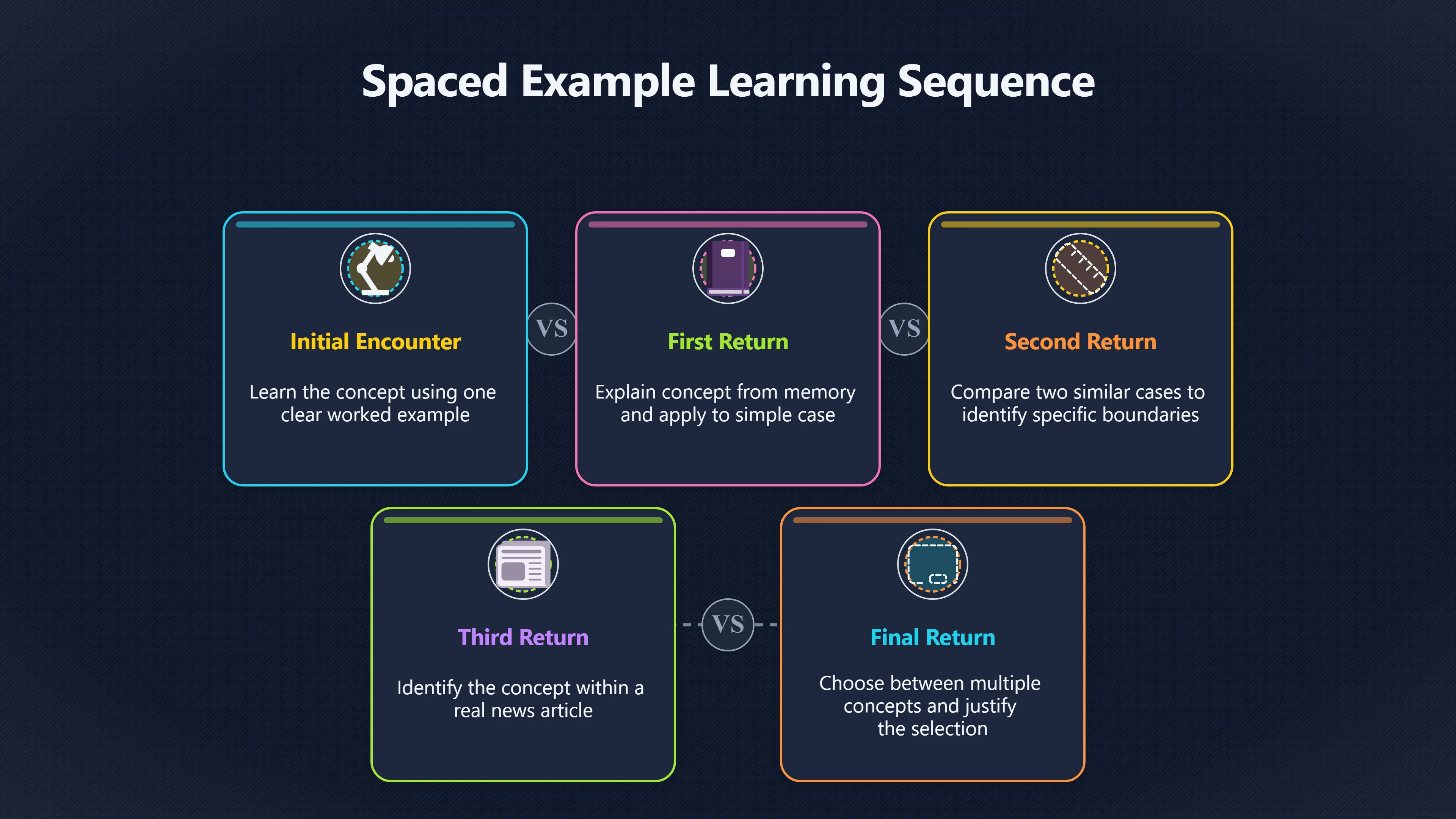
- First encounter: learn the concept with one clear worked example.
- First return: explain the concept from memory and apply it to a fresh but simple case.
- Second return: compare two similar cases, only one of which fits.
- Third return: find the concept in a real article, chart or decision.
- Later return: choose between several possible concepts and justify the choice.
This sequence keeps the focus on flexible use. The learner is not merely recalling a definition; they are building a habit of asking, “What kind of situation is this?” Retrieval-practice guidance on transfer makes a similar distinction: simple retrieval can transfer well across question formats, but application and inference usually need broader questions, meaningful explanations and useful feedback. [PDF Retrieval Practice]pdf.retrievalpractice.orgOpen source on retrievalpractice.org.
For example, a learner studying “base rates” might eventually examine a real hiring claim: “Most successful candidates came from elite universities.” The concept becomes useful only when the learner asks what proportion of applicants came from those universities, how selection occurred, and whether success rates differ after accounting for the starting pool. The spaced-example method has done its job when the learner can recognise that structure without being told, “This is a base-rate problem.”
What makes a spaced example sequence work
Good implementation is deliberate. Simply collecting many examples is not enough; the examples need to be sequenced so that learners repeatedly reconnect the concept while also seeing new boundaries and uses.
A strong spaced-example sequence usually has five features.
It begins with clarity. The first example should be clean enough for the learner to understand the concept. Early variability is helpful only if the learner has something stable to vary from.
It changes surface features. Later examples should shift domain, format, emotional tone or data presentation. A concept learned through a paragraph should later appear in a chart, a decision memo or a headline.
It includes non-examples. Learners need cases that look tempting but do not quite fit. These prevent the concept from becoming a vague label for anything similar.
It asks for explanation, not just identification. “Which concept is this?” is weaker than “Which concept is this, what cue made you think so, and what would make you change your mind?”
It returns after forgetting. The spacing matters because the learner has to reconstruct the idea. Immediate variety can help comparison, but delayed variety tests whether the concept remains usable when the original lesson context has faded.
Recent work comparing variability in worked examples and retrieval practice reinforces the need to think about format. Cao’s 2026 study notes that retrieval practice and worked examples both support learning and generalisation, while category-learning research suggests that varied examples can improve generalisation. The study specifically investigates how variability in learning materials affects generalisation under retrieval-practice and worked-example conditions. [Springer]link.springer.comOpen source on springer.com.

The main failure modes
Spaced examples can be poorly designed. The most common failure is variety without a target. If learners see a flood of unrelated cases, they may remember fragments but miss the shared structure. Another failure is over-obvious labelling: if every prompt says “Use confirmation bias here”, the learner practises applying a given label, not recognising when the label is needed.
There is also a risk of premature difficulty. Novices often need worked examples before they can benefit from open-ended transfer tasks. Research on worked-example variability in geometrical problem-solving found that students who studied worked examples gained most from high-variability examples and invested less time and mental effort in practice, suggesting that varied examples can support transfer when learners are not overloaded by unguided problem solving. [ResearchGate]researchgate.netResearch Gate Variability-of-Worked-Examples-and-Transfer-ofResearch Gate Variability-of-Worked-Examples-and-Transfer-of
The practical compromise is to fade support. Early spaced examples can include cues, explanations and worked comparisons. Later examples should remove some cues and require the learner to choose, justify and revise. The aim is not to make practice maximally hard; it is to make it hard in the same way real use will be hard.
Can one concept travel across situations?
Yes, but it rarely travels by definition alone. A concept becomes portable when the learner has met it repeatedly, retrieved it after gaps, compared it with nearby ideas, tested it against borderline cases and used it on real material. Spacing supplies the time gap that makes retrieval meaningful. Varied examples supply the changed conditions that make transfer possible.
For analytical thinking, this is the difference between owning a term and owning a tool. A term stays attached to the lesson where it was learned. A tool can be picked up later, in a different room, while reading a different article, facing a different decision, and still help the thinker see what matters.
Amazon book picks
Further Reading
Books and field guides related to Can one concept travel across situations?. Use these as the next step if you want deeper reading beyond the article.
How We Learn
Covers spacing, varied practice, forgetting, and applying knowledge across contexts.
Make It Stick
Explains retrieval practice, spacing, interleaving, varied examples, and transfer of learning.
Why Don't Students Like School?
Connects cognitive science with classroom strategies that improve understanding and transfer.
eBay marketplace picks
Marketplace Samples
Live-tested eBay searches with available results related to this page.



Endnotes
-
Source: poorvucenter.yale.edu
Title: Poorvu Center for Teaching and Learning Transfer of Knowledge to New Contexts
Link: https://poorvucenter.yale.edu/transfer-of-knowledge-to-new-contextsSource snippet
Poorvu Center for Teaching and LearningTransfer of Knowledge to New Contexts - Poorvu CenterTransfer is the ability to apply learned know...
-
Source: pure.mpg.de
Link: https://pure.mpg.de/rest/items/item_3380375_2/component/file_3383568/contentSource snippet
Because all experiences are unique, learning always requires some generalization.Read more...
-
Source: researchgate.net
Link: https://www.researchgate.net/publication/321988375_Retrieving_and_applying_knowledge_to_different_examples_promotes_transfer_of_learning -
Source: groups.psych.northwestern.edu
Title: Psychology Groups Comparison Promotes Learning and Transfer of Relational
Link: https://groups.psych.northwestern.edu/gentner/papers/kurtzBoukrina%26Gentner_2013.pdf -
Source: aaalab.stanford.edu
Title: AAALab Contrasting Cases
Link: https://aaalab.stanford.edu/research/inventive-learning/contrasting-cases/index.html -
Source: aaalab.stanford.edu
Title: AAALab Inventing to Prepare for Future Learning
Link: https://aaalab.stanford.edu/assets/papers/2004/Inventing_to_prepare_for_future_learning.pdf -
Source: pmc.ncbi.nlm.nih.gov
Link: https://pmc.ncbi.nlm.nih.gov/articles/PMC8589969/ -
Source: link.springer.com
Link: https://link.springer.com/article/10.1007/s10648-026-10169-w -
Source: researchgate.net
Title: Research Gate Variability-of-Worked-Examples-and-Transfer-of
Link: https://www.researchgate.net/profile/Jeroen-J-G-Van-Merrienboer/publication/232498122_Variability_of_Worked_Examples_and_Transfer_of_Geometrical_Problem-Solving_Skills_A_Cognitive-Load_Approach/links/0046352cd2dccc20d9000000/Variability-of-Worked-Examples-and-Transfer-of-Geometrical-Problem-Solving-Skills-A-Cognitive-Load-Approach.pdf -
Source: researchgate.net
Link: https://www.researchgate.net/publication/350281128_A_systematic_review_of_interleaving_as_a_concept_learning_strategy -
Source: researchgate.net
Link: https://www.researchgate.net/publication/232573105_Effects_of_variable_encoding_and_spaced_presentations_on_vocabulary_learning -
Source: researchgate.net
Link: https://www.researchgate.net/publication/271707756_On_the_acquisition_of_abstract_knowledge_Structural_alignment_and_explication_in_learning_causal_system_categories -
Source: researchgate.net
Link: https://www.researchgate.net/publication/232542083_Practicing_Versus_Inventing_With_Contrasting_Cases_The_Effects_of_Telling_First_on_Learning_and_Transfer -
Source: researchgate.net
Title: 347931447 Desirable Difficulties in Theory and Practice
Link: https://www.researchgate.net/publication/347931447_Desirable_Difficulties_in_Theory_and_Practice -
Source: link.springer.com
Link: https://link.springer.com/article/10.1007/s44217-026-01248-9 -
Source: pubmed.ncbi.nlm.nih.gov
Link: https://pubmed.ncbi.nlm.nih.gov/29265856/Source snippet
Retrieving and applying knowledge to different examples...by AC Butler · 2017 · Cited by 87 — All four experiments showed that var...
-
Source: bera-journals.onlinelibrary.wiley.com
Link: https://bera-journals.onlinelibrary.wiley.com/doi/10.1002/rev3.3266Source snippet
Bera JournalsA systematic review of interleaving as a concept learning...by J Firth · 2021 · Cited by 117 — A systematic review was cond...
-
Source: bjorklab.psych.ucla.edu
Link: https://bjorklab.psych.ucla.edu/wp-content/uploads/sites/13/2016/04/EBjork_RBjork_2011.pdf -
Source: pdf.retrievalpractice.org
Link: https://pdf.retrievalpractice.org/TransferGuide.pdf -
Source: pmc.ncbi.nlm.nih.gov
Link: https://pmc.ncbi.nlm.nih.gov/articles/PMC11536137/ -
Source: pmc.ncbi.nlm.nih.gov
Link: https://pmc.ncbi.nlm.nih.gov/articles/PMC9902256/ -
Source: pmc.ncbi.nlm.nih.gov
Link: https://pmc.ncbi.nlm.nih.gov/articles/PMC12741211/ -
Source: education-ni.gov.uk
Link: https://www.education-ni.gov.uk/sites/default/files/2025-04/May%20Newsletter%20-%20Retrieval%20Practice%20%20What%20it%20is%2C%20Why%20it%20Works%20and%20How%20to%20Do%20It%20Better.PDF -
Source: mindomax.com
Title: desirable difficulties
Link: https://www.mindomax.com/desirable-difficulties -
Source: barnard.edu
Link: https://barnard.edu/sites/default/files/inline-files/Transfer.pdf
Additional References
-
Source: youtube.com
Link: https://www.youtube.com/watch?v=qc4gqGdK4TYSource snippet
Realigning simulation instructional design with learning | Dr. Jeffrey Cheung | MERIT...
-
Source: youtube.com
Link: https://www.youtube.com/watch?v=fSpQRnk_2LMSource snippet
The Smarter Way to Practice Baseball | Baseball Training IQ...
-
Source: youtube.com
Title: Steven C. Pan
Link: https://www.youtube.com/watch?v=7CkSLfB4UfoSource snippet
[Review] Make It Stick: The Science of Successful Learning (Peter C. Brown) Summarized...
-
Source: medium.com
Link: https://medium.com/age-of-awareness/a-deep-dive-into-desirable-difficulties-41dbd17e9b9e -
Source: thejulian-tsh.org.uk
Link: https://www.thejulian-tsh.org.uk/news-and-events/blog/how-i-use-interleaving-and-schemas -
Source: thirdspacelearning.com
Link: https://thirdspacelearning.com/blog/interleaving/ -
Source: academia.edu
Link: https://www.academia.edu/94715066/On_the_acquisition_of_abstract_knowledge_Structural_alignment_and_explication_in_learning_causal_system_categories -
Source: learningscientists.org
Link: https://www.learningscientists.org/blog/2026/6/18-1 -
Source: evidencebased.education
Link: https://evidencebased.education/resource/retrieval-and-spaced-practice-study-strategies-that-must-be-combined/ -
Source: semanticscholar.org
Link: https://www.semanticscholar.org/paper/Variability-of-Worked-Examples-and-Transfer-of-A-Paas-Merri%C3%ABnboer/1512a1cc2b8199c1e3258b1bf26bc402d42ee88f
Topic Tree