Within Critical Skills
How Sure Should You Really Be?
Good judgement depends on matching confidence to evidence and knowing what assumption would change the conclusion.
On this page
- Why overconfidence survives weak evidence
- How to state uncertainty clearly
- What would change my mind as a habit
Page outline Jump by section
Introduction
Good judgement is not about being certain. It is about matching your level of confidence to the strength of the available evidence. In everyday life, decisions usually have to be made before all the facts are known: choosing a job, interpreting a medical headline, investing money, or deciding whether a news story is trustworthy. The question is rarely “Can I be completely sure?” but rather “How sure should I be, given what I know now?”
 Confidence calibration is the habit of making confidence proportional to evidence. A well-calibrated thinker is neither permanently sceptical nor habitually certain. They recognise what is known, what is uncertain, and which assumptions their judgement depends on. Research in psychology and decision science consistently shows that people are often overconfident, especially when evidence is incomplete, but that calibration can improve with feedback, explicit probability judgements, and deliberate reflection on uncertainty. [NCBI+2Wikipedia]ncbi.nlm.nih.govNCBIReviewing the evidence: heuristics and biasesNIHby L Bojke · 2021 · Cited by 3 — Confirmation bias, for instance, leads individuals to focus on information that is consistent…
Why overconfidence survives weak evidence
One reason overconfidence is so persistent is that confidence feels like evidence even when it is not. A vivid explanation, a familiar story, or repeated exposure can create a strong subjective sense of certainty without adding reliable information.
Psychologists distinguish between confidence and accuracy because the two do not automatically move together. Someone may express great certainty while being wrong, or hesitate despite having the better-supported conclusion. Calibration asks whether confidence matches actual correctness over time. If someone says they are 80% confident on many different questions, they should be correct roughly eight times out of ten. That is what being well calibrated means. [Wikipedia]WikipediaCalibrated probability assessmentCalibrated probability assessment
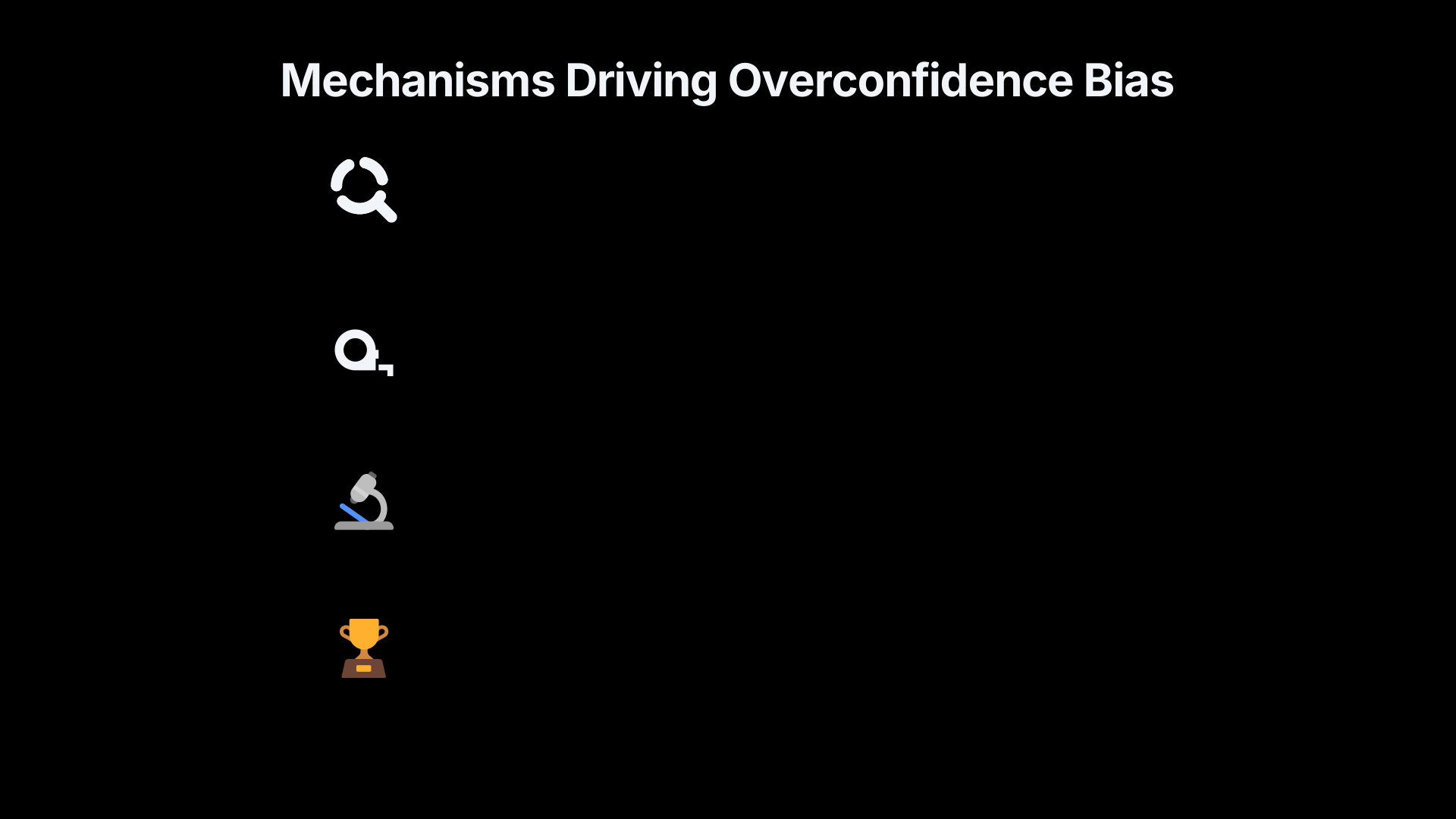
Several mechanisms push confidence beyond what the evidence justifies.
- Confirmation bias: Once people favour an explanation, they tend to notice supporting evidence more readily than conflicting evidence.
- Overprecision: People often believe their estimates are much more exact than they really are, producing confidence intervals that are far too narrow.
- Illusion of validity: Consistent or detailed information can create unwarranted certainty even when the underlying evidence is weak.
- Motivated reasoning: Desired outcomes can subtly influence what people accept as convincing evidence. [NCBI+2Wikipedia]ncbi.nlm.nih.govNCBIReviewing the evidence: heuristics and biasesNIHby L Bojke · 2021 · Cited by 3 — Confirmation bias, for instance, leads individuals to focus on information that is consistent…
These effects appear across many domains. Investors become too certain about market forecasts, managers overestimate project success, clinicians can become attached to an early diagnosis, and ordinary readers may treat a persuasive article as stronger evidence than it really is. The common mistake is confusing the quality of an explanation with the quality of the evidence supporting it.
How to state uncertainty clearly
People often think uncertainty means ignorance or indecision. In reality, expressing uncertainty accurately is a mark of careful reasoning.
Instead of presenting conclusions as either true or false, calibrated thinkers communicate both their judgement and its strength. That can be done without complex statistics.
For example:
- Instead of “This policy will reduce costs,” say “The current evidence suggests it probably will, but the estimate depends on customer behaviour remaining similar.”
- Instead of “I’m certain this headline is misleading,” say “Several warning signs make me doubtful, although I have not yet checked the original source.”
- Instead of “This treatment definitely works,” say “The available studies support a benefit, but the size of that benefit remains uncertain.”
This approach separates three different ideas that people often blur together:
QuestionSeparate answerWhat do I currently believe?The present conclusion.How confident am I?The degree of certainty justified by the evidence.Why might I be wrong?The assumptions or missing information that could change the judgement.
Notice that uncertainty does not weaken a conclusion when the evidence is genuinely strong. If dozens of independent, high-quality studies point in the same direction, high confidence is appropriate. Calibration means allowing confidence to rise with evidence, not keeping every belief permanently tentative. [BIT]bi.teamTStay calibrated: a practical guide to debiasing decision-…25 Sept 2025 — To be well-calibrated means your confidence in your judgem…
What would change my mind as a habit
One of the simplest ways to improve calibration is to identify, before deciding, what evidence would alter your conclusion.
Without this step, it is easy to interpret every new piece of information as confirmation of an existing view. By specifying potential disconfirming evidence in advance, you make your confidence accountable.
Useful questions include:
- What observation would genuinely surprise me?
- Which assumption matters most?
- What evidence would reduce my confidence by half?
- What evidence would make me much more confident?
- Am I treating missing evidence as if it supported my position?
This habit shifts thinking from defending beliefs to testing them. Scientists formalise this through hypotheses and prediction, but the same idea works in everyday decisions. Before buying an expensive product, for example, you might decide that finding consistent reports of reliability problems from multiple independent sources would change your mind. Before accepting a workplace proposal, you might identify the key assumption whose failure would undermine the expected benefits.
The important point is that confidence becomes conditional rather than absolute.
Treat confidence as something you update
Confidence should not be fixed. It should change as new evidence arrives.
A practical way to think about updating is:
- Begin with a tentative judgement based on current evidence.
- Estimate roughly how confident you are.
- Seek information that could strengthen or weaken that judgement.
- Adjust confidence in proportion to the quality—not simply the quantity—of the new evidence.
This process avoids two opposite mistakes. One is refusing to revise a belief despite contradictory evidence. The other is changing opinion every time a single new claim appears. Good calibration requires weighing both the reliability of the source and how much genuinely new information it contributes.
Independent evidence deserves more weight than repeated versions of the same claim. Ten articles repeating one press release do not provide ten independent pieces of evidence.
Practical ways to improve calibration
Calibration is a skill that improves with repeated feedback rather than a personality trait that some people naturally possess.
Several practices have strong support from decision science:
- Use probability language. Instead of “definitely” or “impossible”, think in terms such as “unlikely”, “roughly even”, or “highly probable”.
- Keep prediction records. Writing down forecasts and reviewing them later reveals whether your confidence matches reality.
- Estimate ranges rather than single numbers. Wider ranges often better reflect genuine uncertainty than precise-looking point estimates.
- Seek independent disagreement. A well-informed critic is often more valuable than another supporter.
- Separate confidence from commitment. You can act decisively while remaining open to revision if circumstances change. [Wikipedia+2BIT]WikipediaCalibrated probability assessmentCalibrated probability assessment
Professional weather forecasters and experienced prediction researchers illustrate this principle well. Their goal is not perfect prediction but reliable probability estimates that improve through continual feedback. Over time, their stated confidence becomes more closely aligned with actual outcomes than unaided intuition alone. [Wikipedia]WikipediaCalibrated probability assessmentCalibrated probability assessment
Confidence is a judgement, not a feeling
Many people treat confidence as an emotion: they feel certain, therefore they believe they are probably right. Critical thinking reverses this relationship. Confidence becomes a judgement that must be earned by evidence.
That shift has practical consequences. It reduces the temptation to mistake clarity for truth, encourages explicit recognition of uncertainty, and makes beliefs easier to revise when better information appears. Rather than asking, “Am I confident?” the more useful question becomes, “Does the available evidence justify this level of confidence?”
Making that distinction is one of the most transferable habits of critical thinking because nearly every important decision must be made before certainty is possible.
Amazon book picks
Further Reading
Books and field guides related to How Sure Should You Really Be?. Use these as the next step if you want deeper reading beyond the article.
Superforecasting
Focuses on calibrated confidence, probability judgments, and updating beliefs with evidence.
The Scout Mindset
Encourages matching beliefs to evidence and cultivating intellectual humility.
The Art of Thinking Clearly
Introduces common thinking errors, including overconfidence and poor evidence evaluation.
How to Measure Anything
Shows practical approaches to estimating uncertainty and making better-calibrated judgments.
eBay marketplace picks
Marketplace Samples
Live-tested eBay searches with available results related to this page.



Endnotes
-
Source: ncbi.nlm.nih.gov
Title: NCBIReviewing the evidence: heuristics and biases
Link: https://www.ncbi.nlm.nih.gov/books/NBK571047/Source snippet
NIHby L Bojke · 2021 · Cited by 3 — Confirmation bias, for instance, leads individuals to focus on information that is consistent...
-
Source: Wikipedia
Title: Calibrated probability [assessment]({{ ‘assessment/’ | relative_url }})
Link: https://en.wikipedia.org/wiki/Calibrated_probability_assessment -
Source: Wikipedia
Title: Overconfidence effect
Link: https://en.wikipedia.org/wiki/Overconfidence_effect -
Source: bi.team
Link: https://www.bi.team/publications/stay-calibrated-a-practical-guide-to-debiasing-decision-making/Source snippet
TStay calibrated: a practical guide to debiasing decision-...25 Sept 2025 — To be well-calibrated means your confidence in your judgem...
-
Source: Wikipedia
Title: Illusion of validity
Link: https://en.wikipedia.org/wiki/Illusion_of_validity -
Source: Wikipedia
Title: Critical theory
Link: https://en.wikipedia.org/wiki/Critical_theorySource snippet
Critical theoryCritical theory is a social, historical, and political school of thought and philosophical perspective which centers on...
-
Source: pmc.ncbi.nlm.nih.gov
Link: https://pmc.ncbi.nlm.nih.gov/articles/PMC12730000/Source snippet
Experimental Study of Overconfidence Biases in Young...by DG Gültekin · 2025 · Cited by 3 — This study investigated two forms of overcon...
-
Source: dictionary.cambridge.org
Link: https://dictionary.cambridge.org/dictionary/english/criticalSource snippet
English meaning - Cambridge Dictionary5 days ago — saying that someone or something is bad or wrong: a critical report, critical of, Sh...
Additional References
-
Source: merriam-webster.com
Link: https://www.merriam-webster.com/dictionary/criticalSource snippet
CRITICAL Definition & Meaning3 days ago — 1. a: inclined to criticize severely and unfavorably Don't be so critical. This is just a firs...
-
Source: codefinity.com
Link: https://codefinity.com/blog/Understanding-Cognitive-Distortions-in-Data-AnalyticsSource snippet
Understanding Cognitive Distortions in Data AnalyticsOverconfidence bias, often referred to as the "overconfidence effect," is a cognitiv...
-
Source: wordwebonline.com
Link: https://www.wordwebonline.com/en/CRITICALSource snippet
critical- WordWeb dictionary definitionMarked by a tendency to find and call attention to errors and flaws · Characterized by careful eva...
-
Source: obyo.ai
Link: https://obyo.ai/guides/cognitive-biases/the-overconfidence-effect-calibration-and-its-failuresSource snippet
5 days ago — This is the overconfidence effect in a nutshell: people's subjective confidence dramatically and consistently outpaces t...
-
Source: emerald.com
Link: https://www.emerald.com/k/article/doi/10.1108/K-08-2025-1866/1357777/A-serial-mediation-model-of-confirmation-bias-theSource snippet
A serial mediation model of confirmation bias: the influence of...8 Apr 2026 — The purpose of this study is to find the susceptibility o...
-
Source: thesaurus.com
Title: CRITICA L Synonyms & Antonyms
Link: https://www.thesaurus.com/browse/criticalSource snippet
CRITICAL Synonyms & Antonyms - 184 wordsFind 184 different ways to say CRITICAL, along with antonyms, related words, and example sentence...
-
Source: marketing.wharton.upenn.edu
Title: WALTERS DANIELS JMP
Link: https://marketing.wharton.upenn.edu/wp-content/uploads/2015/04/WALTERS-DANIELS-JMP.pdfSource snippet
Unknowns: A Critical Determinant of Confidence...by DJ Walters · Cited by 92 — We propose that an important determinant of judged confid...
-
Source: arxiv.org
Link: https://arxiv.org/html/2403.09552v1Source snippet
“Are You Really Sure?” Understanding the Effects of...14 Mar 2024 — Results show that calibrating human self-confidence enhances human-A...
-
Source: nature.com
Link: https://www.nature.com/articles/s42256-026-01217-9Source snippet
Competing Biases underlie Overconfidence and...by D Kumaran · 2026 — Here, we develop a controlled experimental paradigm to test how LLM...
-
Source: youtube.com
Title: The latest developments in combining expert judgements
Link: https://www.youtube.com/watch?v=_fmt3qXI89gSource snippet
Annie Duke on Thinking in Bets - And Why Winners Can Be Wrong...
Topic Tree