Within Sharper Thinking
Is the Question Already Trapping You?
The way a question is framed can hide better options, distort priorities, or make one answer seem inevitable.
On this page
- How framing narrows attention
- Reframing examples from work and life
- Questions that reopen the choice
Page outline Jump by section
Introduction
Framing effects matter because many project and life decisions are not answered so much as set up. The wording, comparison point, default option, time horizon, and implied goal can quietly make one answer feel obvious before the real choice has been examined. A team asked “How do we deliver this project on time?” may ignore whether the project is still worth doing. A person asking “Should I stay or quit?” may miss options such as renegotiating the role, testing a side path, or changing the decision deadline.
The classic finding is that people can choose differently when the same outcomes are described as gains rather than losses. Tversky and Kahneman’s 1981 work showed that formally equivalent choices can produce sharply different preferences depending on whether consequences are framed around lives saved or lives lost. [Science]science.orgAmos Tversky and Daniel Kahneman… Science. Volume 211 | Issue 4481 30 January 1981. Copyright. © 1981.Read more… For better thinking, the practical lesson is not simply “avoid bias”. It is: before committing to an answer, inspect the question.
How framing narrows attention
A frame works by selecting what is salient. It says, often without announcing itself, which facts matter, which alternatives count, what “success” means, and what reference point should be used. That is why framing is so powerful in project and life decisions: these choices usually involve uncertainty, emotion, sunk effort, reputation, and competing values. The frame does not need to be false to be restrictive.
In decision research, framing is not one single trick. Levin, Schneider and Gaeth’s influential typology separates risky-choice framing, attribute framing, and goal framing. Risky-choice framing changes whether outcomes are presented as gains or losses; attribute framing changes how a feature is described, such as “90% success” versus “10% failure”; goal framing changes whether action is presented as achieving a benefit or avoiding a loss. [PubMed]pubmed.ncbi.nlm.nih.govA Typology and Critical Analysis of Framing EffectsThen we discuss attribute framing, which affects the evaluation of object or eve… These distinctions matter because different frames distort thinking in different ways.
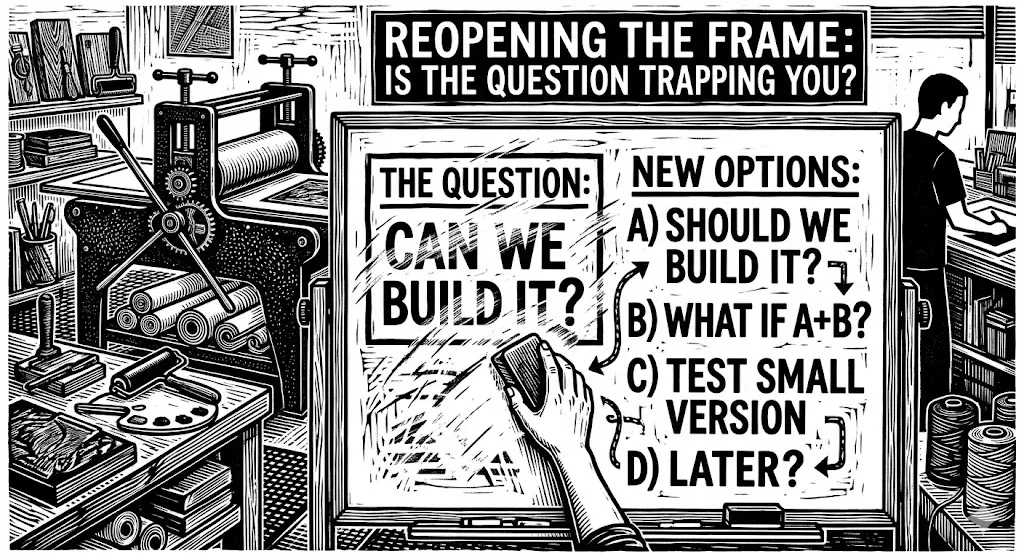
In projects, a narrow frame often hides the most useful question. “Can we build it?” directs attention to technical feasibility. “Should we build it?” brings in value, opportunity cost, timing, and alternatives. “How do we get stakeholder approval?” treats approval as the goal. “What decision would we recommend if approval politics disappeared?” exposes whether the case is actually strong.
In life decisions, the same narrowing happens in quieter ways. “Am I too old to change career?” frames the issue around age and loss. “What experiments could reduce uncertainty about a career change over the next three months?” frames it around learning and reversibility. “Can I afford to move?” focuses on money alone. “What would moving change about my relationships, work options, stress, and future flexibility?” opens a wider set of values.
When the question makes one answer feel inevitable
The most dangerous frames are not always manipulative. Many are inherited from habit, workplace language, family expectations, or the previous decision. A project that was approved last year becomes “the project we need to deliver”, not “one possible use of people, money and attention”. A relationship becomes “something to save” or “something to leave”, not a system with several possible repairs, boundaries, or experiments.
One reason this happens is that people evaluate choices relative to reference points. Prospect theory, developed by Kahneman and Tversky, showed that people often treat gains and losses asymmetrically, with losses weighing especially heavily. [The Decision Lab]thedecisionlab.comThe Decision Lab Framing effectThe Decision LabFraming effect - The Decision LabAccording to researchers Levin, Schneider, and Gaeth, there are three main types of fram… In practical terms, the same option can feel cautious or reckless depending on what is treated as the baseline. A job change framed as “giving up stability” feels different from the same move framed as “buying a chance to avoid five more years of stagnation”.
Status quo bias adds another trap. Samuelson and Zeckhauser found that people disproportionately stick with existing arrangements, including in consequential domains such as health plans and retirement programmes. [Springer]link.springer.comStatus quo bias in decision makingStatus quo bias in decision making The frame “stay with the current option unless there is overwhelming evidence to change” gives the present an advantage that may not be deserved. In life, that can keep people in unsuitable jobs, routines, subscriptions, living arrangements, or social obligations. In organisations, it can keep weak projects alive because cancellation is framed as an active loss while continuing is framed as merely carrying on.
Default options show how much the structure of a choice can matter. Research on organ donation has found that participation is strongly influenced by whether the system is opt-in or opt-out, partly because defaults carry implied recommendations and reduce the need for active choice. [PMC]pmc.ncbi.nlm.nih.govPMCThe meaning of default options for potential organ donorsPMCThe meaning of default options for potential organ donors The wider lesson is not that every decision should be nudged. It is that “doing nothing” is rarely neutral. It is a frame with consequences.

Reframing examples from work and life
Reframing is not positive thinking. It is the disciplined act of changing the question so hidden assumptions become visible. A useful reframe does not merely make an option sound better; it changes what evidence you seek and what alternatives you compare.
Project launch.
Narrow frame: “How can we get this approved?”
Better frame: “What would have to be true for this to be the best use of our next six months?”
This reframe shifts attention from persuasion to assumptions. It asks about demand, capacity, opportunity cost, downside risk, and comparison projects.
Delayed project.
Narrow frame: “How do we catch up?”
Better frame: “Which parts still create enough value to justify finishing, and which parts should be cut?”
The first question assumes the original scope is still sacred. The second recognises that late projects often need scope reframing, not just harder work.
Career dissatisfaction.
Narrow frame: “Should I quit?”
Better frame: “What are the smallest reversible tests that would tell me whether the problem is the role, the organisation, the field, or my current workload?”
This turns a high-pressure identity decision into an information-gathering decision.
Personal finance.
Narrow frame: “Can I afford this?”
Better frame: “What future option am I buying or giving up by spending this money now?”
The reframe brings opportunity cost into view. It does not automatically say “spend less”; it asks whether the purchase fits the life you are trying to build.
Conflict.
Narrow frame: “How do I prove I was right?”
Better frame: “What outcome would make this relationship or collaboration work better after the conversation?”
This shifts the goal from vindication to repair, boundary-setting, or mutual clarity.
A project that already has heavy investment. [researchgate.net]researchgate.netSource details in endnotes.
Narrow frame: “We have spent too much to stop now.”
Better frame: “If we had not already spent this money and effort, would we start this project today?”
This is one of the simplest ways to weaken sunk-cost framing. Escalation of commitment is a recognised project-management risk, and Bent Flyvbjerg’s overview of behavioural biases in project management includes escalation, optimism bias, planning fallacy, anchoring and base-rate neglect among the major sources of poor project decisions. [Sage Journals]journals.sagepub.comOpen source on sagepub.com.
The project trap: delivery framing versus decision framing
Projects are especially vulnerable to framing because they develop momentum. Once a name, sponsor, budget and deadline exist, the social frame changes. The project becomes a commitment to defend. Questions about whether it should exist may sound disloyal, late, or negative, even when they are exactly the questions that would protect the organisation.
This is where delivery framing can crowd out decision framing. Delivery framing asks: “How do we execute the plan?” Decision framing asks: “Is this still the right plan under current evidence?” Both are necessary, but they belong at different moments. A team that stays permanently in delivery mode may become efficient at completing the wrong thing.
The planning fallacy is a related framing problem. Lovallo and Kahneman argued that executives often take an “inside view”, focusing on the details of their own plan while underweighting the outcomes of similar past projects. Their proposed corrective is the “outside view”: compare the project with a reference class of similar efforts before trusting the internal story. [Harvard Business Review]hbr.orgHarvard Business Review Delusions of Success: How Optimism UnderminesHarvard Business Review Delusions of Success: How Optimism Undermines Project Management Institute guidance describes reference class forecasting in similar terms: build a sample of comparable projects, establish the distribution of outcomes, and compare the current estimate against that distribution. [Project Management Institute]pmi.orgProject Management Institute Planning FallacyProject Management Institute Planning Fallacy
This is a reframe with teeth. Instead of asking, “Can our team deliver this in nine months?”, ask, “How often have teams like ours delivered projects like this in nine months, and what happened when they tried?” The second question is less flattering, but usually more useful.
The life trap: identity framing versus experiment framing
Life decisions feel different from project decisions because they are entangled with identity. “Should I move city?”, “Should I have a child?”, “Should I leave this career?”, “Should I end this relationship?” These are not spreadsheet choices. They involve values, belonging, fear, regret, and imagined futures. That makes framing even more influential.
Identity frames often make a decision heavier than it needs to be. “Am I the kind of person who gives up?” is a poor frame for deciding whether to leave a draining commitment. “What would a responsible next step look like given the evidence?” is better. “Have I wasted the last five years?” is a painful but usually unhelpful frame. “What have I learned that changes what I should do next?” preserves information without forcing past effort to justify future cost.
Experiment framing is often useful because many life decisions are partly reversible or can be tested. Instead of asking “What should I do with my life?”, ask:
- “What uncertainty is blocking the decision?”
- “What small action would reduce that uncertainty?”
- “What would I learn within a defined time period?”
- “What would make me stop, continue, or change direction?”
This does not trivialise major decisions. It prevents them from being framed as one dramatic leap when they may be better approached as a sequence of evidence-gathering moves.
Questions that reopen the choice
The best anti-framing habit is to deliberately generate alternative frames before deciding. The goal is not to find a clever wording that supports what you already want. It is to make the choice harder to trap.
Useful reframing questions include:
- What is the decision actually about? Is it about money, time, reputation, learning, safety, fairness, energy, or future flexibility?
- What is being treated as fixed that may not be fixed? Scope, deadline, location, role, budget, relationship pattern, or success metric may be more negotiable than the first frame suggests.
- What is the current reference point? Are you comparing against the past, the original plan, someone else’s expectations, or the best available alternative?
- What would this look like from the outside view? How have similar projects, jobs, moves, purchases, or commitments usually turned out?
- What would I choose if the sunk cost disappeared? This separates past investment from future value.
- What would I advise a friend or another team to do? Distance often reveals frames that feel invisible from inside the situation.
- What is the opposite frame, and what does it reveal? “What do we gain by doing this?” should be paired with “What do we lose by doing this?” and “What do we lose by not doing it?” should be paired with “What do we preserve by not doing it?”
- What option is missing because of either-or wording? Many real choices are not A versus B, but A, B, both partly, neither, later, smaller, reversed, delegated, tested, or redesigned.
These questions work because they move attention from answer selection to problem representation. In complex decisions, the representation is often half the decision.
Using pre-mortems to break the success frame
A project plan usually enters the room wearing a success frame. The slides describe benefits, milestones, owners and confidence. Risk registers may exist, but they often feel secondary. A pre-mortem reverses the frame: assume the project has failed, then ask why.
Gary Klein’s pre-mortem method, popularised in Harvard Business Review, asks team members to imagine that the project has ended badly and generate plausible reasons for failure. [Harvard Business Review]hbr.orgHarvard Business Review Performing a Project PremortemHarvard Business Review Performing a Project Premortem The value is social as much as analytical. It gives people permission to voice doubts without being cast as obstructive. A concern that sounds negative under the frame “support the plan” becomes useful under the frame “explain the failure we are pretending already happened”.
For personal decisions, a lighter version works well. Before making a major commitment, imagine two future scenes:
- “It is one year later and this decision went badly. What happened?”
- “It is one year later and not making this decision went badly. What happened?”
This paired pre-mortem prevents the common mistake of examining only the risk of action. Many decisions also carry the risk of inaction, delay, avoidance, or slow drift.
Ethical framing versus manipulative framing
Framing is unavoidable. Every proposal, conversation, form, menu, dashboard or question presents information in some order and against some background. The ethical issue is not whether a frame exists, but whether it helps people understand the decision or quietly steers them by hiding important alternatives.
Choice architecture research makes this especially clear. Retirement forms, health choices and donation systems can change behaviour by altering defaults, active-choice requirements, and the wording of consequences. [Social Security]ssa.govOpen source on ssa.gov. These tools can help people act on their own long-term interests, but they can also be used to exploit inertia, confusion or fear.
A fair frame should make the real trade-off easier to see. A manipulative frame makes the sponsor’s preferred answer easier to choose while making other valid options less visible. In projects, manipulation may appear as “strategic alignment” language that hides weak evidence. In life, it may appear as advice that smuggles in someone else’s values: “A sensible person would stay”, “A brave person would leave”, “Successful people never quit”, or “You owe it to yourself to take the risk”.
The test is simple: after hearing the frame, does the decision-maker understand the alternatives, consequences and uncertainties better than before? If not, the frame may be doing more persuasion than clarification.
The practical payoff: better questions before better answers
Improving thinking is often imagined as finding better answers faster. Framing effects show why that is not enough. A fast answer to a trapped question can still be a poor decision. The higher-value skill is noticing when the question has already narrowed the field.
For projects, this means separating “Can we deliver?” from “Should we continue?”, using outside-view comparisons, and making it socially safe to question the frame before the organisation becomes locked in. For life decisions, it means replacing identity-heavy, either-or questions with frames that reveal values, reversibility, experiments, and opportunity costs.
A good frame does not guarantee a good decision. It does something more basic: it gives the decision a fair chance.
eBay marketplace picks
Marketplace Samples
Live-tested eBay searches with available results related to this page.



Endnotes
-
Source: link.springer.com
Title: Status quo bias in decision making
Link: https://link.springer.com/article/10.1007/BF00055564 -
Source: rzeckhauser.scholars.harvard.edu
Title: Status Quo Bias in Decision Making
Link: https://rzeckhauser.scholars.harvard.edu/publications/status-quo-bias-decision-making -
Source: pmc.ncbi.nlm.nih.gov
Title: PMCThe meaning of default options for potential organ donors
Link: https://pmc.ncbi.nlm.nih.gov/articles/PMC3458339/ -
Source: project-management.com
Link: https://project-management.com/cognitive-biases-in-project-management/ -
Source: science.org
Link: https://www.science.org/doi/10.1126/science.7455683Source snippet
Amos Tversky and Daniel Kahneman... Science. Volume 211 | Issue 4481 30 January 1981. Copyright. © 1981.Read more...
Published: January 1981
-
Source: pubmed.ncbi.nlm.nih.gov
Link: https://pubmed.ncbi.nlm.nih.gov/7455683/Source snippet
Science. 1981 Jan 30;211(4481):453-8. doi: 10.1126/science.7455683. Authors. A Tversky, D Kahneman.Read more...
-
Source: pubmed.ncbi.nlm.nih.gov
Link: https://pubmed.ncbi.nlm.nih.gov/9831520/Source snippet
A Typology and Critical Analysis of Framing EffectsThen we discuss attribute framing, which affects the evaluation of object or eve...
-
Source: thedecisionlab.com
Title: The Decision Lab Framing effect
Link: https://thedecisionlab.com/biases/framing-effectSource snippet
The Decision LabFraming effect - The Decision LabAccording to researchers Levin, Schneider, and Gaeth, there are three main types of fram...
-
Source: journals.sagepub.com
Link: https://journals.sagepub.com/doi/10.1177/87569728211049046 -
Source: hbr.org
Title: Harvard Business Review Delusions of Success: How Optimism Undermines
Link: https://hbr.org/2003/07/delusions-of-success-how-optimism-undermines-executives-decisions -
Source: pubmed.ncbi.nlm.nih.gov
Link: https://pubmed.ncbi.nlm.nih.gov/12858711/ -
Source: pmi.org
Title: Project Management Institute Planning Fallacy
Link: https://www.pmi.org/learning/library/planning-fallacy-causes-solutions-project-expectations-6374 -
Source: hbr.org
Title: Harvard Business Review Performing a Project Premortem
Link: https://hbr.org/2007/09/performing-a-project-premortem -
Source: ssa.gov
Link: https://www.ssa.gov/policy/docs/ssb/v70n4/v70n4p1.html -
Source: pmc.ncbi.nlm.nih.gov
Link: https://pmc.ncbi.nlm.nih.gov/articles/PMC2631940/ -
Source: pmc.ncbi.nlm.nih.gov
Link: https://pmc.ncbi.nlm.nih.gov/articles/PMC5904751/ -
Source: pubmed.ncbi.nlm.nih.gov
Link: https://pubmed.ncbi.nlm.nih.gov/9719656/ -
Source: pubmed.ncbi.nlm.nih.gov
Link: https://pubmed.ncbi.nlm.nih.gov/7070445/ -
Source: pmc.ncbi.nlm.nih.gov
Link: https://pmc.ncbi.nlm.nih.gov/articles/PMC4556535/ -
Source: dictionary.cambridge.org
Link: https://dictionary.cambridge.org/dictionary/english/project -
Source: dictionary.cambridge.org
Link: https://dictionary.cambridge.org/us/dictionary/english/problem -
Source: hbr.org
Link: https://hbr.org/2024/01/to-solve-a-tough-problem-reframe-it -
Source: hbr.org
Link: https://hbr.org/2017/01/are-you-solving-the-right-problems -
Source: hbr.org
Title: the secret to better problem solving
Link: https://hbr.org/podcast/2016/12/the-secret-to-better-problem-solving -
Source: hbr.org
Title: moving beyond either or decision making
Link: https://hbr.org/podcast/2025/09/moving-beyond-either-or-decision-making -
Source: hbr.org
Link: https://hbr.org/2026/06/our-favorite-management-tips-on-decision-making -
Source: hbr.org
Link: https://hbr.org/topic/subject/decision-making-and-problem-solving -
Source: hbr.org
Title: do you understand the problem youre trying to solve
Link: https://hbr.org/podcast/2024/04/do-you-understand-the-problem-youre-trying-to-solve -
Source: hbr.org
Title: making good decisions
Link: https://hbr.org/podcast/2014/11/making-good-decisions -
Source: hbr.org
Title: One Frame of Reference Isn’t Enough
Link: https://hbr.org/video/2919114910001/one-frame-of-reference-isnt-enough -
Source: hbr.org
Title: A Better Framework for Solving Tough Problems
Link: https://hbr.org/podcast/2024/05/a-better-framework-for-solving-tough-problems -
Source: hbr.org
Title: the right way to solve complex business problems
Link: https://hbr.org/podcast/2018/12/the-right-way-to-solve-complex-business-problems -
Source: hbr.org
Link: https://hbr.org/archive-toc/BR0307 -
Source: thedecisionlab.com
Link: https://thedecisionlab.com/biases/commitment-bias -
Source: thedecisionlab.com
Link: https://thedecisionlab.com/biases/the-sunk-cost-fallacy -
Source: thedecisionlab.com
Link: https://thedecisionlab.com/reference-guide/psychology/choice-architecture -
Source: thedecisionlab.com
Link: https://thedecisionlab.com/biases/status-quo-bias -
Source: Wikipedia
Link: https://en.wikipedia.org/wiki/Project -
Source: Wikipedia
Title: Planning fallacy
Link: https://en.wikipedia.org/wiki/Planning_fallacy -
Source: journals.sagepub.com
Link: https://journals.sagepub.com/doi/10.1177/0272989X0202200108 -
Source: sk.sagepub.com
Title: [gain loss]({{ ‘gain-loss/’ | relative_url }}) framing effects
Link: https://sk.sagepub.com/ency/edvol/medical/chpt/gain-loss-framing-effects -
Source: journals.sagepub.com
Link: https://journals.sagepub.com/doi/10.1509/jppm.30.2.191 -
Source: managementplatform.nl
Title: Reference Class Forecasting
Link: https://managementplatform.nl/reference-class-forecasting/08/02/2026 -
Source: linkedin.com
Link: https://www.linkedin.com/posts/harvard-business-review_a-leaders-framework-for-decision-making-activity-7291080031345205248-iAVh -
Source: scribd.com
Link: https://www.scribd.com/document/729125014/Science-the-Framing-of-Decisions-and-the-Psychology-of-Choice -
Source: pmi.org
Link: https://www.pmi.org/about/what-is-a-project -
Source: knowledgetrain.co.uk
Link: https://www.knowledgetrain.co.uk/project-management/projects?srsltid=AfmBOoozzL6oouw4Z0C4qxy6TWOAu4xJIiXO86JAnE13378X3st7D5iQ
Additional References
-
Source: youtube.com
Title: Behavioral Finance Basics
Link: https://www.youtube.com/watch?v=AQsnhtCCMtMSource snippet
Framing Effect: Do You Prefer the Glass to be Half-Empty or Half-Full?...
-
Source: youtube.com
Title: Framing Effect | The Psychological Bias That Shapes our Decisions
Link: https://www.youtube.com/watch?v=keXzVu2O_80Source snippet
Behavioral Finance Basics - How Framing Affects Decisions - Allais Paradox...
-
Source: youtube.com
Title: Change The Frame, Change Your Brain (The Framing Effect)
Link: https://www.youtube.com/watch?v=l50nrLxZJHUSource snippet
Framing Effect | The Psychological Bias That Shapes our Decisions...
-
Source: academia.edu
Link: https://www.academia.edu/420075/Attribute_Framing_and_Goal_Framing_Effects_In_Health_Decisions -
Source: academia.edu
Link: https://www.academia.edu/3291417/Delusions_of_Success_Comment_on_Dan_Lovallo_and_Daniel_Kahneman -
Source: researchgate.net
Link: https://www.researchgate.net/publication/4818725_Framing_Effects_Dynamics_and_Task_Domains -
Source: researchgate.net
Link: https://www.researchgate.net/publication/3229642_Performing_a_Project_Premortem -
Source: researchgate.net
Link: https://www.researchgate.net/publication/5152072_Status_Quo_Bias_in_Decision-Making -
Source: researchgate.net
Link: https://www.researchgate.net/publication/395555624_The_Impact_of_Framing_Effects_and_Loss_Aversion_on_Decision-making_Across_Health_Finance_and_Retirement_Domains -
Source: researchgate.net
Link: https://www.researchgate.net/publication/222262436_A_New_Look_at_Framing_Effects_Distribution_of_Effect_Sizes_Individual_Differences_and_Independence_of_Types_of_Effects
Topic Tree