Within Open Mind
Listen First Without Surrendering Your Standards
In hard conversations, showing that you understand a view can make disagreement clearer without pretending to agree.
On this page
- Understanding before evaluation
- Language that lowers threat without hiding disagreement
- Why personal narratives can open space for facts
Page outline Jump by section
Introduction
When a disagreement matters, the biggest obstacle is often not a lack of evidence but a failure to understand what the other person is actually claiming. Receptive listening means making a genuine effort to understand a claim before deciding whether it is true, false, incomplete or irrelevant. It does not require agreement, lowering evidential standards or treating all opinions as equally credible. Instead, it separates two distinct tasks: first understanding, then evaluating.
 This distinction is central to actively open-minded thinking. People frequently rebut a simplified version of an opponent’s position, fill gaps with assumptions or respond to the category they think a claim belongs to rather than to the claim itself. Receptive listening slows this process just enough to make disagreement more accurate, which in turn makes later criticism more precise and more persuasive. Research on active listening and motivated reasoning suggests that feeling understood can reduce defensiveness while creating better conditions for evidence-based discussion. [NCBI+2Wholebeing Institute]ncbi.nlm.nih.govNCBIActive ListeningStatPearls - NCBI Bookshelf - NIHby K Tennant · 2023 · Cited by 59 — In active listening, it is critical that the receiver acknowledges r…
Understanding before evaluation
Listening first is not about postponing judgement indefinitely. It is about ensuring that the judgement addresses the real claim rather than an imagined one.
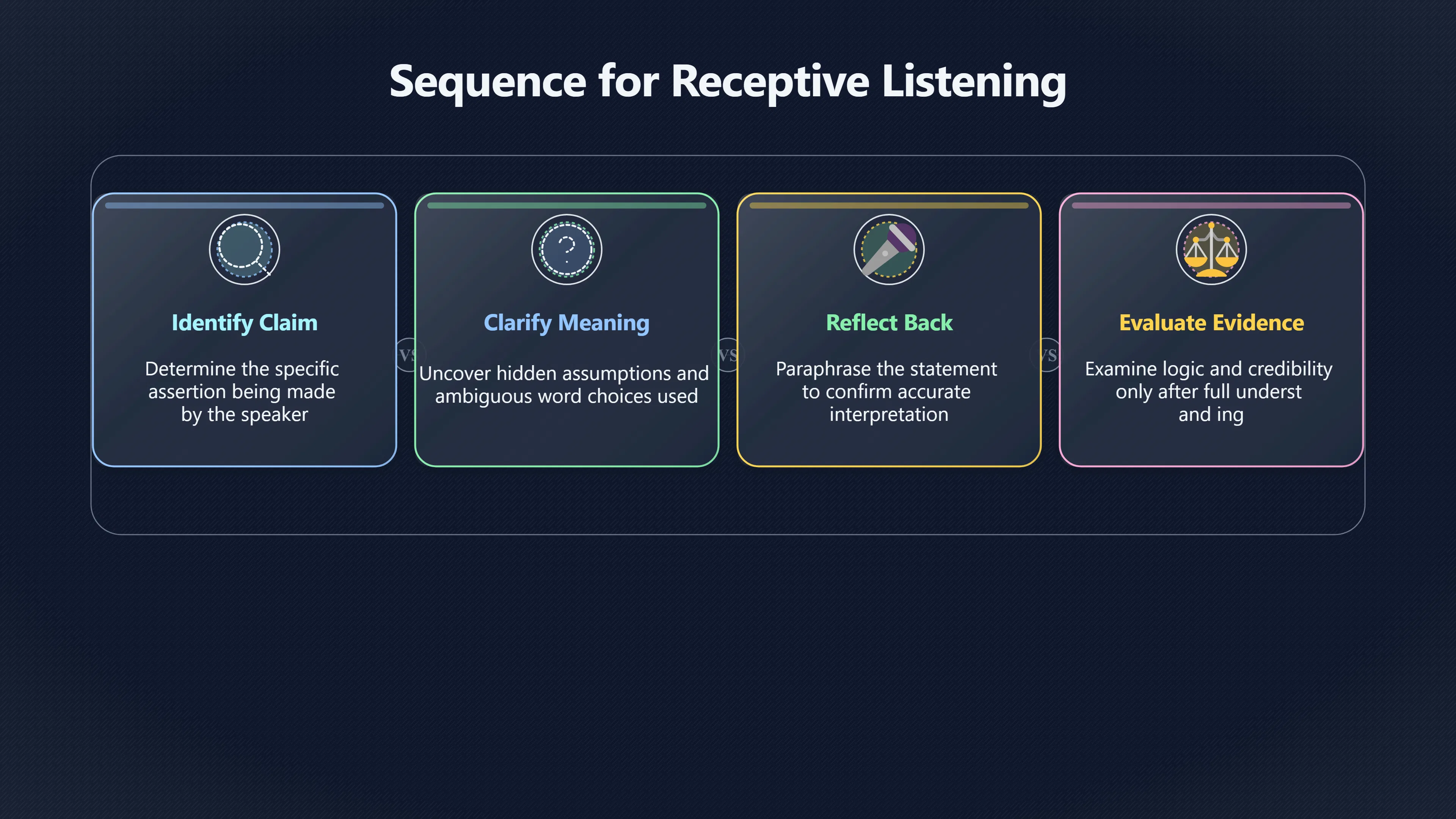
A useful sequence is:
- Identify the claim. What is the person actually asserting?
- Clarify the meaning. Are there ambiguous words or hidden assumptions?
- Reflect it back. State the claim in your own words and ask whether you have understood it correctly.
- Only then evaluate. Examine evidence, logic, credibility and implications.
This order matters because understanding and evaluation rely on different mental tasks. If evaluation begins too early, people often stop processing new information and instead search for reasons to defend their existing view. Research on motivated reasoning suggests that people frequently scrutinise unwelcome evidence more harshly than evidence supporting what they already believe. Accuracy goals can reduce this tendency, but only if people genuinely attempt to understand before reaching a conclusion. [Wikipedia]WikipediaMotivated reasoningMotivated reasoning
Active listening research likewise treats feedback as part of understanding rather than agreement. Paraphrasing allows the speaker to confirm or correct your interpretation before criticism begins, reducing misunderstandings that would otherwise dominate the conversation. [NCBI]ncbi.nlm.nih.govNCBIActive ListeningStatPearls - NCBI Bookshelf - NIHby K Tennant · 2023 · Cited by 59 — In active listening, it is critical that the receiver acknowledges r…
Language that lowers threat without hiding disagreement
Many conversations deteriorate because people hear evaluation where the other person intended only clarification. Small changes in language can separate these stages.
Instead of immediately arguing, try statements such as:
- “Let me check that I’ve understood your point.”
- “If I’ve heard you correctly, you’re saying…”
- “What convinced you that this explanation fits best?”
- “Am I missing an important part of your reasoning?”
These responses communicate intellectual seriousness rather than concession. They leave room for later disagreement while making it clear that criticism will be directed at the actual argument.
By contrast, statements like “That’s obviously wrong” or “People like you always think…” merge interpretation, judgement and identity into a single response. Once that happens, the discussion often shifts from examining evidence to defending status and group membership.
Carl Rogers and Richard Farson argued decades ago that careful listening reduces the perceived threat of criticism. When people believe they have been understood accurately, they are often less defensive and more willing to examine their own reasoning. Importantly, this effect comes from understanding rather than from pretending to agree. [Wholebeing Institute]wholebeinginstitute.comWholebeing Institute'Active Listening' by Carl RRogers and Richard E. Farsonby CR Rogers · Cited by 1037 — Because listening reduces the threat of having one's ideas criticized, the per…
Why personal narratives can open space for facts
Facts rarely appear in isolation. People often introduce evidence through personal experience:
- “This happened to my family.”
- “This is what I saw at work.”
- “My experience made me doubt the official explanation.”
The narrative itself may not establish a general conclusion, but it often explains why someone currently believes what they do.
Recognising this distinction is valuable. A listener can acknowledge the experience without accepting the broader inference:
“I can see why that experience would make you question the usual explanation. I’d like to separate what happened from the wider conclusion you’re drawing.”
This response validates the reality of the experience while preserving space to evaluate whether the evidence supports the larger claim.
Ignoring personal narratives entirely can backfire because people often interpret dismissal of their experience as dismissal of themselves. Once conversations become identity-focused, factual disagreement becomes harder to resolve. Understanding the story first helps clarify exactly which part of the reasoning should later be examined.

Listening for the strongest version of a claim
Receptive listening also improves analytical accuracy by reducing “straw man” disagreements.
Rather than responding to the weakest possible interpretation, look for the strongest reasonable version of the person’s position. Practical habits include:
- asking what evidence would change their mind;
- distinguishing factual claims from value judgements;
- separating certainty from speculation;
- identifying which conclusions are central and which are secondary.
For example, someone saying, “Artificial intelligence worries me,” might mean:
- current systems are unreliable;
- future systems could become dangerous;
- regulation is inadequate;
- workers face economic disruption.
Responding as though they had made all four claims at once creates unnecessary disagreement. Careful listening identifies which claim is actually under discussion before criticism begins.
Common mistakes that look like listening
Some conversational habits resemble receptive listening but accomplish something different.
Waiting politely to speak. Remaining silent while mentally preparing a rebuttal is not the same as trying to understand.
Repeating words without meaning. Mechanical paraphrasing can sound insincere if it merely echoes phrases without capturing the underlying point.
Assuming agreement is required. Understanding a position does not commit you to accepting it. Courts, scientists, negotiators and investigators routinely work to understand claims that they may later reject.
Confusing empathy with endorsement. Acknowledging why someone believes something differs from concluding that the belief is justified.
These distinctions matter because receptive listening is a tool for improving judgement, not replacing it.

Putting receptive listening into practice
In difficult conversations, a simple discipline can improve both understanding and critical evaluation.
Before offering your own view, ask yourself:
- Can I explain the other person’s position in a way they would recognise as accurate?
- Do I know which evidence led them there?
- Have I separated their experience from the conclusion they draw from it?
- Am I criticising their actual claim rather than the nearest stereotype?
- Have I applied the same evidential standards to their position that I expect for my own?
If the answer to these questions is yes, disagreement becomes clearer rather than softer. The goal is not harmony for its own sake but more accurate reasoning. Listening first ensures that criticism targets the real argument, making both agreement and disagreement more intellectually honest.
Amazon book picks
Further Reading
Books and field guides related to Listen First Without Surrendering Your Standards. Use these as the next step if you want deeper reading beyond the article.
Think Again
Explores intellectual humility, revising beliefs, and understanding opposing viewpoints.
Crucial Conversations: Tools for Talking When Stakes are High
Rating: 4.0/5 from 28 Google Books ratings
Directly addresses listening first, reducing defensiveness, and discussing difficult topics without abandoning standards.
How to Win Friends and Influence People
Emphasizes listening, understanding others, and communicating disagreement constructively.
Never Split the Difference
Shows how tactical listening and thoughtful questioning improve understanding before persuasion.
eBay marketplace picks
Marketplace Samples
Live-tested eBay searches with available results related to this page.



Endnotes
-
Source: ncbi.nlm.nih.gov
Title: NCBIActive Listening
Link: https://www.ncbi.nlm.nih.gov/books/NBK442015/Source snippet
StatPearls - NCBI Bookshelf - NIHby K Tennant · 2023 · Cited by 59 — In active listening, it is critical that the receiver acknowledges r...
-
Source: Wikipedia
Title: Motivated reasoning
Link: https://en.wikipedia.org/wiki/Motivated_reasoning -
Source: wholebeinginstitute.com
Title: Wholebeing Institute’Active Listening’ by Carl R
Link: https://wholebeinginstitute.com/wp-content/uploads/Rogers_Farson_Active-Listening.pdfSource snippet
Rogers and Richard E. Farsonby CR Rogers · Cited by 1037 — Because listening reduces the threat of having one's ideas criticized, the per...
-
Source: journal.aldinhe.ac.uk
Link: https://journal.aldinhe.ac.uk/index.php/jldhe/article/view/1409Source snippet
listening for effective student engagementby A Newton · 2024 · Cited by 10 — In this workshop, participants discussed how active listenin...
Additional References
-
Source: bumc.bu.edu
Link: https://www.bumc.bu.edu/facdev-medicine/files/2016/10/Active-Listening-Handout.pdfSource snippet
Boston University Medical CampusActive ListeningActive Listening. Active Listening means being deeply engaged in and attentive to what th...
-
Source: researchgate.net
Link: https://www.researchgate.net/publication/379083877ACTIVE_LISTENING-A_MODEL_OF_EMPATHETIC_COMMUNICATION_IN_THE_HELPING_PROFESSIONSSource snippet
(PDF) ACTIVE LISTENING -A MODEL OF EMPATHETIC...20 Mar 2024 — The paper aims to show the development of the concept of active listening...
-
Source: asana.com
Link: https://asana.com/resources/active-listeningSource snippet
Effective active listening: Examples, techniques & exercisesActive listening is a powerful communication tool that helps teams connect, c...
-
Source: manifold.open.umn.edu
Title: chapter 15 listening
Link: https://manifold.open.umn.edu/read/chapter-15-listeningSource snippet
15: ListeningListening is the learned process of receiving, interpreting, recalling, evaluating, and responding to verbal and nonverbal m...
-
Source: youtube.com
Title: Disagreeing Better: Research-backed Tools for Navigating Conflict
Link: https://www.youtube.com/watch?v=IqqFx2JeZhMSource snippet
Why Educated People Follow Dumb Ideas – Nietzsche and the Psychology of Motivated Reasoning...
-
Source: youtube.com
Link: https://www.youtube.com/watch?v=UCp8GXCsBbQSource snippet
THIS Is Why You MUST Talk LESS | Simon Sinek...
-
Source: verywellmind.com
Link: https://www.verywellmind.com/what-is-active-listening-3024343Source snippet
7 Active Listening Techniques For Better Communication14 Apr 2026 — Active listening techniques are strategies to help you focus on, unde...
-
Source: youtube.com
Title: Julia Minson | How to Disagree Better | Talks at Google
Link: https://www.youtube.com/watch?v=GigRB6bZ0MISource snippet
Disagreeing Better: Research-backed Tools for Navigating Conflict...
-
Source: youtube.com
Title: THIS Is Why You MUST Talk LESS | Simon Sinek
Link: https://www.youtube.com/watch?v=4wWZqasA3GASource snippet
Critical Listening: How to Quickly Understand Difficult Things...
-
Source: youtube.com
Title: Critical Listening: How to Quickly Understand Difficult Things
Link: https://www.youtube.com/watch?v=UlMCTUvxa78
Topic Tree