Within Tradeoffs
What Are You Really Giving Up?
Opportunity cost explains why a choice can be expensive even when the visible price looks small.
On this page
- Visible costs versus displaced alternatives
- Everyday examples: meetings, bargains and commitments
- How to name the next best alternative before choosing
Page outline Jump by section
Introduction
Every choice has a visible cost, such as money spent or time used, and a hidden cost: what that same money, time or attention could have achieved elsewhere. Economists call this hidden cost opportunity cost—the value of the next-best alternative you give up when making a choice. Thinking in terms of opportunity cost improves analytical skills because it shifts attention from “What does this cost?” to “What am I giving up?” [Federal Reserve Bank of St. Louis]stlouisfed.orgFederal Reserve Bank of StLouisReal-Life Examples of Opportunity Cost | St. Louis FedJune 3, 2026 — 29 Jan 2020 — “Opportunity cost is the value of the next-best a…
 Many everyday decision mistakes happen because people count only the obvious price. A meeting seems to cost just 30 minutes. A discounted item looks like a bargain. Saying “yes” to another commitment feels harmless. Yet each decision replaces another use of the same limited resources. Once you begin identifying the displaced alternative before deciding, many poor choices become easier to spot.
Visible Costs Versus Displaced Alternatives
The easiest costs to notice are explicit ones: the money paid, the time scheduled or the effort required. Opportunity cost is different because it measures what those resources could have produced in their best available alternative.
For example:
- Buying a £30 item costs £30 in cash, but it may also cost the opportunity to reduce debt, increase savings or buy something more valuable later.
- Spending an hour in a meeting costs one hour on the calendar, but it may replace concentrated work, customer conversations or recovery time.
- Accepting a weekend commitment may cost no money at all, yet it eliminates other possibilities such as rest, family activities or personal projects.
This explains why two choices with identical price tags can have very different real costs. The question is never simply “What am I pay?” but “Compared with my next-best option, what am I losing?” Federal Reserve Bank of St. Louis+2Econlib [stlouisfed.org]stlouisfed.orgFederal Reserve Bank of StLouisReal-Life Examples of Opportunity Cost | St. Louis FedJune 3, 2026 — 29 Jan 2020 — “Opportunity cost is the value of the next-best a…
Why Everyday Decisions Go Wrong
Opportunity cost is often overlooked because the forgone alternative is invisible. Humans naturally notice what they receive more easily than what quietly disappears.
Several common mistakes illustrate this mechanism.
Treating free as costless. A free event, free trial or complimentary service may still consume valuable time and attention. If those hours replace higher-value work or meaningful leisure, the opportunity cost can exceed the financial saving.
Focusing on discounts instead of usefulness. Buying something because it is 50% off encourages comparison with the original price rather than with alternative uses of the money. A product that remains unused is often more expensive than not buying it at all because it displaced a better use of the same budget.
Ignoring the cost of small interruptions. A short interruption rarely appears significant in isolation. However, repeated meetings, messages and context switching reduce the time available for uninterrupted work. The visible interruption may be only minutes long, while the opportunity cost includes lost concentration and delayed completion of more valuable tasks. Research on mental effort has argued that people often experience demanding activities as costly partly because they prevent pursuit of other worthwhile activities competing for attention. [PMC]pmc.ncbi.nlm.nih.govPMCAn opportunity cost model of subjective effort and taskby R Kurzban · 2013 · Cited by 1825 — Feeding at the current patch carries opportunity costs – that is, the value of the next-best alt…
Everyday Examples That Reveal Hidden Costs
Meetings
A meeting scheduled for 30 minutes rarely costs only 30 minutes. Preparation, transition between tasks and the time needed to regain concentration can make the true cost much higher.
Instead of asking, “Can I spare half an hour?” ask, “What productive activity will this replace?” If the meeting prevents completion of a critical report or interrupts deep analytical work, the opportunity cost may exceed the meeting’s direct value.
Bargains and Sales
Retail promotions encourage attention to money saved rather than alternatives forgone.
Imagine two choices:
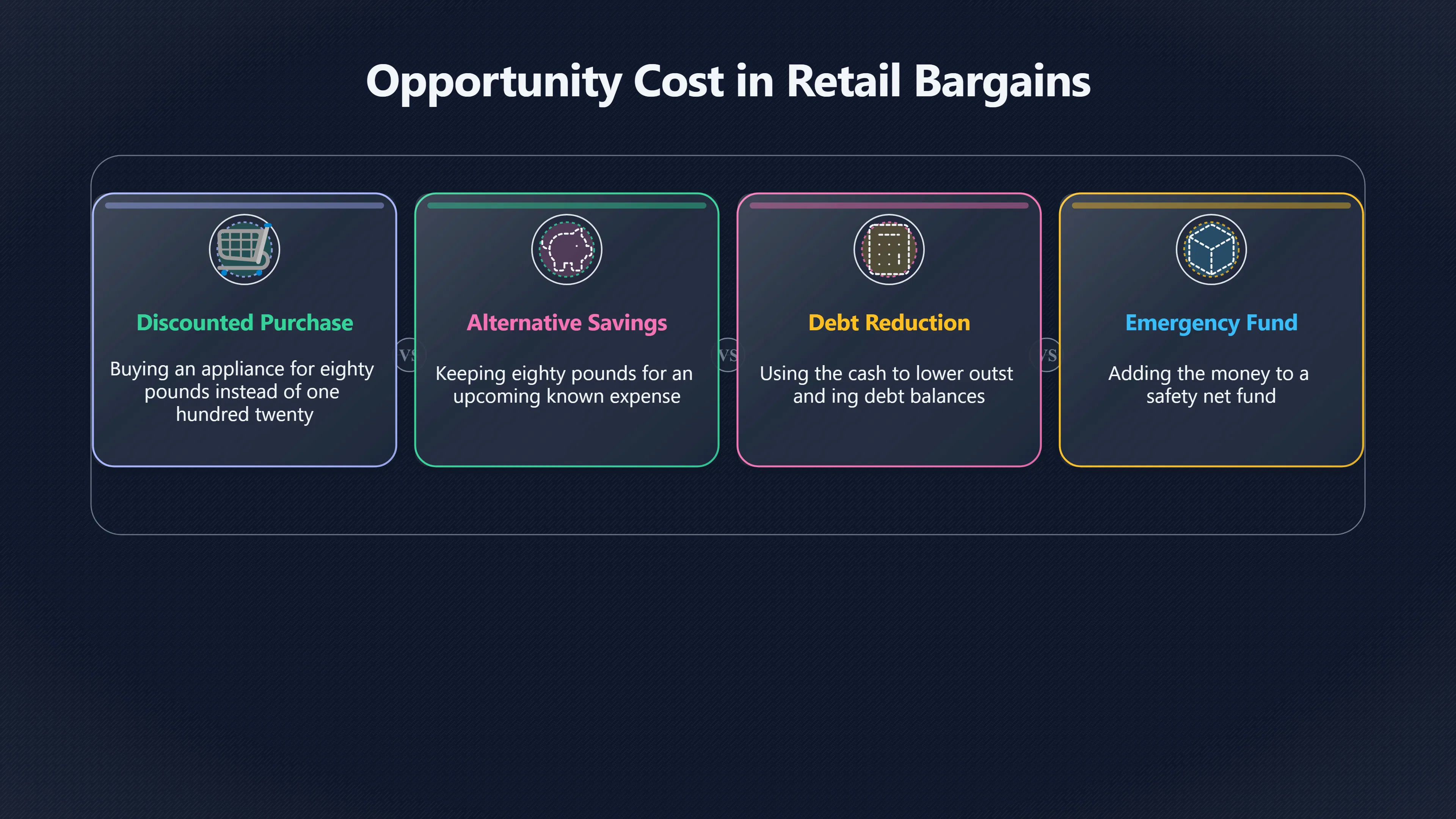
- Buy an appliance for £80 instead of its usual £120.
- Keep the £80 for an upcoming expense you know you will face.
The relevant comparison is not with the original £120 price but with the best alternative use of the £80. A genuine bargain is only valuable if it beats the value of what that money would otherwise accomplish.
Commitments
Agreeing to another committee, volunteer role or social obligation often feels easier than declining because the future schedule still appears empty.
However, every future commitment occupies time that could later become valuable for unexpected work, relationships or recovery. The opportunity cost is uncertain but still real because flexibility itself has value.
Name the Next-Best Alternative Before Choosing
One practical habit dramatically improves tradeoff thinking: explicitly identify the next-best alternative before making a decision.
Rather than asking only whether an option is worthwhile, complete this sentence:
“If I choose this, the best realistic alternative I am giving up is…”
For example:
- “If I attend this meeting, I give up two hours of uninterrupted writing.”
- “If I buy this discounted item, I give up adding that money to my emergency fund.”
- “If I accept this project, I give up the capacity to take on higher-priority work next month.”
This exercise forces hidden costs into view. Even when the final decision stays the same, it becomes a conscious tradeoff rather than an accidental one.
It also prevents comparing a real option with an unrealistic fantasy. Opportunity cost concerns the best available alternative, not every imaginable possibility. Economists define it as the value of the next-best choice that is actually available under current constraints. [Federal Reserve Bank of St. Louis]stlouisfed.orgFederal Reserve Bank of StLouisReal-Life Examples of Opportunity Cost | St. Louis FedJune 3, 2026 — 29 Jan 2020 — “Opportunity cost is the value of the next-best a…
Common Misunderstandings
Several ideas are frequently confused with opportunity cost.(#endnote-7 “Endnote 7”) [federalreserveeducation.org]federalreserveeducation.orgSource details in endnotes.
- It is not the same as money spent. Financial cost is only one component. Time, flexibility, attention and future opportunities can all be opportunity costs.
- It is not a sunk cost. Money or effort already spent cannot be recovered and should not determine future choices. Opportunity cost looks forward to what could still be achieved instead. [munich-business-school.de]munich-business-school.de► Opportunity CostsSimply ExplainedOpportunity costs, also known as alternative costs, are the potential benefits that are foregone if a decision is made in…
- It does not require perfect prediction. You cannot know every future outcome with certainty. The goal is simply to compare realistic alternatives before deciding, not to forecast the future perfectly.
A Better Question for Better Decisions
Opportunity cost makes tradeoffs visible by changing the question you ask. Instead of evaluating a decision in isolation, compare it with the strongest realistic alternative.
Before saying yes to a meeting, buying a bargain or accepting another commitment, identify what that choice will replace. The visible price may be small, but the hidden cost is often where the most important part of the decision lies. When you consistently name the next-best alternative before choosing, everyday decisions become less reactive and more aligned with what you value most.

Amazon book picks
Further Reading
Books and field guides related to What Are You Really Giving Up?. Use these as the next step if you want deeper reading beyond the article.
Naked Economics
Rating: 4.5/5 from 7 Google Books ratings
Introduces core economic concepts including tradeoffs and scarcity.
eBay marketplace picks
Marketplace Samples
Live-tested eBay searches with available results related to this page.



Endnotes
-
Source: stlouisfed.org
Title: Federal Reserve Bank of St
Link: https://www.stlouisfed.org/open-vault/2020/january/real-life-examples-opportunity-costSource snippet
LouisReal-Life Examples of Opportunity Cost | St. Louis FedJune 3, 2026 — 29 Jan 2020 — “Opportunity cost is the value of the next-best a...
Published: June 3, 2026
-
Source: econlib.org
Link: https://www.econlib.org/library/Topics/College/opportunitycost.html -
Source: pmc.ncbi.nlm.nih.gov
Title: PMCAn opportunity cost model of subjective effort and task
Link: https://pmc.ncbi.nlm.nih.gov/articles/PMC3856320/Source snippet
by R Kurzban · 2013 · Cited by 1825 — Feeding at the current patch carries opportunity costs – that is, the value of the next-best alt...
-
Source: munich-business-school.de
Title: ► Opportunity Costs
Link: https://www.munich-business-school.de/en/l/business-studies-dictionary/financial-knowledge/opportunity-costsSource snippet
Simply ExplainedOpportunity costs, also known as alternative costs, are the potential benefits that are foregone if a decision is made in...
-
Source: youtube.com
Link: https://www.youtube.com/watch?v=2uJYrf43dMsSource snippet
Opportunity Cost | Why Choices Have Hidden Costs?...
-
Source: youtube.com
Title: Opportunity Cost | Why Choices Have Hidden Costs?
Link: https://www.youtube.com/watch?v=0_cKG6rT5hASource snippet
Opportunity Cost: The Hidden Cost of Everything...
-
Source: ebsco.com
Link: https://www.ebsco.com/research-starters/economics/opportunity-cost -
Source: federalreserveeducation.org
Link: https://www.federalreserveeducation.org/teaching-resources/economics/scarcity/opportunity-cost
Additional References
-
Source: investopedia.com
Link: https://www.investopedia.com/terms/o/opportunitycost.aspSource snippet
Opportunity Cost: Definition, Formula, and ExamplesOpportunity cost refers to the potential profit provided by a missed opportunity—the r...
-
Source: youtube.com
Title: What Is Opportunity Cost And Why It Controls Every Decision You Make
Link: https://www.youtube.com/watch?v=ng-cgKDJg0kSource snippet
Understanding Opportunity Cost: How to Make Better Decisions Every Time (personal and business)...
-
Source: evansonslabs.com
Link: https://evansonslabs.com/2025/10/03/concept-of-opportunity-costs/Source snippet
Concept of Opportunity Costs | Behavioral Economicsby JE Njoroge — Opportunity cost is inherently relative: it measures what a decision-m...
-
Source: surface.syr.edu
Link: https://surface.syr.edu/cgi/viewcontent.cgi?article=1180&context=eliSource snippet
Louis, 2020. 1. 2. Why the opportunity cost and marginal benefit are important? It helps in the decision process of a choice and...Read...
-
Source: youtube.com
Title: Opportunity Cost: The Hidden Cost of Everything
Link: https://www.youtube.com/watch?v=BQQ1HFobVPQSource snippet
Opportunity Cost: Choices and Trade-Offs...
-
Source: youtube.com
Title: Opportunity Cost: Choices and Trade-Offs
Link: https://www.youtube.com/watch?v=cM9jDPoBjuc
Topic Tree