Within Spacing
Why cramming feels better than it works
Cramming can create fluent recognition in the moment while leaving knowledge unavailable when real problems appear later.
On this page
- The difference between familiarity and future access
- Why warm context misleads learners
- How spacing exposes fragile understanding
Page outline Jump by section
Introduction
Cramming often feels like successful learning because it produces an immediate sense of fluency. After hours with the same notes, ideas become familiar, definitions seem obvious, and recognising the correct answer feels effortless. That experience is real, but it is also misleading. The ease comes largely from the fact that the material is still active in short-term memory and surrounded by the same mental context in which it was studied. When that context disappears after a few days, much of the apparent mastery disappears with it. Research in cognitive psychology consistently shows that immediate performance during study is not the same as durable learning, and that learners frequently overestimate how well they will remember material in the future. [ResearchGate]researchgate.netResearch Gate The science of effective learning with a focus on spacingThe science of effective learning with a focus on spacing…August 3, 2022 — 2 Feb 2023 — In this Review, we discuss key res…
 For anyone trying to improve thinking and analytical skills, this distinction matters. Good analysis depends on being able to retrieve concepts, evidence and procedures when faced with new problems, not merely recognising them during a study session. The central trap of cramming is that it rewards familiarity while giving little information about whether knowledge will remain accessible later.
The difference between familiarity and future access
The most important reason cramming feels effective is that it increases familiarity, not necessarily future accessibility.
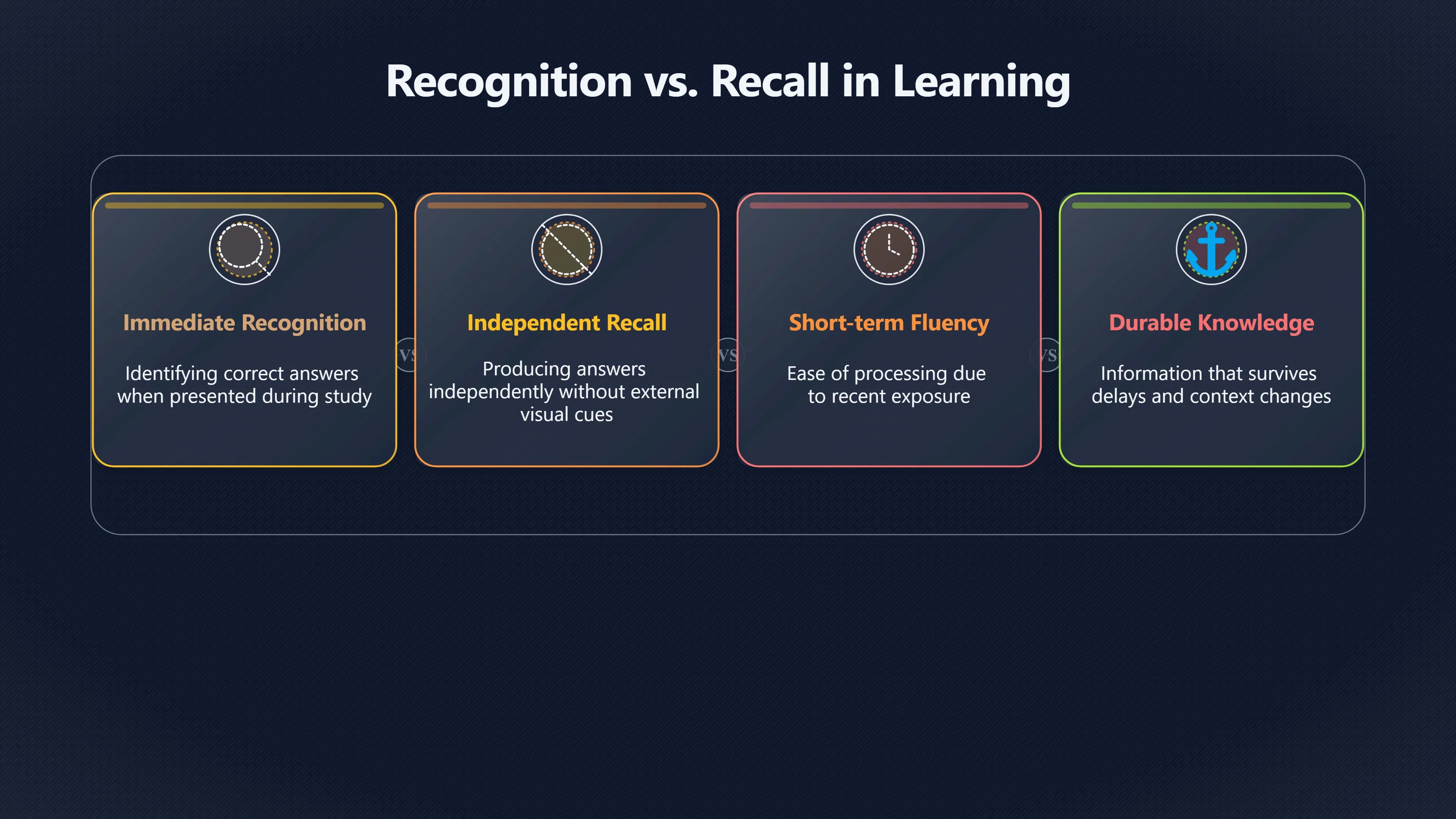
During a long study session, the same information is encountered repeatedly within minutes or hours. Each encounter makes the material easier to process. Psychologists call this increased processing ease fluency. Because fluency feels like understanding, learners often interpret it as evidence that learning has occurred. In reality, the feeling mostly reflects that the information has been seen recently rather than that it has been stored in a durable form. [ResearchGate]researchgate.netResearch Gate The science of effective learning with a focus on spacingThe science of effective learning with a focus on spacing…August 3, 2022 — 2 Feb 2023 — In this Review, we discuss key res…
This creates a critical distinction:
- Recognition means identifying the correct answer when it is presented.
- Recall means producing the answer independently when it is needed.
Cramming often produces excellent recognition immediately afterwards. Real-world reasoning, however, depends far more on recall. An analyst interpreting data, a doctor diagnosing symptoms or a student solving an unfamiliar problem cannot rely on seeing the correct answer in front of them.
Research on metacognition—the study of how people judge their own learning—shows that learners routinely mistake fluent recognition for durable knowledge. This helps explain why many people leave an intensive revision session feeling confident, only to discover days later that much of the material has become difficult to retrieve. [ResearchGate]researchgate.netResearch Gate The science of effective learning with a focus on spacingThe science of effective learning with a focus on spacing…August 3, 2022 — 2 Feb 2023 — In this Review, we discuss key res…
Why warm context misleads learners
A long cramming session creates unusually favourable conditions for remembering.
Every piece of information is surrounded by the same environment, the same notebook, the same sequence of examples and the same uninterrupted train of thought. Because all of these cues remain active, retrieval during the session is unusually easy.
The problem appears when those cues disappear.
Several days later:
- the surrounding context has changed;
- other experiences have interfered with memory;
- recently activated information has faded; and
- retrieval must occur without the support of the original study environment.
Knowledge that seemed instantly available during cramming may now require genuine reconstruction. If that reconstruction has never been practised, retrieval often fails.
Researchers distinguish between performance during learning and learning itself. High performance while studying can be produced simply because the information remains temporarily accessible. Lasting learning is measured by what survives after delays, distractions and changes in context. These two outcomes often diverge, making immediate confidence a poor predictor of future memory. [ResearchGate]researchgate.netResearch Gate The science of effective learning with a focus on spacingThe science of effective learning with a focus on spacing…August 3, 2022 — 2 Feb 2023 — In this Review, we discuss key res…
This is why students are often surprised by exam results. They are not discovering that they never understood the material; they are discovering that understanding developed under warm study conditions does not automatically transfer to later situations where retrieval is harder.

How spacing exposes fragile understanding
Distributed practice deliberately interrupts the comfortable conditions that make cramming feel successful.
Instead of reviewing material continuously, spaced learning allows some forgetting to occur before returning to it. That temporary forgetting is valuable because it reveals whether knowledge can actually be recovered.
If a learner struggles briefly to remember a concept and then successfully retrieves it, the effort strengthens future access more than another immediate rereading would. Researchers describe this principle as one form of a “desirable difficulty”: the task becomes harder during practice but produces stronger long-term retention. [ResearchGate+2Cognition and Learning Lab]researchgate.netResearch Gate The science of effective learning with a focus on spacingThe science of effective learning with a focus on spacing…August 3, 2022 — 2 Feb 2023 — In this Review, we discuss key res…
Spacing therefore functions as a diagnostic tool as well as a learning strategy. It exposes weaknesses that cramming hides.
For example:
- After cramming, a statistical formula may feel completely familiar because it has just been read five times.
- After three days, attempting to derive or explain that formula without notes quickly reveals whether the underlying idea is actually available.
- The retrieval attempt identifies gaps that would otherwise remain invisible until an exam or real analytical task.
Rather than reducing confidence unnecessarily, these moments of difficulty provide more accurate information about the current state of learning.
Why the feeling of difficulty is often a better sign
One of the paradoxes of effective learning is that methods producing the strongest long-term memory frequently feel less productive.
When learners space study sessions, test themselves or retrieve information from memory, they experience more forgetting and more mistakes during practice. Subjectively, this can feel like poorer learning.
Objectively, however, these strategies often produce superior retention on delayed tests. Reviews of learning research suggest that learners underuse spacing partly because its immediate experience is less rewarding than rereading or cramming, even though the delayed outcomes are consistently better. [ResearchGate]researchgate.netResearch Gate The science of effective learning with a focus on spacingThe science of effective learning with a focus on spacing…August 3, 2022 — 2 Feb 2023 — In this Review, we discuss key res…
This mismatch explains why intuition about studying is often unreliable:
- Easy study sessions usually produce high confidence.
- Harder retrieval sessions often produce lower confidence.
- Delayed testing frequently reverses these impressions, with the harder sessions leading to better memory.
The discomfort comes not from failing to learn but from exercising the retrieval processes that future thinking depends upon.

What this means for analytical thinking
Analytical skill requires more than recognising concepts after intensive exposure. It requires retrieving definitions, assumptions, examples, procedures and counterexamples when confronting unfamiliar situations.
Cramming can temporarily support performance when the assessment closely follows the study session. It is far less reliable when knowledge must be applied after days or weeks, transferred to new problems or combined with information learned elsewhere.
Spacing helps because it repeatedly asks a different question: Can you still find this idea after time has passed? That question is much closer to the demands of genuine reasoning than Does this page still look familiar?
For improving thinking that lasts, the critical lesson is not that cramming never works—it often boosts short-term performance—but that the feeling it produces is an unreliable guide to whether knowledge will remain available when real analysis begins.
eBay marketplace picks
Marketplace Samples
Live-tested eBay searches with available results related to this page.


Endnotes
-
Source: researchgate.net
Title: Research Gate The science of effective learning with a focus on spacing
Link: https://www.researchgate.net/publication/362093173_The_science_of_effective_learning_with_a_focus_on_spacing_and_retrieval_practiceSource snippet
The science of effective learning with a focus on spacing...August 3, 2022 — 2 Feb 2023 — In this Review, we discuss key res...
Published: August 3, 2022
-
Source: learninglab.psych.purdue.edu
Title: 2007 Karpicke Roediger JEPLMC
Link: https://learninglab.psych.purdue.edu/downloads/2007/2007_Karpicke_Roediger_JEPLMC.pdfSource snippet
Cognition and Learning LabExpanding Retrieval Practice Promotes Short-Term...by JD Karpicke · 2007 · Cited by 585 — Gradually increasing...
Additional References
-
Source: bjorklab.psych.ucla.edu
Link: https://bjorklab.psych.ucla.edu/wp-content/uploads/sites/13/2016/04/BjorkYan_IncreasingImportanceOfHowToLearn.pdfSource snippet
Dunlosky (2012), for example, found that 66 percent of surveyed students report cramming the night before exams, and Kornell and Bjork (2...
-
Source: psychologyinaction.org
Link: https://www.psychologyinaction.org/2018-10-22-the-dangers-of-fluency/Source snippet
The Dangers of Fluencyby PG Series — Retrieval fluency is the feeling that information is easy to recall, springing to mind without a lot...
-
Source: teachertoolkit.co.uk
Link: https://www.teachertoolkit.co.uk/wp-content/uploads/2022/10/s44159-022-00089-1.pdfSource snippet
Review, we discuss key research findings on two specific learning strategies: spacing and retrieval practice. We focus on how these...Re...
-
Source: glasp.co
Link: https://glasp.co/articles/desirable-difficultiesSource snippet
g, retrieval, interleaving, generation) build durable learning while easy ones...
-
Source: easefactor.ai
Link: https://www.easefactor.ai/blog/active-recall-spaced-repetition/Source snippet
ds calm, compounding mastery for students...
-
Source: pmc.ncbi.nlm.nih.gov
Link: https://pmc.ncbi.nlm.nih.gov/articles/PMC8759977/Source snippet
of the Spacing Effect and Influences on Perceptions...by X Yuan · 2022 · Cited by 56 — This paper suggests that spacing could significan...
-
Source: psychology.ucsd.edu
Title: spaced practice
Link: https://psychology.ucsd.edu/undergraduate-program/undergraduate-resources/academic-writing-resources/effective-studying/spaced-practice.htmlSource snippet
PracticeUnlike cramming, spaced practice involves multiple learning sessions, but each session is shorter. Having multiple sessions allow...
-
Source: youtube.com
Title: Spaced Practice vs Cramming | Which Actually Works?
Link: https://www.youtube.com/watch?v=fGP3yK-Cj7YSource snippet
Cramming Feels Smart...But Kills Your Memory: Neuroscience Behind...
-
Source: youtube.com
Title: Study Smart: Illusions of Competence
Link: https://www.youtube.com/watch?v=m4MtR0uuW9MSource snippet
Overcoming Illusions of Competence, Dr. Elizabeth Bjork...
-
Source: youtube.com
Link: https://www.youtube.com/watch?v=r7lmG_orLmcSource snippet
Study Smart: Illusions of Competence...
Topic Tree