Within Framing
Why doing nothing is still a frame
Defaults can quietly turn not choosing into a choice, shaping projects, personal habits, and public decisions without looking forceful.
On this page
- What defaults imply about the best choice
- Why opt in and opt out systems change behaviour
- How to audit defaults in work and life
Page outline Jump by section
Introduction
Default options are one of the most powerful framing mechanisms because they make not deciding feel like a decision in its own right. When a form is already filled in, a software setting is pre-selected, or a project plan continues unless someone actively stops it, inaction acquires the appearance of neutrality. Yet doing nothing is rarely neutral. It is simply acceptance of the path that has been designed as the baseline.
 For improving analytical thinking, this matters because defaults quietly shape behaviour without overt persuasion. They influence personal habits, workplace decisions and public policy by changing what people perceive as normal, recommended or easiest. Rather than asking only whether a choice is free, good decision-makers also ask who chose the default, what assumptions it embeds and whether remaining inactive genuinely reflects their own priorities rather than someone else’s design. [dangoldstein.com]dangoldstein.comDefaults SciencePOLICY FORUMby EJ Johnson · Cited by 3571 — In presumed-consent states, people are organ donors unless they register not to be, and in ex…
What defaults imply about the best choice
A default is the outcome people receive if they make no active selection. Although it may appear to be merely an administrative convenience, people often interpret a default as carrying information.
Several psychological mechanisms work together:
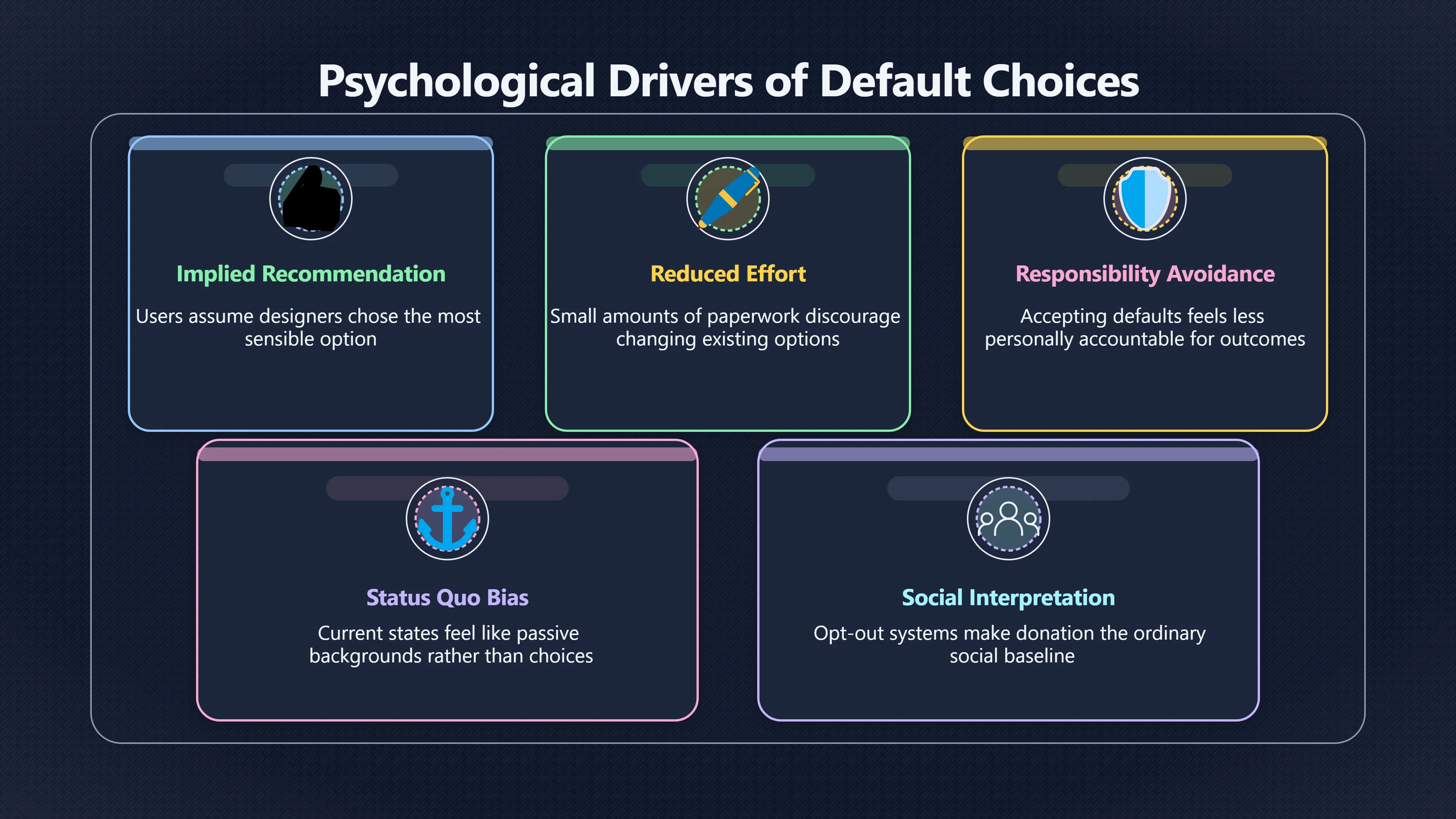
- An implied recommendation. People frequently assume that whoever designed the choice environment selected the default because it is sensible, safe or typical.
- Reduced effort. Even small amounts of paperwork, clicking, reading or uncertainty discourage changing the existing option.
- Avoiding responsibility. Accepting the default feels less personally accountable than actively changing it if the outcome later proves disappointing.
- Treating the default as the status quo. Once something is presented as the current state, changing it feels like an intervention while leaving it alone feels passive, even though both produce consequences. [dangoldstein.com+2SSRN]dangoldstein.comDefaults SciencePOLICY FORUMby EJ Johnson · Cited by 3571 — In presumed-consent states, people are organ donors unless they register not to be, and in ex…
The important analytical point is that defaults do not simply influence what people choose. They influence how people mentally classify the decision. A default transforms one option into the normal background against which alternatives are judged.
This is why the language of “doing nothing” can be misleading. In many situations, doing nothing means accepting a particular policy, project, subscription, investment strategy or organisational process. The absence of action is still an action because the default determines the outcome.
Why opt-in and opt-out systems change behaviour
The best-known evidence comes from organ donation policies. Countries differ in whether citizens must actively register to become donors (opt-in) or are treated as donors unless they decline (opt-out). Simply changing this default has been associated with dramatically different participation rates, even when underlying public attitudes are broadly supportive of donation. [dangoldstein.com+2Columbia Business School]dangoldstein.comDefaults SciencePOLICY FORUMby EJ Johnson · Cited by 3571 — In presumed-consent states, people are organ donors unless they register not to be, and in ex…
Researchers initially explained these differences through several interacting mechanisms:
- changing the default reduces effort;
- many people procrastinate over emotionally difficult decisions;
- people interpret the default as signalling what society expects;
- remaining with the default feels psychologically easier than deviating from it. [dangoldstein.com]dangoldstein.comDefaults SciencePOLICY FORUMby EJ Johnson · Cited by 3571 — In presumed-consent states, people are organ donors unless they register not to be, and in ex…
Later work added another insight. Defaults change the meaning people attach to the choice itself. Under an opt-in system, agreeing to donate can feel like an unusually generous personal act. Under an opt-out system, donation becomes the ordinary baseline, while refusing donation appears to require special justification. The behaviour changes not only because the paperwork changes but because the social interpretation changes. [PMC]pmc.ncbi.nlm.nih.govPMCThe meaning of default options for potential organ donors“opt-out”)…
This illustrates an important lesson for analytical thinking: framing does not merely alter incentives. It changes what people believe a decision represents.
Why defaults work even when people know they exist
One common misconception is that defaults only affect people who fail to notice them. Research suggests otherwise.
Even when individuals know a default has been deliberately chosen, it can continue to influence decisions. The default still reduces cognitive effort, preserves the current state and provides a reference point against which alternatives are evaluated. Awareness weakens some effects but does not eliminate them. [Wikipedia]WikipediaStatus quo biasStatus quo bias
This matters because intelligent, informed people are not immune. Busy professionals often inherit meeting schedules, project plans, software settings and reporting structures simply because changing them requires additional work and justification.
The result is organisational inertia disguised as rational continuity.
Defaults in projects and everyday decisions
Project work contains countless defaults that rarely receive explicit discussion.
Examples include:
- a project continuing unless someone formally cancels it;
- recurring meetings staying in calendars indefinitely;
- previous year’s budget becoming the starting point for the next year’s spending;
- existing suppliers being automatically renewed;
- established technical architectures being reused because they already exist.
None of these arrangements are inherently wrong. The problem arises when people stop recognising them as choices.
The same pattern appears in personal life:
- automatic subscription renewals;
- retirement contribution rates left unchanged for years;
- privacy settings accepted during account creation;
- exercise routines abandoned because restarting requires deliberate effort;
- default phone notifications continually interrupting attention.
In each case, the designed baseline quietly becomes what feels normal.

When helpful defaults become problematic
Behavioural research generally finds that well-designed defaults can improve outcomes in health, savings and other domains because they reduce unnecessary friction while preserving freedom to opt out. However, the same mechanism can also steer behaviour in ways people never consciously intended. [dangoldstein.com]dangoldstein.comDefaults SciencePOLICY FORUMby EJ Johnson · Cited by 3571 — In presumed-consent states, people are organ donors unless they register not to be, and in ex…
This creates an ethical tension.
Supporters argue that every system must have some default, so choosing one that helps people achieve widely shared goals is reasonable.
Critics respond that defaults may exploit predictable biases rather than informed preferences, particularly when organisations benefit from customer inaction, such as through automatic renewals or permissive data-sharing settings.
More recent research also suggests that defaults can have unintended side effects. For example, increasing participation in one behaviour may alter perceptions about whether additional voluntary actions are still necessary, highlighting that defaults should be evaluated for broader consequences rather than only their immediate success. [PMC]pmc.ncbi.nlm.nih.govCrowding-out effects of opt-out defaults: Evidence from organ…by P Güntürkün · 2025 · Cited by 5 — While past research focused on t…
For analytical thinking, the lesson is not that defaults are good or bad. It is that they deserve inspection because they influence behaviour precisely by making themselves seem unremarkable.
How to audit defaults in work and life
One practical habit is to treat every apparent “non-decision” as a hidden decision.
Useful questions include:
- What happens if nobody acts? This identifies the true default.
- Who selected this baseline? Was it chosen deliberately, inherited or accidental?
- Does the default reflect today’s goals? Many defaults survive simply because nobody revisits them.
- What effort is required to change it? Small frictions often explain surprisingly large behavioural differences.
- Would I actively choose this option if there were no default? This separates genuine preference from passive acceptance.
- Would reversing the default change many people’s behaviour? If so, the existing pattern may reveal more about choice architecture than about underlying preferences.
These questions help expose situations where people mistake convenience for evidence or continuity for correctness.

The broader lesson for better thinking
Defaults are powerful because they redefine what counts as “doing nothing”. Once an option becomes the baseline, accepting it feels passive even though it still shapes future outcomes.
Analytical thinking improves when you stop treating defaults as invisible background conditions. Whether evaluating a personal habit, a software setting, a business process or a public policy, recognising the default turns an apparently neutral situation back into an explicit decision. That shift often reveals assumptions, trade-offs and alternatives that would otherwise remain hidden beneath the comforting illusion that inaction carries no frame at all.
Amazon book picks
Further Reading
Books and field guides related to Why doing nothing is still a frame. Use these as the next step if you want deeper reading beyond the article.
Nudge
Defaults, opt-in and opt-out design, and choice architecture are central themes of the book.
Predictably Irrational, Revised and Expanded Edition
Rating: 4.0/5 from 15 Google Books ratings
Shows how seemingly small contextual cues and default-like settings shape choices irrationally.
Misbehaving
Covers the development of behavioural economics and why real people deviate from rational choice assumptions.
Predictably Irrational
Shows how seemingly small contextual cues and default-like settings shape choices irrationally.
eBay marketplace picks
Marketplace Samples
Live-tested eBay searches with available results related to this page.




Endnotes
-
Source: dangoldstein.com
Title: Defaults Science
Link: https://www.dangoldstein.com/papers/DefaultsScience.pdfSource snippet
POLICY FORUMby EJ Johnson · Cited by 3571 — In presumed-consent states, people are organ donors unless they register not to be, and in ex...
-
Source: pmc.ncbi.nlm.nih.gov
Link: https://pmc.ncbi.nlm.nih.gov/articles/PMC8349348/Source snippet
An effective method to increase the number of potential cadaveric organ donors is to make people donors by default with the option to opt...
-
Source: papers.ssrn.com
Link: https://papers.ssrn.com/sol3/papers.cfm?abstract_id=1324774Source snippet
First, consider that every policy must have a no-action default.Read more...
-
Source: business.columbia.edu
Title: Business School Defaults and Donation Decisions
Link: https://business.columbia.edu/sites/default/files-efs/pubfiles/1139/Defaults_and_Donation_Decisions_-_Transplantation.pdfSource snippet
Columbia Business SchoolDefaults and Donation Decisions - Columbia Business Schoolby EJ Johnson · 2004 · Cited by 375 — We then describe...
-
Source: pmc.ncbi.nlm.nih.gov
Title: PMCThe meaning of default options for potential organ donors
Link: https://pmc.ncbi.nlm.nih.gov/articles/PMC3458339/Source snippet
“opt-out”)...
-
Source: Wikipedia
Title: Status quo bias
Link: https://en.wikipedia.org/wiki/Status_quo_bias -
Source: pmc.ncbi.nlm.nih.gov
Link: https://pmc.ncbi.nlm.nih.gov/articles/PMC12560092/Source snippet
Crowding-out effects of opt-out defaults: Evidence from organ...by P Güntürkün · 2025 · Cited by 5 — While past research focused on t...
-
Source: pmc.ncbi.nlm.nih.gov
Link: https://pmc.ncbi.nlm.nih.gov/articles/PMC12413501/Source snippet
Donation Decisions: When Deviating from the Status...by M Motsenok · 2025 — We found that under an opt-in policy, participants saw thems...
-
Source: gov.wales
Link: https://www.gov.wales/sites/default/files/statistics-and-research/2019-08/121203optoutorgandonationen.pdfSource snippet
s of organ donation, ranging from an increase of 2.7 donors per million population (...Read more...
Additional References
-
Source: thedecisionlab.com
Link: https://thedecisionlab.com/intervention/bias-in-organ-donationSource snippet
Bias in organ donationWhen comparing opt-in versus opt-out organ donation programs, results showed that organ donation rates in opt-out s...
-
Source: journals.sagepub.com
Title: Sage Journals Does Changing Defaults save Lives?
Link: https://journals.sagepub.com/doi/10.1177/237946151900500106Source snippet
Effects of Presumed...by M Steffel · 2019 · Cited by 44 — In this review, we examine whether presumed consent organ donation policies sa...
-
Source: researchgate.net
Link: https://www.researchgate.net/publication/256039654_Decisions_by_DefaultSource snippet
with the default option that requires no action (Johnson...Read more...
-
Source: ifo.de
Title: wp 2023 403 Schulze Spuentrup Organ Donation
Link: https://www.ifo.de/DocDL/wp-2023-403_Schulze_Spuentrup-Organ_Donation.pdfSource snippet
Does Implementing Opt-Out Solve The Organ Shortage...by SS Spuentrup · 2023 — Applying the prospect and nudge theory to organ donation p...
-
Source: researchgate.net
Link: https://www.researchgate.net/publication/8996952_Medicine_Do_defaults_save_livesSource snippet
ider that every policy must have a no-action default.Read more...
-
Source: scribd.com
Link: https://www.scribd.com/document/948666564/Organ-Donation-Case-Study-3Source snippet
strations by simplifying the decision-making process.Read more...
-
Source: thedecisionlab.com
Link: https://thedecisionlab.com/intervention/how-default-settings-doubled-organ-donation-rates-in-the-usSource snippet
These findings reflect the power of the default...Read more...
-
Source: econstor.eu
Title: ifo dice report v14 y2016 i4 p90 94
Link: https://www.econstor.eu/bitstream/10419/167291/1/ifo-dice-report-v14-y2016-i4-p90-94.pdfSource snippet
The Effect of Presumed Consent Defaults on Organ Donationby J Li · 2016 · Cited by 16 — Some individuals who do not wish to register as d...
-
Source: eprints.whiterose.ac.uk
Title: whiterose.ac.uk Presumed dissent?
Link: https://eprints.whiterose.ac.uk/id/eprint/217875/1/fwac001.pdfSource snippet
Opt-out organ donation and the...by NJ Williams · 2022 · Cited by 15 — ABSTRACT. It is often claimed that a legitimate approach to organ...
-
Source: ijsser.org
Link: https://ijsser.org/2025files/ijsser_10__161.pdfSource snippet
The Behavioral Economics of Organ Donationby HM Kirtikumar — Likewise, the status quo bias favors the default option, which in opt-out sy...
Topic Tree