Within Alternatives
Is It Motivation Or Something Else?
Performance issues can look like motivation problems until onboarding, role fit, access, and instructions are compared.
On this page
- Common workplace explanations that mimic each other
- Evidence that separates effort from unclear systems
- How managers can check alternatives before acting
Page outline Jump by section
Introduction
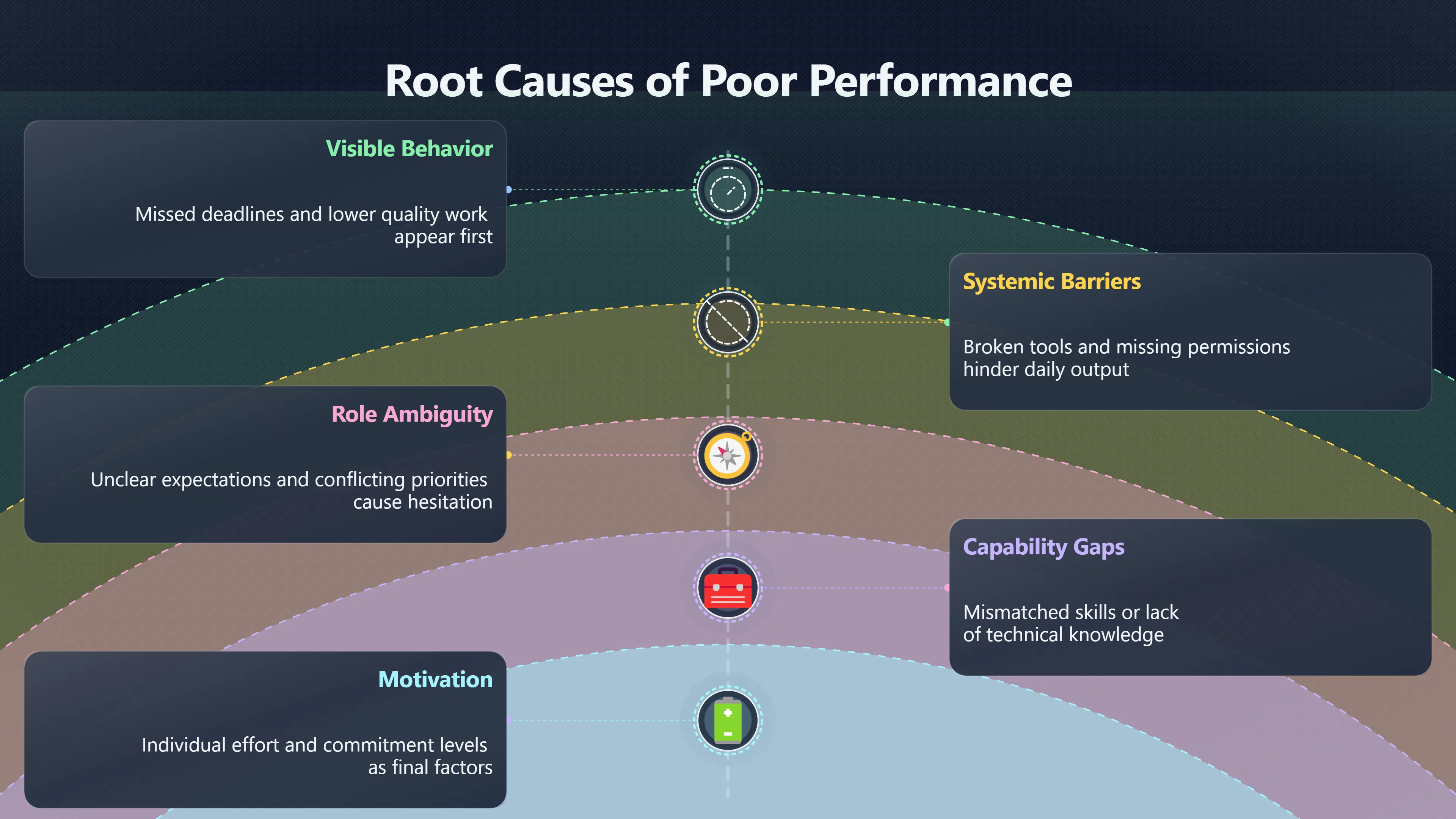
When an employee’s performance declines, it is tempting to settle on the most obvious explanation: they have lost motivation, stopped trying, or lack commitment. In practice, these are only some of several plausible explanations. The same visible behaviour—missed deadlines, lower output, mistakes, disengagement, or reluctance to take initiative—can also arise from poor onboarding, unclear expectations, inadequate access to tools, mismatched skills, changing workloads, conflicting priorities, or ineffective management.
 Thinking in terms of live alternatives means resisting the urge to treat motivation as the default diagnosis. Instead, managers compare several plausible explanations and deliberately seek evidence that distinguishes between them. This approach leads to fairer decisions, more effective interventions, and fewer costly mistakes such as disciplining an employee whose real problem is a broken work system. Research on performance management consistently shows that employee performance is shaped by a combination of capability, opportunity, organisational systems, leadership, feedback, and motivation rather than by motivation alone. [CIPD+2PMC]cipd.orgPeople performance: an evidence reviewPeople performance: an evidence reviewJune 10, 2022 — In people management research, it is probably the most measured organisational…
Common workplace explanations that mimic each other
Many workplace problems produce remarkably similar symptoms. That is why relying on first impressions is risky.
A manager might observe that an employee is:
- missing deadlines
- making more mistakes
- participating less in meetings
- avoiding difficult work
- appearing distracted
- producing lower-quality work
These observations do not identify the underlying cause. Several competing explanations may fit equally well.
Observable behaviourPossible explanationSlow workLack of knowledge, unclear priorities, excessive workload, missing tools, motivation problemsFrequent mistakesPoor training, unclear procedures, fatigue, system changes, rushing, inadequate feedbackLittle initiativeUnclear authority, fear of making mistakes, previous criticism, role ambiguity, low engagementMissed deadlinesUnrealistic workload, hidden dependencies, poor planning, insufficient resources, procrastinationWithdrawal from meetingsUncertainty about expectations, lack of psychological safety, overload, conflict, reduced interest
The important point is that several explanations often predict the same visible outcome. Choosing one explanation too early encourages confirmation bias: every new observation is interpreted as further proof of the preferred story rather than as evidence that distinguishes between competing possibilities. [Wikipedia]WikipediaConfirmation biasConfirmation bias
Why motivation is often overdiagnosed
Managers naturally notice behaviour because behaviour is visible. Systems, instructions, access problems and role ambiguity are much less visible.
This creates a common reasoning error:
Performance is poor → effort appears low → therefore motivation must be the problem.
The missing step is asking whether another explanation could produce exactly the same behaviour.
For example, someone who receives contradictory instructions from two managers may hesitate before acting. From the outside, hesitation can resemble laziness. Likewise, an employee who lacks access to essential software or customer information may appear inefficient despite working hard.
Research on people performance consistently finds that individual performance depends on multiple interacting influences including role clarity, leadership, capability, feedback, organisational support, wellbeing and work design. Treating motivation as the only explanation ignores much of what predicts performance in practice. [CIPD+2PMC]cipd.orgPeople performance: an evidence reviewPeople performance: an evidence reviewJune 10, 2022 — In people management research, it is probably the most measured organisational…
Evidence that separates effort from unclear systems
The most useful question is not “What explains today’s problem?” but “What evidence would distinguish these explanations?”
Instead of collecting evidence that merely fits one theory, managers can compare what each explanation predicts.
If motivation is the problem
Motivation becomes more plausible when several indicators appear together:
- the employee understands expectations but consistently ignores them
- adequate resources and access are available
- performance remains poor across different tasks and situations
- coaching and clarification produce little improvement
- similar employees facing the same conditions perform normally
None of these proves low motivation, but together they strengthen that explanation.
If the system is the problem
System problems make different predictions.
Signs include:
- multiple employees encountering the same obstacles
- repeated confusion about priorities
- inconsistent instructions from different managers
- missing software, permissions or equipment
- work repeatedly delayed by external dependencies
- improvement after processes or tools are fixed
In this case, improving the system should improve performance. If performance rises immediately after barriers are removed, blaming motivation was probably mistaken.
The distinguishing feature is predictive power. Each explanation should suggest different evidence that could potentially prove it wrong.
How onboarding changes the picture
Performance concerns during the first months of employment deserve particular caution.
New employees frequently experience:
- uncertainty about informal expectations
- unfamiliar technology
- incomplete understanding of internal processes
- limited organisational networks
- uncertainty about decision authority
Without recognising these factors, managers may mistake predictable adjustment difficulties for poor attitude.
Research on onboarding consistently finds that structured onboarding improves role clarity, confidence, organisational commitment and job performance while reducing turnover intentions. Effective onboarding is not simply orientation paperwork; it helps employees understand expectations, relationships, workflows and sources of support. [SHURA+2Wikipedia]shura.shu.ac.ukDigital onboarding and employee outcomesSeptember 11, 2022 — by K Sani · 2022 · Cited by 120 — Onboarding is an HR routine of introd…
Consider two employees who both miss deadlines in their first month.
One may lack motivation.
The other may still be discovering where essential information resides, who approves work, and how decisions are actually made.
The behaviour looks similar. The underlying mechanisms—and therefore the appropriate management response—are completely different.

Role fit versus capability
Another common diagnostic mistake is confusing poor performance with lack of ability.
Capability itself contains several distinct possibilities:
- insufficient technical knowledge
- mismatch between strengths and role requirements
- inadequate experience
- missing practice
- cognitive overload from excessive task switching
Someone may perform poorly in one role while thriving in another.
For example, an excellent technical specialist promoted into a management position may struggle not because they stopped trying, but because the new role demands coaching, delegation and conflict management rather than technical expertise.
Comparing alternative explanations encourages managers to ask whether changing responsibilities, providing training or redesigning work would solve the problem before concluding that the individual lacks commitment.
Access problems often masquerade as poor performance
Many productivity problems originate outside the employee.
Examples include:
- delayed security permissions
- missing customer data
- unreliable software
- outdated documentation
- unclear approval chains
- unavailable subject-matter experts
These obstacles create delays that resemble low productivity when viewed only through output measures.
One useful diagnostic question is:
Could a highly motivated employee perform well under these conditions?
If the honest answer is “probably not,” attention should shift towards removing barriers before evaluating effort.
A practical comparison process for managers
Rather than asking, “Why is this employee underperforming?”, managers can work through competing explanations.
- List several plausible causes. Include motivation alongside alternatives such as unclear expectations, onboarding gaps, workload, access problems, capability, health, role fit or conflicting priorities.
- Ask what each explanation predicts. What evidence would become more likely if this explanation were correct?
- Collect evidence that could change your mind. Avoid looking only for confirmation.
- Test the least costly intervention first. Clarifying expectations or fixing access problems may quickly reveal whether deeper issues remain.
- Review whether the explanation still fits. Good diagnosis evolves as new evidence appears.
This approach resembles diagnostic reasoning in other professions: several explanations remain “live” until evidence meaningfully separates them.
A workplace example
Imagine a customer support representative whose response times suddenly increase.
A manager who assumes low motivation might begin disciplinary conversations immediately.
A manager using live alternatives would instead consider several explanations:
- Has workload increased?
- Have response systems changed?
- Is the employee covering additional responsibilities?
- Has product complexity increased?
- Did recent policy changes require longer investigations?
- Is there evidence of disengagement outside this metric?
Suppose investigation reveals that recent software updates added several authentication steps and every team member’s response times have increased.
The original explanation—lack of effort—no longer fits the evidence nearly as well as a system explanation.
Because the diagnosis changes, the solution changes as well: improve workflow rather than punish employees.
Better decisions come from better comparisons
Workplace performance problems rarely have a single obvious cause. Similar behaviours can emerge from very different mechanisms, including motivation, role clarity, onboarding quality, capability, workload, management practices and organisational systems.
Keeping several explanations alive long enough for evidence to distinguish between them reduces confirmation bias and improves both fairness and effectiveness. Managers who compare competing explanations are less likely to discipline the wrong person, overlook broken processes, or miss opportunities to improve training and role design. The central question shifts from “Which explanation feels most convincing?” to “Which explanation best accounts for the evidence, and what new evidence would distinguish it from the alternatives?”
Amazon book picks
Further Reading
Books and field guides related to Is It Motivation Or Something Else?. Use these as the next step if you want deeper reading beyond the article.
Crucial Conversations: Tools for Talking When Stakes are High
Rating: 4.0/5 from 28 Google Books ratings
Supports evidence-based conversations that distinguish between motivation, capability, and workplace barriers.
The First 90 Days, Updated and Expanded
Helps managers diagnose performance issues systematically, clarify expectations, and improve onboarding rather than assuming low motivation.
Multipliers
Shows how leadership behaviours influence employee capability, engagement, and results instead of relying on simplistic motivation explan...
The First 90 Days
Helps managers diagnose performance issues systematically, clarify expectations, and improve onboarding rather than assuming low motivation.
eBay marketplace picks
Marketplace Samples
Live-tested eBay searches with available results related to this page.



Endnotes
-
Source: cipd.org
Title: People performance: an evidence review
Link: https://www.cipd.org/globalassets/media/knowledge/knowledge-hub/evidence-reviews/people-performance-practice-summary_tcm18-109854.pdfSource snippet
People performance: an evidence reviewJune 10, 2022 — In people management research, it is probably the most measured organisational...
Published: June 10, 2022
-
Source: pmc.ncbi.nlm.nih.gov
Link: https://pmc.ncbi.nlm.nih.gov/articles/PMC10658249/Source snippet
management system and its role for employee...by N Siraj · 2023 · Cited by 84 — This study aims to investigate the role of PMS in enhanc...
-
Source: Wikipedia
Title: Confirmation bias
Link: https://en.wikipedia.org/wiki/Confirmation_bias -
Source: shura.shu.ac.uk
Link: https://shura.shu.ac.uk/30719/1/PDF_Proof%20%286%29.PDFSource snippet
Digital onboarding and employee outcomesSeptember 11, 2022 — by K Sani · 2022 · Cited by 120 — Onboarding is an HR routine of introd...
Published: September 11, 2022
-
Source: Wikipedia
Link: https://en.wikipedia.org/wiki/Onboarding
Additional References
-
Source: thedecisionlab.com
Link: https://thedecisionlab.com/reference-guide/management/performance-managementSource snippet
Performance ManagementPerformance management is a strategy for observing and assessing employee work, aiming to align abilities with comp...
-
Source: mckinsey.com
Title: in the spotlight performance management that puts people first
Link: https://www.mckinsey.com/capabilities/people-and-organizational-performance/our-insights/in-the-spotlight-performance-management-that-puts-people-firstSource snippet
McKinsey & CompanyPerformance management that puts people first15 May 2024 — Companies that focus on their people's performance are 4.2 t...
Published: May 2024
-
Source: appraisd.com
Title: integrating employee onboarding and performance management
Link: https://www.appraisd.com/blog/integrating-employee-onboarding-and-performance-managementSource snippet
Employee Onboarding in Employee Management Systems24 Aug 2023 — How to successfully integrate employee onboarding tactics into your exist...
-
Source: staffcircle.com
Title: 5 performance management issues and how to overcome them
Link: https://www.staffcircle.com/blogs/5-performance-management-issues-and-how-to-overcome-them/Source snippet
5 Performance Management Issues and How to Overcome...9 Jun 2025 — In this post, we'll discuss how we help people leaders to overcome th...
-
Source: researchgate.net
Link: https://www.researchgate.net/publication/393612883_Clarifying_Roles_Enhancing_Results_Job_Descriptions_and_Employee_PerformanceSource snippet
e within organisational contexts.Read more...
-
Source: youtube.com
Title: SHARPEN YOUR ANALYTICAL & PROBLEM SOLVING SKILLS
Link: https://www.youtube.com/watch?v=3p_jAa4ZI08Source snippet
Performance Management In 7 minutes | Building High-Performing Teams #performancemanagement...
-
Source: mdpi.com
Link: https://www.mdpi.com/2071-1050/14/21/14017Source snippet
The Key Strategies for Measuring Employee Performance...by TDN Vuong · 2022 · Cited by 263 — The systematic review findings revealed tha...
-
Source: youtube.com
Title: Developing Strong Analytical Skills (10 Minutes)
Link: https://www.youtube.com/watch?v=q3ZZTsSTBDcSource snippet
SHARPEN YOUR ANALYTICAL & PROBLEM SOLVING SKILLS - PART 2...
-
Source: youtube.com
Title: Improve Your Problem-Solving Skills
Link: https://www.youtube.com/watch?v=NKnwekjII2QSource snippet
Developing Strong Analytical Skills (10 Minutes)...
-
Source: youtube.com
Link: https://www.youtube.com/watch?v=xBy5RfR12iU
Topic Tree