Within Tradeoffs
When Good Enough Beats Perfect
Satisficing can protect attention when the search for the perfect option becomes part of the problem.
On this page
- Bounded rationality and limited attention
- Maximising, satisfaction and search fatigue
- How to define good enough before comparing options
Page outline Jump by section
Introduction
Real decisions are rarely made under ideal conditions. Most happen with incomplete information, limited time, competing priorities and finite mental energy. In these situations, searching endlessly for the perfect option can become part of the problem rather than the solution. A decision that is good enough, made at the right time, often creates more value than a theoretically optimal choice reached too late or at excessive cost.
 This idea is captured by the concept of satisficing, introduced by economist and cognitive scientist Herbert Simon as part of his theory of bounded rationality. Rather than assuming people can always identify the best possible option, Simon argued that they search until they find an option that meets their important requirements, then stop looking. This is not settling for mediocrity. It is an adaptive response to the real constraints of human attention, knowledge and time. [cooperative-individualism.org+2Stanford Encyclopedia of Philosophy]cooperative-individualism.orgsimon herbert a behavioral model of rational choice 1955 febAuthor(s): Herbert A. Simon…
Why “good enough” is often the more rational choice
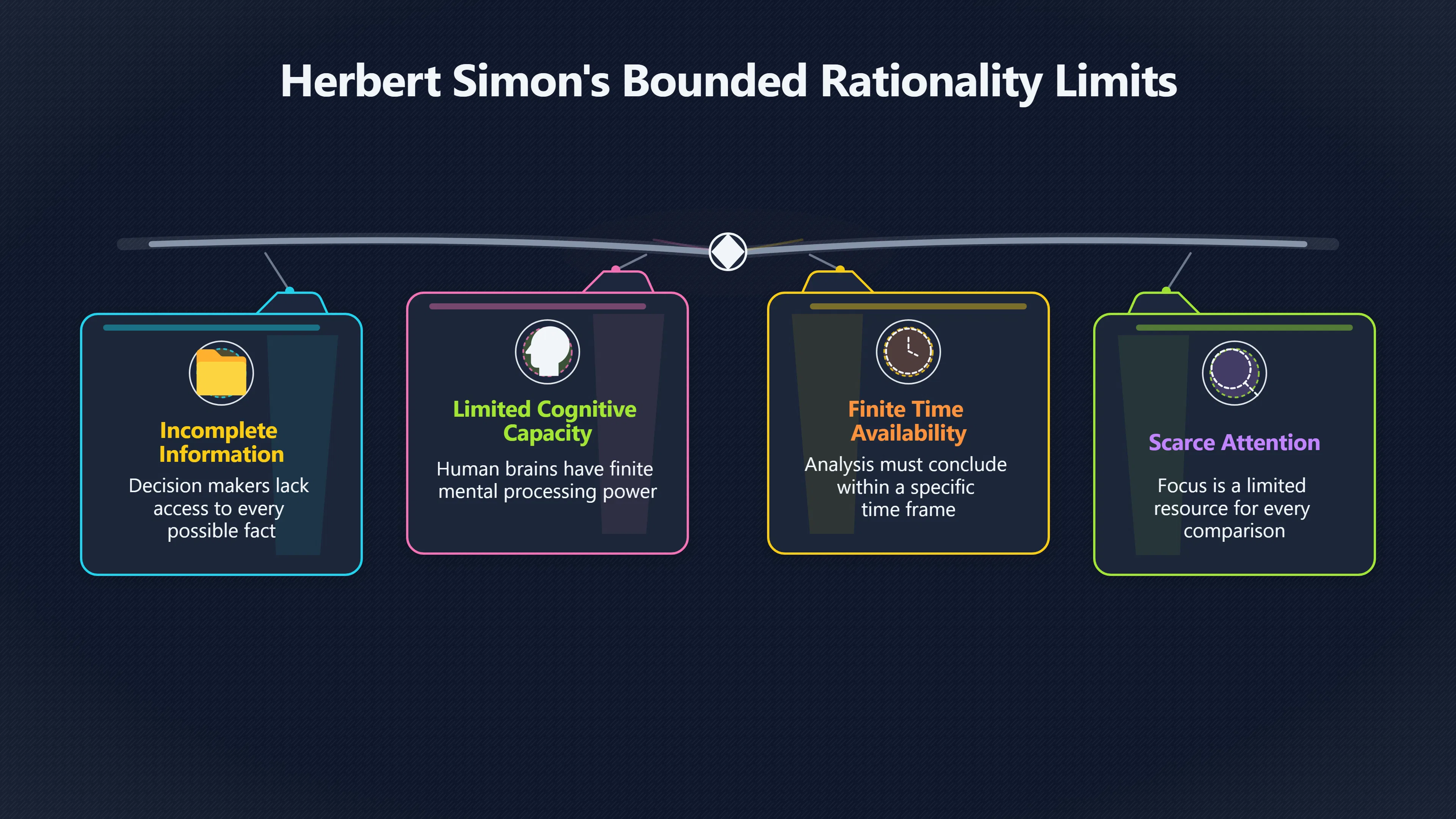
Classical economic models often assumed that decision-makers could compare every alternative and identify the optimum. Simon challenged this picture in the 1950s by arguing that real people face three unavoidable limits:
- information is incomplete;
- cognitive capacity is limited; [thedecisionlab.com]thedecisionlab.comBounded Rationality | Reference GuideSimon, however, was the first to hypothesize that humans work with limited cognitive resources and i…
- time available for analysis is finite.
Because of these constraints, people generally cannot optimise every decision. Instead, they use search strategies that stop once an acceptable solution is found. Simon called this satisficing—combining “satisfy” and “suffice”. Far from being irrational, it is frequently the most efficient use of scarce attention. [cooperative-individualism.org+2NobelPrize.org]cooperative-individualism.orgsimon herbert a behavioral model of rational choice 1955 febAuthor(s): Herbert A. Simon…
This insight has become influential well beyond economics, shaping research in psychology, management, artificial intelligence and public administration. Modern discussions of bounded rationality continue to treat it as a descriptive theory of how people actually make decisions rather than how perfectly informed agents would behave. [Springer+2QMRO]link.springer.comSimon's bounded rationality | Decisions in Economics and…by A Giarlotta · 2024 · Cited by 29 — Bounded rationality in percepti…
Bounded rationality and limited attention
Attention is one of the scarcest resources in decision-making. Every additional comparison consumes time and mental effort that cannot be used elsewhere.
The practical implication is important. A decision process has costs of its own:
- collecting more information; [investopedia.com]investopedia.comSimon, states that individuals make decisions with limited information, which leads to satisfactory…Read more…
- comparing additional alternatives;
- delaying action;
- increasing cognitive fatigue;
- creating opportunities for second-guessing.
Eventually the value of gathering another piece of information becomes smaller than its cost. At that point, continuing the search no longer improves the overall decision—it simply extends it.
This explains why experienced professionals often stop searching earlier than novices. Their expertise allows them to recognise when a solution already satisfies the essential requirements instead of treating every remaining uncertainty as a reason to postpone commitment. Simon’s work emphasised that rationality should be judged relative to the decision-maker’s actual environment and computational limits, not against an impossible standard of perfect optimisation. [JSTOR+2NobelPrize.org]jstor.orgRational Decision Making in Business Organizationsby HA Simon · 1979 · Cited by 7271 — But the important thing about the search and…
Maximising, satisficing and search fatigue
A useful distinction in behavioural research is between maximisers and satisficers.
- Maximisers aim to identify the absolute best option, often continuing to search even after finding several excellent alternatives.
- Satisficers search until they locate an option meeting their predefined criteria and then stop.
Neither approach is universally better. When choices are few and consequences are enormous—for example selecting a medical treatment or designing a spacecraft—more extensive optimisation may be justified.
However, many everyday decisions involve hundreds or thousands of similar options. In these environments, maximising often carries psychological costs.
Research by Barry Schwartz and colleagues found that people with stronger maximising tendencies frequently report:
- greater regret after decisions;
- more social comparison; [ebsco.com]ebsco.comBounded Rationality | Social Sciences and HumanitiesBounded rationality is a concept that suggests individuals' decision-making abilities…
- lower satisfaction with chosen options;
- more difficulty making decisions in the first place. [PubMed]pubmed.ncbi.nlm.nih.govMaximizing versus satisficing: happiness is a matter of choiceby B Schwartz · 2002 · Cited by 3163 — Study 2 found maximizers less…
Later studies suggest one reason: maximisers tend to interpret even relatively minor decisions as highly important, encouraging them to invest disproportionate effort in comparing alternatives. This can increase decision difficulty without necessarily improving outcomes. [PMC]pmc.ncbi.nlm.nih.govTaking Decisions Too Seriously: Why Maximizers Often Get…by M Luan · 2022 · Cited by 15 — We find that maximizers perceive the same…
The problem is therefore not ambition itself. It is allowing the search for perfection to consume more resources than the improvement in the eventual choice is worth.
How to define “good enough” before comparing options
Satisficing works best when “good enough” is defined before the comparison begins. Otherwise the acceptance standard moves every time a better option appears.
A practical approach is to establish three layers of criteria.
Non-negotiable requirements
These are conditions that must be satisfied. A rental property might need to be within a commuting distance, inside a fixed budget and structurally safe.
Strong preferences
These improve the decision but are not essential. Examples include a larger garden, newer appliances or better transport links.
Nice extras
These influence the choice only if several options already satisfy the higher-level requirements.
This ordering changes the search process. Instead of asking, “Is there anything even better?” the question becomes, “Does this option satisfy everything that genuinely matters?”
Once every essential criterion has been met, further searching should require a clear reason rather than becoming the default.
Recognising when the search should stop
One of the hardest parts of satisficing is knowing when continued comparison is no longer productive.
Several signals suggest the search has reached diminishing returns:
- newly discovered options differ only in minor details;
- comparisons are repeatedly revisiting the same tradeoffs;
- additional information changes preferences very little;
- delay itself is becoming expensive;
- uncertainty cannot realistically be eliminated.
For example, someone buying a laptop may spend twenty minutes identifying five models that all satisfy their requirements, then spend another four hours comparing tiny differences in benchmark scores that will never matter in daily use. The second phase consumes far more attention while producing almost no practical improvement.
In these situations, stopping is not evidence of laziness. It reflects an understanding that decision quality depends on both the outcome and the cost of reaching it.
Good enough is not careless
Choosing a satisfactory option is sometimes criticised as encouraging low standards. That misunderstands Simon’s idea.
Satisficing does not mean:
- ignoring important evidence;
- accepting preventable risks;
- abandoning careful thinking.
Instead, it means matching the effort spent on a decision to its importance and recognising that the decision process itself has opportunity costs.
A surgeon preparing for an operation should gather extensive information because mistakes are costly. Choosing a restaurant for lunch usually deserves a much smaller investment of attention. Rationality involves scaling effort to stakes rather than applying maximum analysis everywhere.
This proportionality is one reason bounded rationality remains influential across fields ranging from organisational management to artificial intelligence, where computational resources are also finite. [Taylor & Francis Online+2QMRO]tandfonline.comTaylor & Francis OnlineBounded Rationality: Managerial Decision-Making and Databy LM Pittenger · 2023 · Cited by 26 — This paper brings t…
A more realistic standard for better decisions
Tradeoff thinking becomes more practical when perfection is replaced with adequacy under real constraints. Every hour spent searching for marginal improvements is an hour unavailable for acting, learning or addressing other problems.
The central lesson of satisficing is therefore not that excellence is unimportant, but that decision-making should account for the scarcity of time, attention and information. Defining acceptable outcomes in advance, recognising diminishing returns in further search and stopping once essential objectives have been met often produces decisions that are both more efficient and more satisfying than endless optimisation. In the real world, the best decision is frequently not the perfect one, but the one that is good enough for the situation and made while there is still time for it to matter.
Amazon book picks
Further Reading
Books and field guides related to When Good Enough Beats Perfect. Use these as the next step if you want deeper reading beyond the article.
The Paradox of Choice
Explains why satisficing often outperforms endless optimization.
eBay marketplace picks
Marketplace Samples
Live-tested eBay searches with available results related to this page.



Endnotes
-
Source: cooperative-individualism.org
Title: simon herbert a behavioral model of rational choice 1955 feb
Link: https://cooperative-individualism.org/simon-herbert_a-behavioral-model-of-rational-choice-1955-feb.pdfSource snippet
Author(s): Herbert A. Simon...
-
Source: plato.stanford.edu
Title: Encyclopedia of Philosophy Bounded Rationality
Link: https://plato.stanford.edu/entries/bounded-rationality/Source snippet
Stanford Encyclopedia of PhilosophyBounded Rationality - Stanford Encyclopedia of Philosophyby G Wheeler · 2018 · Cited by 222 — Simon's...
-
Source: link.springer.com
Link: https://link.springer.com/article/10.1007/s10203-024-00436-2Source snippet
Simon's bounded rationality | Decisions in Economics and...by A Giarlotta · 2024 · Cited by 29 — Bounded rationality in percepti...
-
Source: nobelprize.org
Link: https://www.nobelprize.org/uploads/2018/06/simon-lecture.pdfSource snippet
Simon - Prize Lectureby HA SIMON · Cited by 7172 — I shall have more to say later about the positive case for a descriptive theory of bou...
-
Source: qmro.qmul.ac.uk
Title: QMROBounded Rationality, Satisficing, Artificial Intelligence
Link: https://qmro.qmul.ac.uk/xmlui/bitstream/handle/123456789/80343/Schwarz%20Bounded%20Rationality%2C%20Satisficing%2C%20Artificial%20Intelligence%2C%20and%20Decision-Making%20in%20Public%20Organizations%3A%20The%20Contributions%20of%20Herbert%20Simon%202022%20Accepted.pdf?sequence=2Source snippet
by G Schwarz · 2022 · Cited by 69 — Their study demonstrates that good decision making alone is not sufficient to ensure that a decis...
-
Source: jstor.org
Link: https://www.jstor.org/stable/1808698Source snippet
Rational Decision Making in Business Organizationsby HA Simon · 1979 · Cited by 7271 — But the important thing about the search and...
-
Source: pmc.ncbi.nlm.nih.gov
Link: https://pmc.ncbi.nlm.nih.gov/articles/PMC9240276/Source snippet
Taking Decisions Too Seriously: Why Maximizers Often Get...by M Luan · 2022 · Cited by 15 — We find that maximizers perceive the same...
-
Source: pubmed.ncbi.nlm.nih.gov
Link: https://pubmed.ncbi.nlm.nih.gov/12416921/Source snippet
Maximizing versus satisficing: happiness is a matter of choiceby B Schwartz · 2002 · Cited by 3163 — Study 2 found maximizers less...
-
Source: tandfonline.com
Link: https://www.tandfonline.com/doi/abs/10.1080/08874417.2022.2111380Source snippet
Taylor & Francis OnlineBounded Rationality: Managerial Decision-Making and Databy LM Pittenger · 2023 · Cited by 26 — This paper brings t...
-
Source: thedecisionlab.com
Title: Bounded Rationality
Link: https://thedecisionlab.com/biases/bounded-rationalitySource snippet
The Decision...Bounded Rationality is a behavioral bias that occurs when human decision-making process attempt to satisfice, rather than...
-
Source: thedecisionlab.com
Link: https://thedecisionlab.com/reference-guide/psychology/bounded-rationalitySource snippet
Bounded Rationality | Reference GuideSimon, however, was the first to hypothesize that humans work with limited cognitive resources and i...
-
Source: Wikipedia
Title: Bounded rationality
Link: https://en.wikipedia.org/wiki/Bounded_rationalitySource snippet
Bounded rationalityBounded rationality is the idea that rationality is limited when individuals make decisions, rational individuals w...
-
Source: Wikipedia
Link: https://en.wikipedia.org/wiki/SatisficingSource snippet
SatisficingSatisficing is a decision-making strategy or cognitive heuristic that entails searching through the available alternatives...
-
Source: ebsco.com
Link: https://www.ebsco.com/research-starters/social-sciences-and-humanities/bounded-rationalitySource snippet
Bounded Rationality | Social Sciences and HumanitiesBounded rationality is a concept that suggests individuals' decision-making abilities...
-
Source: pmc.ncbi.nlm.nih.gov
Link: https://pmc.ncbi.nlm.nih.gov/articles/PMC10232769/Source snippet
by R Viale · 2023 · Cited by 32 — This article aims to show that there is an alternative way to explain human action with respect to t...
Additional References
-
Source: researchgate.net
Link: https://www.researchgate.net/publication/283653840_Bounded_Rationality_and_Behavioural_EconomicsSource snippet
Bounded Rationality and Behavioural EconomicsAnother definition of bounded rationality highlights decision-making analysis when individua...
-
Source: mitpress.mit.edu
Link: https://mitpress.mit.edu/9780262192064/models-of-bounded-rationality-volume-2/Source snippet
MIT PressModels of Bounded RationalityIn particular, Simon has brought the insights of decision theory, organization theory (especially a...
-
Source: kitces.com
Link: https://www.kitces.com/blog/the-paradox-of-choice-schwartz-maximizers-satisficers-gratitude-comparisons-realistic-goals-financial-satisfaction/Source snippet
Developing A “Good Enough” Mindset To Increase...Jul 21, 2021 — For example, Schwartz's research has found that, compared to the actions...
-
Source: thedecisionlab.com
Link: https://thedecisionlab.com/reference-guide/psychology/satisficing -
Source: investopedia.com
Link: https://www.investopedia.com/terms/h/herbert-a-simon.aspSource snippet
Simon, states that individuals make decisions with limited information, which leads to satisfactory...Read more...
-
Source: accessmedicine.mhmedical.com
Title: Access Medicine is a subscription-based resource from Mc Graw Hill that
Link: https://accessmedicine.mhmedical.com/book.aspx?bookid=2576Source snippet
mhmedical.comSchwartz's Principles of Surgery, 11e - AccessMedicineRead Schwartz's Principles of Surgery, 11e online now, exclusively on...
-
Source: scispace.com
Title: the origin of bounded rationality and intelligence 3tqyt0qk94
Link: https://scispace.com/pdf/the-origin-of-bounded-rationality-and-intelligence-3tqyt0qk94.pdfSource snippet
The origin of bounded rationality and intelligence.The economist/psychol- ogist/computer scientist Herbert Simon (1955) created a new ter...
-
Source: bura.brunel.ac.uk
Link: https://bura.brunel.ac.uk/bitstream/2438/4995/1/Fulltext.pdf?ref=thebrink.meSource snippet
Simon's decision making approachby G Campitelli · 2010 · Cited by 283 — Finally, we put forward a proposal aimed at integrating the field...
-
Source: psychotricks.com
Title: Instead, they may be satisfied with a good enough solution
Link: https://psychotricks.com/bounded-rationality/Source snippet
Satisficing and Optimizing: A Bounded Rationality Approach5 Oct 2024 — Bounded rationality suggests that people may not always strive for...
-
Source: psychologistworld.com
Link: https://www.psychologistworld.com/cognitive/maximizers-satisficers-decision-makingSource snippet
or them buy are often disappointed when they fail to achieve them...Read more...
Topic Tree