Within Better Questions
When Should the Answer Be Judged?
A choice can look right this week and wrong next year, so the question needs a time horizon before the search begins.
On this page
- Short term gains and long term side effects
- How timeframes change evidence relevance
- Using time limits to prevent false certainty
Page outline Jump by section
Introduction
Many practical questions cannot be answered well until you decide when the answer should be judged. A decision that looks successful after one week may prove harmful after one year, while a choice that appears disappointing at first may produce the best long-term outcome. Before searching for evidence, a well-designed question should therefore include a time horizon: days, weeks, months or years. That simple addition changes which evidence is relevant, which comparisons are fair, and which conclusions are justified.
 Thinking in explicit timeframes is a core part of analytical reasoning because many errors arise from comparing evidence measured over different periods. Short-term results often capture immediate reactions, whereas longer-term evidence reveals adaptation, maintenance, unintended consequences or delayed benefits. Choosing the wrong timeframe can make a correct answer appear false or a poor decision appear successful. [ResearchGate]researchgate.netResearch Gate A systematic review of risky-choice framing effectsThis includes the characterization of different research designs used, the size and robustness…Read more…
Why the Same Question Has Different Answers Over Time
Many everyday questions contain an unspoken assumption that success is timeless. In reality, most outcomes evolve.
Consider the question, “Is this exercise programme effective?” The answer depends on what period matters:
- After one week, soreness may increase and measurable fitness may barely change.
- After three months, cardiovascular fitness and strength may improve substantially.
- After a year, the more important question may be whether people continued exercising at all.
Each answer is accurate within its own timeframe, but they describe different realities.
The same applies across practical decisions:
QuestionShort-term answerLong-term answerShould I save money or spend it?Spending creates immediate satisfaction.Saving may improve future security and flexibility.Is learning a difficult skill worthwhile?Progress feels slow and effort is high.Skills often compound into opportunities over years.Does a workplace change improve performance?Productivity may temporarily fall during adjustment.New routines may outperform previous methods after adoption.
The important analytical lesson is not that long-term thinking is always superior. Rather, it is that evidence must match the period being evaluated.
Short-Term Gains and Long-Term Side Effects
Many decisions involve trade-offs between immediate benefits and delayed consequences.
Behavioural economists describe this as intertemporal choice—making decisions whose costs and benefits occur at different times. People frequently place disproportionately high value on immediate rewards, a tendency known as temporal discounting. Research links stronger temporal discounting with numerous real-world choices involving saving, health and other behaviours requiring delayed rewards. [PMC]pmc.ncbi.nlm.nih.govPMCDoes temporal discounting explain unhealthy behaviorby GW Story · 2014 · Cited by 407 — These studies reveal that high discount rates for money (and in some instances food or drug reward…
This explains why practical questions often change when the timeframe changes.
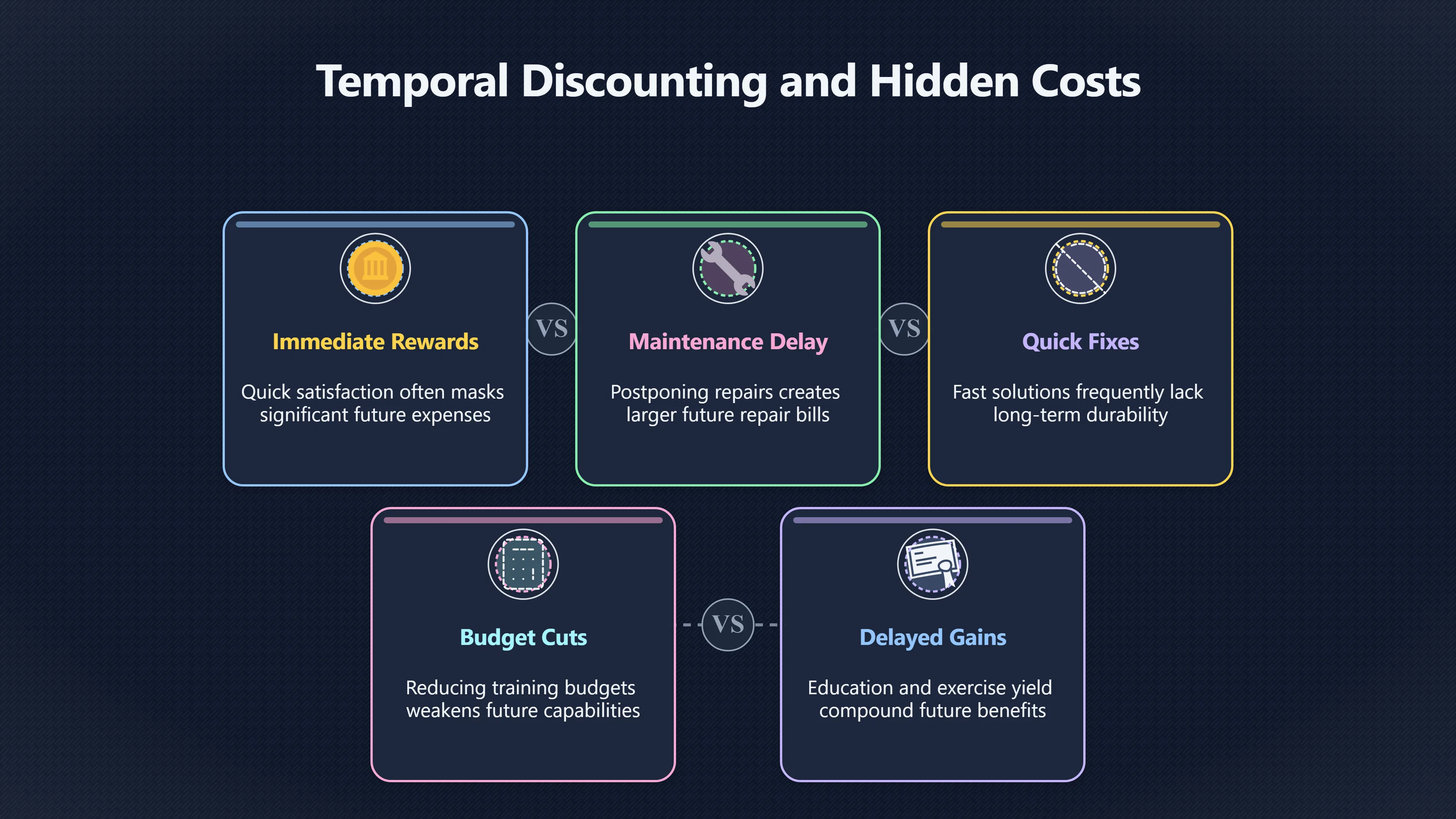
Immediate rewards may hide future costs.
Examples include:
- postponing maintenance because today’s savings outweigh future repair costs;
- choosing the quickest solution instead of the most durable one;
- reducing training budgets to improve this quarter’s finances while weakening future capability.
Immediate costs may produce later gains.
Examples include:
- investing time in education;
- exercising regularly;
- replacing outdated systems;
- learning a more efficient workflow.
None of these choices can be judged fairly after only a few days. Their value depends on whether the chosen timeframe is long enough for intended effects to appear.
How Timeframes Change Which Evidence Matters
Specifying a time horizon changes not only the answer but also the evidence worth collecting.
Suppose someone asks:
“Does remote working improve productivity?”
Without a timeframe, studies measuring output during the first month, employee satisfaction after six months, and staff retention after three years all appear equally relevant. Yet they answer different questions.
Early measurements often capture novelty and adjustment.
Medium-term measurements may show stabilised routines.
Long-term measurements can reveal turnover, promotion patterns, organisational learning or cultural changes that were invisible earlier.
The timeframe therefore acts as a filter. Evidence collected outside that period may still be interesting, but it cannot directly answer the question being asked.
A useful habit is to ask:
- When should success first become visible?
- How long might temporary adjustment effects last?
- When would unintended consequences normally emerge?
- Is this a decision whose benefits accumulate or fade?
Those questions prevent mixing incompatible evidence into a single conclusion.
Historical Lessons About Judging Too Soon
History repeatedly shows that early impressions can reverse.
Large organisational changes frequently produce temporary declines in performance while people learn new systems. Judging the change during that adjustment period may wrongly label an ultimately successful reform as a failure.
The reverse also occurs. Some interventions create impressive early results because of novelty, enthusiasm or unusually favourable circumstances before later returning to previous performance levels. Researchers therefore distinguish between immediate outcomes and sustained effects rather than assuming that early success predicts durable improvement. [University of York]york.ac.ukUniversity of YorkUnderstanding the dynamics of decision-making and choiceby B Beresford · 2008 · Cited by 203 — To inform the Panel Stud…
Even personal forecasting suffers from similar problems. Research on the planning fallacy shows that people consistently underestimate how long tasks will take, despite having experience with similar projects. Instead of asking how long comparable work actually required, people often imagine an unusually smooth future. Kahneman and Tversky argued that adopting an “outside view” based on previous comparable cases helps produce more realistic forecasts. [Massachusetts Institute of Technology]web.mit.eduMassachusetts Institute of TechnologyWhy People Underestimate Their Task Completion TimesOctober 7, 2004 — by R Buehler · 1994 · Cited by…
The broader lesson is that choosing an evaluation date is itself a reasoning decision. An answer judged too early may systematically favour options with immediate visibility while penalising those whose value emerges gradually.
Using Time Limits to Prevent False Certainty
Explicit timeframes reduce ambiguity because they force predictions to become testable.
Instead of asking:
“Will this decision work?”
Ask:
“Will this reduce customer complaints by at least 20% within six months?”
That revised question creates a clear point at which the claim can be evaluated.
Useful time-limited questions often specify:
- The starting point: when the change begins.
- The evaluation point: when success should reasonably be visible.
- The expected outcome: what should improve.
- The comparison: compared with what alternative.
This prevents endlessly moving the goalposts. If the predicted improvement fails to appear within the agreed timeframe, the original claim requires revision rather than indefinite postponement.
Practical Rules for Choosing the Right Time Horizon
No single timeframe fits every decision. Instead, choose one that matches the underlying mechanism.
As a practical guide:
- Use days or weeks when evaluating immediate operational effects, such as software bugs, response times or delivery delays.
- Use months when behaviour change, learning or organisational adaptation is expected.
- Use years when examining investments, careers, infrastructure, retirement savings or durable policy effects.
- Use multiple checkpoints when both immediate disruption and long-term performance matter.
Where possible, compare evidence gathered at the same stage of the process. Comparing another project’s first month with your project’s third year rarely produces meaningful conclusions.
The simple question, “When should this answer be judged?” often improves reasoning more than searching for another source of evidence. It aligns the evidence with the mechanism being studied, prevents premature certainty, and makes practical questions genuinely answerable rather than merely debatable.
Amazon book picks
Further Reading
Books and field guides related to When Should the Answer Be Judged?. Use these as the next step if you want deeper reading beyond the article.
The Signal and the Noise
Explains how forecasts should be evaluated against explicit time horizons and evolving evidence.
Thinking, Fast and Slow
Provides the cognitive foundations for avoiding premature conclusions and evaluating evidence carefully.
Decisive
Emphasizes testing decisions over appropriate timeframes and avoiding short-term thinking traps.
Superforecasting: The Art and Science of Prediction
Explains how forecasts should be evaluated against explicit time horizons and evolving evidence.
eBay marketplace picks
Marketplace Samples
Live-tested eBay searches with available results related to this page.




Endnotes
-
Source: researchgate.net
Title: Research Gate A systematic review of risky-choice [framing]({{ ‘framing/’ | relative_url }}) effects
Link: https://www.researchgate.net/publication/375412867_A_systematic_review_of_risky-choice_framing_effectsSource snippet
This includes the characterization of different research designs used, the size and robustness...Read more...
-
Source: pmc.ncbi.nlm.nih.gov
Title: PMCDoes temporal discounting explain unhealthy behavior
Link: https://pmc.ncbi.nlm.nih.gov/articles/PMC3950931/Source snippet
by GW Story · 2014 · Cited by 407 — These studies reveal that high discount rates for money (and in some instances food or drug reward...
-
Source: york.ac.uk
Link: https://www.york.ac.uk/inst/spru/pubs/pdf/decisionmaking.pdfSource snippet
University of YorkUnderstanding the dynamics of decision-making and choiceby B Beresford · 2008 · Cited by 203 — To inform the Panel Stud...
-
Source: web.mit.edu
Link: https://web.mit.edu/curhan/www/docs/Articles/biases/67_J_Personality_and_Social_Psychology_366%2C_1994.pdfSource snippet
Massachusetts Institute of TechnologyWhy People Underestimate Their Task Completion TimesOctober 7, 2004 — by R Buehler · 1994 · Cited by...
Published: October 7, 2004
Additional References
-
Source: thedecisionlab.com
Link: https://thedecisionlab.com/biases/planning-fallacySource snippet
The Decision LabPlanning fallacyPlanning Fallacy is the tendency to be too optimistic about one's estimates. As a result, the time needed...
-
Source: youtube.com
Title: Why Second-Order Thinking Creates Smarter Decisions & Better Life Outcomes
Link: https://www.youtube.com/watch?v=ERsOOYxBUQMSource snippet
Second order Thinking - Long term decisions - The Vanquish Podcast...
-
Source: arxiv.org
Link: https://arxiv.org/abs/1901.07024 -
Source: youtube.com
Title: Second order Thinking
Link: https://www.youtube.com/watch?v=ZfoN_x3zyFwSource snippet
What is 10/10/10 Rule | Explained in 2 min...
-
Source: youtube.com
Title: Move on From Mistakes with the 10-10-10 Rule
Link: https://www.youtube.com/watch?v=yY61xdM4CX0Source snippet
A Decision-Making Framework That Removes Regret...
-
Source: youtube.com
Title: What is 10/10/10 Rule | Explained in 2 min
Link: https://www.youtube.com/watch?v=mAWzR9D0uXYSource snippet
Move on From Mistakes with the 10-10-10 Rule...
-
Source: youtube.com
Title: A Decision-Making Framework That Removes Regret
Link: https://www.youtube.com/watch?v=zDwV2Q4PVpQ
Topic Tree