Within Weakest Link
When 'Will' Quietly Becomes the Weak Link
Future-tense promises often hide the forecasts that make a plan fragile, from adoption claims to delivery dates.
On this page
- Why future tense claims deserve scrutiny
- How to separate evidence from forecasts
- Examples from launches, vendors and regulation
Page outline Jump by section
Introduction
Many weak plans hide behind a single word: will. Statements such as “customers will adopt the product”, “the supplier will deliver on time”, or “regulators will approve the proposal” often sound like settled facts when they are actually forecasts about an uncertain future. The “will” test is a simple weakest-link technique: whenever a plan relies on future-tense certainty, pause and ask what evidence exists today, what assumptions are being made, and what would happen if those assumptions proved wrong. This shifts attention from the attractiveness of a plan to the fragility of the predictions that support it. Research on planning bias and assumption-based planning shows that making assumptions explicit—and testing the most important ones first—reduces avoidable surprises and improves decision quality. [The Decision Lab+2Department of Statistics]thedecisionlab.comThe Decision LabPlanning fallacyPlanning Fallacy is the tendency to be too optimistic about one's estimates. As a result, the time needed…
Why future-tense claims deserve scrutiny
The word will performs an important psychological trick. It compresses a chain of uncertain events into a single confident statement. Once that happens, listeners often stop distinguishing between what is already known and what is merely expected.
Consider these examples:
- “Customers will switch because our product is cheaper.”
- “The new software will be ready by September.”
- “The regulator will approve the application.”
- “The integration will only take two weeks.”
Each sentence quietly depends on several independent forecasts. Customers must notice the product, care about price, trust the supplier, and be willing to change. A software release depends on staffing, technical complexity, testing, dependencies and unexpected defects. Regulatory approval depends on criteria outside the organisation’s control.
Weakest-link thinking asks a different question from ordinary scepticism. Instead of asking whether the whole plan sounds plausible, it asks:
Which future prediction carries the greatest weight, and how much evidence supports it?
That question often reveals that the apparent certainty of “will” is doing more work than the available evidence.
How to separate evidence from forecasts
The practical value of the “will” test comes from rewriting confident statements into their underlying assumptions.
For every future-tense claim, separate three elements:
StatementEvidence todayForecast being assumedCustomers will adopt the product.Pilot users liked the prototype.Early enthusiasm represents the wider market.The supplier will deliver on schedule.Previous deliveries have been reliable.Future capacity and logistics remain stable.Regulation will permit launch.Current guidance appears favourable.No unexpected legal or policy changes occur.
This distinction matters because evidence can be verified immediately, whereas forecasts require probabilities rather than certainty.
A useful habit is to replace “will” with phrases such as:
- “We expect…”
- “Our current evidence suggests…”
- “This depends on…”
- “This forecast assumes…”
Doing so forces hidden assumptions into the open without weakening the analysis. Instead of sounding less confident, the plan becomes more transparent about its dependencies.
The approach mirrors formal “key assumptions” techniques used in structured analysis. Analysts first identify the assessment they wish to support, then list both explicit and implicit assumptions before deliberately challenging those assumptions rather than treating them as unquestioned facts. [Department of Statistics]stat.berkeley.eduTradecraft Primer apr09Department of StatisticsStructured Analytic Techniques for Improving Intelligence…by AT Primer · 2009 · Cited by 62 — Checking for key…
Why hidden planning assumptions become weak links
Future-tense claims are especially dangerous because people naturally construct plans from an “inside view”. They imagine how their own project should unfold instead of comparing it with similar projects that have already been completed.
This contributes to the planning fallacy—the tendency to underestimate time, costs and risks while overestimating likely benefits. The bias persists even when people know similar projects previously took longer or cost more than expected. [The Decision Lab]thedecisionlab.comThe Decision LabPlanning fallacyPlanning Fallacy is the tendency to be too optimistic about one's estimates. As a result, the time needed…
Several mechanisms commonly hide beneath confident planning language:
- Optimistic schedules. Teams assume tasks will proceed without interruptions, rework or unexpected dependencies.
- Behavioural forecasts. Plans assume customers, employees or partners will respond exactly as expected.
- Capability assumptions. Organisations assume they possess the skills, funding or capacity required throughout implementation.
- External stability. Plans quietly assume competitors, suppliers and regulators will not significantly change the environment.
The danger is cumulative. A project rarely depends on one forecast alone. Several individually reasonable assumptions can combine into a highly fragile overall plan.
Examples from launches, vendors and regulation
Product launches
A technology company might announce:
“Users will migrate quickly because the new version is better.”
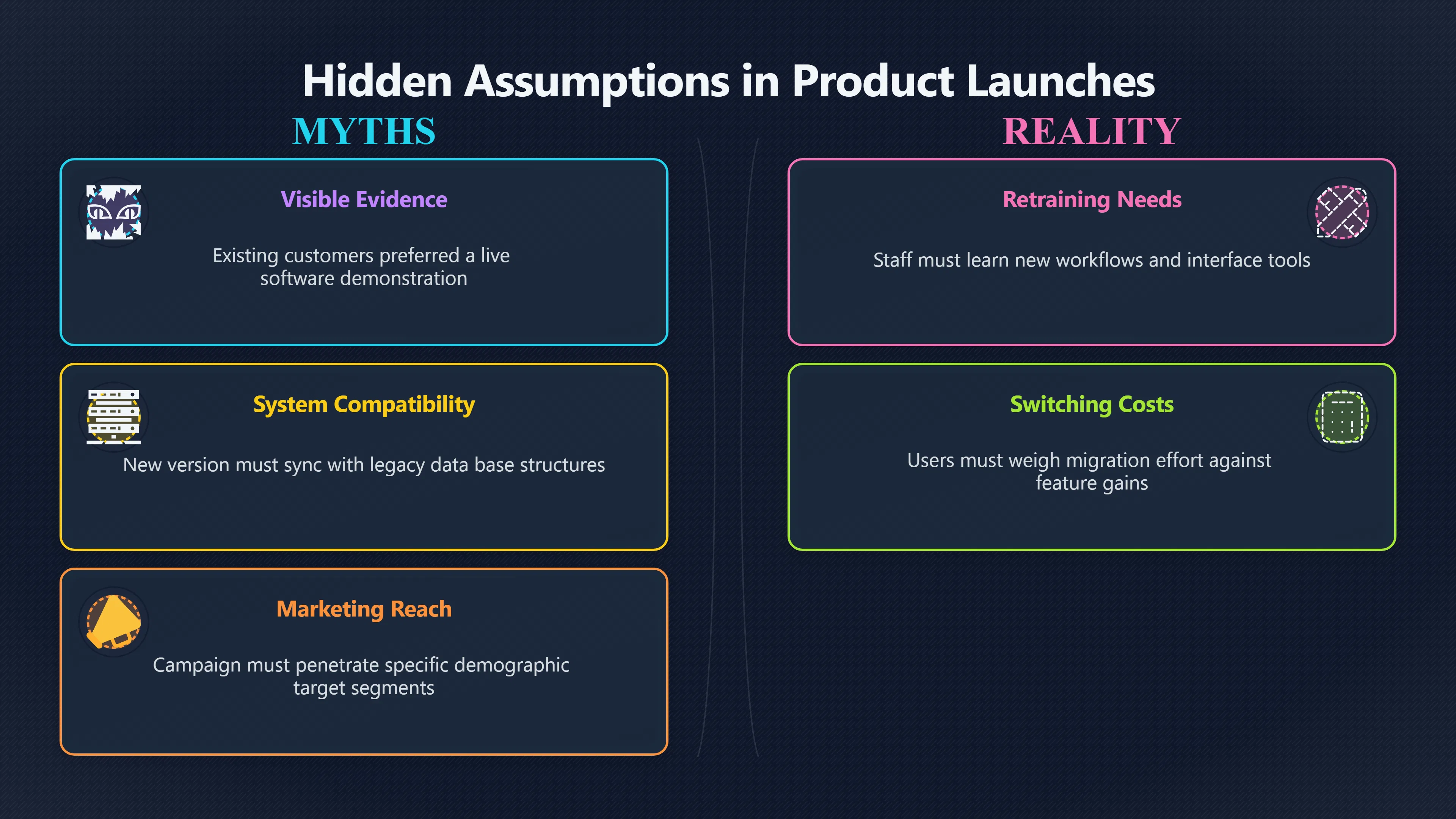
The visible evidence may only show that existing customers preferred a demonstration. The hidden assumptions include willingness to retrain staff, compatibility with existing systems, acceptable switching costs and sufficient marketing reach.
Testing these assumptions early—through pilots, pricing experiments or customer interviews—is usually cheaper than discovering adoption problems after launch.
Vendor commitments
Project plans often state:
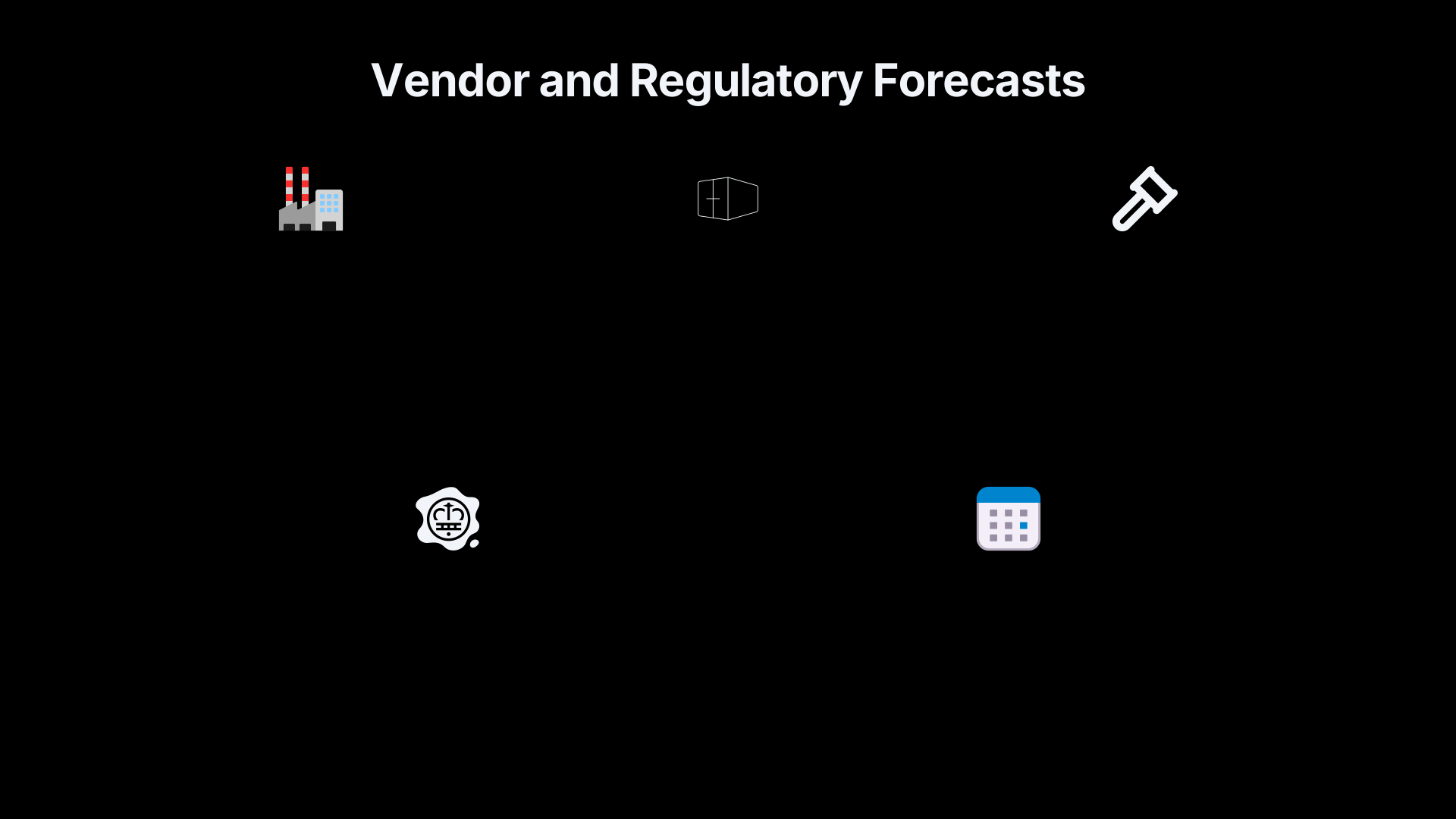
“The supplier will complete installation in six weeks.”
This prediction frequently combines assumptions about manufacturing capacity, shipping, customs clearance, specialist availability and local installation conditions.
Rather than accepting the sentence as a fact, the “will” test asks:
- What evidence supports this timetable?
- What has happened on comparable projects?
- Which dependency is least certain?
- What contingency exists if delivery slips?
These questions often reveal that supplier confidence is itself based on further assumptions.
Regulatory approval
Businesses sometimes write:
“Approval will be received during the third quarter.”
Unless formal approval has already been granted, this is not evidence but a forecast.
Better reasoning separates known facts from expectations:
- Current regulations permit applications.
- Previous comparable applications required approximately six months.
- No objections have yet been raised.
- The schedule assumes no policy changes or additional information requests.
The resulting plan is less vulnerable because its uncertainty is visible rather than concealed inside a confident sentence.
Turning the “will” test into a practical habit
The goal is not to eliminate forecasts. Planning is impossible without making predictions about the future. The objective is to prevent predictions from masquerading as established facts.
A practical review process is:
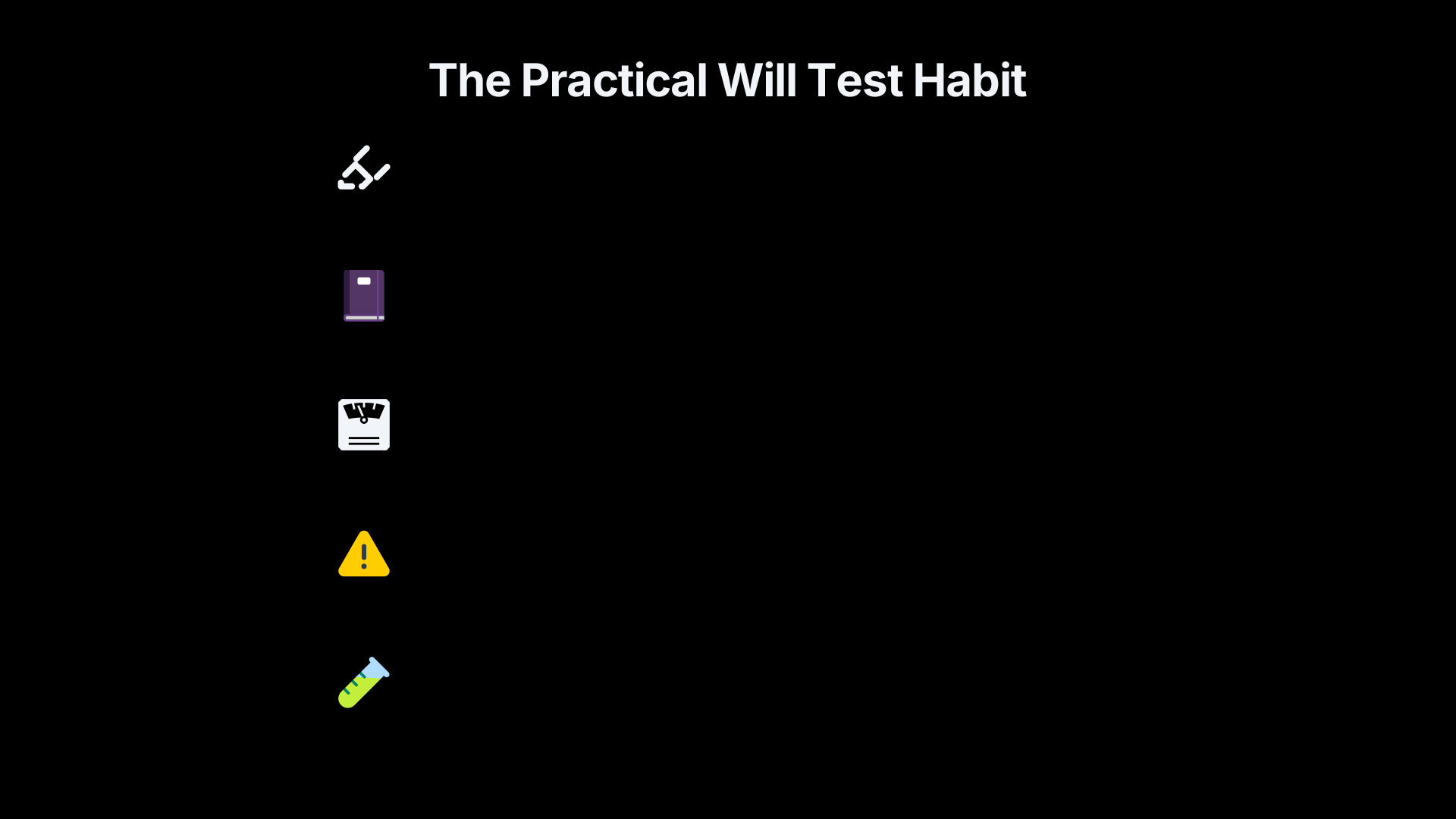
- Highlight every important use of will, must, or is going to.
- Rewrite each statement as an explicit assumption.
- Ask what current evidence genuinely supports that assumption.
- Identify which assumption would cause the greatest damage if it failed.
- Design the cheapest available test before making large commitments.
This closely matches assumption-based planning approaches, which recommend identifying critical assumptions, ranking them by their impact on the plan, testing the highest-risk assumptions early, and revising plans as new evidence emerges rather than treating forecasts as permanent truths. [Wikipedia+2Foxwood Associates]WikipediaAssumption-based planningAssumption-based planning
What the “will” test changes
The “will” test does not make planning pessimistic; it makes planning more honest. Instead of treating confidence as evidence, it distinguishes observations from expectations and predictions from commitments.
Within weakest-link thinking, this distinction is powerful because the most damaging failures often arise not from incorrect facts but from untested forecasts. A plan built around explicit, testable assumptions can adapt when conditions change. A plan built around unquestioned uses of “will” often discovers its weakest link only after implementation has already begun.
Amazon book picks
Further Reading
Books and field guides related to When 'Will' Quietly Becomes the Weak Link. Use these as the next step if you want deeper reading beyond the article.
Superforecasting
Directly addresses evaluating future claims instead of accepting confident forecasts.
The Art of Thinking Clearly
Covers biases that cause readers to mistake predictions for established facts.
eBay marketplace picks
Marketplace Samples
Live-tested eBay searches with available results related to this page.



Endnotes
-
Source: Wikipedia
Title: Assumption-based planning
Link: https://en.wikipedia.org/wiki/Assumption-based_planning -
Source: Wikipedia
Title: Planning fallacy
Link: https://en.wikipedia.org/wiki/Planning_fallacySource snippet
Planning fallacyThe planning fallacy is a phenomenon in which predictions about how much time will be needed to complete a future task...
-
Source: thedecisionlab.com
Link: https://thedecisionlab.com/biases/planning-fallacySource snippet
The Decision LabPlanning fallacyPlanning Fallacy is the tendency to be too optimistic about one's estimates. As a result, the time needed...
-
Source: stat.berkeley.edu
Title: Tradecraft Primer apr09
Link: https://www.stat.berkeley.edu/~aldous/157/Papers/Tradecraft%20Primer-apr09.pdfSource snippet
Department of StatisticsStructured Analytic Techniques for Improving Intelligence...by AT Primer · 2009 · Cited by 62 — Checking for key...
-
Source: foxwoodassociates.com
Title: test your assumptions when planning 2
Link: https://www.foxwoodassociates.com/2018/09/06/test-your-assumptions-when-planning-2/Source snippet
Foxwood AssociatesTest Your Assumptions When Planning6 Sept 2018 — The foundational building blocks of any business plan are the assumpti...
Additional References
-
Source: gamma.app
Link: https://gamma.app/docs/Chapter-9-Assumption-Testing-kmwxk1z2vnhsewkSource snippet
Chapter 9: Assumption TestingAssumption Testing is a process used to identify and validate key assumptions underlying a new business conc...
-
Source: shapingtomorrow.com
Link: https://www.shapingtomorrow.com/methods/AssumptionsSource snippet
AssumptionsAssumptions helps analysts and teams question their pre-existing mental model and to make explicit the underlying hypotheses o...
-
Source: dnb.nl
Link: https://www.dnb.nl/media/1gmkp1vk/supervision-of-behaviour-and-culture_tcm46-380398-1.pdfSource snippet
Supervision of Behaviour and CultureThis chapter aims to explain the model and basic assumptions underlying. DNB's supervision of organis...
-
Source: johnolivant.com
Title: John“Business Planning Assumptions”
Link: https://www.johnolivant.com/2025/01/13/business-planning-assumptions/Source snippet
“Business Planning Assumptions” - John13 Jan 2025 — When it comes to business planning, assumptions play a crucial role. They form the fo...
-
Source: linkedin.com
Link: https://www.linkedin.com/pulse/assumptions-planning-constantin-gonciuleaSource snippet
Assumptions and PlanningIn summary, discovery-driven planning is the solution to the planning fallacy trap. Stating the assumptions for s...
-
Source: youtube.com
Title: Why Most Strategies Fail — And How Assumption-Based Planning Fixes It
Link: https://www.youtube.com/watch?v=K2XQqXzkNTUSource snippet
[Critical Thinking]({{ 'critical-skills/' | relative_url }}) Questions to Test Assumptions...
-
Source: youtube.com
Title: Critical Thinking Questions to Test Assumptions
Link: https://www.youtube.com/watch?v=WED3VcgzcYQSource snippet
How Assumptions and Overthinking Sabotage Decision Making Under Pressure...
-
Source: youtube.com
Title: Do You Have Hidden Assumptions?
Link: https://www.youtube.com/watch?v=8goY6xuAxp8Source snippet
Strategic Planning Process: How to Create a Strategic Plan...
-
Source: youtube.com
Title: How Assumptions and Overthinking Sabotage Decision Making Under Pressure
Link: https://www.youtube.com/watch?v=raTfmUdrfcsSource snippet
Do You Have Hidden Assumptions?...
-
Source: youtube.com
Title: Strategic Planning Process: How to Create a Strategic Plan
Link: https://www.youtube.com/watch?v=o0UXAhzTkHE
Topic Tree