Within Explain It
What a Blank Page Reveals About Understanding
A two-minute blank page can show whether you can rebuild an idea or only recognize familiar wording.
On this page
- Why recall feels harder than recognition
- How to run a two minute explanation
- What vague filler words usually hide
Page outline Jump by section
Introduction
A blank page is one of the simplest ways to discover whether you genuinely understand an idea or have merely become familiar with its wording. When you close your notes and try to explain a concept from memory for two minutes, the missing pieces become visible. You quickly learn whether you can reconstruct the logic, connect the important parts and explain why something works, rather than simply recognising it when you see it.
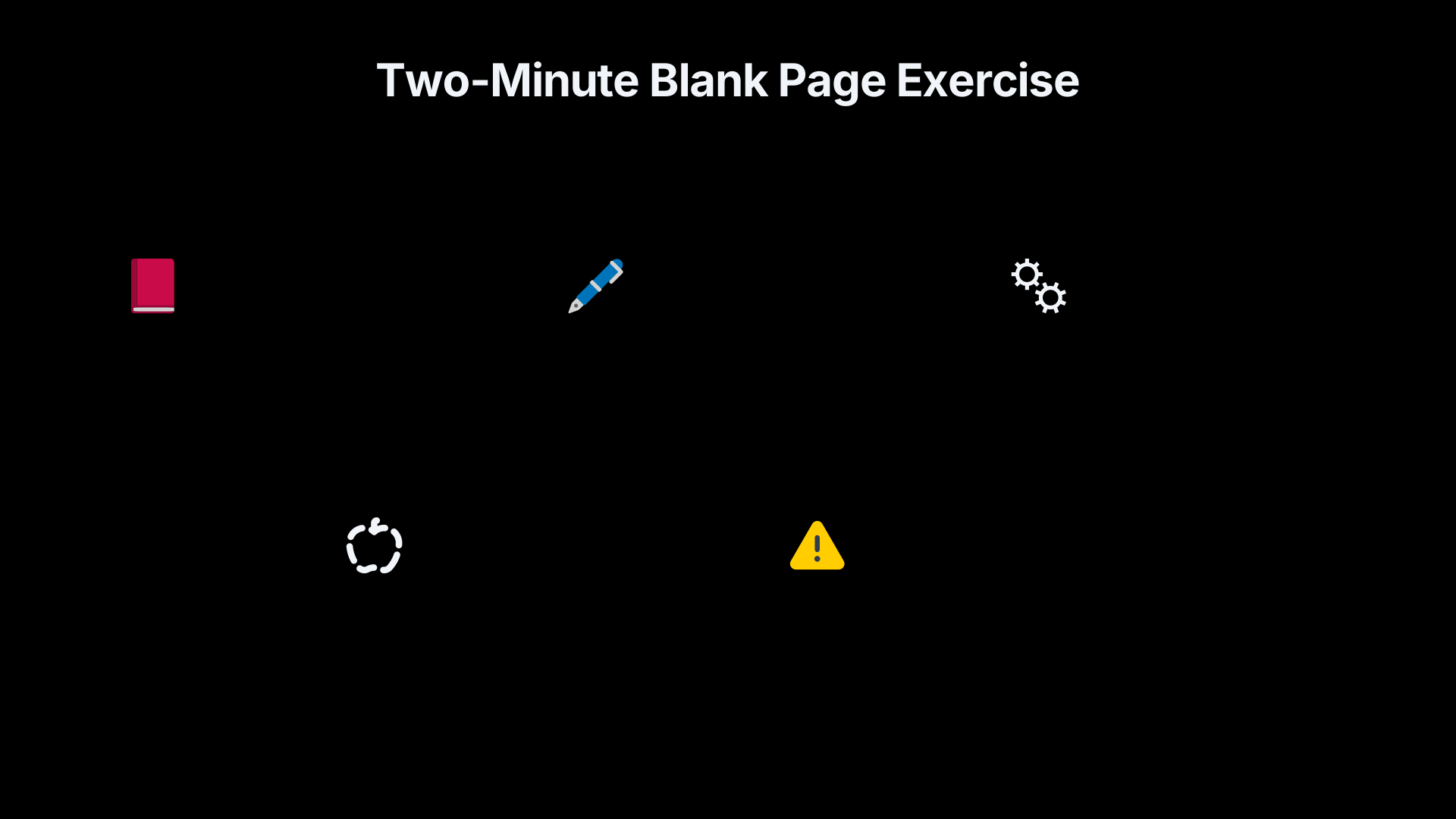 This matters because analytical thinking depends on usable knowledge, not passive familiarity. Research on retrieval practice and the illusion of explanatory depth shows that people consistently overestimate how well they understand complex ideas until they attempt to explain them in their own words. The blank-page exercise is therefore less a memory test than a diagnostic tool: it reveals where understanding is solid, where it is fragile and where confidence has outrun comprehension. [PMC]pmc.ncbi.nlm.nih.govby L Rozenblit · 2002 · Cited by 1507 — We argue here that people's limited knowledge and their misleading intuitive epistemology comb…
Why recall feels harder than recognition
Reading a textbook, article or set of notes provides constant cues. Headings, diagrams and familiar phrases trigger recognition, creating the feeling that you understand the material. That feeling can be accurate, but it can also be misleading because the information is still being supplied by the page.
A blank page removes those cues. Instead of recognising an answer, you must generate it yourself. That requires rebuilding the structure of the concept from memory:
- defining the central idea
- identifying the key relationships
- explaining cause and effect
- deciding what details matter
- producing an example without prompting
These are exactly the processes needed when solving problems, analysing evidence or explaining ideas to someone else.
Psychologists describe this mismatch between perceived and actual understanding as the illusion of explanatory depth. People often believe they possess detailed causal knowledge until they are asked to explain how something works step by step. At that point, missing links that were previously hidden become obvious. [PMC]pmc.ncbi.nlm.nih.govby L Rozenblit · 2002 · Cited by 1507 — We argue here that people's limited knowledge and their misleading intuitive epistemology comb…
An important feature of this illusion is that it is strongest for explanations rather than simple facts. You may remember that earthquakes involve tectonic plates or that inflation affects prices, yet still struggle to explain the chain of events connecting one step to the next. Recognising keywords is much easier than reconstructing mechanisms. [PMC]pmc.ncbi.nlm.nih.govby L Rozenblit · 2002 · Cited by 1507 — We argue here that people's limited knowledge and their misleading intuitive epistemology comb…
How to run a two-minute explanation
The exercise works best when it is deliberately short. The goal is not to produce polished writing but to expose the current state of your understanding before memory fades into guessing.
Choose one concept and put every source of information out of sight.
Then spend about two minutes writing or speaking as though teaching an intelligent beginner. Resist the temptation to stop every time you hesitate. Those hesitations are often the most valuable information.
A practical sequence is:
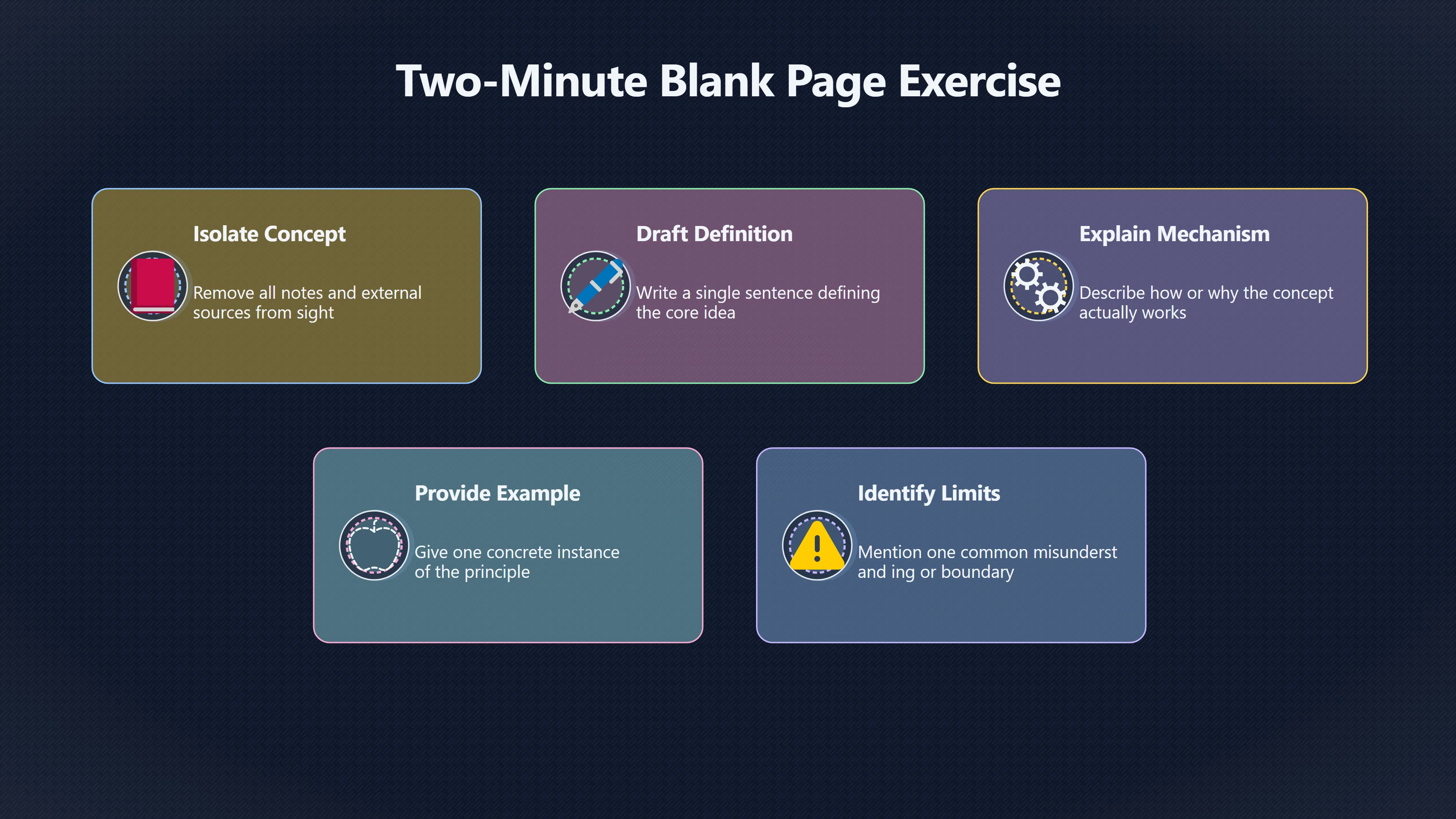
- Write a one-sentence definition.
- Explain how or why it works.
- Give one concrete example.
- Mention one common misunderstanding or limitation.
- Stop after two minutes and compare your explanation with a trusted source.
The comparison is where learning happens. Instead of asking whether your explanation was “good”, ask more precise questions:
- Which essential step did I skip?
- Which relationship did I confuse?
- Where did I rely on vague language?
- Which technical term did I use without explaining?
- Which example failed to illustrate the principle?
This turns the blank page into a form of feedback rather than a performance test. The aim is not to prove that you know enough, but to discover exactly what you need to strengthen. Research on explanation and metacognition suggests that attempting explanations improves calibration between confidence and actual understanding, especially when followed by checking against accurate information. [PMC]pmc.ncbi.nlm.nih.govby L Rozenblit · 2002 · Cited by 1507 — We argue here that people's limited knowledge and their misleading intuitive epistemology comb…
What vague filler words usually hide
One of the biggest advantages of the blank-page method is that it exposes verbal shortcuts.
While reading, phrases such as “basically”, “kind of”, “it works because of the system” or “it’s related to” may feel acceptable because the missing detail is still visible elsewhere on the page.
On a blank page, these expressions often signal a genuine gap.
Common warning signs include:
- Replacing mechanisms with labels. Saying “it’s caused by supply and demand” without explaining how supply and demand change behaviour.
- Using circular definitions. Explaining critical thinking as “thinking critically” or evolution as “things evolving”.
- Skipping causal steps. Jumping from the beginning of a process to the outcome without describing the intermediate links.
- Depending on technical vocabulary. Using specialist terms that you cannot define independently.
- Changing the subject. Providing related facts instead of answering the actual explanatory question.
These patterns matter because analytical reasoning depends on causal structure. If you cannot describe the intermediate steps, you may recognise conclusions without understanding how they were reached.
What the gaps actually mean
Finding gaps is not evidence of failure. It is evidence that the exercise is working.
A blank page often reveals several distinct types of weakness:
Gap revealedWhat it usually indicatesForgotten terminologyWeak factual recallMissing intermediate stepsShallow causal understandingPoor exampleDifficulty applying the ideaConfused comparisonsConcepts are not well distinguishedExcessive filler languageConfidence exceeds explanatory knowledge
Different gaps require different responses. Memorising another definition will not repair a missing causal chain, while studying more examples may do little if the underlying mechanism remains unclear.
This distinction is one reason explanation exercises are valuable. They diagnose what kind of knowledge is missing rather than simply showing that something has been forgotten. [PMC]pmc.ncbi.nlm.nih.govby L Rozenblit · 2002 · Cited by 1507 — We argue here that people's limited knowledge and their misleading intuitive epistemology comb…

Turning the diagnosis into stronger understanding
The greatest value of the blank-page exercise comes after the explanation is finished.
Once you compare your explanation with a reliable source, rewrite only the sections that contained genuine gaps. Avoid rewriting everything. Concentrating on the weak links forces you to rebuild the parts that were previously missing.
Repeating the same explanation a day or two later provides a much stronger indication of progress than repeatedly rereading the original notes. If the second explanation becomes more precise, contains fewer filler phrases and reconstructs the mechanism without prompting, your understanding has become more usable rather than merely more familiar.
Over time, this habit also improves self-assessment. Instead of judging understanding by how comfortable material feels while reading, you begin judging it by whether you can recreate the idea independently. That shift reduces false confidence and builds the kind of flexible knowledge needed for analysis, problem-solving and communication. [PMC+2ResearchGate]pmc.ncbi.nlm.nih.govby L Rozenblit · 2002 · Cited by 1507 — We argue here that people's limited knowledge and their misleading intuitive epistemology comb…
eBay marketplace picks
Marketplace Samples
Live-tested eBay searches with available results related to this page.


Endnotes
-
Source: pmc.ncbi.nlm.nih.gov
Link: https://pmc.ncbi.nlm.nih.gov/articles/PMC3062901/Source snippet
by L Rozenblit · 2002 · Cited by 1507 — We argue here that people's limited knowledge and their misleading intuitive epistemology comb...
-
Source: researchgate.net
Link: https://www.researchgate.net/publication/372669028_Broad_effects_of_shallow_understanding_Explaining_an_unrelated_phenomenon_exposes_the_illusion_of_explanatory_depthSource snippet
Broad effects of shallow understanding: Explaining an...We discuss alternative accounts of the illusion of explanatory depth...
-
Source: Wikipedia
Title: Illusion of explanatory depth
Link: https://en.wikipedia.org/wiki/Illusion_of_explanatory_depth
Additional References
-
Source: pages.stern.nyu.edu
Link: https://pages.stern.nyu.edu/~aalter/jpspioed.pdfSource snippet
Stern School of BusinessA Construal Level Account of the Illusion of Explanatory Depthby AL Alter · Cited by 264 — An illusion of explana...
-
Source: thedecisionlab.com
Link: https://thedecisionlab.com/biases/the-illusion-of-explanatory-depthSource snippet
The Illusion of Explanatory DepthThe illusion of explanatory depth (IOED) describes our belief that we understand more about the world th...
-
Source: medien.ifi.lmu.de
Title: I Think I Get Your Point, AI!
Link: https://www.medien.ifi.lmu.de/pubdb/publications/pub/chromik2021iui/chromik2021iui.pdfSource snippet
The Illusion of Explanatory...by M Chromik · 2021 · Cited by 256 — According to psychologi- cal research deliberate self-explanation res...
-
Source: douglaswise.co.uk
Title: [illusion explanatory]({{ ‘false-fluency-4a90fc/’ | relative_url }}) depth
Link: https://www.douglaswise.co.uk/blog/illusion-explanatory-depthSource snippet
The Illusion of Explanatory Depth4 Feb 2021 — The 'illusion of explanatory depth' is a cognitive bias that leads people to believe that t...
-
Source: youtube.com
Title: The Illusion of Explanatory Depth: You Don’t Understand It Like You Think
Link: https://www.youtube.com/watch?v=yDJuCWUC5P8Source snippet
How to Learn Faster with the Feynman Technique (Example Included)...
-
Source: youtube.com
Title: How to Learn Faster with the Feynman Technique (Example Included)
Link: https://www.youtube.com/watch?v=_f-qkGJBPtsSource snippet
You Don't Know Anything - The Illusion of Explanatory Depth - FutureIQ...
-
Source: jsaw.lib.lehigh.edu
Link: https://jsaw.lib.lehigh.edu/campbell/Wilson.pdfSource snippet
and Persistence of the Illusion of Explanatory Depthby J Wilson — These studies provide a better understanding of the IOED and its limits...
-
Source: youtube.com
Title: Learn Faster with The Feynman Technique
Link: https://www.youtube.com/watch?v=FrNqSLPaZLcSource snippet
The Illusion of Explanatory Depth: You Don't Understand It Like You Think...
-
Source: wegrowteachers.com
Link: https://wegrowteachers.com/overcoming-the-illusion-of-explanatory-depth/Source snippet
Overcoming The Illusion Of Explanatory Depth19 Jan 2026 — A: The Illusion of Explanatory Depth is a cognitive bias where learners feel th...
-
Source: youtube.com
Title: Active Recall: Why the Best Study Method Feels Like the Worst
Link: https://www.youtube.com/watch?v=qfHomRdzeikSource snippet
Learn Faster with The Feynman Technique...
Topic Tree