Within Problem Parts
When neat parts hide the real problem
Breaking a problem into pieces only works if you later rebuild the links between causes, risks, constraints, and options.
On this page
- How decomposition can fragment the situation
- Mapping interactions between parts
- Checking whether one fix worsens another part
Page outline Jump by section
Introduction
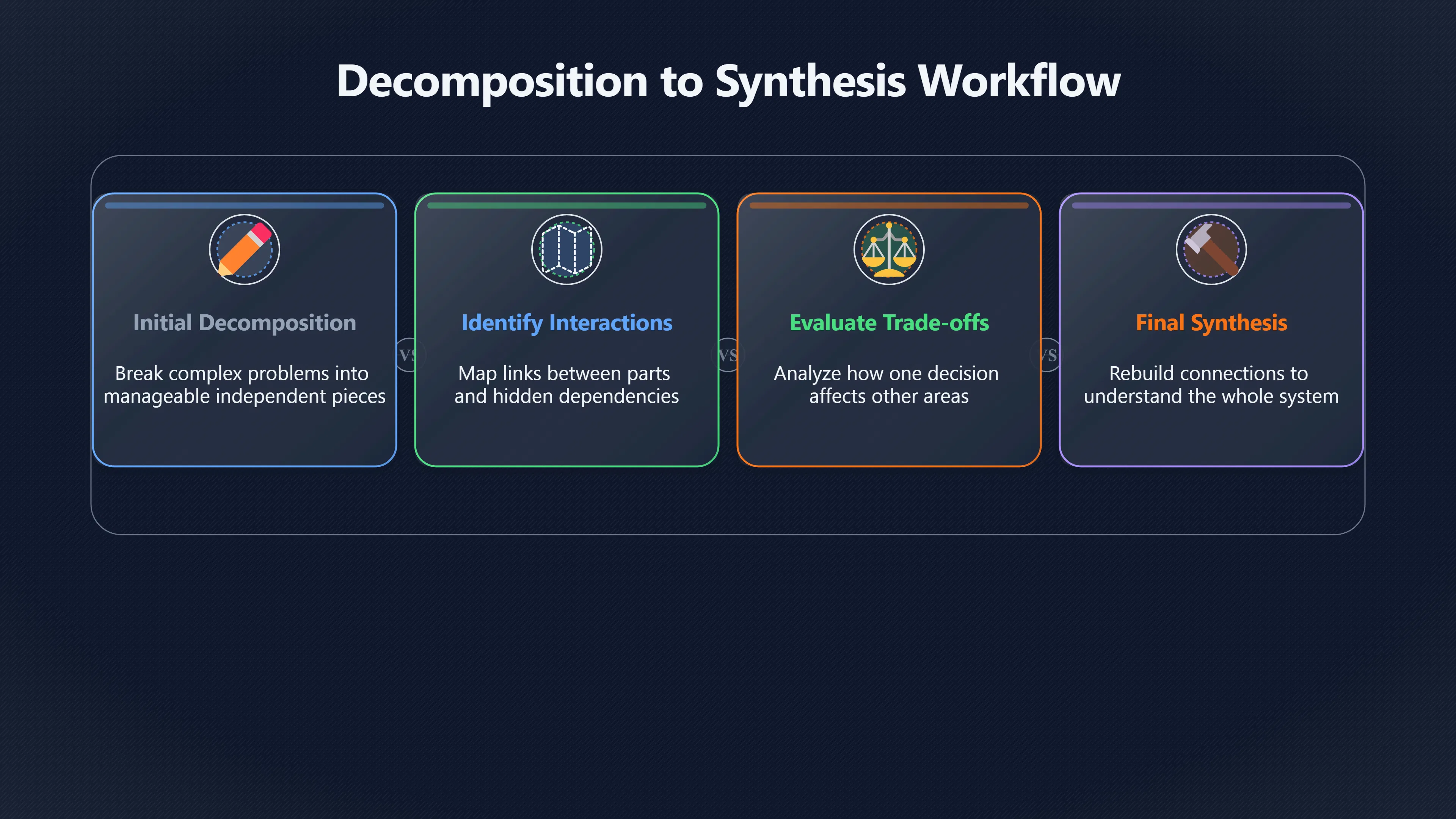
Breaking a difficult problem into smaller parts is one of the most useful analytical techniques, but it is only half of the job. The real value comes from putting those parts back together in a way that preserves the relationships between causes, constraints, risks and possible solutions. Without that step, a tidy analysis can become misleading because real-world problems rarely behave as isolated pieces.
 Good analytical thinking therefore moves from decomposition to synthesis. After identifying separate elements, you rebuild the connections between them to understand how one decision affects another, where trade-offs appear, and which interactions determine the overall outcome. Research on systems thinking consistently shows that many important properties of complex situations arise from the relationships between parts rather than from the parts themselves.[OECD+2The W. Edwards Deming Institute]oecd.orgSystemic Thinking for Policy MakingSystemic Thinking for Policy Making - OECDThe approach provides a methodology to achieve a better understanding of the non-linear beh…
How decomposition can fragment the situation
Separating a problem into manageable pieces makes investigation easier, but it also creates a risk. Each part can begin to look independent even when the original problem depended on continuous interaction between many elements.
Imagine a delayed product launch. A decomposed analysis may produce separate workstreams for engineering, finance, marketing and customer support. Each team can optimise its own area successfully, yet the organisation may still make a poor decision if the interactions between those areas are ignored. A cheaper engineering solution may increase support costs. A marketing deadline may increase technical risk. A financial saving may damage customer trust.
This is a classic example of what systems thinkers describe as losing the behaviour of the whole by concentrating exclusively on the behaviour of the parts. Russell Ackoff argued that analysis explains how components function, whereas synthesis explains why the overall system behaves as it does. Understanding emerges when the relationships are restored rather than when the components are studied in isolation.[Annie Vella]annievella.comSynthesis involvesAnnie VellaExploring Systems Thinking Through Russell Ackoff - Annie VellaJuly 6, 2024 — Synthetic thinking helps us understand the role…
The same principle appears in the OECD’s work on complex problem solving. Modern analytical skill requires not only separating information into manageable components but also reconnecting those components into a coherent understanding of a changing system.[OECD]oecd.orgPDF] The Nature of Problem Solving (ENOECD[PDF] The Nature of Problem Solving (EN) - OECDMay 18, 2025 — While in individual CPS, problem solvers have to interact with a dynami…
Mapping interactions between parts
Reconnecting a problem means identifying the links that were temporarily hidden during decomposition. Instead of asking only, “What is this part?”, the question becomes, “How does this part change the behaviour of other parts?”
Several types of relationships deserve particular attention.
- Cause-and-effect links. Does changing one factor reliably influence another, either immediately or after a delay?
- Constraints. Does one solution become impossible because another requirement must remain fixed?
- Dependencies. Does success in one area depend on progress somewhere else?
- Feedback loops. Can today’s solution alter tomorrow’s conditions, reinforcing or weakening the original problem?
- Trade-offs. Does improving one objective reduce performance somewhere else?
These connections are often more informative than the individual components themselves. For example, reducing inventory may appear financially attractive until the relationship with supplier delays, customer demand and production resilience is considered. The important insight is not that inventory exists, but that inventory interacts with uncertainty throughout the system.
Systems engineering standards similarly emphasise identifying interfaces and interdependencies because performance, resilience and security depend on how components work together, not merely on how well each component performs independently.[NIST Publications]nvlpubs.nist.govSP.800 160v1NIST PublicationsNIST.SP.800-160v1.pdf16 Nov 2022 — It provides security-related implementation guidance for the standard and should be u…
Practical ways to rebuild the links
Several simple techniques help restore the whole picture without abandoning the clarity gained through decomposition.
Relationship maps. Draw arrows showing which factors influence others. The objective is not artistic precision but making hidden assumptions visible.
Cross-impact questions. After proposing any solution, ask:
- Which other parts does this affect?
- Which assumptions become invalid?
- Which stakeholders experience new risks?
- What secondary effects might appear later?
Interface reviews. Rather than reviewing each workstream independently, review the boundaries between them. Many implementation failures occur at interfaces rather than inside individual components.
Scenario comparison. Compare several possible futures instead of evaluating only one preferred solution. This exposes relationships that remain invisible in a single-path analysis.
Checking whether one fix worsens another part
Perhaps the most valuable step in synthesis is deliberately searching for unintended consequences.
Many poor decisions are locally successful but globally harmful. A department meets its own performance target while making the wider organisation less effective. This happens because optimisation has been applied to a subsystem instead of the entire system.
Consider several common examples:
- Reducing customer support staffing lowers costs but increases waiting times, leading to lower retention and higher acquisition costs.
- Speeding software development by reducing testing accelerates releases but increases maintenance work later.
- Introducing stricter approval procedures reduces one category of error while creating costly delays elsewhere.
None of these outcomes becomes obvious if each issue is examined separately.
System dynamics research has repeatedly demonstrated that many persistent organisational problems arise because decision-makers underestimate delayed effects and feedback loops. Actions that appear beneficial in the short term can trigger balancing or reinforcing feedback that reverses the original gains.[executive.mit.edu+2MIT OpenCourseWare]executive.mit.eduSystem Dynamics and the Problem-Solving ProcessIn this 5-day course, discover MIT Sloan's approach to System Dynamics and problem-solving…
A useful discipline is therefore to test every proposed intervention with questions such as:
- What could this make worse?
- Which assumptions depend on conditions remaining unchanged?
- Which part of the system absorbs the cost of this improvement?
- Does solving this problem create another one later?
These questions encourage analysis that reflects real systems instead of isolated components.
Signs that synthesis is incomplete
An analysis often appears comprehensive while still missing the relationships that determine the outcome. Common warning signs include:
- Every section can be read independently with almost no cross-reference.
- Solutions optimise individual departments rather than the whole objective.
- Risks are listed separately but never connected to specific decisions.
- Assumptions remain implicit instead of being linked to conclusions.
- Time delays, feedback or indirect effects receive little attention.
- Success measures improve for one component without demonstrating improvement for the overall problem.
When these symptoms appear, the analysis may be organised but not yet integrated.

Rebuilding the whole without losing clarity
Effective analytical thinking alternates between two complementary modes. First, decomposition reduces complexity by separating a problem into understandable pieces. Then synthesis restores complexity by reconnecting those pieces into the real system they represent.
The aim is not to abandon structure but to ensure that structure reflects reality. A good final analysis should explain not only what the important parts are, but also how they influence one another, where trade-offs emerge, which constraints shape the available choices and how one intervention changes the rest of the system. That is the point at which breaking a problem apart becomes genuine understanding rather than merely producing a well-organised outline.
Amazon book picks
Further Reading
Books and field guides related to When neat parts hide the real problem. Use these as the next step if you want deeper reading beyond the article.
Thinking in Systems
Directly explains how interactions between parts create system-wide behaviour and why synthesis matters after decomposition.
The Fifth Discipline
Shows how interconnected structures and feedback loops shape organisational outcomes.
The Art of Thinking Clearly
Helps readers recognise analytical mistakes that arise from oversimplifying complex situations.
The Systems View of Life
Explores why relationships between components often matter more than isolated parts.
eBay marketplace picks
Marketplace Samples
Live-tested eBay searches with available results related to this page.



Endnotes
1.
Source: oecd.org
Title: Systemic Thinking for Policy Making
Link:https://www.oecd.org/en/publications/systemic-thinking-for-policy-making_879c4f7a-en.html
Source snippet
Systemic Thinking for Policy Making - OECDThe approach provides a methodology to achieve a better understanding of the non-linear beh...
2.
Source: deming.org
Link:https://deming.org/ackoff-on-systems-thinking-and-management/
Source snippet
Edwards Deming InstituteAckoff on Systems Thinking and Management - The Deming InstituteAckoff starts with a very good explanation of ana...
3.
Source: nvlpubs.nist.gov
Title: SP.800 160v1
Link:https://nvlpubs.nist.gov/nistpubs/SpecialPublications/NIST.SP.800-160v1.pdf
Source snippet
NIST PublicationsNIST.SP.800-160v1.pdf16 Nov 2022 — It provides security-related implementation guidance for the standard and should be u...
4.
Source: oecd.org
Title: [PDF] The Nature of Problem Solving (EN)
Link:https://www.oecd.org/content/dam/oecd/en/publications/reports/2017/04/the-nature-of-problem-solving_g1g787cf/9789264273955-en.pdf
Source snippet
OECD[PDF] The Nature of Problem Solving (EN) - OECDMay 18, 2025 — While in individual CPS, problem solvers have to interact with a dynami...
Published: May 18, 2025
5.
Source: nvlpubs.nist.gov
Title: SP.800 160v1r1
Link:https://nvlpubs.nist.gov/nistpubs/SpecialPublications/NIST.SP.800-160v1r1.pdf
Source snippet
NIST PublicationsEngineering Trustworthy Secure Systemsby R Ross · 2022 · Cited by 77 — NIST is responsible for developing information se...
6.
Source: executive.mit.edu
Link:https://executive.mit.edu/course/business-dynamics/a056g00000URaMkAAL.html
Source snippet
System Dynamics and the Problem-Solving ProcessIn this 5-day course, discover MIT Sloan's approach to System Dynamics and problem-solving...
7.
Source: ocw.mit.edu
Link:https://ocw.mit.edu/courses/res-15-004-system-dynamics-systems-thinking-and-modeling-for-a-complex-world-january-iap-2020/resources/systems-thinking-and-modeling-for-a-complex-world-iap-2020/
Source snippet
MIT OpenCourseWareSystems Thinking and Modeling for a Complex WorldThis one-day workshop provides a brief overview of System Dynamics and...
8.
Source: protection.interaction.org
Title: Systems thinking aims to examine and understand the whole
Link:https://protection.interaction.org/resources/tools-for-systems-thinkers-the-6-fundamental-concepts-of-systems-thinking/
Source snippet
for Systems Thinkers: The 6 Fundamental Concepts of...September 7, 2017 — Synthesis: Synthesis is the combining of two or more things to...
Published: September 7, 2017
9.
Source: csrc.nist.gov
Title: sp800 160 second draft
Link:https://csrc.nist.gov/files/pubs/sp/800/160/2pd/docs/sp800_160_second-draft.pdf
Source snippet
Security Engineering Considerations for a Multidiscipl4 May 2016 — NIST Special Publication 800-160 attempts to bring greater clarity to...
Published: May 2016
10.
Source: csrc.nist.rip
Title: rip S P 800-160 Vol
Link:https://csrc.nist.rip/publications/detail/sp/800-160/vol-1/final
Source snippet
1, Systems Security Engineering - CSRCEngineering-based solutions are essential to managing the growing complexity, dynamicity, and inter...
11.
Source: youtube.com
Title: Systems Thinking
Link:https://www.youtube.com/watch?v=Miy9uQcwo3U
Source snippet
Synthesis & Analysis...
12.
Source: annievella.com
Title: Synthesis involves
Link:https://annievella.com/posts/exploring-systems-thinking-through-russell-ackoff/
Source snippet
Annie VellaExploring Systems Thinking Through Russell Ackoff - Annie VellaJuly 6, 2024 — Synthetic thinking helps us understand the role...
Published: July 6, 2024
Additional References
13.
Source: amazon.de
Link:https://www.amazon.de/NIST-800-160-Systems-Security-Engineering/dp/1547146141?tag=searcht-20
Source snippet
NIST SP 800-160 Systems Security EngineeringThis publication addresses the engineering-driven perspective and actions necessary to develo...
14.
Source: open.edu
Link:https://www.open.edu/openlearn/science-maths-technology/computing-ict/managing-complexity-a-systems-approach-introduction/content-section-15.9.2
Source snippet
Managing complexity: Systems dynamics | OpenLearnThe closed-loop diagram used in SD modelling raises awareness of unintended consequences...
15.
Source: ac.cto.mil
Link:https://ac.cto.mil/wp-content/uploads/2022/08/Systems-Eng-Guidebook_Feb2022-Cleared.pdf
Source snippet
Engineering GuidebookThe Systems Engineering Guidebook provides guidance and recommended best practices for defense acquisition programs...
16.
Source: industrialcyber.co
Link:https://industrialcyber.co/nist/nist-sp-800-160-focuses-on-plugging-security-into-systems-engineering-to-develop-defensible-survivable-systems/
Source snippet
NIST SP 800-160 focuses on plugging security into...9 Jun 2022 — NIST SP 800-160 focuses on plugging security into systems engineering t...
17.
Source: educationaldatamining.org
Link:https://educationaldatamining.org/EDM2023/proceedings/2023.EDM-long-papers.4/2023.EDM-long-papers.4.pdf
Source snippet
training intervention, named Chunky Parsons Prob- lem (CPP), that introduces to students the...
18.
Source: mdpi.com
Link:https://www.mdpi.com/2227-7102/13/2/201
Source snippet
heory in the IS field, bonds to CT to address some well-known common issues related to CT...
19.
Source: medium.com
Link:https://medium.com/disruptive-design/tools-for-systems-thinkers-the-6-fundamental-concepts-of-systems-thinking-379cdac3dc6a
Source snippet
September 7, 2017 — In this series on systems thinking, I share the key insights and tools needed to develop and advance a systems mindse...
Published: September 7, 2017
20.
Source: learning.com
Title: Why is Decomposition Required in Computational Thinking
Link:https://www.learning.com/blog/why-is-decomposition-required-in-computational-thinking/
Source snippet
September 6, 2022 — The technique of decomposition is required in computational thinking because it breaks complex tasks into subtasks wh...
Published: September 6, 2022
21.
Source: researchgate.net
Link:https://www.researchgate.net/publication/44827001_Business_Dynamics_System_Thinking_and_Modeling_for_a_Complex_World
Source snippet
d illustrate with a successful application to a difficult business issue.Read more...
22.
Source: researchgate.net
Link:https://www.researchgate.net/publication/334660587_Analysis_of_Systems_Security_Engineering_Design_Principles_for_the_Development_of_Secure_and_Resilient_Systems
Source snippet
Standards and Technology Special Publication (NIST SP) 800-160 Volume 1...
Topic Tree